A value proposition is a short statement of what a customer gets from a product, who it's for and why it's a better choice than the alternative. On a homepage it's usually the headline and the line under it, backed by two or three proof points. Wise does it in seven words and a number: “The fast way to send money abroad,” followed by the claim that most transfers arrive in under 20 seconds.
Below are eight real value propositions, as they appeared on the companies' own pages in November 2026, and 24 written for invented businesses. The first sample, for a swim school, shows where each line comes from.
Headline: Swimming lessons your kids will ask to go back to
Subheadline: Classes of four in a pool kept at 90°F, grouped by ability, with make-up lessons any day of the term. Every child brings home a progress card each month, so you can see what they've learned.
- Weekday classes until 7:30 p.m., and all day Saturday
- No lost lessons: miss one, book another that term
- Teachers certified and trained in-house for 40 hours before their first class
Button: Book a trial lesson
Trace one phrase back and you can see the method. “Will ask to go back to” answers the gain parents cared about most in interviews, a child who wants to return. The warm pool and the classes of four appear only as proof: the 90°F water answers a pain parents named, a cold pool and a crying child. The canvas below shows the full table behind it.
| If you want… | Start with |
|---|---|
| If you want…The parts and a fill-in formula | Start withThe parts of a value proposition |
| If you want…To see what real companies say | Start withReal value proposition examples |
| If you want…A method for finding yours | Start withThe value proposition canvas |
| If you want…Samples for a business like yours | Start withExamples by business type |
| If you want…To tell it apart from a tagline or mission | Start withValue proposition vs tagline and mission |
| If you want…Steps and a test | Start withHow to write one |
| If you want…To fix a weak one | Start withWeak value propositions, rewritten |
The parts of a value proposition
A value proposition on a web page is usually four pieces, read in this order:
- The headline: the main benefit, in the customer's words. Not what the product is called, but what changes for the person who buys it.
- The subheadline: one or two sentences on who it's for, what it does and how, specific enough that the wrong customer can tell it isn't for them.
- The proof: two or three bullets, numbers or short facts that make the headline believable. A guarantee, a price or a result each counts.
- The next step: a button that names the first thing the customer gets. The call to action examples show how to word it.
Two fill-in formats help with the first draft. The first is for the page; the second is an internal positioning statement, never published, that keeps the team agreed on what the page should say.
| Format | The blanks | Filled in for an invented company |
|---|---|---|
| FormatPage version | The blanks[Product] helps [customer] [get a result] by [how], unlike [the alternative]. | Filled in for an invented companyStockroom helps small restaurants order the right amount by turning supplier invoices into a live inventory count, unlike a clipboard count on Sunday night. |
| FormatPositioning statement | The blanksFor [customer] who [need], [product] is a [category] that [benefit]. Unlike [alternative], it [difference]. | Filled in for an invented companyFor restaurants with one to three locations who over-order produce, Stockroom is an inventory app that tells you what to reorder before each delivery cutoff. Unlike spreadsheet counts, it updates itself from your invoices. |
Real value proposition examples
Each line below was on the company's own page when this guide was checked in November 2026. Homepages change often, so treat these as snapshots and check the live page before you quote one.
| Company | The value proposition | What it does well |
|---|---|---|
| CompanyWise | The value proposition“The fast way to send money abroad,” with a line beneath saying most transfers arrive in under 20 seconds. | What it does wellA category plus one advantage, then a number that proves the advantage. |
| CompanyStripe | The value proposition“Financial infrastructure to grow your revenue,” then a subheadline covering payments, business banking and custom revenue models, from a company's first transaction up to its billionth. | What it does wellNames the category in a finance team's words, and the range tells a startup and a giant that both belong. |
| CompanyBasecamp | The value propositionProject management for running a whole company, sold as “Famously straightforward and easy-to-use.” | What it does wellCompetes on simplicity, and does it without naming a single rival. |
| Companycharity: water | The value propositionA headline about clean and safe water for every person on the planet, and the promise that “100% of public donations go directly to fund clean water projects.” | What it does wellA nonprofit's value proposition is for donors, and this one answers a doubt many of them have: where the money goes. |
| CompanyDropbox | The value proposition“Less uploading. Less explaining. More doing.” | What it does wellBenefits framed as chores removed. The three-part rhythm makes it easy to remember. |
| CompanyCalendly | The value proposition“All the work around meetings, handled.” | What it does wellNames the job the customer wants done, not the features that do it. |
| CompanyWarby Parker | The value proposition“Try 5 frames at home for free.” | What it does wellTurns an obvious objection to buying glasses online, not being able to try them on, into the offer itself. |
| CompanyApple, iPod launch (2001) | The value propositionThe press release subhead: “Ultra-Portable MP3 Music Player Puts 1,000 Songs in Your Pocket.” | What it does wellA number the buyer could picture instead of a storage spec. The release added the weight (6.5 ounces) and the price ($399) as proof. |
Notice what's missing: none of the eight says “innovative,” “cutting-edge” or “all-in-one.” Each picks one benefit and lets the rest of the page carry the others. Notice also how often the proof is a number (20 seconds, 5 frames, 100%, 1,000 songs). A number is a claim the reader can check, which makes it easier to believe.
The value proposition canvas
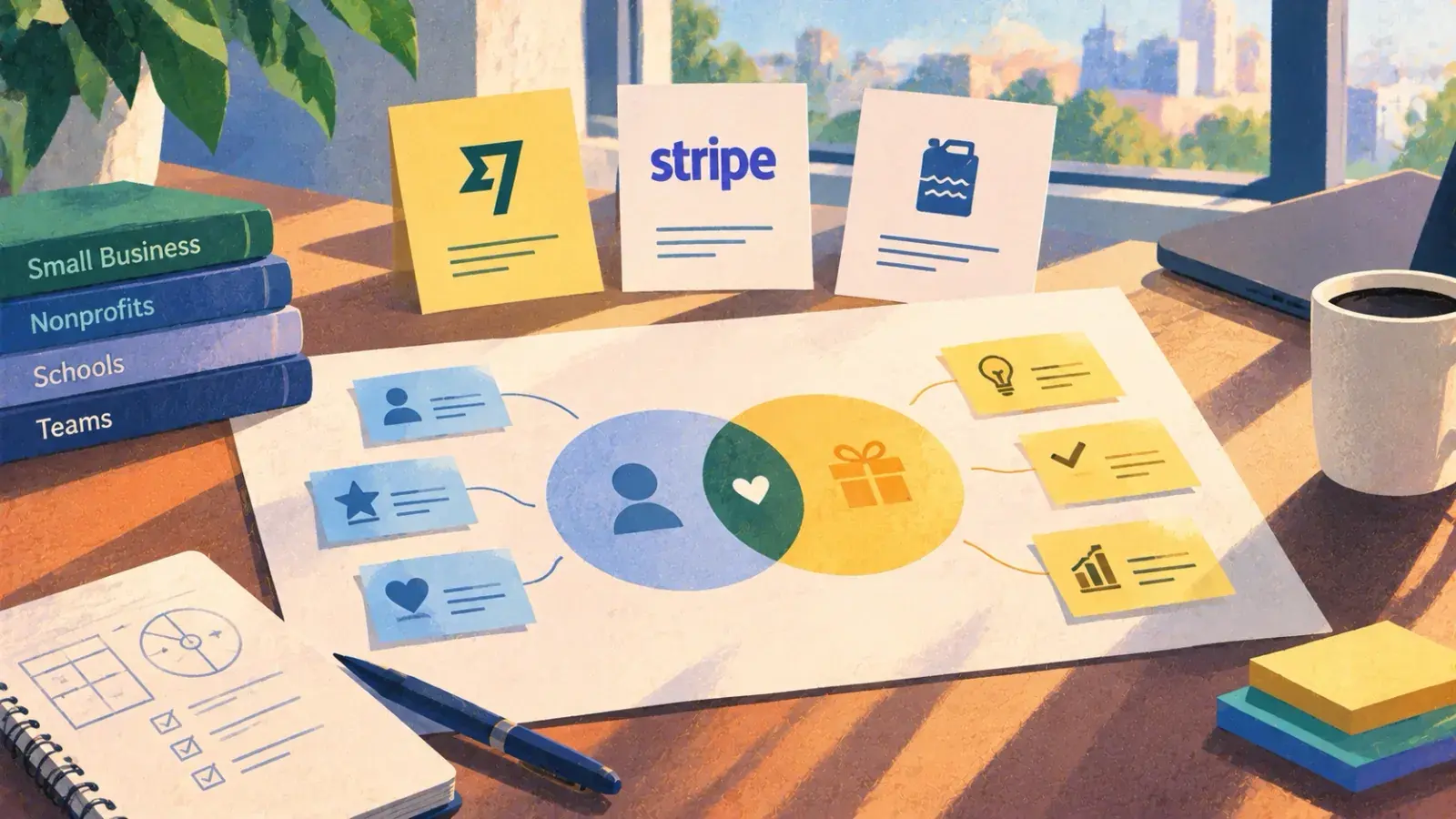
The value proposition canvas is a one-page tool for finding what your value proposition should say before you write it. It comes from Strategyzer, which publishes it, and is explained in the book Value Proposition Design (2014) by Alexander Osterwalder, Yves Pigneur, Gregory Bernarda, Alan Smith and Trish Papadakos. The term itself is much older: it is usually traced to a June 1988 McKinsey staff paper by Michael Lanning and Edward Michaels, “A business is a value delivery system.” The canvas has two halves that you fill in separately and then match.
| Half | Box | What goes in it |
|---|---|---|
| HalfCustomer profile | BoxCustomer jobs | What goes in itWhat one customer segment is trying to get done: tasks, problems to solve, needs to satisfy |
| HalfCustomer profile | BoxPains | What goes in itWhat gets in the way: the obstacles and frustrations they run into |
| HalfCustomer profile | BoxGains | What goes in itThe outcomes and benefits they want |
| HalfValue map | BoxProducts and services | What goes in itWhat you offer that this segment would use |
| HalfValue map | BoxPain relievers | What goes in itHow each offering removes or reduces a specific pain |
| HalfValue map | BoxGain creators | What goes in itHow each offering produces a specific gain |
You have fit when the pain relievers and gain creators line up with the pains and gains that matter most to the customer. The caution worth remembering is Strategyzer's own: “Fit is a claim until customers confirm it.” A canvas filled in from a conference room is a hypothesis. Interviews, sales calls and tests turn it into something you can build a homepage on.
A filled-in canvas: a children's swim school
| Customer profile: parents of children aged 4 to 9 | Value map: Brightwater Swim School |
|---|---|
| Customer profile: parents of children aged 4 to 9Job: get their child confident in the water before summer | Value map: Brightwater Swim SchoolSmall classes of four, grouped by ability rather than age |
| Customer profile: parents of children aged 4 to 9Job: fit lessons around school and work | Value map: Brightwater Swim SchoolClasses until 7:30 p.m. on weekdays and all day Saturday |
| Customer profile: parents of children aged 4 to 9Pain: a cold pool and a crying child | Value map: Brightwater Swim SchoolPain reliever: the teaching pool is kept at 90°F |
| Customer profile: parents of children aged 4 to 9Pain: a missed lesson is money lost | Value map: Brightwater Swim SchoolPain reliever: make-up lessons any day that term |
| Customer profile: parents of children aged 4 to 9Pain: no idea whether lessons are working | Value map: Brightwater Swim SchoolGain creator: a progress card every month, with the next skill named |
| Customer profile: parents of children aged 4 to 9Gain: a child who asks to go back | Value map: Brightwater Swim SchoolGain creator: a badge for every new skill, given out at the poolside |
The swim school value proposition at the top of this page came from this table. Its headline answers the last row, the gain parents cared about most, rather than the school's proudest feature. That is the canvas doing its job: deciding which true thing goes first.
Value proposition examples by business type
Six full value propositions with headline, subheadline, proof and button, then eighteen one-line versions for other kinds of business. All of them are original, written for invented companies.
1. Business software: restaurant inventory
Headline: Know what's in the walk-in before you place the order
Subheadline: Stockroom turns your supplier invoices into a running count of what's on the shelves, and tells you what to reorder before each delivery cutoff.
- Set up from last month's invoices in an afternoon
- Works with the suppliers and price lists you already use
- $89 a month per location, cancel any month
Button: Count my first delivery
Why it works. The headline names a moment every kitchen manager knows, the order placed from memory. The subheadline explains the mechanism in one sentence, and the proof answers the three questions a busy owner asks next: how long, will it fit what I have, what does it cost.
2. Consumer app: a budget for couples
Headline: One budget for two people who spend differently
Subheadline: Pocketful gives couples a shared budget for the bills and a private one for everything else, so nobody has to explain a coffee.
- Split bills by income, or evenly, or any way you agree
- Your private spending stays private, even from your partner
- Free for one shared budget; $4 a month for more
Button: Start a budget together
Why it works. It sells the relationship problem, not the spreadsheet. “Nobody has to explain a coffee” is the line couples repeat to each other, and the privacy bullet answers the objection before anyone raises it.
3. Online shop: stone-ground flour
Headline: Flour milled the week you bake with it
Subheadline: Stonecrop Mill grinds whole wheat, rye and spelt to order and ships within four days, so the flour still tastes of the grain.
- The milling date is printed on every bag
- Two-pound bags, small enough to use while fresh
- Skip or pause any month from your account
Button: Choose your first three flours
Why it works. Freshness is the difference, so every line proves freshness: milled to order, shipped in four days, dated, sold in small bags. A supermarket can't say any of it.
4. Local service: a moving company
Headline: Moves priced by the job, not by the hour
Subheadline: Larkspur Movers gives you one fixed price after a video walkthrough of your home, so a slow elevator or a long hallway costs us, not you.
- Your fixed quote within 24 hours of the walkthrough
- Every box labeled by room, and checked off when it arrives
- Licensed and insured for interstate moves
Button: Book a 15-minute video walkthrough
Why it works. The alternative, hourly pricing and the fear of the bill creeping up, is inside the headline. The subheadline turns the risk around in a sentence anyone who has moved will understand.
5. Freelancer: a grant writer
Headline: Grant proposals written by someone who used to read them
Subheadline: I spent six years as a program officer at two community foundations. Now I write proposals for nonprofits with budgets under $3 million, from the first draft to the budget narrative.
- A first draft within two weeks of our kickoff call
- One fixed fee per proposal, agreed before I start
- Two rounds of revision included
Button: Send me the funder's guidelines
Why it works. For a freelancer, the difference is usually the person. This one puts the credential in the headline as a benefit (she knows what reviewers skip), an appeal to ethos, and keeps the proof practical: timing, price, revisions. The button asks for the document the client already has open.
6. Nonprofit: a literacy program
Headline: Every child in Ashford reading by third grade
Subheadline: We train volunteers to tutor second and third graders twice a week, in their own schools. Last year 412 children took part, and 81% finished the year reading at grade level.
- $60 pays for one child's books and tutor training for a term
- Tutors are background-checked and trained for 12 hours
- Our yearly results are published, school by school
Button: Fund a child's term
Why it works. A nonprofit has two customers, the people it serves and the people who pay, and this page is for the second. It states the outcome as a goal, proves progress with a number, and ties the gift to one child and one term.
Eighteen one-line value propositions
| Business | Value proposition | Why it works |
|---|---|---|
| BusinessPayroll software for restaurants | Value propositionPayroll that handles tips, split shifts and three locations without a spreadsheet. | Why it worksNames the three things generic payroll gets wrong |
| BusinessBookkeeping firm | Value propositionA bookkeeper who answers within a day, for less than a part-time hire. | Why it worksThe alternative is in the sentence |
| BusinessCoworking space | Value propositionA desk ten minutes from home, so you stop working from the kitchen. | Why it worksA picture of the problem it ends |
| BusinessOnline editing course | Value propositionEdit your own novel in six weeks, with a real editor reading your pages. | Why it worksA time frame and the proof that it's not just videos |
| BusinessAdult piano lessons | Value propositionPiano for adults who quit as kids, playing songs you choose. | Why it worksSpeaks to a specific regret |
| BusinessNurse recruiting agency | Value propositionNurses placed in ten days, by recruiters who used to be nurses. | Why it worksSpeed and credibility in one line |
| BusinessIT support company | Value propositionIT support for offices of 10 to 50 people, with a 15-minute response time. | Why it worksCustomer size plus a measurable promise |
| BusinessMeal kit | Value propositionDinners for two in 20 minutes, with the vegetables already chopped. | Why it worksThe time, and the chore that's gone |
| BusinessPet insurance | Value propositionVet bills reimbursed in three days, from a photo of the invoice. | Why it worksAnswers the fear of claim paperwork |
| BusinessFurniture brand | Value propositionSolid wood furniture that ships flat and goes together without tools. | Why it worksPairs a quality signal with a convenience |
| BusinessChildren's book subscription | Value propositionTwo picture books a month, chosen for your child's age by a librarian. | Why it worksWho chooses is the difference |
| BusinessHarbor inn | Value propositionA quiet room above the harbor, five minutes' walk from the ferry. | Why it worksLocation as the whole proposition |
| BusinessWedding photographer | Value propositionEvery photo delivered in three weeks, not three months. | Why it worksA contrast with the industry's usual wait |
| BusinessSchool communication app | Value propositionMessages to parents translated into 40 languages, so every family hears from the school. | Why it worksThe benefit for the school's whole community |
| BusinessMachine shop | Value propositionCustom metal parts in five days, quoted within an hour of your drawing. | Why it worksTwo numbers buyers compare first |
| BusinessBank account for freelancers | Value propositionAn account that sets your taxes aside every time a client pays. | Why it worksAutomates the task freelancers forget |
| BusinessTutoring service | Value propositionA tutor who has taught your child's exact course, booked by the hour. | Why it worksSpecific fit, flexible commitment |
| BusinessAuthor's newsletter | Value propositionOne new short story every Friday, from the writer of the Port Avery mysteries. | Why it worksWhat arrives, when, and from whom |
Value proposition vs tagline and mission
A value proposition is often confused with the other short statements a company keeps. They do different jobs for different readers, and a homepage usually carries two or three of them.
| Statement | Its job | Who reads it | Example |
|---|---|---|---|
| StatementValue proposition | Its jobSays what the customer gets and why it beats the alternative | Who reads itProspective customers | Example“The fast way to send money abroad” |
| StatementTagline | Its jobSigns off the brand, beside the name, for years | Who reads itEveryone who sees the logo | Example“Invented for life” (Bosch) |
| StatementSlogan | Its jobSells one campaign or product | Who reads itThe campaign's audience | ExampleA line that changes with the campaign |
| StatementMission statement | Its jobSays what the organization does every day, for whom | Who reads itStaff, partners, donors | ExampleUsually on the about page |
| StatementVision statement | Its jobDescribes the future the organization is working toward | Who reads itStaff and supporters | Example“A world where everyone has a decent place to live” (Habitat for Humanity) |
| StatementElevator pitch | Its jobIntroduces you or the company in 30 to 60 seconds of speech | Who reads itSomeone you just met | ExampleSpoken, not printed |
For the neighbors, see the tagline examples, the vision statement examples and the elevator pitch examples. An elevator pitch is a value proposition said out loud, with a person attached.
How to write a value proposition
- Pick one customer
Write the segment as narrowly as you can bear: not “small businesses” but “restaurants with one to three locations that order produce twice a week.” A value proposition written for everyone is hard to make persuasive to anyone in particular.
- Collect their words
Interview five customers or people who chose a competitor. Ask what they were trying to get done, what got in the way and what a good result looked like. Write their answers down verbatim; these are the jobs, pains and gains for the canvas, and their phrases are often better than yours.
- Name the real alternative
The alternative often isn't a direct competitor. It may be a spreadsheet, a clipboard, a part-time hire, a cousin with a van, or doing nothing. Write down what customers do today without you, because that's what your headline has to beat.
- Choose the one benefit and its proof
From the canvas, pick the gain or pain relief you deliver clearly better than the alternative and can prove: a number, a guarantee, a method, a credential. If you can't prove it, it doesn't go in the headline.
- Draft ten headlines, then the rest
Write ten headlines for that one benefit, in the customer's words. Pick the best, then write the subheadline (who, what, how), three proof points and the button. The copywriting examples show how homepages and landing pages build out from here.
- Test it on strangers
Show the draft to someone in the segment for five seconds, then hide it and ask what the product does and who it's for. If they can't say, the words aren't working yet. With traffic, run two versions of the page or two ads that differ only in the headline and keep the one that brings more customers, not just more clicks.
Before the stranger test, you can attach your interview notes to the Strokes Assistant and ask which claims on the draft page nothing in the notes supports. Those are the lines that are still a guess.
Weak value propositions, rewritten
Most weak value propositions describe the company instead of the customer, or claim a quality instead of proving a result. Here are eight invented first drafts, each beside the rewrite from this page that replaces it.
| First draft | Rewrite | What changed |
|---|---|---|
| First draftThe all-in-one platform for modern restaurants | RewriteKnow what's in the walk-in before you place the order | What changedA moment the customer recognizes instead of a category claim |
| First draftInnovative financial solutions for couples | RewriteOne budget for two people who spend differently | What changedThe relationship problem, in plain words |
| First draftPremium quality flour | RewriteFlour milled the week you bake with it | What changedA checkable fact replaces an adjective |
| First draftProfessional, reliable movers | RewriteMoves priced by the job, not by the hour | What changedNames the fear and removes it |
| First draftExperienced grant writer | RewriteGrant proposals written by someone who used to read them | What changedThe experience becomes a benefit |
| First draftEmpowering young readers | RewriteEvery child in Ashford reading by third grade | What changedAn outcome with a place and a deadline |
| First draftWe're passionate about swimming | RewriteSwimming lessons your kids will ask to go back to | What changedFrom the school's feeling to the parent's goal |
| First draftBest-in-class IT services | RewriteIT support for offices of 10 to 50 people, with a 15-minute response time | What changedA customer size and a promise you can measure |
Take the first row. “The all-in-one platform for modern restaurants” is a broad promise: the reader has to guess what “all” includes and whether their kitchen counts as modern. “Know what's in the walk-in before you place the order” names one moment a kitchen manager has lived through and one result they can check against their own Sunday-night count. The benefit is narrower, and that is what makes it clearer: the right reader can tell at once that it's for them.
- Category words instead of benefits. “Platform,” “solution” and “all-in-one” tell the reader what you think you are, not what they get.
- Adjectives instead of proof. “Premium,” “reliable” and “best-in-class” are claims every competitor also makes. A date on a flour bag is proof none of them can copy.
- Several benefits at once. Fast, cheap, easy and secure in one headline makes it hard for any of them to land. Lead with one and move the rest into the proof.
- No alternative in sight. A value proposition is a comparison, even when the competitor isn't named. If you can't say what you're better than, the reader can't either.
Frequently asked questions
What is the difference between a value proposition and a mission statement?
A value proposition is written for customers and says what they get and why to choose you over the alternative. A mission statement is written for staff, partners and supporters and says what the organization does every day and for whom. A company can keep the same mission for decades while its value proposition changes with the market.
How long should a value proposition be?
The headline is usually under a dozen words, and the subheadline one or two sentences. With two or three proof points and a button, the whole thing fits on the first screen of a homepage. If it needs a paragraph to make sense, the benefit probably isn't clear yet.
Is a value proposition the same as a USP?
They overlap. A unique selling proposition, or USP, is the one claim that sets a product apart from its competitors. A value proposition is broader: it also says who the product is for and what they get from it. In practice, the USP is often the “unlike the alternative” part of a value proposition.