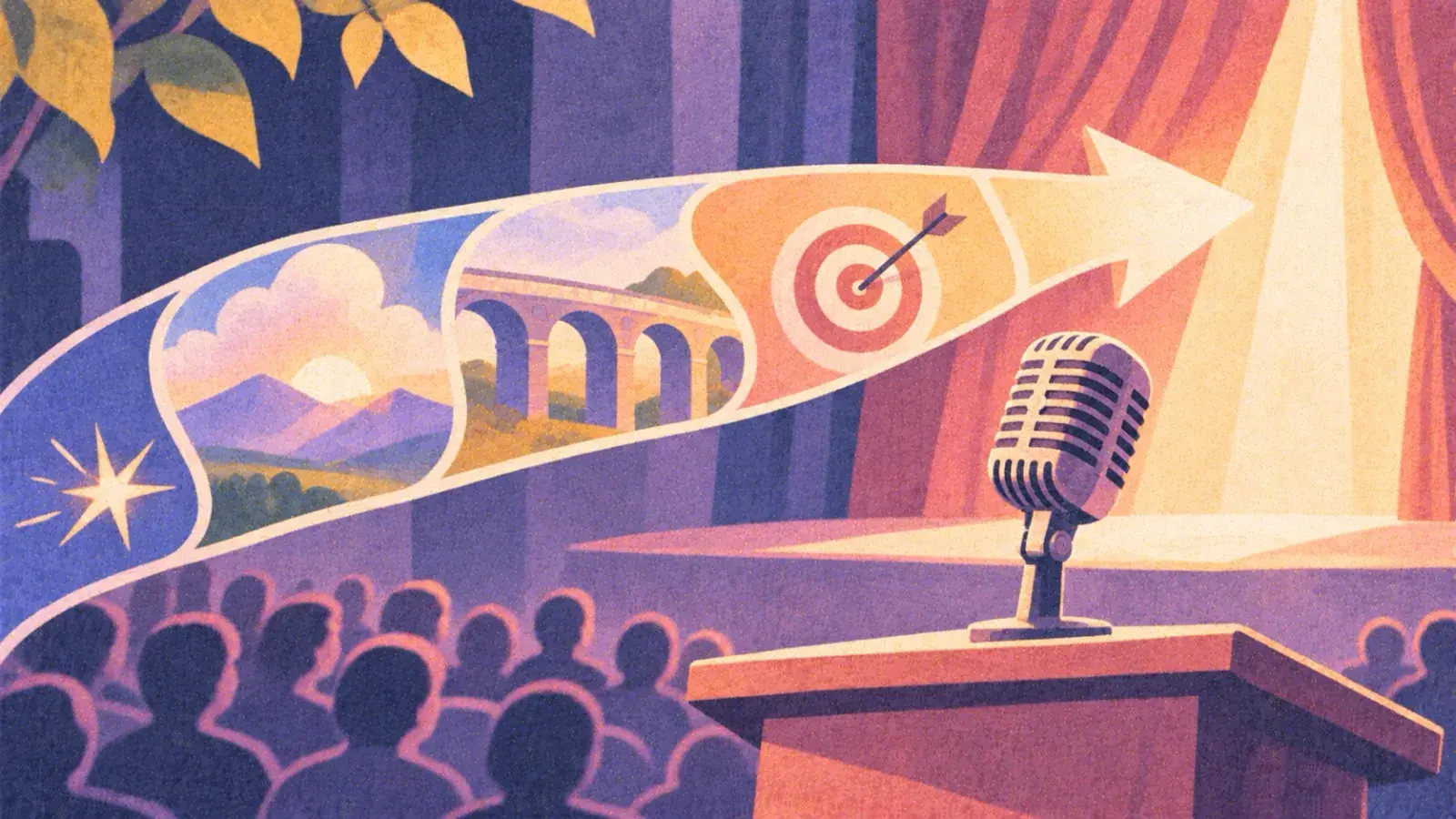
A speech conclusion has three parts: a signal that you are finishing, a summary that restates your central idea (and, in longer talks, your main points in a sentence), and a clincher, the final line built to be remembered. Its job is to keep the promise the opening made: answer the question the hook raised, pay off the preview, and leave the room one thing to do or picture. Each of the 15 conclusions below closes a speech whose opening is in speech introduction examples.
The people, places and numbers are invented. If it's the first line you need, start with attention getters for speeches; for nine closing techniques shown on a single speech, see how to end a speech.
Fix a weak conclusion
Start with the promise. The plowing speech, the first of the fifteen, opens with a question and a small mystery:
Hook. “Last February, our street was the last one in Stellwood to be plowed. It took three days. So I asked the city why.”
Preview. “I'll cover the three priority levels, how a plow route is built, and the one thing that slows a plow more than snow.”
Before. “So, yeah, I guess that's pretty much all I've got about snow. Any questions?”
After. “So, back to my street. I can't move it closer to the garage. But what slows a plow most isn't snow. It's parked cars. At the next snow emergency, move yours, and our street might only take two days.”
The first ending apologizes for having nothing left. The second answers the hook's question, names the preview's mystery and stops on the one thing a listener can do on the next snowy night: move the car. That action is what the room carries out, and it pays off the opening without repeating the speech. The full version, summary included, is example 1.
Two other weak endings are common. The second speech is a 150-word recap that walks through the snow plan again, route by route; the fix gives each priority level a few words: “Hospitals and buses first, hills second, everyone else by distance from the garage.” The new fact (“Oh, and one more thing: public works also sells road salt at cost”) reopens a speech the audience thought was closing. If it matters, it belongs earlier, or on a handout.
If you draft in Strokes, ask the Strokes Assistant to review the whole speech before you rehearse: does the conclusion bring in anything new, and does the clincher call back to the opening?
The three parts of a conclusion
| Part | Its job | Sounds like |
|---|---|---|
| PartSignal | Its jobTells the room you're finishing and wakes up anyone who drifted | Sounds like“Let's go back to my street.” “Here's the decision I need.” “One last detour.” |
| PartSummary | Its jobRestates the thesis, plus the main points in one sentence if the talk ran past five minutes | Sounds like“Four moves: find, tuck, square, fold.” “Six people, at work by four every morning.” |
| PartClincher | Its jobThe last line: an action, a callback, a toast, a send-off or a name | Sounds like“Vote on the 14th.” “To Hana and Daniel.” “Please welcome Dr. Ifeoma Nwosu.” |
Most of the clinchers below are callbacks: they return to the story, object or line the speech opened with, now carrying everything the audience heard in between. It is the same shape as a frame story, and it helps because the audience recognizes the ending before the last word arrives. To find yours, list the specific details from your opening (last February, three days, the forty-page snow plan) and, beside each, the line in your conclusion that returns to it. A detail with nothing beside it is a callback you haven't used. If your opening has nothing specific enough to return to, fix the opening first: stories, props and contrasts give a callback the most to hold.
| Speech | Clincher | What the room carries out |
|---|---|---|
| Speech1. Informative speech | ClincherCallback to the opening | What the room carries outMove the car at the next snow emergency |
| Speech2. Persuasive speech | ClincherThe ask, with a date | What the room carries outVote on the 14th |
| Speech3. Demonstration speech | ClincherA challenge for tonight | What the room carries outOne sheet, forty seconds |
| Speech4. Self-introduction | ClincherA favor to ask | What the room carries outHelp with the number 14 bus |
| Speech5. Business presentation | ClincherThe decision and its cost | What the room carries outApprove today or pay through the holidays |
| Speech6. Pitch to investors | ClincherBack to one person | What the room carries outTeresa, home before her kids |
| Speech7. Conference talk | ClincherAn assignment for Monday | What the room carries outSkip one meeting, write its story |
| Speech8. Training session | ClincherCallback with a wink | What the room carries outTen seconds before you click |
| Speech9. Fundraising appeal | ClincherFinished story, then the ask | What the room carries out“I really don't have to give it back?” |
| Speech10. Wedding toast | ClincherRaise a glass | What the room carries outThe best deal either of them will make |
| Speech11. Eulogy | ClincherA final image | What the room carries outLie back, breathe, trust the water |
| Speech12. Retirement tribute | ClincherA prop and a toast | What the room carries outThe red pencil, kept sharpened |
| Speech13. Award acceptance | ClincherAn invitation | What the room carries outThe rye comes out at seven |
| Speech14. Graduation speech | ClincherA send-off | What the room carries outTake the tour |
| Speech15. Introducing a speaker | ClincherThe speaker's name | What the room carries outDr. Ifeoma Nwosu |
Conclusions for class speeches
A graded speech needs a conclusion the instructor can hear: a clear signal, the thesis restated, and a final line that isn't “Any questions?”
1. Informative speech
Signal. “So, back to my street.”
Summary. “Priority one: the roads to the hospital, the fire stations and the bus routes. Priority two: the hills. Priority three: everything else, in the order the routes run out from the garage. We're priority three, at the far end of route 11.”
Clincher. “I can't move our street closer to the garage. But what slows a plow most isn't snow. It's parked cars. At the next snow emergency, move yours, and our street might only take two days.”
Why it works. The signal returns to the opening complaint, and the summary walks the three priority levels in the preview's order before answering the hook's question with the speaker's own street. The clincher returns to the small mystery the preview promised, which the body has already solved, and turns it into one thing to do. The wry last clause keeps an informative speech from ending as a lecture.
2. Persuasive speech
Signal. “So here's what I'm asking the council to do.”
Summary. “Allow up to four hens, no roosters, on lots over a quarter acre, with a $25 permit. No roosters means no crowing at dawn. A covered run and a cleaning rule, the same terms our six neighbors use, take care of smell and rats.”
Clincher. “Willow Bend already trusts its residents with pythons. Vote on the 14th to trust us with four hens.”
Why it works. The ask is repeated almost word for word from the thesis, so nobody leaves with a fuzzier version of it. Each objection gets one line, in the order the preview promised. The clincher turns the opening contrast into the request and adds a date, which gives agreement something specific to do.
3. Demonstration speech
Signal. “Let's see those sheets.” [The class holds up its folded squares.]
Summary. “Four moves: find the corners, tuck them together, square the edges, fold it small. Corners inside corners. That's the whole secret.”
Clincher. [Holds up the crumpled ball beside the square.] “Tonight, take one sheet out of the back of your closet and give it forty seconds. If it still comes out a ball, bring it on Thursday and I'll fold it for you.”
Why it works. A demonstration conclusion repeats the steps in the same words as the preview, so people remember them as a sequence. The props come back for one last before-and-after, and the challenge is small enough to do tonight, with a promise that makes the speaker accountable too.
4. Self-introduction speech
Signal. “So that's me.”
Summary. “Eleven moves, four countries, one nursing degree in progress and a firm belief in bus maps.”
Clincher. “Here's the favor: I still can't work out the number 14 bus. If you can, find me after class, and I'll teach you one bathroom question in any of my five languages.”
Why it works. The summary compresses the whole introduction into one rhythmic line. A favor makes a useful ending for a self-introduction, because it gives classmates an easy reason to start a conversation, and the five languages close the loop on the opening joke.
Conclusions for work and public talks
At work the clincher is usually a decision, a next step or something to try. The audience should leave knowing what happens on Monday.
5. Business presentation
Signal. “Here's the decision I need from you today.”
Summary. “Most of the $212,000 traces to one wrong delivery estimate. Fixing it takes one sprint and two engineers.”
Clincher. “If we approve the fix today, the estimate is right by November 1, before holiday orders start. If we wait until January, we pay for the bug through the eight busiest weeks of the year.”
Why it works. A business conclusion ends on the decision and what each choice costs, not on a slogan. The summary repeats the cause and the price in two sentences, so anyone who drifted during the charts can still decide. The dates make waiting visible as a choice with a price.
6. Pitch to investors
Signal. “Let me go back to Teresa.”
Summary. “Nine visits, one paper map and an hour lost every day. Routewell gives that hour back, two agencies are already paying for it, and we're raising $1.5 million to reach the next twenty.”
Clincher. “Yesterday Teresa finished her last visit at 3:40 and was home before her kids. We'd like to give that afternoon to every home-care nurse in the country.”
Why it works. The summary restates problem, product, traction and ask in one breath, the version an investor repeats to partners afterward. The clincher returns to the nurse from the opening, now with a better day, so the numbers end as a scene.
7. Conference talk
Signal. “I'll leave you with one assignment.”
Summary. “We stopped sitting through every meeting, spent those hours on what each decision would do to the people it touched, and all three numbers we watched went the right way: reading time up, new subscribers up, corrections down.”
Clincher. “Look at next week's calendar and find the meeting you cover only because it's on the calendar. Skip it once. Write the story the meeting was about.”
Why it works. Conference audiences are more likely to remember a talk that gave them something to do. The summary turns twenty minutes into one sentence with three results, and the clincher is an assignment small enough to try once, with a last line built on the talk's thesis.
8. Training session
Signal. “Before you go back to your desks, the three things to remember.”
Summary. “It's urgent, it's from someone who doesn't usually write to you, and it wants a click or a payment. If you clicked anyway, call us, and the sooner the better. If you're not sure, press Report. It takes two clicks.”
Clincher. “And next month, when an email says your parking permit is about to expire, take ten seconds. It might be us again.”
Why it works. A training conclusion should recap the procedure as a list people can act on. The callback to the parking-permit email ties the habit to the one moment everyone in the room remembers, and the wink at the end keeps the warning from sounding like a scolding.
9. Fundraising appeal
Signal. “Before you pick up a pledge card, let me tell you what Dev did next.”
Summary. “Forty instruments cost $36,000. Every $900 puts one in a child's hands for as long as that child wants to play.”
Clincher. “Dev practiced every day for a year. In June he played his first recital, and afterward he walked straight up to me with the cello and asked, again, ‘I really don't have to give it back?’ Tonight you get to answer that for forty more kids. The cards are on your tables.”
Why it works. A fundraising conclusion names the price of one unit of impact, here a single instrument. It finishes the story the opening started, so the ask arrives inside a scene rather than after a chart, and the last line points at the action: the pledge card in front of every guest.
Conclusions for special occasions
Occasion speeches end on a ritual the room already knows: a raised glass, a name, a send-off. The summary shrinks to the one idea, said once more.
10. Wedding toast
Signal. “So let me finish where I started, with Hana's investments.”
Summary. “She once sold my bicycle for four dollars and a bag of plums. Daniel is the first thing she's ever chosen that she will never, ever trade.”
Clincher. “Everyone, please raise your glasses. To Hana and Daniel: the best deal either of them will ever make.”
Why it works. A toast ends with instructions: raise a glass, and here are the words. The callback turns the opening joke into the compliment, so the laugh and the sentiment land in the same line.
11. Eulogy
Signal. “The last person she stood in the water with was me.”
Summary. “Rita stood in the water with a seven-year-old who wouldn't let go of the ladder, with a widower who learned at seventy-one, and with me, long after I could swim, every time I was afraid of something.”
Clincher. “She isn't in the water with us anymore. But every one of us she taught knows what to do now. Lie back. Breathe. Trust the water to hold you. Thank you, Rita.”
Why it works. The conclusion finishes the third story the preview promised, then names all three in one sentence. The final image turns her swimming lesson into comfort without a platitude, and speaking to her by name gives the room a place to put its grief.
12. Retirement tribute
Signal. “Joan, before you go, there's one more correction.”
Summary. “Thirty-six years, 212 spellings of the mayor's name, one stylebook in a coat pocket, one night the presses stopped and the paper came out anyway, and a newsroom full of people who write better because you circled things in pencil and never once raised your voice.”
Clincher. [Holds up a red pencil.] “This is the last pencil from your desk drawer. We're keeping it on the copy desk, sharpened, in case the mayor runs again. Everyone: to Joan.”
Why it works. The summary is a list of her habits, each taken from the opening, which is how a tribute turns details into praise. The pencil calls back to the credibility line, and the joke about the mayor lets the room laugh just before it raises a glass. The retirement speech examples mostly end on a toast too, for other jobs and other lengths of service.
13. Award acceptance
Signal. “That's the crew.”
Summary. “Six people, at work by four every morning, including the morning the chamber called. This award is theirs.”
Clincher. “Thank you again to the chamber for calling back. If you'd like to thank the crew yourselves, we open at six. The rye comes out at seven.”
Why it works. An acceptance speech should end quickly and keep the credit pointed at others. The summary folds the opening phone call into the praise, and the clincher is a warm, specific invitation that gives the room a way to thank the crew in person.
14. Graduation speech
Signal. “One last detour.”
Summary. “We started this place by getting lost: the cheese factory, the wrong lecture hall, the major half of us dropped by spring. The detours were the education.”
Clincher. “There's no bus today. From here we each drive ourselves. So when you take the wrong exit, and you will, don't turn around right away. Take the tour.”
Why it works. A graduation conclusion sends people off with a wish, and this one turns the opening anecdote into advice. The summary names all three detours from the preview in one breath, and the last line is three words long, short enough to quote at the party afterward.
15. Introducing a guest speaker
Signal. “I'll stop there, because she's the one you came to hear.”
Summary. “Ten years studying why patients wait, methods three hospital systems in this state now use, and a claim about waiting rooms that will start some arguments on the drive home.”
Clincher. “Please welcome Dr. Ifeoma Nwosu.” [Turn toward her, start the applause and stay at the lectern until she reaches it.]
Why it works. The conclusion of an introduction has one job: to hand the room to the speaker. The summary recaps her credentials and the stakes without previewing her talk, and the clincher is her name, said last and clearly, while you turn toward her.
Six famous closings, annotated
All six are public domain: speeches by US presidents in office, or published before 1929. The texts are from the American Presidency Project, the Avalon Project at Yale Law School, the National Archives, George Mason University's History Matters and Abraham Lincoln Online.
“We have provided the machinery to restore our financial system; it is up to you to support and make it work. It is your problem no less than it is mine. Together we cannot fail.”
The close of Roosevelt's first fireside chat, whose opening is annotated in informative speech examples. It hands the problem to the audience and keeps the speaker inside it. Each sentence is shorter than the one before, and the last is four words long, with “fail” held for the end. It is a call to action whose action is confidence.
“With malice toward none, with charity for all, with firmness in the right as God gives us to see the right, let us strive on to finish the work we are in, to bind up the nation's wounds, to care for him who shall have borne the battle and for his widow and his orphan, to do all which may achieve and cherish a just and lasting peace among ourselves and with all nations.”
One sentence of 74 words, built from two runs of parallel phrases: three “with” phrases that set the spirit, then four “to” phrases that set the work. Parallelism is one of the oldest rhetorical devices, and here it lets a very long sentence stay easy to follow by ear. The close is a picture of the future made of tasks, and it ends on the widest frame available, “all nations.”
“Trusting in Him who can go with me, and remain with you and be every where for good, let us confidently hope that all will yet be well. To His care commending you, as I hope in your prayers you will commend me, I bid you an affectionate farewell.”
Lincoln spoke to his neighbors at the railroad depot as he left Springfield for his inauguration. This is the version he began writing down on the train afterward, at his companions' request, and his secretary John Nicolay finished; a Springfield newspaper's report of the spoken words differs. The close is a blessing exchanged, his for theirs, and then three plain words, “an affectionate farewell,” say exactly what the speech is. It is a good model for any farewell or retirement speech: the last line names the occasion.
“…with the pride of those who know that the day has come when America is privileged to spend her blood and her might for the principles that gave her birth and happiness and the peace which she has treasured. God helping her, she can do no other.”
The address that led to the declaration of war against Germany opens by naming the moment, “serious, very serious, choices of policy” (its first sentence is annotated in speech introduction examples), and closes on resolve. The long sentence raises the stakes clause by clause, and the last sentence drops to eight words that leave no room for doubt. Ending a grave speech on its shortest sentence is a move worth borrowing.
“Having behind us the commercial interests and the laboring interests and all the toiling masses, we shall answer their demands for a gold standard by saying to them, you shall not press down upon the brow of labor this crown of thorns. You shall not crucify mankind upon a cross of gold.”
Bryan's speech on whether the party should back the free coinage of silver ends on one image delivered twice, the crown of thorns and then the cross, in two parallel clauses that begin “you shall not.” The second is shorter and sharper, and the speech's title arrives as its last three words. An image close works when it compresses the whole argument into a picture, as this one does.
“We pray that peoples of all faiths, all races, all nations, may have their great human needs satisfied; that those now denied opportunity shall come to enjoy it to the full; that all who yearn for freedom may experience its spiritual blessings; that those who have freedom will understand, also, its heavy responsibilities; that all who are insensitive to the needs of others will learn charity; that the scourges of poverty, disease and ignorance will be made to disappear from the earth, and that, in the goodness of time, all peoples will come to live together in a peace guaranteed by the binding force of mutual respect and love.”
The published text of the address remembered for its warning about the “military-industrial complex” ends with a prayer built as a list: seven clauses that begin with “that,” each a hope, the last widened to “all peoples.” On air, Eisenhower then added a brief goodbye about becoming a private citizen that Friday. A list close like this suits a solemn occasion and a large audience. At a team meeting it would sound like a sermon.
Draft the clincher first
Draft two or three clinchers of different types (a callback, an ask, a toast) and choose by reading each aloud. Put the most important word at the end of the sentence, and slow down when you say it. The speech outline template gives the last line its own slot, so you can write it before the body and draft toward it.
Frequently asked questions
How do you write a conclusion for an informative speech?
Signal the end, retrace your main points in one sentence, ideally in the same order and words as your preview, and finish with a line that tells listeners what to do or notice with what they learned. The snow-plow example on this page ends by giving listeners one thing to do at the next snow emergency.
How do you end a persuasive speech?
Restate the ask exactly as you stated it in the introduction, answer the main objections in a line each, and close with a specific action and a date: sign the card, vote on the 14th, approve the fix today. A callback to your opening, turned into the ask, makes the last line easy to remember.
What is a clincher in a speech?
The clincher is the last line of a speech, written so the audience remembers it. Common clinchers are a call to action, a callback to the opening story or image, a short quotation, a toast, a question to think about and, when you introduce another speaker, their name. Most of the fifteen on this page are callbacks, because a specific opening gives the ending something to return to.
Can a conclusion include anything new?
Not a new point or a new argument: it reopens a speech the audience thought was closing. The exception is the end of a story the opening began. The fundraising appeal on this page tells what Dev did next, and the pitch shows the nurse's better afternoon. That material is new, but it finishes something the room already cares about, so it lands as a payoff rather than a detour.