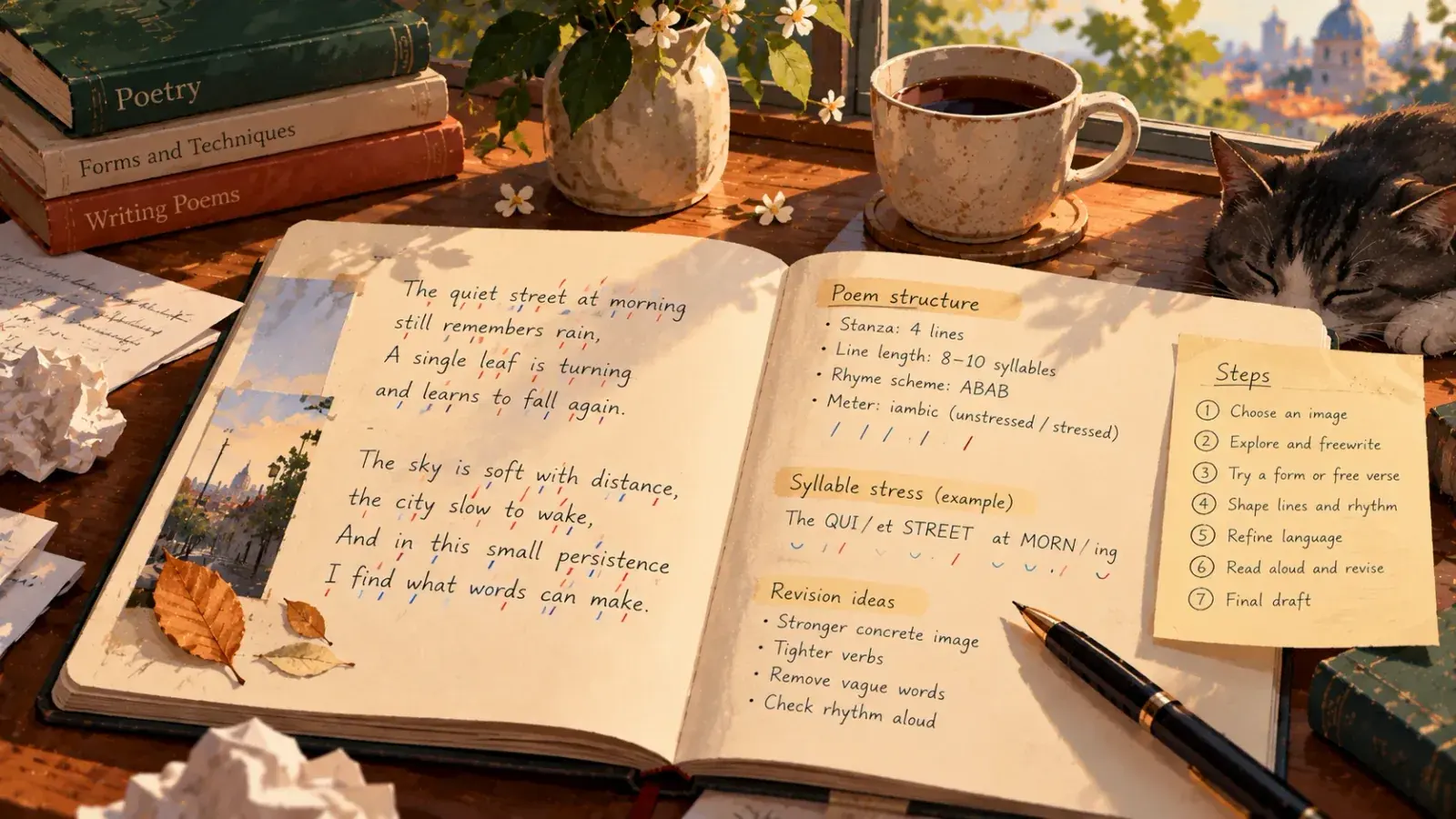
Meter in poetry is the regular pattern of stressed and unstressed syllables in a line of verse. It is measured in feet, small units of two or three syllables such as the iamb (da-DUM) or the dactyl (DUM-da-da), and a meter is named by the type of foot and the number of feet per line: iambic pentameter is five iambs, trochaic tetrameter four trochees. Reading a line to find its meter is called scansion.
This page covers the seven feet you will meet, the line lengths from dimeter to octameter, the common meters scanned in public-domain poems from Shakespeare to Dickinson, the variations that keep meter from sounding mechanical, a step-by-step way to scan any line, and a short practice set with answers. In the scanned lines, stressed syllables are in bold and a vertical bar separates the feet.
How meter works
English is a stress language. Every word of two or more syllables has one syllable that is said more strongly than the others: begin, garden, tomorrow. One-syllable words take their stress from their job in the sentence. Nouns, main verbs and adjectives usually carry a stress. Articles, prepositions, conjunctions and most pronouns usually don't.
Meter arranges those natural stresses into a pattern that repeats line after line. From Chaucer to the early twentieth century, most English poetry was accentual-syllabic: it counts both the stresses and the syllables. A line of iambic pentameter usually has ten syllables and five beats, and a reader hears the beat under the sense of the sentence, the way you hear a drum under a song.
Here is one line scanned slowly: the opening of Shakespeare's Sonnet 18 (1609), "Shall I compare thee to a summer's day?" It has ten syllables. Two of its words have a fixed stress, compare and summer's, and "day" is a noun, so it takes a stress too. That puts beats on syllables 4, 8 and 10. Fill in the same alternation from the start and the line reads:
Shall I | compare | thee to | a sum | mer's day?
Five iambs. Notice "to": a preposition you would say lightly in conversation sits on a beat here, and a reader gives it just enough weight to keep the pattern going. The first foot is open to choice. Most readers put the beat on "I"; some lean on "Shall" instead, which turns the first foot into a trochee (Shall I). Both are natural English, and the line is iambic pentameter either way.
That is the difference between meter and rhythm. Meter is the abstract pattern, da-DUM five times, and it recurs from line to line. Rhythm is what one particular line sounds like when you say it: the light beat on "to," the choice on "Shall I," the rise of the question at the end. Good metrical verse keeps both audible: the pattern, and the speaking voice pushing against it.
The metrical feet
A foot is one unit of the pattern. Seven are worth knowing. Most English verse is built from the two-syllable feet in the first four rows, with the iamb doing most of the work.
| Foot | Pattern | Sounds like | Words | In a line |
|---|---|---|---|---|
| FootIamb | Patternunstressed, stressed | Sounds likeda-DUM | Wordsaway, begin, the door | In a lineWas this | the face | that launched | a thou | sand ships |
| FootTrochee | Patternstressed, unstressed | Sounds likeDUM-da | Wordsgarden, table, mother | In a lineDouble, | double | toil and | trouble |
| FootSpondee | Patternstressed, stressed | Sounds likeDUM-DUM | Wordsdead end, red wine | In a lineRough winds | do shake | the dar | ling buds | of May |
| FootPyrrhic | Patternunstressed, unstressed | Sounds likeda-da | Wordsof the, in a | In a lineWhen to | the ses | sions of | sweet si | lent thought |
| FootAnapest | Patternunstressed, unstressed, stressed | Sounds likeda-da-DUM | Wordsunderstand, intervene | In a linelike the wolf | on the fold |
| FootDactyl | Patternstressed, unstressed, unstressed | Sounds likeDUM-da-da | Wordsbeautiful, merrily | In a lineHalf a league, | half a league |
| FootAmphibrach | Patternunstressed, stressed, unstressed | Sounds likeda-DUM-da | Wordsbanana, tomorrow | In a lineThere was an | Old Man with | a beard |
Spondees and pyrrhics almost never run for a whole line. They turn up as substitutions inside iambic lines, where they make a passage heavier or lighter. Iambs and anapests are called rising feet, because they end on the stress. Trochees and dactyls are falling feet.
Line lengths: dimeter to octameter
The second half of a meter's name counts the feet in each line, from the Greek for one to eight.
| Name | Feet per line | Example |
|---|---|---|
| NameMonometer | Feet per line1 | ExampleRare. Whole poems in one-foot lines exist mostly as curiosities. |
| NameDimeter | Feet per line2 | ExampleHalf a league, half a league (Tennyson, 1854): dactylic dimeter |
| NameTrimeter | Feet per line3 | ExampleHe kindly stopped for me (Dickinson): iambic trimeter |
| NameTetrameter | Feet per line4 | ExampleBy the shores of Gitche Gumee (Longfellow, 1855): trochaic tetrameter |
| NamePentameter | Feet per line5 | ExampleThe curfew tolls the knell of parting day (Gray, 1751): iambic pentameter |
| NameHexameter | Feet per line6 | ExampleThis is the forest primeval. The murmuring pines and the hemlocks (Longfellow, 1847): dactylic hexameter |
| NameHeptameter | Feet per line7 | ExampleThe outlook wasn't brilliant for the Mudville nine that day (Ernest Thayer, 1888): iambic heptameter |
| NameOctameter | Feet per line8 | ExampleOnce upon a midnight dreary, while I pondered, weak and weary (Poe, 1845): trochaic octameter |
Common meters, with examples
These are the meters you are most likely to meet in English poetry, each scanned in a public-domain poem. For the form built most often on the first of them, see the guide to writing a sonnet, which goes through Shakespeare's variations line by line.
Iambic pentameter
Was this the face that launched a thousand ships,
And burnt the topless towers of Ilium?
Was this | the face | that launched | a thou | sand ships,
Five iambs, ten syllables. It is the most common meter in English poetry, used by Shakespeare in his plays and sonnets, by Milton in Paradise Lost and by Wordsworth in The Prelude, partly because ordinary English sentences fall into it so easily. Unrhymed iambic pentameter is called blank verse.
Iambic tetrameter
She walks in beauty, like the night
Of cloudless climes and starry skies;
She walks | in beau | ty, like | the night
Of cloud | less climes | and star | ry skies;
One foot shorter than pentameter, and noticeably quicker. Eight syllables leave little room for padding, so tetrameter suits songs, narrative verse and wit.
Common meter (ballad meter)
Because I could not stop for Death,
He kindly stopped for me;
The carriage held but just ourselves
And Immortality.
Because | I could | not stop | for Death,
He kind | ly stopped | for me;
Common meter alternates lines of iambic tetrameter and iambic trimeter, eight syllables then six. It is the meter of many hymns, including John Newton's 1779 "Amazing grace! (how sweet the sound)," and of traditional ballads. Dickinson used it and its variants in many of her poems, which is why so many of them can be sung to hymn tunes, and then unsettled it with dashes, slant rhyme and strange turns. The last line here scans with a light beat on the final syllable: And Im | mortal | ity.
Trochaic tetrameter
By the shores of Gitche Gumee,
By the shining Big-Sea-Water,
By the | shores of | Gitche | Gumee,
By the | shining | Big-Sea- | Water,
Four falling feet in every line, for the whole poem. Longfellow modeled the meter on the Finnish epic the Kalevala, and its chant-like regularity is why the poem is so easy to parody. Hiawatha keeps the final unstressed syllable, but many English poems in trochees drop it, a variation covered below.
Trochaic octameter
Once upon a midnight dreary, while I pondered, weak and weary,
Over many a quaint and curious volume of forgotten lore—
Once u | pon a | midnight | dreary, | while I | pondered, | weak and | weary,
Eight trochees, sixteen syllables, with a rhyme in the middle of the line (dreary, weary) that splits it into two halves. Few well-known poems use a line this long. Poe explained how he built the poem, meter included, in his essay "The Philosophy of Composition" (1846), where he describes it as "octameter acatalectic, alternating with heptameter catalectic": a full eight-foot line, then one with its last light syllable dropped, seven and a half feet long. The second line above is one of those.
Anapestic tetrameter
The Assyrian came down like the wolf on the fold,
And his cohorts were gleaming in purple and gold;
The Assyr | ian came down | like the wolf | on the fold,
And his co | horts were gleam | ing in pur | ple and gold;
Two light syllables before every stress give anapests their gallop, which suits a cavalry charge. "Assyrian" has to be squeezed into three syllables (as-SYR-yan) to fit, a small example of elision. The same meter carries comic verse and, much later, a great deal of Dr. Seuss.
Dactylic meter
Half a league, half a league,
Half a league onward,
All in the valley of Death
Rode the six hundred.
Half a league, | half a league,
Half a league | onward,
Dactyls fall hard and fast, like hooves. Notice that the second line ends on "onward," a two-syllable foot: English lines in falling meters often lose their last unstressed syllables, so the line ends on a firmer beat than "-da-da." Longfellow's Evangeline (1847) is written in dactylic hexameter.
Amphibrachic meter
There was an Old Man with a beard,
Who said, "It is just as I feared!—
Two Owls and a Hen,
Four Larks and a Wren,
Have all built their nests in my beard!"
There was an | Old Man with | a beard,
The bouncing da-DUM-da of the limerick can be read as amphibrachs, as here, or as anapests with an iamb at the start (There was | an Old Man | with a beard). Both readings put the stresses in the same places. When two scansions agree on the stresses, the choice between them is a matter of convention, not of right and wrong.
Metrical variation
Strict meter for line after line sounds like a metronome. Poets vary it constantly, and recognizing the standard variations is most of what makes scansion easy.
| Variation | What happens | Example |
|---|---|---|
| VariationSubstitution | What happensOne foot is swapped for another: a spondee for weight, a pyrrhic for speed, a trochee to start a line with a push | ExampleRough winds | do shake | the dar | ling buds | of May |
| VariationFeminine ending | What happensAn extra unstressed syllable at the end of the line | ExampleTo be, | or not | to be, | that is | the question |
| VariationCatalexis | What happensThe last unstressed syllable is dropped, so the line ends on a stress | ExampleTyger | Tyger, | burning | bright, |
| VariationCaesura | What happensA pause in the middle of the line, usually at a punctuation mark | ExampleTo err is human, to forgive, divine. (Pope, 1711) |
| VariationEnjambment | What happensThe sentence runs over the end of the line without a pause | ExampleOf Man's first disobedience, and the fruit / Of that forbidden tree… (Milton, 1667) |
| VariationElision | What happensTwo syllables are run together to fit the count | ExampleThat sav'd a wretch like me (“Amazing Grace,” 1779) |
In "To be, or not to be," some readers put the fourth beat on "that" rather than "is." Meter allows both, and an actor chooses. That flexibility is the reason scansion is a reading, not a calculation. The opening sentence of Paradise Lost runs on for more than a dozen lines before its first full stop, which is how enjambment builds momentum in a long poem.
Meter, rhythm and free verse
Accentual-syllabic meter is one way of organizing a line. There are others, and a poem without any of them is still not without rhythm.
| System | What it counts | Where you meet it |
|---|---|---|
| SystemAccentual-syllabic | What it countsStresses and syllables | Where you meet itMost English poetry from Chaucer to the early twentieth century |
| SystemAccentual | What it countsStresses only, with any number of light syllables | Where you meet itOld English verse such as Beowulf, nursery rhymes, much rap and spoken word |
| SystemSyllabic | What it countsSyllables only, whatever the stresses | Where you meet it5-7-5 haiku in English, syllabic poems in French and Japanese |
| SystemFree verse | What it countsNothing fixed: lines follow the phrase and the breath | Where you meet itMost contemporary poetry |
I celebrate myself, and sing myself,
And what I assume you shall assume,
For every atom belonging to me as good belongs to you.
Whitman's lines don't repeat a foot, but they are not random. The repetition (myself, myself; assume, assume), the parallel structure and the long third line that breaks the pattern all do the work meter does elsewhere. The guide to writing a poem covers line breaks in free verse. For a strictly syllabic form, see the haiku examples.
How to scan a poem
- Read the line aloud as speech
Say it the way you would say it to a friend, not the way you think a poem should sound. Sing-song reading invents stresses that aren't there.
- Count the syllables
Write the number at the end of the line. In iambic verse, ten suggests pentameter and eight tetrameter, and an odd count often means a feminine ending or a dropped syllable.
- Mark the stresses in longer words
Words of two or more syllables have a fixed stress, which any dictionary shows: curfew, parting. Mark these first, because they rarely move. They can weaken, though: next to a heavier word, a word's stress may fall into a light position, as the second syllable of "before" does in the Christmas line in the practice set below.
- Decide the one-syllable words
Give a stress to the nouns, main verbs and adjectives, and leave the articles, prepositions and conjunctions light. Where you're unsure, let the pattern of the surrounding feet decide.
- Find the repeating foot
Look for the unit that recurs most often and draw bars between the feet. Start from the end of the line if the beginning is irregular: openings vary more than endings.
- Count the feet and name the meter
Foot plus number gives the name. Scan three or four lines before you decide, because a single line can hide the pattern behind its variations. Then note the variations (a trochee at the start, a feminine ending) rather than forcing them into the pattern.
Here is a line from Thomas Gray's "Elegy Written in a Country Churchyard" (1751) scanned with the traditional marks, x for unstressed and / for stressed:
Scansion of one line
x    /     x    /      x    /      x   /      x    /
The  cur-  few  tolls  the  knell  of  part-  ing  day,
Ten syllables, five stresses, alternating from the second syllable: five iambs, so iambic pentameter. Every stress falls on a word that matters (curfew, tolls, knell, parting, day), which is part of why the line sounds so settled.
How to write in meter
- Start with iambs. English falls into iambic rhythm naturally. Write a few lines of iambic tetrameter before you try pentameter or anything falling.
- Say it in prose first. Write what the line means as a plain sentence, then look for the order of the same words, or close synonyms, that fits the beat.
- Don't twist the word order. "To town I to the market went today" scans and sounds absurd. "I walked to town to buy a loaf of bread" scans and sounds like a person. When the meter forces an inversion, change the words, not their order.
- Let the long words set the beat. A three-syllable word fixes three positions at once, so place it first and fill in around it.
- Vary on purpose. Put substitutions where you want emphasis, often at the start of a line or right after a pause, and keep the rest regular so the variation can be heard.
- Read every line aloud. If you have to distort a word's natural stress to make it fit, a reader will stumble exactly there.
For a second look at a draft, open the Strokes Assistant beside the poem and ask it to mark the stresses in a stanza and name the lines that break the pattern. Then check its marks by reading aloud, as in step 1 above: names and words with two accepted stresses need your ear.
Practice: scan these lines
Scan each line, then check your answers below. All six are from public-domain poems.
- "The curfew tolls the knell of parting day," (Thomas Gray, 1751)
- "Tyger Tyger, burning bright," (William Blake, 1794)
- "'Twas the night before Christmas, when all through the house" ("A Visit from St. Nicholas," 1823)
- "Double, double toil and trouble;" (Shakespeare, Macbeth)
- "This is the forest primeval. The murmuring pines and the hemlocks," (Longfellow, Evangeline, 1847)
- "She walks in beauty, like the night" (Byron, 1815)
- The cur | few tolls | the knell | of part | ing day: iambic pentameter.
- Tyger | Tyger, | burning | bright: trochaic tetrameter, with the last syllable dropped.
- 'Twas the night | before Christ | mas, when all | through the house: anapestic tetrameter.
- Double, | double | toil and | trouble: trochaic tetrameter.
- This is the | forest pri | meval. The | murmuring | pines and the | hemlocks: dactylic hexameter, ending on a two-syllable foot.
- She walks | in beau | ty, like | the night: iambic tetrameter.
If you got the Christmas line as iambic, read it again faster. The two light syllables before each stress ('Twas the, be-fore, -mas when, through the) are what make it gallop.
Frequently asked questions
What is the most common meter in English poetry?
Iambic pentameter. Shakespeare's sonnets and most of the verse in his plays, Milton's Paradise Lost and a large share of English poetry from the sixteenth to the nineteenth century are written in it, rhymed or unrhymed. Iambic tetrameter and common meter, which alternates four-beat and three-beat lines, are also widespread, especially in hymns and ballads.
Is iambic pentameter always ten syllables?
No. Ten is the base count, but a feminine ending adds an unstressed eleventh syllable ("that is the question"), and elision runs two syllables together, as "disobedience" does to fit the first line of Paradise Lost. What stays constant is five beats in a rising pattern, so count the stresses as well as the syllables before you decide a line breaks the meter.
Does a poem have to have meter?
No. Free verse, which has no regular meter, is the most common form in contemporary poetry, and poets such as Walt Whitman were writing it in the nineteenth century. Free verse still has rhythm, built from repetition, line length and the natural stresses of speech. Fixed forms such as the sonnet and the villanelle traditionally use meter.