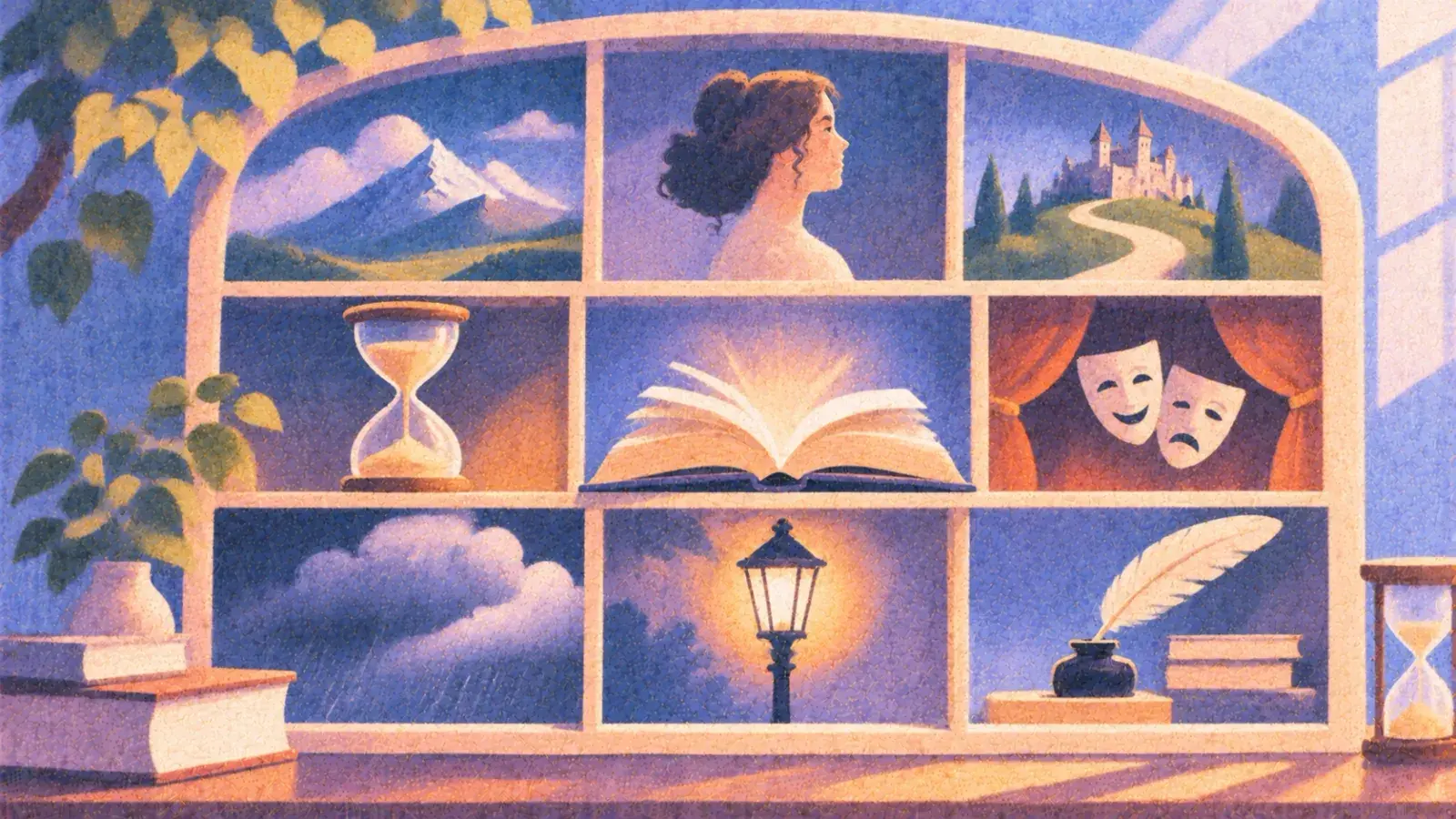
Literary elements are the basic parts every story, novel, play and narrative poem is built from, and the parts readers analyze: plot, character, setting, theme, point of view, conflict, tone, mood and style. Literary devices are something else: techniques such as metaphor, irony or foreshadowing that a writer uses in some passages and not in others. Every story has a setting. Not every story has a metaphor.
Below: the nine elements in one table, how elements differ from devices, each element with a public-domain example, where the list comes from, and how to write about elements in an essay. If you are building a story rather than reading one, the guide to the elements of a story turns the same list into a writer's checklist.
The 9 elements at a glance
| Element | What it is | Ask | Example below |
|---|---|---|---|
| ElementPlot | What it isThe events, linked by cause | AskWhat happens, and why? | Example below“The Red-Headed League” |
| ElementCharacter | What it isThe people the story follows | AskWho are they, and how do we know? | Example belowMr. Micawber |
| ElementSetting | What it isWhere and when, including the social world | AskWhat does the place do to the people? | Example belowEgdon Heath |
| ElementConflict | What it isThe struggle between opposing forces | AskWho or what is against whom? | Example belowThe Call of the Wild |
| ElementPoint of view | What it isWho tells the story, and how much they know | AskWhose eyes, and how close? | Example belowMoby-Dick |
| ElementTheme | What it isThe idea about life the work explores | AskWhat does the ending decide? | Example below“The Happy Prince” |
| ElementTone | What it isThe attitude of the writing toward its subject | AskHow does the voice feel about this? | Example belowHuckleberry Finn |
| ElementMood | What it isThe feeling the work creates in the reader | AskHow does it make me feel? | Example below“The Raven” |
| ElementStyle | What it isHow the sentences are built | AskWhat do the words and rhythms do? | Example belowA Tale of Two Cities |
Why these nine? Each is something every narrative has, and each answers a different question you can put to any story, which is the working test for an element. Five-item school lists (character, setting, plot, conflict, theme) leave out point of view and the three that govern how a story sounds and feels: tone, mood and style. Longer lists often add symbolism or imagery, which this page treats as devices, because a story can do without them.
Literary elements vs. literary devices
An element is a part every story has, whether the writer thought about it or not. A device is a tool the writer picks up for a particular effect. You can ask what the setting of any story is; you can only ask about the metaphors in a story that has some.
Literary elements
- Present in every story, play or narrative poem
- Answer what, who, where, why and how it feels
- Run through the whole work
- Plot, character, setting, theme, point of view, conflict, tone, mood, style
Literary devices
- Optional: used in some works or passages and not others
- Answer how a particular passage gets its effect
- Usually local: a line, a scene, a recurring image
- Metaphor, simile, irony, foreshadowing, symbolism, alliteration, flashback
One scene shows the split. Read it once for what it contains, then again for how the sentences deliver it.
The 7:40 bus was late again. Rosa counted the pigeons on the shelter roof, eleven, the same eleven as yesterday, and told herself the letter in her coat could wait one more day. Behind her the drinks machine hummed like someone trying not to cry.
What it contains: a setting (a stop where the bus is always late), a character (someone who counts pigeons instead of deciding), a conflict (the letter), a point of view (close third, inside Rosa: she “told herself”) and a mood. Those are elements. Any version of this scene would have them.
| Device in the scene | Element it serves |
|---|---|
| Device in the sceneRepetition: “again,” “the same eleven as yesterday” | Element it servesSetting: a wait that has become a routine |
| Device in the sceneForeshadowing: the letter “could wait one more day” | Element it servesConflict and plot: a decision she keeps putting off |
| Device in the sceneSimile: the machine “hummed like someone trying not to cry” | Element it servesMood: strained, unhappy waiting |
The two work together, because devices serve elements. Foreshadowing serves the plot, a recurring image or motif carries a theme, irony shapes tone, and imagery builds setting and mood. Lists differ, and you will see symbolism or imagery called elements in some of them. When you are unsure which you are looking at, ask whether a story could exist without it. A story without a setting is hard to imagine; a story without a simile is easy. For the devices themselves, start with foreshadowing examples and the glossary entry on rhetorical devices.
Each element, with an example
Every example comes from a public-domain work, so you can read the whole thing free.
Plot
A London pawnbroker, Jabez Wilson, is paid £4 a week by the Red-Headed League to copy out the Encyclopædia Britannica, away from his shop. One morning he finds a card on the locked office door:
THE RED-HEADED LEAGUE IS DISSOLVED. October 9, 1890.
Plot is not only what happens but why each event happens. The absurd job exists because Wilson's new assistant, who calls himself Vincent Spaulding, needs him out of the shop while he tunnels from the cellar toward a bank where French gold is stored. The notice means the tunnel is finished, which tells Holmes the robbery is close. The guide to what plot is covers its five stages and the chain of cause.
Character
Annual income twenty pounds, annual expenditure nineteen nineteen and six, result happiness. Annual income twenty pounds, annual expenditure twenty pounds ought and six, result misery.
Mr. Micawber gives the young David this advice just after his release from the King's Bench Prison, where he was held for debt, and just before he leaves London. The joke is the character: a man who knows exactly how to live within his means, never does, and waits “until something turns up.” Writers reveal character directly, by telling, and indirectly, through speech, action, appearance, thought and how others react. Micawber is almost all indirect. For building your own, see character development.
Setting
A Saturday afternoon in November was approaching the time of twilight, and the vast tract of unenclosed wild known as Egdon Heath embrowned itself moment by moment.
The sea changed, the fields changed, the rivers, the villages, and the people changed, yet Egdon remained.
Setting is where and when a story happens, and the social world that comes with it: class, customs, rules. Hardy gives the heath a whole opening chapter, titled “A Face on Which Time Makes but Little Impression.” A setting is working when the story couldn't happen anywhere else. Egdon outlasts the people who struggle against it, and that gives their struggles their scale.
Conflict
He was beaten (he knew that); but he was not broken.
They were savages, all of them, who knew no law but the law of club and fang.
Conflict is the struggle that drives a story: a character against another character, against society, against nature or against themselves. Buck, a dog stolen from a California estate and sold north to the Klondike, meets nearly all of them: men with clubs, the lead dog Spitz, whom he fights and kills, the cold and the trail, and at last a pull inside himself between the wild and his love for John Thornton, which “drew him back to the fire again.” Layered conflicts keep a plot moving when one of them is settled.
Point of view
Call me Ishmael. Some years ago—never mind how long precisely—having little or no money in my purse, and nothing particular to interest me on shore, I thought I would sail about a little and see the watery part of the world.
Point of view is who tells the story and how much they can know. Ishmael narrates in first person, but the story is Ahab's, and Ishmael tells it as a sailor who watched the captain's hunt from the deck. A witness narrator sees the hero from outside and can live to tell the story; Ishmael is the only man of the crew who does. The point of view guide shows one scene told every way.
Theme
A gilded statue of a prince asks a swallow to strip away his ruby, his sapphire eyes and his gold leaf and give them to the poor of the city. The swallow stays too long into winter and dies at his feet, and the prince's lead heart cracks. The town's leaders melt the shabby statue down; an art professor explains, “As he is no longer beautiful he is no longer useful.” Then God asks an angel to bring him “the two most precious things in the city,” and the angel brings the broken heart and the dead bird.
Theme is the idea about life a work explores, best put as a sentence: what a city prizes and what is precious can be opposites. Wilde never states it. He sets two judgments side by side, the professor's and God's, and the ending picks one. The guide to themes in literature lists 50 more.
Tone
Persons attempting to find a motive in this narrative will be prosecuted; persons attempting to find a moral in it will be banished; persons attempting to find a plot in it will be shot.
BY ORDER OF THE AUTHOR, PER G. G., CHIEF OF ORDNANCE.
Tone is the attitude the writing takes toward its subject and its reader: here mock-official and deadpan, a joke dressed as a military order. It warns readers off exactly what a literature class looks for, a motive, a moral and a plot, in a book with plenty of all three. Tone lives in word choice and sentence shape; see tone in literature for how it is built.
Mood
Once upon a midnight dreary, while I pondered, weak and weary,
Over many a quaint and curious volume of forgotten lore—
While I nodded, nearly napping, suddenly there came a tapping,
As of some one gently rapping, rapping at my chamber door.
Ah, distinctly I remember it was in the bleak December,
And each separate dying ember wrought its ghost upon the floor.
Mood is what the work makes the reader feel. Poe builds dread from the hour (midnight), the season (December), the light (a dying fire), the sound (rhymes inside the lines: dreary and weary, napping and tapping) and a knock nobody can explain yet. Tone belongs to the speaker, weary and grieving; mood belongs to the reader, uneasy and waiting. See mood in literature for more.
Style
It was the best of times, it was the worst of times, it was the age of wisdom, it was the age of foolishness, it was the epoch of belief, it was the epoch of incredulity, it was the season of Light, it was the season of Darkness, it was the spring of hope, it was the winter of despair, we had everything before us, we had nothing before us, we were all going direct to Heaven, we were all going direct the other way—in short, the period was so far like the present period, that some of its noisiest authorities insisted on its being received, for good or for evil, in the superlative degree of comparison only.
Style is how the writing is built: word choice, sentence length and shape, rhythm and figurative language. Dickens runs one sentence on paired opposites, clause after clause opening with the same words, then swerves into a dry joke about the age's noisiest voices, who would describe it only in superlatives. The style suits a novel built on pairs, two cities and two look-alike men. Its two main techniques have pages of their own: repetition and juxtaposition.
Where the list comes from
The oldest list is Aristotle's. In the Poetics, written in the fourth century BC, he divides tragedy into parts and ranks them.
Every Tragedy, therefore, must have six parts, which parts determine its quality—namely, Plot, Character, Diction, Thought, Spectacle, Song.
The Plot, then, is the first principle, and, as it were, the soul of a tragedy: Character holds the second place.
Plot and character survive unchanged. Diction, the wording, is close to what we call style, and Thought, the reasoning characters put into words, is the nearest Aristotle comes to theme. Spectacle and Song belonged to the stage. E. M. Forster's 1927 lectures, published as Aspects of the Novel, made a list for fiction: story, characters, plot, fantasy, prophecy, pattern and rhythm. The classroom list keeps the core of both and adds what matters in any narrative: where it happens, who tells it, what the characters struggle against, and how it feels.
How to write about elements
An essay about a novel is usually about how a few elements work together, not a tour of all nine.
- Start from a question
Pick something in the work that puzzled you: why the heath gets a whole chapter, why Twain opens with a threat. Your question decides which elements matter.
- Choose two elements that interact
Setting and mood, point of view and theme, conflict and character. The interesting claims are about the relationship.
- Collect evidence
Short quotations with the chapter or line, and a sentence on what each one shows.
- Connect it to the theme
Elements matter because of what they make the work say. End each paragraph on what the element adds to the meaning, and build your thesis statement from the answer.
Read your own draft by element
The list works on your own manuscript as well as on Hardy's. Draft first and analyze after. Then read a chapter for one element at a time: only the setting, only the point of view, only the tone. Problems that hide on a normal reread are easier to see when you look for one thing.
The Strokes Assistant can take the same pass with you: ask it about one element in a chapter, such as where the setting drops out for pages at a time or where the point of view slips.
Frequently asked questions
Is symbolism a literary element or a literary device?
Most lists treat symbolism as a device, because a story can exist without symbols and writers use them for specific effects. Some lists call it an element because symbols are so common. Either way, when you write about a symbol, connect it to the element it serves, which is usually the theme.
What is the difference between tone and mood?
Tone is the attitude of the writer or narrator toward the subject: ironic, mournful, playful. Mood is the feeling the work creates in the reader: dread, calm, suspense. They can match or differ, and a deadpan narrator telling a frightening story gives a calm tone and a tense mood. Ask how the voice sounds for tone, and how you feel for mood.
How many literary elements are there?
There is no fixed number. Aristotle named six parts of tragedy, E. M. Forster discussed seven aspects of the novel, and textbooks vary. This page uses nine, plot, character, setting, theme, point of view, conflict, tone, mood and style, because each is a part every narrative has and each answers a different question. Shorter lists usually stop at character, setting, plot, conflict and theme.