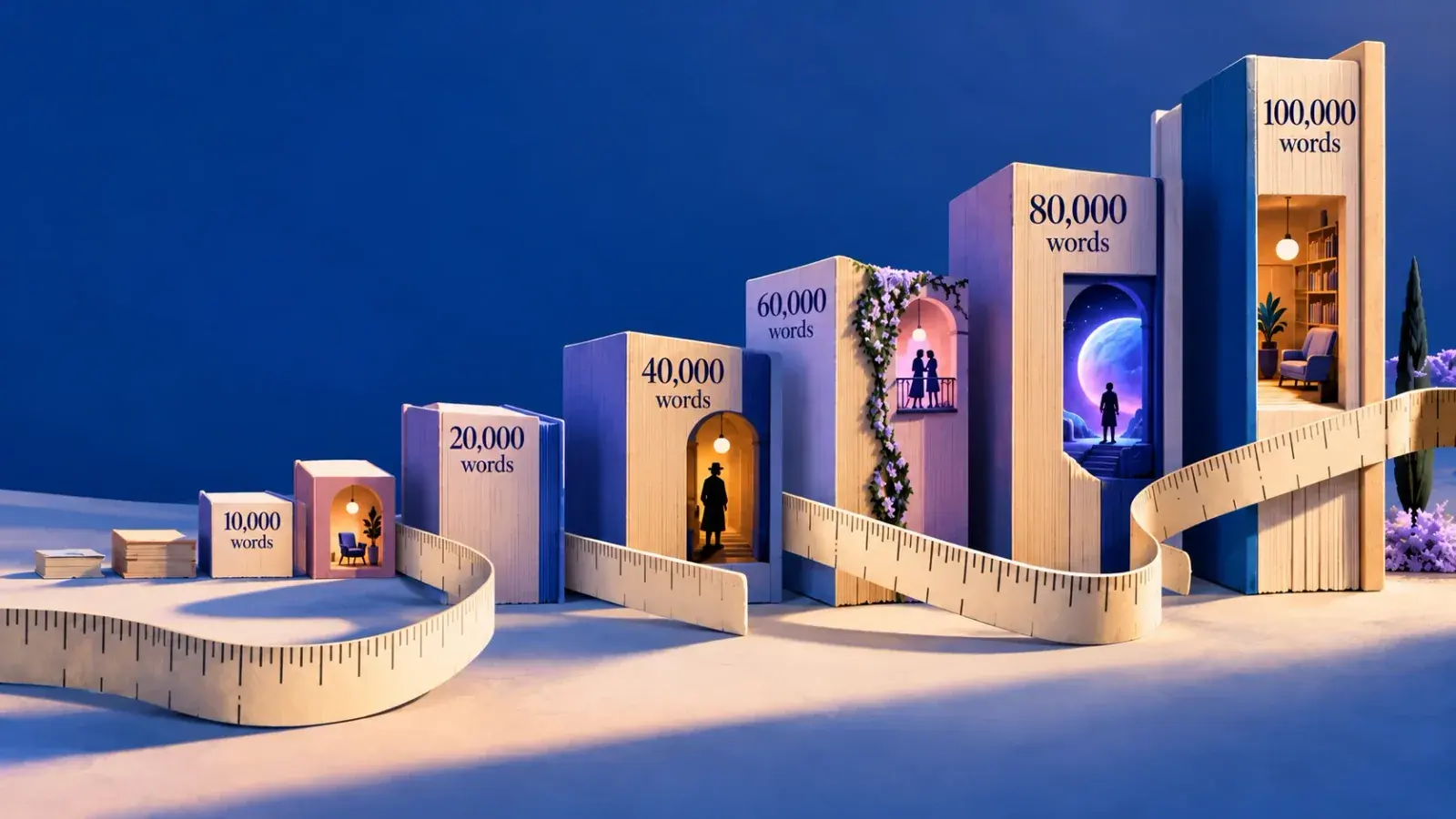
Most adult novels have between about 20 and 45 chapters, though anything from a dozen to more than a hundred is normal, and there is no standard number. How many chapters a book needs starts as arithmetic: divide its length by the length of a typical chapter. An 80,000-word novel with 3,000-word chapters has about 27; cut into the 1,500-word chapters many thrillers use, the same book has more than 50. The final count comes from the story: how many turns it needs, and where they fall.
Below are the chapter counts of 29 well-known books, as examples rather than targets, and a way to set your own count from your outline. For how long each chapter should run, see how long a chapter should be.
Chapter counts by genre
Two numbers give a starting estimate: the length your genre expects (see how many words is a novel) and the chapter length it tends to use (see how long a chapter should be). Divide the first by the second.
| Genre | Book (words) | Chapter (words) | Chapters |
|---|---|---|---|
| GenreThriller, mystery | Book (words)70,000–100,000 | Chapter (words)1,500–3,000 | ChaptersAbout 28–57, often more |
| GenreRomance | Book (words)70,000–100,000 | Chapter (words)2,000–3,500 | ChaptersAbout 24–43 |
| GenreLiterary fiction | Book (words)80,000–100,000 | Chapter (words)3,000–6,000 | ChaptersAbout 15–30 |
| GenreScience fiction | Book (words)90,000–120,000 | Chapter (words)2,500–4,500 | ChaptersAbout 23–42 |
| GenreEpic fantasy | Book (words)90,000–120,000+ | Chapter (words)4,000–8,000 | ChaptersAbout 13–26 |
| GenreYoung adult | Book (words)55,000–80,000 | Chapter (words)2,000–4,000 | ChaptersAbout 17–34 |
| GenreMiddle grade | Book (words)20,000–55,000 | Chapter (words)1,000–2,500 | ChaptersAbout 15–38 |
Real books wander outside these ranges all the time. A fantasy novel told through many viewpoints can have short chapters, and a literary novel can be built from a handful of long ones. Treat the range as a sanity check, not a target.
Chapters for any book length
If you know your length and roughly how long your chapters run, this table gives a starting estimate.
| Book (words) | 1,500-word chapters | 2,500 | 3,500 | 5,000 | 7,000 |
|---|---|---|---|---|---|
| Book (words)20,000 | 1,500-word chapters13 | 2,5008 | 3,5006 | 5,0004 | 7,0003 |
| Book (words)40,000 | 1,500-word chapters27 | 2,50016 | 3,50011 | 5,0008 | 7,0006 |
| Book (words)50,000 | 1,500-word chapters33 | 2,50020 | 3,50014 | 5,00010 | 7,0007 |
| Book (words)60,000 | 1,500-word chapters40 | 2,50024 | 3,50017 | 5,00012 | 7,0009 |
| Book (words)70,000 | 1,500-word chapters47 | 2,50028 | 3,50020 | 5,00014 | 7,00010 |
| Book (words)80,000 | 1,500-word chapters53 | 2,50032 | 3,50023 | 5,00016 | 7,00011 |
| Book (words)90,000 | 1,500-word chapters60 | 2,50036 | 3,50026 | 5,00018 | 7,00013 |
| Book (words)100,000 | 1,500-word chapters67 | 2,50040 | 3,50029 | 5,00020 | 7,00014 |
| Book (words)120,000 | 1,500-word chapters80 | 2,50048 | 3,50034 | 5,00024 | 7,00017 |
| Book (words)150,000 | 1,500-word chapters100 | 2,50060 | 3,50043 | 5,00030 | 7,00021 |
How many chapters real books have
These are observed counts, offered as examples: the chapters listed in each book's table of contents, taken from the Project Gutenberg texts for public-domain titles and from chapter-by-chapter study guides for recent ones. Where editions differ, the table says which one it counts.
| Book | Published | Chapters |
|---|---|---|
| BookAlice's Adventures in Wonderland | Published1865 | Chapters12 |
| BookThe Lion, the Witch and the Wardrobe | Published1950 | Chapters17 |
| BookCharlotte's Web | Published1952 | Chapters22 |
| BookHarry Potter and the Philosopher's Stone | Published1997 | Chapters17 |
| BookHoles | Published1998 | Chapters50, in three parts (the third is one chapter) |
| BookThe Outsiders | Published1967 | Chapters12 |
| BookHarry Potter and the Order of the Phoenix | Published2003 | Chapters38 |
| BookThe Hunger Games | Published2008 | Chapters27 |
| BookDon Quixote | Published1605, 1615 | Chapters126: 52 in Part One, 74 in Part Two |
| BookThe Count of Monte Cristo | Published1844–46 | Chapters117 |
| BookA Tale of Two Cities | Published1859 | Chapters45, in three books |
| BookLittle Women | Published1868–69 | Chapters47, in two parts, numbered straight through in the Project Gutenberg text |
| BookMiddlemarch | Published1871–72 | Chapters86, in eight books, plus a prelude and a finale |
| BookThe Picture of Dorian Gray | Published1891 | Chapters20 (13 in the 1890 magazine version) |
| BookThe Hound of the Baskervilles | Published1902 | Chapters15 |
| BookOf Mice and Men | Published1937 | Chapters6 sections |
| BookThe Hobbit | Published1937 | Chapters19 |
| BookNineteen Eighty-Four | Published1949 | Chapters24, in three parts, plus an appendix |
| BookThe Catcher in the Rye | Published1951 | Chapters26 |
| BookThe Fellowship of the Ring | Published1954 | Chapters22, in two books, after a prologue |
| BookTo Kill a Mockingbird | Published1960 | Chapters31 |
| BookA Game of Thrones | Published1996 | Chapters72 after a prologue, each titled with its viewpoint character's name |
| BookThe Da Vinci Code | Published2003 | Chapters105, between a prologue and an epilogue |
| BookNarrative of the Life of Frederick Douglass | Published1845 | Chapters11, plus an appendix |
| BookWalden | Published1854 | Chapters18 |
| BookUp from Slavery | Published1901 | Chapters17 |
| BookThe Souls of Black Folk | Published1903 | Chapters14, between a forethought and an afterthought |
| BookSilent Spring | Published1962 | Chapters17 |
| BookThinking, Fast and Slow | Published2011 | Chapters38, in five parts |
Three things stand out. Within one kind of book the spread is wide: To Kill a Mockingbird has 31 chapters, Of Mice and Men six sections. A series can change its rhythm as the books grow, and the Harry Potter novels went from 17 chapters in the first to 38 in the fifth. And revision changes the count. When Oscar Wilde turned the 1890 magazine version of The Picture of Dorian Gray into the 1891 book, he added six new chapters and split the last one in two, taking it from 13 to 20.
Children's books and nonfiction
Age changes the arithmetic. Picture books, read aloud in one sitting, usually have no chapters at all. Chapter books for newly independent readers use short chapters a child can finish in one go. The children's novels in the table run from 12 to 22 chapters, with Holes the outlier at 50, and young adult novels track adult fiction.
Nonfiction chapters are organized by topic, and each one tends to develop a single argument at length, so counts run lower. The nonfiction books in the table have 11 to 18 chapters, with Thinking, Fast and Slow (38, in five parts) the exception. Nonfiction is often sold on a proposal with a chapter-by-chapter outline, so the count may be settled before the book is written; see how to write a book proposal.
How to decide your chapter count
- Fix a target length
Start from the range for your genre and audience. A debut thriller at 85,000 words is a safer plan than one at 140,000.
- Choose a chapter length for the pace you want
Short chapters read fast and suit plot-driven books. Long ones let a reader settle into a place or a mind. Your genre's habits are a starting point, not a rule.
- Divide for a starting number
85,000 words in 2,500-word chapters is 34 chapters. Write the number down and treat it as a guess.
- Count the turns in your outline
Most chapters earn their place with at least one change: something learned, decided, won or lost. List the turns your story needs, one line each. That list is a better guide to the count than the arithmetic. A chapter outline template gives each chapter a row, and the guide to outlining a novel covers the methods above that level.
- Fit the count to the structure
In the three-act structure, roughly a quarter of the chapters go to act one, half to act two and a quarter to act three, with the midpoint near the middle chapter. Two narrators who alternate want a pattern the reader can learn, such as strict turns or a rotation.
- Recount after the draft
The finished draft's count is the real one. Consider splitting a long chapter that holds two turns and merging chapters that hold none, then let the number land where it lands.
If the draft is a Strokes project, you can ask the Strokes Assistant to review it and list the chapters where nothing changes and the chapters that hold two turns.
Length. 90,000 words, mid-range for a thriller. At about 2,000 words a chapter, that suggests 45 chapters.
Outline. The plan has 46 turns, so 46 chapters: 11 in act one, 23 in act two, 12 in act three.
Viewpoint. Claire narrates the odd chapters and Owen the even ones, 23 each. With strict turns, every turning point lands in whoever's chapter it falls in, so the writer decides who should live each turn and places it to match:
- Chapter 3, Claire: the inciting incident.
- Chapter 11, Claire: the end of act one, when she decides to go on alone.
- Chapter 24, Owen: the midpoint reveal. It has to be his discovery, so it takes the even chapter just past the middle.
- Chapter 34, Owen: the low point, the last chapter of act two.
- Chapter 45, Claire: the climax, with Owen's chapter 46 as the aftermath.
After the draft. Chapter 30, one of Owen's, runs 5,200 words and holds two turns. Splitting it would put two Owen chapters back to back and push every later chapter out of its narrator's slot, so the second turn moves to the opening of Claire's chapter 31, seen from her side. The count stays at 46.
The arithmetic gave a first guess, the outline gave the count, and the viewpoint pattern decided where each turn could fall.
Parts, prologues and epilogues
Chapter numbers usually count only the chapters. A prologue and an epilogue sit outside the numbering, as in The Da Vinci Code. Parts group chapters into larger movements: Little Women has two, Nineteen Eighty-Four three and Middlemarch eight. Some books number chapters straight through the parts, so Little Women runs from 1 to 47. Others start again in each part: Nineteen Eighty-Four's second part begins at Chapter 1, and so does Book Two of The Fellowship of the Ring.
More chapters or fewer?
When the arithmetic and the outline disagree, these are the usual reasons to lean one way or the other.
More, shorter chapters
- The book is plot-driven and should feel fast.
- Several viewpoints alternate and each needs regular time.
- Readers are young, or read in short sessions.
- Each chapter can end on a real turn.
Fewer, longer chapters
- The pleasure is immersion in a place or a mind.
- Chapters braid several threads together.
- The story unfolds in large movements rather than quick beats.
- Your short chapters keep ending on the same note.
Frequently asked questions
How many chapters is a 300-page book?
A printed page holds roughly 250 to 350 words, so a 300-page book runs about 75,000 to 105,000 words. With 3,000-word chapters that is 25 to 35 chapters; with 2,000-word chapters, 38 to 53. Count words, not pages, since page counts change with trim size and type.
Is 50 chapters too many for a novel?
No. Fifty chapters in an 80,000-word novel means chapters of about 1,600 words, which is common in thrillers and fast commercial fiction. Holes has 50 chapters and The Da Vinci Code 105. A high count becomes a problem mainly when chapters stop ending on a change.
Do the prologue and epilogue count as chapters?
Usually not. Most books leave them out of the chapter numbering: The Da Vinci Code has a prologue, 105 numbered chapters and an epilogue. When you describe a manuscript to an agent, give the total word count, which includes them, rather than a chapter count.