Dissertation acknowledgments are a short section in the front matter where you thank the people and organizations that made the work possible: your advisor and committee, your funders, the people who gave you data or access, colleagues, friends and family. The section is usually optional and nobody grades it, but it is the page the people you know will open first.
A note on spelling: acknowledgments is the usual American form and acknowledgements is chiefly British. Both are correct. Use the one your graduate school’s template uses (the University of North Carolina’s thesis guide, for one, writes Acknowledgements) and keep it the same throughout. Below are eleven original examples, grouped from formal to personal to the harder cases, then a method for writing your own.
What to include, and in what order
There is no required order, but most acknowledgments follow the same arc: from the people who shaped the research to the people who kept you going. Within each group, go from the most central person to the least. Readers skim for their own names, so a predictable order helps.
| Group | Who | What to say about them |
|---|---|---|
| Group1. Advisor | WhoSupervisor, co-advisor, former advisor | What to say about themWhat they taught you or made possible, in one concrete detail |
| Group2. Committee | WhoMembers and outside readers | What to say about themA specific contribution: a question, a method, a chapter |
| Group3. Funding | WhoGrants, fellowships, travel awards | What to say about themThe funder’s required wording, with award numbers |
| Group4. Access and help | WhoArchives, labs, field sites, technicians, participants | What to say about themWhat they gave: data, equipment, time, trust |
| Group5. Colleagues | WhoLab mates, cohort, writing group, co-authors | What to say about themShared work and what it changed |
| Group6. Personal | WhoFriends, partner, family, sometimes a pet | What to say about themAs warm as you like, as long as it is true |
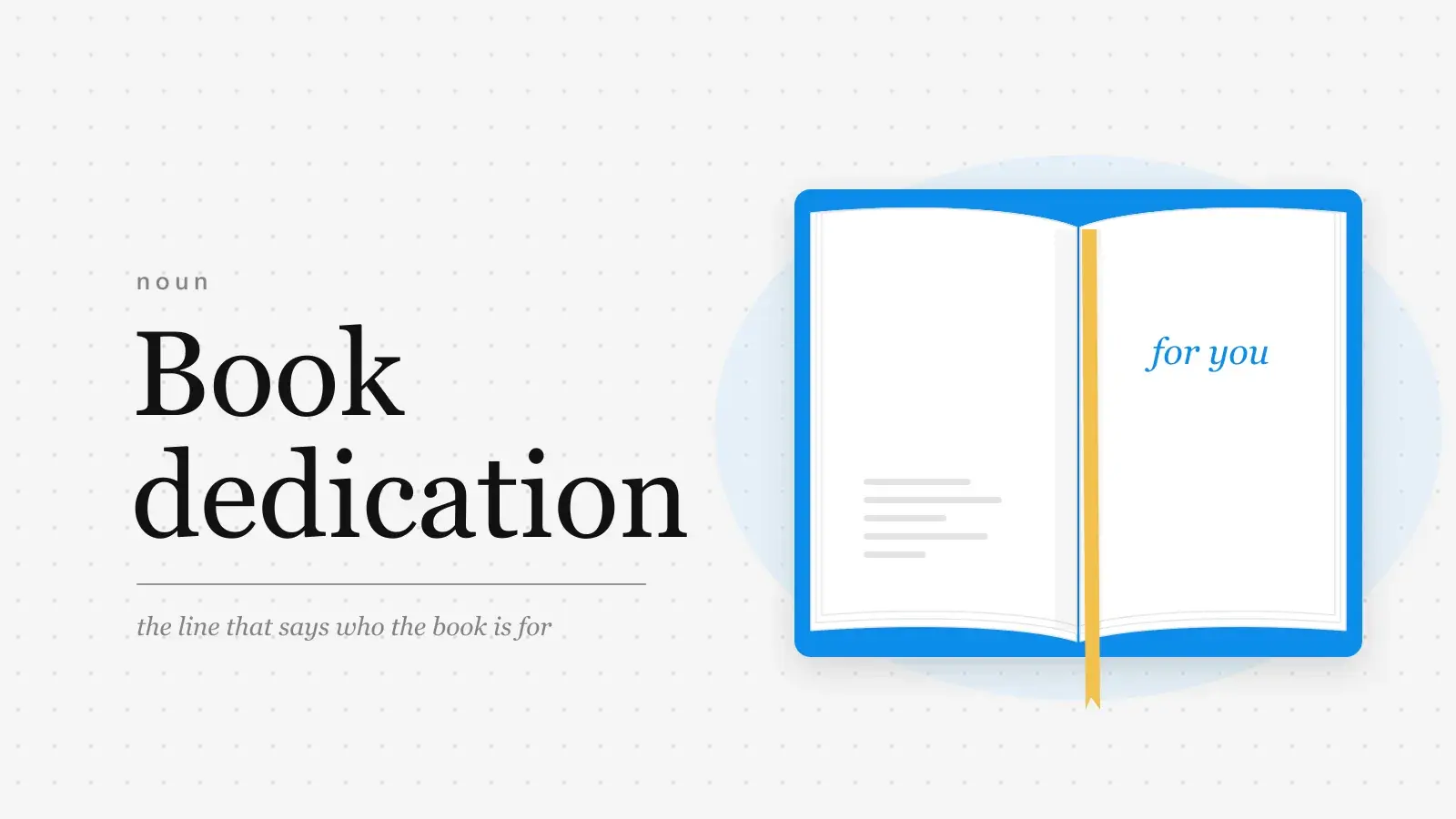
Acknowledgments are not the same as a dedication. A dedication is one line on its own page offering the work to someone; acknowledgments thank many people in prose. Many dissertations have both, and some add an epigraph. If a person matters more than a paragraph can hold, the dedication is the place for them.
Formal or personal: choosing a tone
The same thanks can be written three ways. None is wrong; they suit different fields, committees and people.
| Tone | Thanking the same advisor |
|---|---|
| ToneFormal | Thanking the same advisorI thank my advisor, Professor Ruth Adler, for her guidance and for her rigor at every stage of this project. |
| ToneWarm | Thanking the same advisorRuth Adler read every chapter of this dissertation at least three times and returned each one within a week, with comments sharper than the draft deserved. |
| TonePersonal | Thanking the same advisorRuth, in my first semester you told me the project was too big. You were right, and then you helped me make it smaller. Thank you. |
To find your department’s norm, open five recent dissertations from it in your university’s repository and read only the acknowledgments. It takes ten minutes and tells you more than any rule. A common and safe pattern is formal or warm for the professional paragraphs and personal for the last one.
Formal acknowledgment examples
A science PhD with grant funding
I thank my advisor, Professor Daniel Okafor, for taking me into his group in my second year, after my first project stalled, and for the standard he set for every figure in this dissertation. Professors Mei Lin Zhou and Ricardo Alves served on my committee; their questions at my qualifying exam became the second half of Chapter 4.
Dr. Hannah Brandt trained me on the flow reactor and kept it running through two building floods. Priya Raman and Tomás Ibáñez are co-authors of the work in Chapters 3 and 5, and the rest of the Okafor group answered more of my questions than I can count.
This material is based upon work supported by the National Science Foundation under Award No. [award number]. Additional support came from the department’s [fellowship name] Fellowship.
Finally, thank you to my parents, Grace and Femi Adeyemi, and to my partner, Sam, who listened to five years of dinner conversation about catalysts.
Why it works. Every person gets a verb and a detail, and the order runs from advisor to committee to lab to funder to family. The funding sentence is the funder’s, not a paraphrase. The family gets one line, which is all a formal page needs.
A short, formal paragraph
I am grateful to my advisor, Laura Feldman, and to my committee members, Arun Mehta and Grace Oduya, for their guidance and for their candor about the second chapter. I thank participants in the department’s labor economics workshop for comments on Chapters 1 and 2, and the state Department of Revenue for access to restricted tax records. Financial support from the [fellowship name] is gratefully acknowledged. All errors are my own.
In fields where the page is customarily short, a single paragraph is complete. “All errors are my own” is a fixture of economics papers; leave it out where it is not the norm.
A master’s thesis
I thank my supervisor, Dr. Fatima Noor, for her careful reading and her quick replies, and my second reader, Dr. Paul Grady, for his comments on the survey design. The staff of the graduate writing center helped me restructure Chapter 2. Thanks also to my classmates in the 2026 cohort for two years of shared deadlines, and to my sister, Leila, who read the final draft aloud with me to find the typos.
A note on co-authored chapters
Chapter 2 is a revised version of an article published in [journal] in 2025 with Ana Ruiz and Kenji Watanabe. I designed the study, ran the field trials and wrote the first draft; Ana Ruiz built the sampling frame and Kenji Watanabe advised on the analysis. Chapter 4 was written with my advisor, Mark Levin, who developed the model in Section 4.2. Both co-authors agreed to the use of this material here.
Published or co-written chapters have to be credited somewhere. UC Berkeley’s guidelines list a note in the acknowledgments as one acceptable way; other schools want a separate statement.
Personal acknowledgment examples
A humanities PhD built on an archive
This dissertation began in a box. In 2021 Teresa Novak, then the only archivist at the county historical society, handed me a carton of unprocessed mill payrolls and said no one had opened it in fifty years. Most of Chapter 3 came out of that carton.
My advisor, Robert Asante, let me follow the box even when it led away from my prospectus. On my committee, Margaret Lee taught me to write a paragraph that ends somewhere. Juno, Felipe and Rachel read my drafts at 8 a.m. on Fridays for three years and never once let a vague sentence go.
And Dad, who drove me to the archive on the weekends my car would not start: you have now read more about textile wages than any retired plumber should. Thank you.
Why it works. It opens with a scene instead of a thank-you, and every thank-you is attached to something that happened. The direct address to a parent at the end is common in personal pages and lands because the rest has earned it.
A part-time doctorate
I wrote most of this dissertation between 5 and 7 a.m., before my children woke up and before first period. My principal, Denise Carver, rearranged my schedule so I could collect data, and my colleagues in the English department covered my lunch duty for an entire semester. My advisor, Dr. Luis Ortega, held our meetings at 8 p.m. without ever making it sound like a favor.
Marcus did bedtime alone two nights a week for four years. Ava and Leo: yes, it is finished, and yes, we can go to the beach now.
A first-generation student
My parents, Rosa and Javier Morales, left school after the sixth grade. They did not always know what I was studying, and they never asked when I would be done. They asked whether I had eaten. I would not have started a doctorate without their example of work, or finished one without their patience. Este trabajo también es suyo.
A line in a family language is common and needs no apology. Add a translation in a note if your committee or school expects one.
A lighter touch
Thanks also to the night staff of the science library, who never asked why I was there at 1 a.m.; to the Route 14 bus, which was late only when I was; and to Pickle, a cat with no interest in phylogenetics, who sat on every chapter of this dissertation, some of them in print.
Humor works best in the last paragraph and in small doses. One joke reads as you; five read as a stand-up set, and inside jokes read as nothing to anyone outside them.
Examples for harder situations
A loss during the degree
My grandmother, Esther Kowalski, died in the spring of my fourth year, two weeks before my prospectus defense. She kept a folder of everything I published, including a conference abstract she could not have followed and was proud of anyway. I wish she could have added this to it.
One concrete memory says more than a paragraph about grief. If the loss shaped the whole work, consider the dedication page instead.
A change of advisor
I began this project under Dr. Alan Reyes, who helped shape its first research questions before he left the university in 2023. I thank Dr. Simone Achebe for taking on a student halfway through, reading two years of work in a month and helping me finish it.
If a relationship was difficult, thank the person for something true and specific, keep it to a sentence, and stop. Acknowledgments are permanent and public; they are not the place to settle anything, and leaving out an advisor altogether is louder than a short, neutral line.
Research participants
This study exists because twenty-three nurses gave up their breaks, and sometimes their days off, to talk to me about night shifts. I promised not to name them, and I could not have written a page of it without them. Thanks also to the two unit managers who let me post a flyer and then stayed out of the way.
Thank participants as a group. If naming a hospital, school or town would let someone work out who took part, leave it out, and follow whatever your ethics approval says about identifying sites.
Swap stock phrases for specifics
Most weak acknowledgments are built from the same handful of phrases. Each one can be replaced with a fact only you know.
| Stock phrase | Write this instead |
|---|---|
| Stock phrase“I would like to express my deepest gratitude to…” | Write this instead“I thank…”, or start with what they did |
| Stock phrase“…without whom this would not have been possible” | Write this insteadName what would not have happened: “…who found the money for my final year” |
| Stock phrase“…for their unwavering support” | Write this insteadOne real instance: “…for driving me to the archive twice” |
| Stock phrase“This journey has been…” | Write this insteadCut it and begin with the first person you are thanking |
| Stock phrase“Last but not least…” | Write this insteadJust start the paragraph |
| Stock phrase“…for everything” | Write this insteadPick the one thing that mattered most |
How to write your acknowledgments
- Check your graduate school’s rules
Look up whether the section is optional, where it goes, how the pages are numbered and how it is spaced. Schools differ more than you would expect, as the table below shows. Your school’s thesis guide or template is the authority, not this page.
- Build the list before you write a word
Go through your CV, your funding letters, the methods chapter (who gave you access, equipment or data), your conference travel and your email folders. Ask your advisor whether anyone in the department expects a mention. The week before submission is when people get forgotten.
- Write the professional paragraphs
Advisor, committee, funders, institutions, colleagues, in that order. Give each person one detail. Paste the funding sentences from your award terms and fill in the award numbers.
- Write the personal paragraph
End with the people outside the work. Write it the way you would say it to them, then cut anything you would not want a stranger to read in twenty years.
- Check names and ask permission
Confirm the spelling, titles and accents of every name, and ask before naming anyone outside the academic chain. The University of British Columbia’s guide gives the reason plainly: once the thesis is deposited in the library’s repository, the text cannot change.
- Read it as a stranger will
MIT warns its students that theses in its repository are crawled and indexed by search engines, and many university repositories work the same way. Read the page as an employer, a future student or the person you thanked would. Remove health details, grievances and jokes that need context.
| School | Where it goes | Worth knowing |
|---|---|---|
| SchoolUNC-Chapel Hill | Where it goesAfter the abstract, before the table of contents | Worth knowingOptional; grouped with dedication and preface |
| SchoolMIT | Where it goesAfter the abstract | Worth knowingOptional; single-spaced; the whole thesis is numbered from the title page |
| SchoolUC Berkeley | Where it goesAfter the abstract, among other optional pages in any order | Worth knowingFront matter in lowercase Roman numerals |
| SchoolUBC (Canada) | Where it goesAfter the lists of tables and figures; the dedication follows | Worth knowingOptional; text cannot change after deposit |
On length, the guides above say nothing. A page is typical; past two, even the people you thanked start skimming.
The acknowledgments are usually the last thing written and the first thing read. For the rest of the front matter and where each part sits, see the dissertation outline template; for the work itself, the guide to writing a dissertation stage by stage.
Drafting acknowledgments in Strokes
The easiest acknowledgments to write are the ones you started in year one. In Strokes, a desktop editor that keeps documents as files on your computer, you can keep a running “thanks” document in the same project as your chapters and add a line whenever someone lends you a dataset or reads a draft. When the time comes, ask the AI Assistant to flag stock phrases or check that the funding paragraph matches the award terms you added to the chat. It cannot know who helped you, so the names and the details stay yours. Version history keeps each draft, and the finished page exports to Word or PDF for your school’s template.
Frequently asked questions
How long should dissertation acknowledgments be?
Most graduate schools set no length. One page is typical and two is a sensible maximum. A master’s thesis often needs only a paragraph. Check your school’s guide in case it does set a limit.
Who should I thank first in my acknowledgments?
Usually your advisor, then your committee, funders, institutions and colleagues, with friends and family last. Some writers put family first. Either works if the order is deliberate and the professional thanks are specific.
Can acknowledgments be informal or funny?
Yes, within limits. Personal and lightly humorous acknowledgments are common, especially in the final paragraph. Keep the professional thanks clear, avoid inside jokes, and remember the page is public and permanent.
Should I write acknowledgments in the first person?
Yes. Acknowledgments are written as “I,” even in fields that avoid the first person in the main text. Address people directly (“Ruth, thank you”) only in a personal paragraph.
Is it acknowledgments or acknowledgements?
Both are correct. Acknowledgments is the usual American spelling and acknowledgements is chiefly British. Follow your graduate school’s template and use the same spelling in the heading and the table of contents.