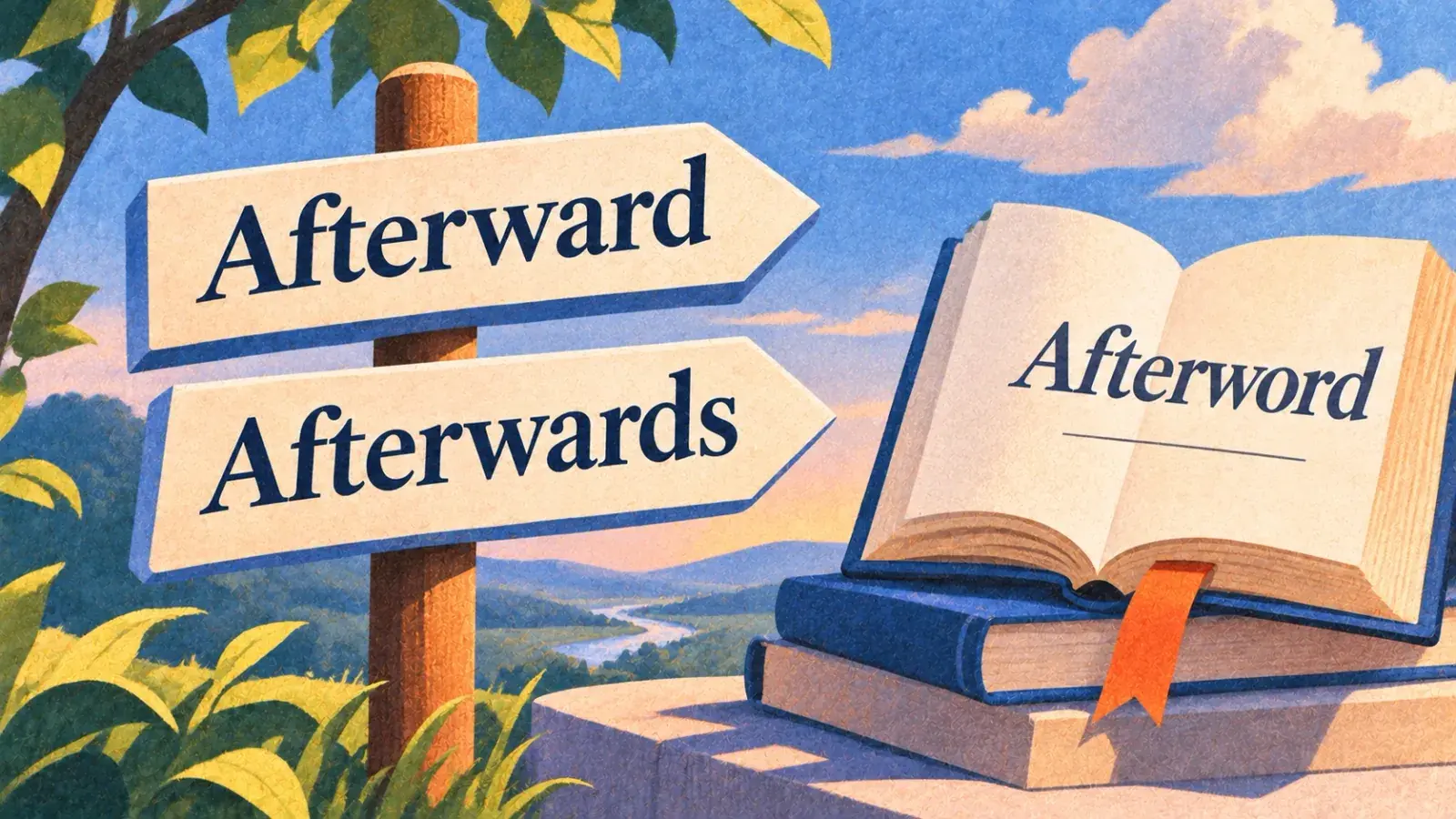
We spoke afterward. The author wrote an afterword. The first uses an adverb meaning later; the second uses a noun, the closing section of a book in which the author or someone else comments on the work. Afterward and afterwards are the same adverb: afterward is the usual form in American English, afterwards in British English. Afterword, with an o, is only ever the book part. The memory trick: an afterword is made of words, while afterward points in a direction, the way toward and backward do.
So an American writes we went for a walk afterward, a British writer we went for a walk afterwards, and either of them might add that the anniversary edition has a new afterword by the author. The first half of this page covers the adverb. The second covers the book part: what an afterword is, how it differs from an epilogue and, briefly, what goes in one.
Afterward, afterwards and afterword compared
| Word | Part of speech | Meaning | Where | Example |
|---|---|---|---|---|
| Wordafterward | Part of speechAdverb | MeaningLater; after that | WhereUsual in American English | ExampleWe talked about it afterward. |
| Wordafterwards | Part of speechAdverb | MeaningLater; after that | WhereUsual in British English | ExampleWe talked about it afterwards. |
| Wordafterword | Part of speechNoun | MeaningA closing section of a book | WhereEverywhere | ExampleThe afterword explains how the novel began. |
Afterward or afterwards: US and UK
Both spellings are correct, and both mean “at a later time.” Merriam-Webster enters the word as afterward or afterwards, with afterward first. The Oxford Learner's Dictionaries enter it as afterwards, marked “especially British English,” and add that North American English usually says afterward. The rule that follows:
- American English: afterward. Afterwards is listed in American dictionaries, so it isn't an error, but afterward is the usual form.
- British English: afterwards. Afterward is understood everywhere but reads as American.
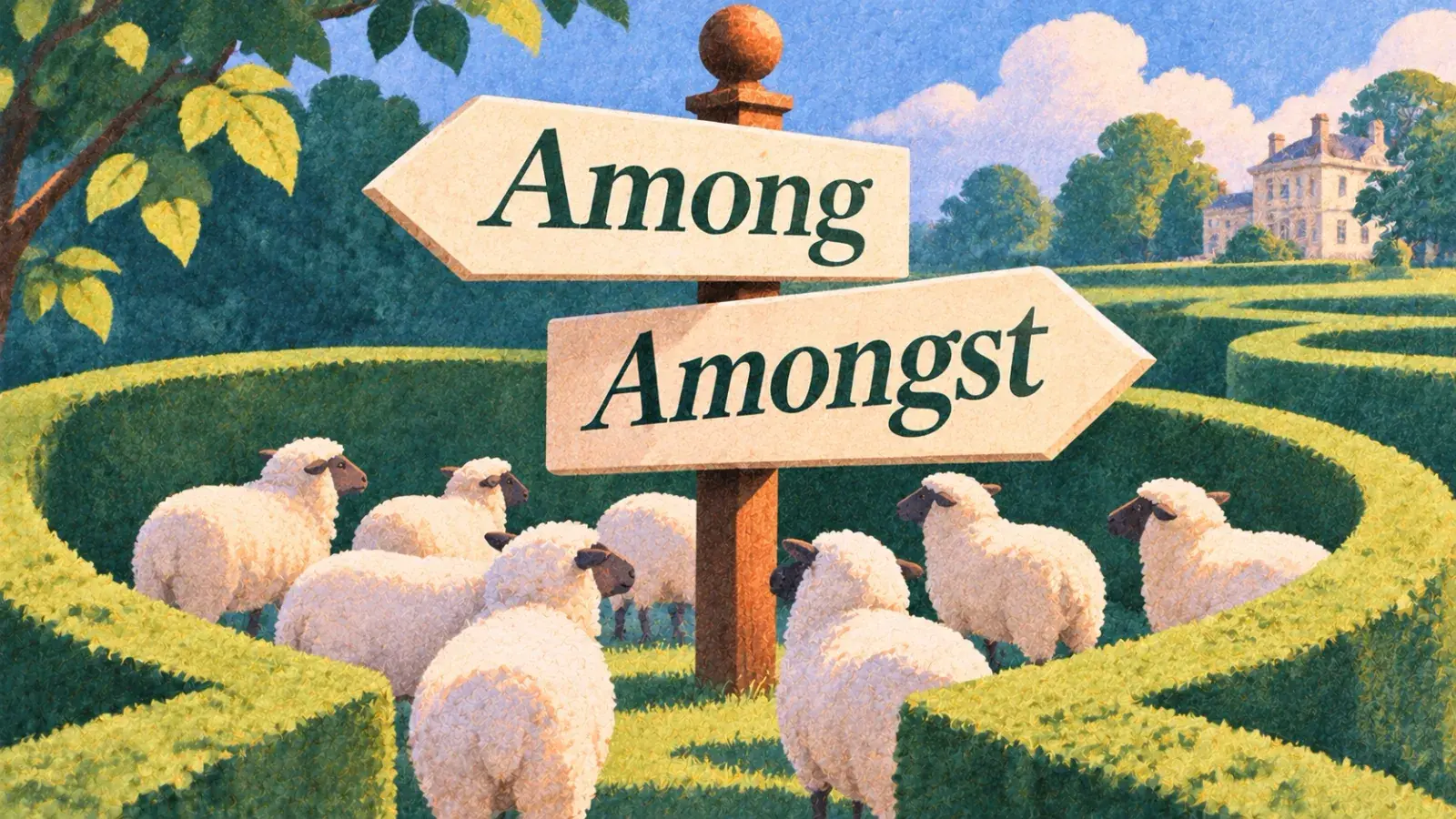
The word goes back to the Old English æfterweard, which ends in the direction suffix that became -ward. The -s of afterwards is the adverbial genitive, an old adverb ending that also gave amongst its medieval form, amonges.
The same split runs through the -ward family. The Oxford Learner's Dictionaries give towards with toward as the form used especially in North America, and backwards with backward as the North American adverb.
An invitation to dinner was soon afterwards despatched; and already had Mrs. Bennet planned the courses that were to do credit to her housekeeping, when an answer arrived which deferred it all.
He said he meant to look to it that Tom should be admitted to the National Military Academy and afterward trained in the best law school in the country…
Austen writes soon afterwards; Twain, six decades later and an ocean away, writes afterward.
What an afterword is
An afterword is a closing section that comments on a book from outside it. Merriam-Webster defines it as “a concluding section that rounds out the design of a literary work” and dates the word to 1890. It is the back-of-the-book counterpart of the front matter that introduces a book: a foreword or a preface. Like a preface, it can be written by the author. Like a foreword, it can be written by someone else: a scholar, a translator, an editor, a writer who loved the book, or a relative introducing a posthumous edition.
Afterwords usually do one of four jobs:
- Look back: the author returns years later, often for an anniversary edition, and says what changed.
- Separate fact from invention in historical or autobiographical fiction, overlapping with an author's note.
- Give context: in a reissued classic or a translation, someone else explains the book's history or the translator's choices.
- Answer the reader's question: was it real, and what happened next?
The word dates from 1890, but the section is older. Nineteenth-century novelists wrote afterwords under other names.
On Friday the Ninth of June in the present year, Mr and Mrs Boffin (in their manuscript dress of receiving Mr and Mrs Lammle at breakfast) were on the South Eastern Railway with me, in a terribly destructive accident.
Dickens uses his postscript for two classic afterword jobs. First he answers readers who assumed he was hiding the novel's central secret, when he had meant them to suspect it. Then he tells them that part of the manuscript was with him in a terrible rail accident, and closes by saying he will never come nearer to parting with his readers “until there shall be written against my life, the two words with which I have this day closed this book:—THE END.”
So endeth this chronicle. It being strictly a history of a boy, it must stop here; the story could not go much further without becoming the history of a man.
Twain's two short paragraphs explain why the book ends where it does and hint that he may return to the younger characters some day. He did, in Adventures of Huckleberry Finn.
Afterword, epilogue or author's note?
The test is whether the section belongs to the story or talks about it.
| Section | Inside the story? | Usually written by | What it does |
|---|---|---|---|
| SectionEpilogue | Inside the story?Yes | Usually written byThe author, in the story's voice | What it doesShows what happened later to the characters or the world |
| SectionAfterword | Inside the story?No | Usually written byThe author or someone else | What it doesComments on the book: its origins, context, reception or truth |
| SectionAuthor's note | Inside the story?No | Usually written byThe author | What it doesSays what is true, what was changed and why; front or back |
An afterword usually comes straight after the last chapter or the epilogue, at the end of the main text and before back matter such as appendixes and notes. The parts of a book guide gives the full order, and the glossary entry on prologue vs epilogue covers the story-side sections.
Writing an afterword: the short version
- Make sure the book needs one
Good reasons: a new edition, real events or people behind the book, or a question readers keep asking. A weaker reason: explaining an ending the book itself hasn't made clear. If the ending needs an explanation, look at the ending first.
- Start outside the story
The first line should make it plain that the author is speaking now, not the narrator. A date, a place or a direct “when I wrote this book” does it.
- Say what only an afterword can
What was real, what happened afterward, what the book got wrong, what changed since it came out. Material the reader needs before chapter one belongs in an introduction instead.
- Keep it short, then sign and date it
Readers arrive having just finished the book, so a few pages is usually plenty. Head it Afterword, or Afterword to the Tenth-Anniversary Edition, and end with your name, place and date when the timing matters.
When The Ferry at Kessel Point came out in 2016, the ferry was still running. Readers wrote to ask whether the crossing in chapter nine was real and whether there had been a deckhand named Ilse. The crossing was real; I took it every Friday for a year. Ilse was three people, two of whom have asked me not to say so.
The ferry stopped in 2021, after the bridge opened. I have changed nothing in the text for this edition, though I was tempted to give Ilse a warmer coat. What I can add is what the book couldn't know: that the landing stage is a car park now, and that on the last crossing the passengers stood on deck in the rain and nobody went inside.
M. R. Halloran, Kessel Point, March 2026
It steps outside the story at once, answers the questions readers asked, reports what changed and leaves the ending alone. The signature and date tell the reader when “now” is.
An afterword is often written years after the rest of the book, which is when details drift: a year that doesn't match chapter four, a name spelled the old way. With the afterword in the same project as the chapters, ask the Strokes Assistant to review the project for places where the afterword and the chapters disagree.
Examples in sentences
American English, afterward:
- We had dinner at the hotel and drove home afterward.
- Shortly afterward, the second printing sold out.
- Write the scene first and check the details afterward.
British English, afterwards:
- Soon afterwards, the paper changed its name.
- Only afterwards did she realise how close she'd come.
- The interviews are recorded now and transcribed afterwards.
The noun, afterword:
- The afterword reveals that the diary turned up at a flea market in Lyon.
- Her translator's afterword explains why she kept the Portuguese place names.
- In the afterword, he admits that the trial in chapter six never happened.
Both in one sentence:
- Afterward, she wrote an afterword explaining what had changed.
- I read the afterword afterwards, which spoiled nothing.
Common afterword and afterward mistakes
In the afterward, the author explains the real trial.→ In the afterword (the noun, a part of the book)Afterword, we drove to the coast.→ Afterward (or afterwards)The book has a forward and an afterward.→ a foreword and an afterword: both book parts end in -wordWe met after words at the café.→ afterward. “After words were exchanged” is fine; it means something else.- Afterward on page 2 and afterwards on page 90 → choose one and note it on your style sheet
Quick quiz: afterward, afterwards or afterword?
- (US) We'll grab dinner ____.
- The new edition includes an ____ by the translator.
- (UK) Shortly ____, the band split up.
- The ____ explains which events really happened.
- (US) She regretted the email almost immediately ____.
- A book can open with a foreword and close with an ____.
- (UK) Only ____ did we see the damage.
- Read the ____ last; it discusses the ending.
- afterward: the adverb, American English
- afterword: a part of the book
- afterwards: the adverb, British English
- afterword: a part of the book
- afterward: the adverb, American English
- afterword: the closing counterpart of a foreword
- afterwards: the adverb, British English
- afterword: a part of the book
Frequently asked questions
Is afterwards wrong in American English?
No. Merriam-Webster enters the word as afterward or afterwards, which marks the two as equal variants, so afterwards is not an error in the US. Afterward is the usual American form, and the Oxford Learner's Dictionaries note that North American English usually says afterward. An American house style may still prefer afterward, so check it, and use one form throughout a document.
What is the difference between an afterword and an epilogue?
An epilogue is part of the story. It is told in the book's own voice and usually shows what happened to the characters later. An afterword is about the story, written from outside it by the author or another writer. If skipping the section would cost the reader part of the plot, it is an epilogue.
Who writes the afterword of a book?
Either the author or someone else. Authors often write afterwords for anniversary editions or to separate fact from fiction. Scholars, translators, editors and other writers write them for reissued classics and translations. That flexibility is the main difference from the front of the book, where a foreword is by someone else and a preface is by the author.