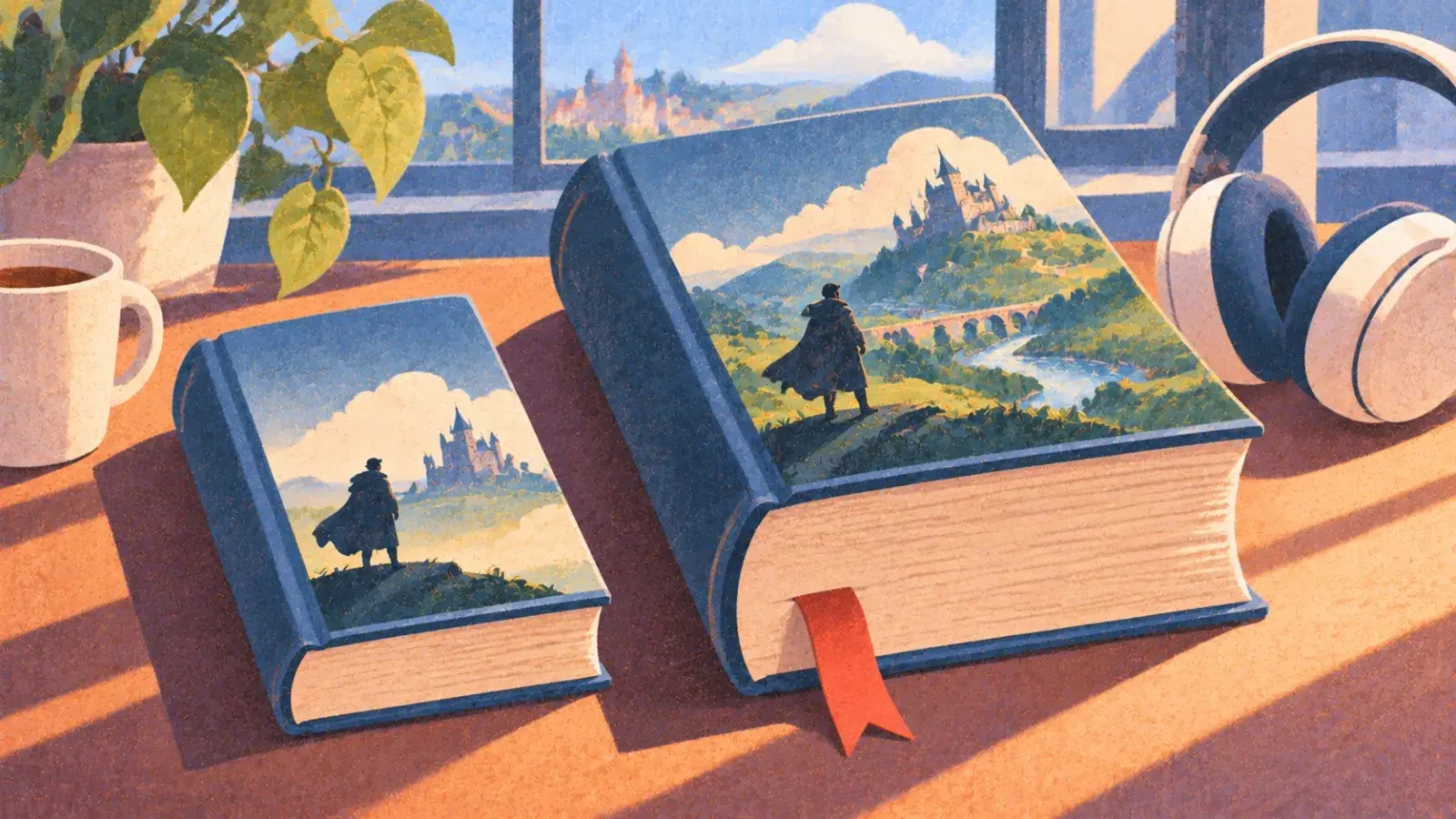
Abridged means shortened: an abridged book, audiobook or dictionary has had words, passages or whole chapters cut, while the overall sense and story stay intact. Unabridged means complete: the full text of the edition, or, for a dictionary, the most complete of its kind. On an audiobook, “unabridged” tells you the narrator reads the complete text, and “abridged” tells you that you are hearing a condensed version. To remember it, think of abbreviate, from the same Latin root.
Both labels describe a text against a particular edition. A complete reading of a translation that was itself cut or softened is unabridged as a recording and still short of the original work, so for a classic in translation, check the translator or the edition as well as the label.
Abridged vs unabridged at a glance
| Abridged | Unabridged | |
|---|---|---|
| Meaning | AbridgedShortened, with parts cut | UnabridgedComplete, nothing cut |
| Books | AbridgedA shortened edition, such as a condensed or children's version | UnabridgedThe full text as published |
| Audiobooks | AbridgedA reading of a cut text, often far shorter than the word count suggests | UnabridgedA reading of the complete text of the stated edition |
| Dictionaries | AbridgedDrawn from a larger dictionary, such as the Shorter Oxford | UnabridgedThe most complete of its kind, such as Webster's Third |
| Noun | Abridgedabridgment; abridgement is common in British English | UnabridgedNo noun in common use |
How to spot an abridged audiobook
- Read the label
Look for the word unabridged or abridged in the listing, the product details or on the case. If neither word appears, don't assume the recording is complete.
- Compare the running time with the book
ACX, the audiobook production platform, says most narrators average about 9,300 words an hour, roughly 150 a minute. Divide the book's word count by 150 for a rough number of minutes: a 90,000-word novel comes to about 10 hours unabridged. That is an estimate, because narrators' pace varies. A much shorter runtime is a reason to check the edition and the abridgment label. The average reading speed post has more on reading-aloud rates.
- Read the description
Phrases such as “abridged by,” “condensed,” “adapted for audio” or “selections” mean you are not getting the complete text as written, and “dramatized” usually means a script adapted from the book. A full cast, by itself, doesn't mean anything was cut: the audiobook of George Saunders's Lincoln in the Bardo has a 166-person cast and is sold as unabridged. Abridged and unabridged editions of the same title can sit side by side, so check which one the listing is for.
- Test the opening
Play the sample with the first page of the print book open. If sentences or paragraphs are missing in the first few minutes, the rest is probably cut as well.
- Know what unabridged leaves out
Unabridged covers the text a narrator can read. A map or a chart is described, left out or supplied as a separate file, and some front and back matter, such as an index, may be skipped. The recording is still unabridged if the main text of the edition is all there; check the listing for a companion file.
What abridge means
Both abridge and abbreviate come from the Late Latin abbreviare, from the Latin brevis, “short.” Merriam-Webster gives the verb four senses:
- To shorten by leaving out words without losing the sense: abridge a memoir for radio, an abridged edition. This is the meaning on book covers.
- To shorten in duration or extent: We abridged the tour to fit the rain.
- To reduce in scope, to diminish (formal): a rule that would abridge the right to protest.
- To deprive (archaic), which is also the earliest sense the dictionary records, from the 14th century.
The formal sense is why the First Amendment forbids laws “abridging the freedom of speech, or of the press.” For books, Merriam-Webster's synonym note draws the line that matters: to abridge is to reduce something while keeping its essential parts and a relative completeness. An abridgment of a novel still tells the whole story, beginning to end. An excerpt doesn't; it is a piece cut out of the whole.
The noun is abridgment, the usual American spelling, or abridgement, which is common in British English. It's the same choice as judgment and judgement.
Abridged, condensed, adapted and expurgated
Covers and listings use labels that sound alike and promise different things:
| Label | What it means | Whose words |
|---|---|---|
| LabelAbridged | What it meansShortened by cutting; the story is still whole | Whose wordsMostly the author's |
| LabelCondensed | What it meansThe same idea, the label Reader's Digest Condensed Books used from 1950 to 1997 | Whose wordsMostly the author's |
| LabelAdapted, retold | What it meansRewritten, often simplified for children or language learners | Whose wordsThe adapter's |
| LabelExcerpt, selections | What it meansPart of the work, not a shortened whole | Whose wordsThe author's |
| LabelExpurgated, bowdlerized | What it meansCut to remove material someone found offensive | Whose wordsThe author's, minus the parts removed |
| LabelDramatized | What it meansA script based on the book, performed by a cast; a full-cast reading of the complete text is not a dramatization | Whose wordsThe adapter's and the author's |
| LabelUnabridged, complete, uncut | What it meansNothing removed | Whose wordsThe author's |
Bowdlerize comes from Thomas Bowdler, whose Family Shakspeare left out words and expressions that, in its own phrase, “cannot with propriety be read aloud in a family.” The first edition (1807) was prepared by his sister Harriet, and the 1818 edition covered all 36 plays. That is expurgation, not abridgment: the aim was taste, not length.
Why abridged audiobooks became common
The steps above are all you need to check a recording; the history explains why so many abridged ones exist. Abridgment in audio began as a storage problem. Caedmon, founded in New York in 1952, recorded on long-playing records that held about 45 minutes across both sides, so it mostly released poems, plays and other short works rather than whole books. A novel read aloud runs many hours.
Cassettes split the market. Some companies, such as Voice Over Books, sold abridged best-sellers read by professional actors. Others built a business on completeness: Duvall Hecht founded Books on Tape in 1975 as a mail-order rental service for unabridged audiobooks, and Recorded Books grew from Henry Trentman's idea, in 1978, of quality unabridged recordings of classic literature. In 1984 Brilliance Audio found a way to record twice as much on the same cassette, which made unabridged editions affordable. Downloads removed the storage limit, but abridged editions still exist, so check before you buy or quote.
If you narrate your own audiobook, the reading will be unabridged unless you cut the text first. The voiceover script template has a pronunciation guide and pacing notes that work for audiobook chapters.
Abridged and unabridged dictionaries
For dictionaries the word has a second meaning. Merriam-Webster defines unabridged as “being the most complete of its class: not based on one larger.” The standard American example is Webster's Third New International Dictionary of the English Language, Unabridged, published in September 1961; by 2005 it held more than 476,000 vocabulary entries, and its most recent printing runs to 2,816 pages. An abridged dictionary is drawn from a bigger one: the Shorter Oxford English Dictionary, first published in February 1933, is a two-volume abridgement of the multivolume Oxford English Dictionary.
The tradition is old. Samuel Johnson's Dictionary of the English Language came out on 15 April 1755 as a folio with a 42,773-word list. In 1756 an abridged edition followed in two octavo volumes, “abstracted from the folio edition by the author,” and it sold over a thousand copies a year for the next 30 years.
Why abridgments exist
- Size and convenience. Johnson's abridgment put the dictionary into octavo volumes, a fraction of the folio's size, and it sold steadily for decades. Reader's Digest Condensed Books packed, most often, five condensed books into one volume from 1950 to 1997.
- Time slots. BBC radio's Book at Bedtime, on the air since 1949, reads abridged books in 15-minute weekday episodes, usually over one or two weeks. Two weeks of episodes add up to two and a half hours, a fraction of the time most novels take read in full.
- Performance. Charles Dickens read A Christmas Carol at Birmingham Town Hall at Christmas 1853, and he went on to read it in public in an abbreviated version 127 times, until 1870, the year he died.
- Audience. Children's editions and graded readers for language learners shorten and simplify classics, which is usually adaptation rather than abridgment.
- Translation and taste. The first single-volume English translation of The Count of Monte Cristo (January 1846) was abridged, and Robin Buss's 1996 translation for Penguin Classics restored material that the common 1846 translation had changed to suit Victorian taste. A complete reading of that 1846 text would be unabridged and still not the whole of Dumas.
Abridge in older and legal English
The rights sense of abridge runs through the US Constitution. The Fifteenth Amendment (1870) says the right to vote “shall not be denied or abridged by the United States or by any State on account of race, color, or previous condition of servitude,” and the Nineteenth (1920) uses the same words for sex. Abridged there means cut back, short of being denied outright.
Shakespeare used the noun for something that shortens the time:
Say, what abridgement have you for this evening?
What masque? what music? How shall we beguile
The lazy time, if not with some delight?
Theseus wants an entertainment to make the evening seem shorter. In Hamlet, Act 2, Scene 2, the prince sees the traveling players arrive and says “look, where my abridgement comes”: they are about to cut his conversation short.
Examples in sentences
- The abridged edition runs 380 pages; the unabridged one, 1,100.
- I listened to the unabridged audiobook, all 31 hours of it.
- The radio version was heavily abridged and lost the whole second subplot.
- Check whether the translation you cite is unabridged.
- The school edition is an abridgment, not the full novel.
- The publisher released abridged and unabridged recordings on the same day.
- No law may abridge the freedom of the press.
- The author prepared her own abridgment for the anthology.
- An abridged reading of the story fit into a 20-minute podcast episode.
- Three hours seemed short for a 100,000-word novel, so I checked whether the recording was abridged.
Abridge your own text
Writers abridge their own work more often than they call it that: a story cut down for a ten-minute reading, a chapter trimmed into a sample for an agent, a talk squeezed into a shorter slot. At a reading pace of about 150 words a minute, ten minutes is roughly 1,500 words. Cut in this order:
- Whole scenes and subplots the main line doesn't need.
- Secondary description and repeated beats inside the scenes you keep.
- Words inside sentences, last, and only for rhythm.
- Then write a bridging sentence wherever a cut leaves a jump.
When you shorten someone else's words in a quotation, don't bridge: mark each cut with an ellipsis so the reader knows text is missing. For your own text, a bridge is fine, because you are the author of both versions.
Original (75 words). When the ferry finally docked at Kirkwall, a full two hours late because of the fog that had rolled in off the Pentland Firth, Morag was the first passenger down the ramp, dragging her grandfather's old leather suitcase behind her on its one good wheel. The town looked smaller than she remembered, grayer too, and the harbor smelled of diesel and seaweed. Nobody had come to meet her, which was exactly what she had expected.
Abridged (36 words). The ferry docked at Kirkwall two hours late, and Morag was first down the ramp, dragging her grandfather's suitcase on its one good wheel. The town looked smaller and grayer. Nobody had come to meet her.
The cut keeps the arrival, the suitcase (it will matter later), the changed town and the missing welcome. It drops the cause of the delay, the smell and her expectation. That last cut changes the tone: in the original she expected nobody, and the short version leaves the reader to guess whether she minds. If the difference matters to the story, keep the clause and cut somewhere else.
When the cut copy is done, attach the full version to a chat with the Strokes Assistant and ask it to review the copy for anything the cuts left dangling, such as a character who is mentioned but never introduced, or a callback to a scene that is gone.
Frequently asked questions
Is abridged or unabridged better?
It depends on what you want. Unabridged gives you the author's full text, which matters for studying, reviewing or quoting the book as written. An abridged version is quicker and can suit a commute or a first taste of a very long classic. For an essay, use the edition your argument is about and name it in the citation; when you discuss the author's exact wording, a complete edition is the safer source.
How do I know if an audiobook is abridged?
Check the listing or the case for the word abridged or unabridged, and read the description for words such as condensed, adapted or selections. Then compare the running time with the book: at roughly 150 words a minute, a 90,000-word novel comes to about 10 hours unabridged. That is an estimate, not proof. A much shorter runtime is a reason to check the edition and the label.
Is it abridgment or abridgement?
Both are correct. Merriam-Webster lists abridgment first, with abridgement as a variant, and abridgment is the usual American spelling. British English often keeps the e, as it does in judgement and acknowledgement. Pick one and use it consistently, and match whatever you chose for judgment in the same document.