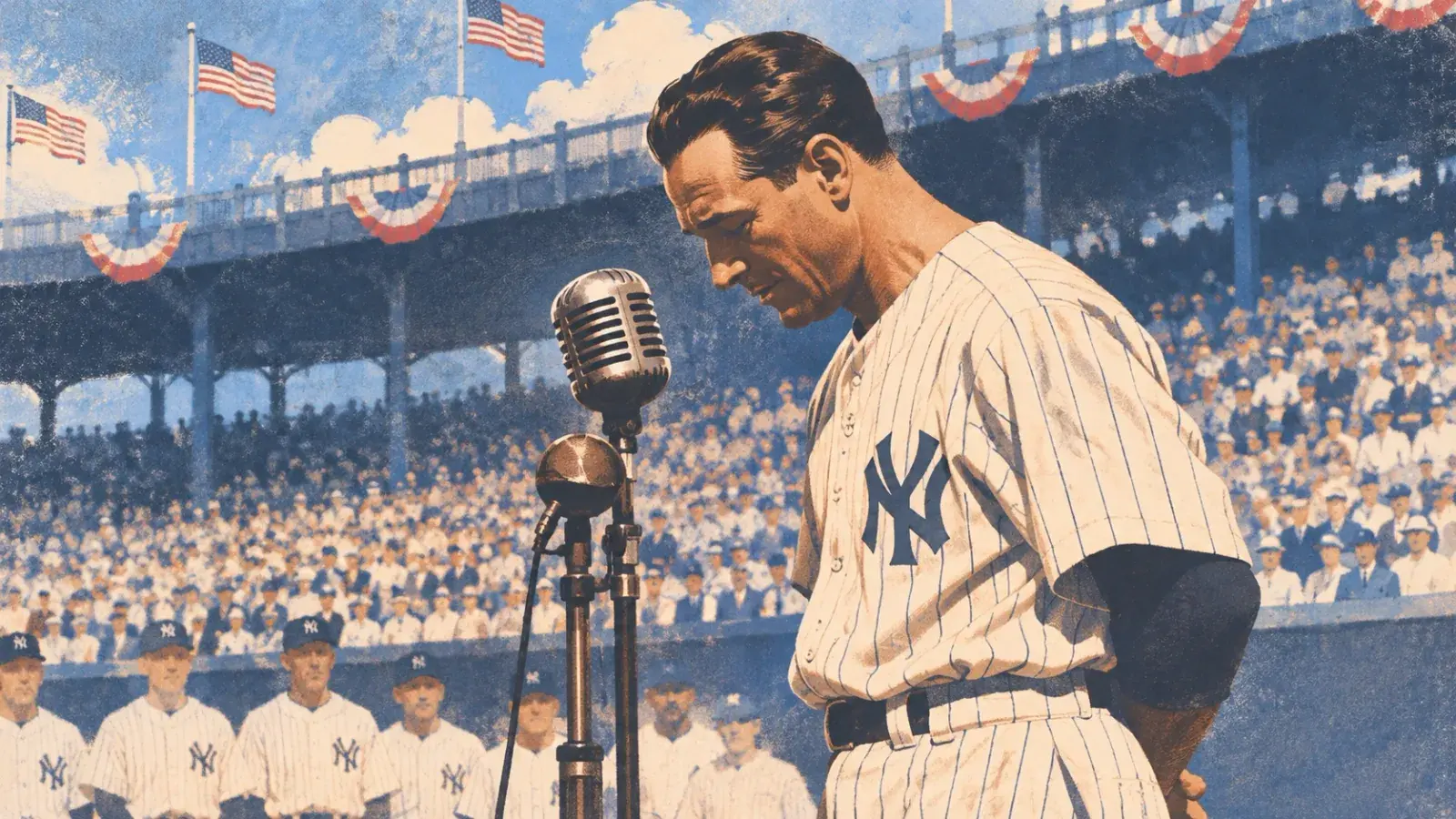
Lou Gehrig's retirement speech was given at home plate in Yankee Stadium on July 4, 1939, Lou Gehrig Appreciation Day, between games of a doubleheader against the Washington Senators, before a crowd of 61,808. Two weeks earlier, a diagnosis of amyotrophic lateral sclerosis, ALS, from doctors at the Mayo Clinic had ended his playing career. In fewer than 300 words he mentions his misfortune briefly at the opening, turns it around in his second sentence, “Yet today I consider myself the luckiest man on the face of the earth,” thanks people by name, and returns to the misfortune at the close.
It has been called baseball's Gettysburg Address, and like Lincoln's it is short and more carefully built than it sounds. No complete recording survives, and printed versions differ slightly, so this analysis follows one: the text on the official Lou Gehrig website, in four paragraphs. The paragraph numbers and devices below refer to that version.
The day at a glance
| Fact | Detail |
|---|---|
| FactDate | DetailTuesday, July 4, 1939 |
| FactPlace | DetailHome plate, Yankee Stadium, the Bronx |
| FactOccasion | DetailLou Gehrig Appreciation Day, between games of a doubleheader against the Washington Senators |
| FactCrowd | Detail61,808 |
| FactThe ceremony | DetailMore than 40 minutes of speeches and gifts. Speakers included Mayor Fiorello La Guardia and Postmaster General James A. Farley. |
| FactOld teammates | DetailMembers of the 1927 Yankees, among them Babe Ruth |
| FactThe speech | DetailFour short paragraphs, fewer than 300 words, about two minutes at an unhurried pace |
| FactSurviving film | DetailNo complete film or audio is known; newsreel fragments survive, the famous line among them |
Why he was retiring
Gehrig had played 2,130 consecutive games for the Yankees when the streak ended on May 2, 1939; he had told his manager, Joe McCarthy, that it was time for him to sit out. His wife, Eleanor, called the Mayo Clinic in Rochester, Minnesota, and he arrived there on June 13. After several days of tests the doctors diagnosed ALS, a disease of the nerve cells that control the muscles. He learned the diagnosis on his 36th birthday, June 19, and it was announced in New York two days later.
Thirteen days after that came the tribute. Gifts piled up at home plate: a silver service from the Yankees, a fruit bowl and two candlesticks from the rival New York Giants, a fishing rod and tackle from the stadium employees and ushers, a tobacco stand from the New York chapter of the Baseball Writers' Association. His 1939 teammates gave him a silver trophy, an eagle on a silver baseball ringed by six small silver bats, with their signatures on one plate and on the other a poem by the New York Times writer John Kieran.
In the account of the Society for American Baseball Research, he was overcome, and for a while it looked as if he would not be able to speak at all. He died on June 2, 1941, at 37. In the United States, ALS is still widely called Lou Gehrig's disease.
How the speech is built
| Paragraph | What he says, paraphrased | What it does |
|---|---|---|
| Paragraph1. The turn | What he says, paraphrasedTwo weeks of reading about his bad break. Then the luckiest-man sentence. Then 17 years of kindness from the fans. | What it doesMentions the misfortune, then turns it around in the next sentence |
| Paragraph2. The questions | What he says, paraphrasedWouldn't anyone count it a privilege to stand with these men? Then one question each for Jacob Ruppert, Ed Barrow, Miller Huggins (six years) and Joe McCarthy (nine). Twice he answers that yes, he is lucky. | What it doesSupports the claim with names. The questions invite the audience to agree. |
| Paragraph3. The whens | What he says, paraphrasedFive sentences in a row that open the same way: the Giants' gift, trophies from everyone down to the groundskeepers, his mother-in-law, his parents, his wife | What it doesMoves from the ballpark to his family, and the last two endings rise above the first three |
| Paragraph4. The close | What he says, paraphrasedHe may have had a bad break, but he has a great deal to live for. Thank you. | What it doesReturns to the misfortune and sets what he has to live for against it |
Look at where the famous sentence sits. It is the second sentence of the speech, not the last. Gehrig states his gratitude first and then supports it with names, years, gifts and relationships.
The famous sentence is the speech's second, not its last. What follows supports it.
The questions, then the whens
Paragraph two runs on rhetorical questions, five of them. The first asks the crowd whether they wouldn't count it a privilege to be associated with the men standing in uniform in front of them. The next four each name one man: the owner, Jacob Ruppert; the man who built the club's organization, Ed Barrow; Miller Huggins, his manager for six years; and Joe McCarthy, his manager for the nine after that. Twice Gehrig stops to answer his own questions with a three-word admission that he is lucky, the move rhetoric calls hypophora. The questions have already invited the crowd to agree, so each answer arrives as a confirmation.
Paragraph three switches to anaphora, the same opening repeated: five sentences in a row begin with when. The first three also end alike, on the same short verdict that this is something, which is epistrophe. They move outward and down the ladder: a gift from the rival Giants, trophies from everyone down to the groundskeepers and the staff in white coats, and a mother-in-law who takes his side in arguments with her own daughter. Then the verdicts rise. His parents, who worked all their lives so he could have an education and grow strong, are a blessing. His wife, who has shown more courage than he had imagined possible, is the finest thing he knows.
The order does part of the arguing. He starts with the people the crowd could see, his teammates in uniform, and ends with the people it knew least: his parents and his wife. The line about his mother-in-law is a joke, and it comes just before the two most serious sentences, which gives the stadium a moment's release before them.
What he leaves out
The speech never names the disease. It doesn't mention the streak, his statistics or his retirement, and the word farewell isn't in it. The illness appears only as a bad break, twice, in the first sentence and in the last paragraph. That understatement, the device rhetoric calls meiosis, lets 61,808 people hear a goodbye without being asked to grieve. Gehrig had every reason to talk about himself and spent nearly the whole speech talking about other people.
Rhetorical devices at a glance
| Device | Where it appears | What it does |
|---|---|---|
| DeviceConcession and reversal | Where it appearsThe bad break, then the luckiest man | What it doesTurns a misfortune everyone knew about into a claim of gratitude |
| DeviceUnderstatement | Where it appearsA fatal illness called a bad break | What it doesKeeps the tone level and lets the audience supply the weight |
| DeviceRhetorical questions | Where it appearsFive in paragraph two, about the men he played for | What it doesInvite the crowd to agree before he answers |
| DeviceHypophora | Where it appearsHe answers the questions himself, twice, with a short admission that he is lucky | What it doesTurns the questions into a refrain that marks the paragraph's beats |
| DeviceAnaphora | Where it appearsFive sentences in a row opening with when | What it doesBuilds a rhythm a stadium can follow |
| DeviceEpistrophe | Where it appearsThe first three of those sentences ending on the same verdict | What it doesMakes the list feel like a count, one item at a time |
| DeviceClimax | Where it appearsEndings that rise from something, to a blessing, to the finest he knows | What it doesSaves the strongest praise for his wife |
| DeviceHumor | Where it appearsThe mother-in-law who takes his side | What it doesA laugh, placed just before the most serious lines |
| DeviceRing structure | Where it appearsThe bad break in the first and last paragraphs | What it doesCloses the frame, with the gratitude inside it |
None of these is exotic. You'll find most of them in the glossary of rhetorical devices, and in plenty of wedding toasts. What makes the speech unusual is how few words each one gets. The whole thing is four paragraphs, and the repetition does the structural work that headings would do on a page.
What survives, and what the film changed
No complete film or audio of the speech is known to exist. Newsreel cameras caught parts of it, the famous line among them, so the full text comes down to us in print, and printed versions don't quite agree. The version in a Society for American Baseball Research article on the speech opens with a word of address to the fans; the Hall of Fame's text and the one on the official Lou Gehrig website start straight in. If you quote it, say which version you are using.
The version most people carry around comes from the movies. In The Pride of the Yankees (1942), directed by Sam Wood, Gary Cooper gives a condensed speech that drops several names, Ruppert and Barrow among them, and moves the luckiest-man line from the opening to the very end. The American Film Institute later ranked that line 38th on its list of the 100 greatest movie quotes.
The change is a lesson in itself. Placed last, the line becomes a curtain line, the thing the audience leaves with. Placed second, as Gehrig had it, it is a claim, and the thanks that follow support it.
Borrowing it for a retirement speech
Few retirement speeches come with news this hard, but the frame can be adapted for an office party, a newsroom or a school assembly:
- Mention the hard thing briefly, and early. If everyone knows why you're leaving, a sentence may be enough before you move on.
- Give the turn before the evidence. Say what you feel, then show why.
- Make gratitude specific. One person, one thing they did. A list of departments is harder to hear as thanks.
- Choose an order for your thanks. Gehrig went from the teammates beside him to his family and saved his wife for last. Pick the order that suits your audience and your departure, and decide where the person who mattered most belongs.
- Allow one light moment if the occasion can take it. Gehrig's comes just before his most serious lines.
- Return to your opening. Gehrig came back to the bad break and set what he had to live for against it. End on what you want listeners to remember.
Most of you heard about the buyouts in March, and most of you have been too polite to ask whether I took mine gladly. I'll answer anyway: I'm walking out of this building owing more than I can pay.
Who wouldn't call it luck to have had thirty-one years of Ray Delgado reading over your shoulder at 11:40 at night, telling you the lede was buried? Or Annette in photo, who never once let a caption run with a name spelled wrong?
When the city desk orders a cake with a typo on it, on purpose, that's love. When my husband learns the deadline schedule better than his own, that's a marriage.
So yes, the buyout came. And I have a great deal to go home to.
The words are new; the frame is Gehrig's. One hard fact, the turn, names as evidence, the family at the end, and the hard fact again to close. The guide to the retirement speech covers timing, tone and what to skip.
Most of Gehrig's speech is a list of people, each with one specific reason, so write that list before the speech: one row per person, what they did, and the one detail you'll say out loud.
When the draft is done, attach the list in the Strokes Assistant panel in Strokes and ask who is missing from the speech and which thanks are too general to mean anything.
For the speech in company, see famous speeches in history, where it sits between Roosevelt and Churchill. For leaving a job rather than a ballpark, the farewell speech guide has examples for leaving a job, a school or a town. And for a farewell that was printed rather than spoken, read our analysis of Washington's Farewell Address.
Frequently asked questions
Why is it called the luckiest man speech?
Because of its second sentence, in which Gehrig, about two weeks after the diagnosis that ended his career was announced, told the crowd that he considered himself the luckiest man on the face of the earth. The 1942 film The Pride of the Yankees moved the line to the end of the speech, and the American Film Institute later ranked the film's version 38th among the greatest movie quotes.
How long was Lou Gehrig's speech?
Short: four paragraphs and about 275 words in the text on the official Lou Gehrig website, roughly two minutes at an unhurried pace. The ceremony around it lasted more than 40 minutes, with speeches by Mayor Fiorello La Guardia and Postmaster General James A. Farley and gifts from the club, his teammates, the rival Giants and the stadium staff.
Is there a recording of Lou Gehrig's speech?
Only in part. No complete film or audio of the speech is known to exist; newsreel footage survives of parts of it, the famous line among them. The full text comes from print, and published versions differ slightly, so name the version you quote. The best-known complete performance is Gary Cooper's in The Pride of the Yankees, which shortens and reorders it.
Did Lou Gehrig have ALS when he gave the speech?
That was his diagnosis. Doctors at the Mayo Clinic in Rochester, Minnesota, diagnosed amyotrophic lateral sclerosis in June 1939, and he learned of it on his 36th birthday. A 2010 Boston University study linking repeated head trauma to an ALS-like disease led some to ask whether his illness was something else, but his records are sealed and the question can't be settled. He died on June 2, 1941, at 37.