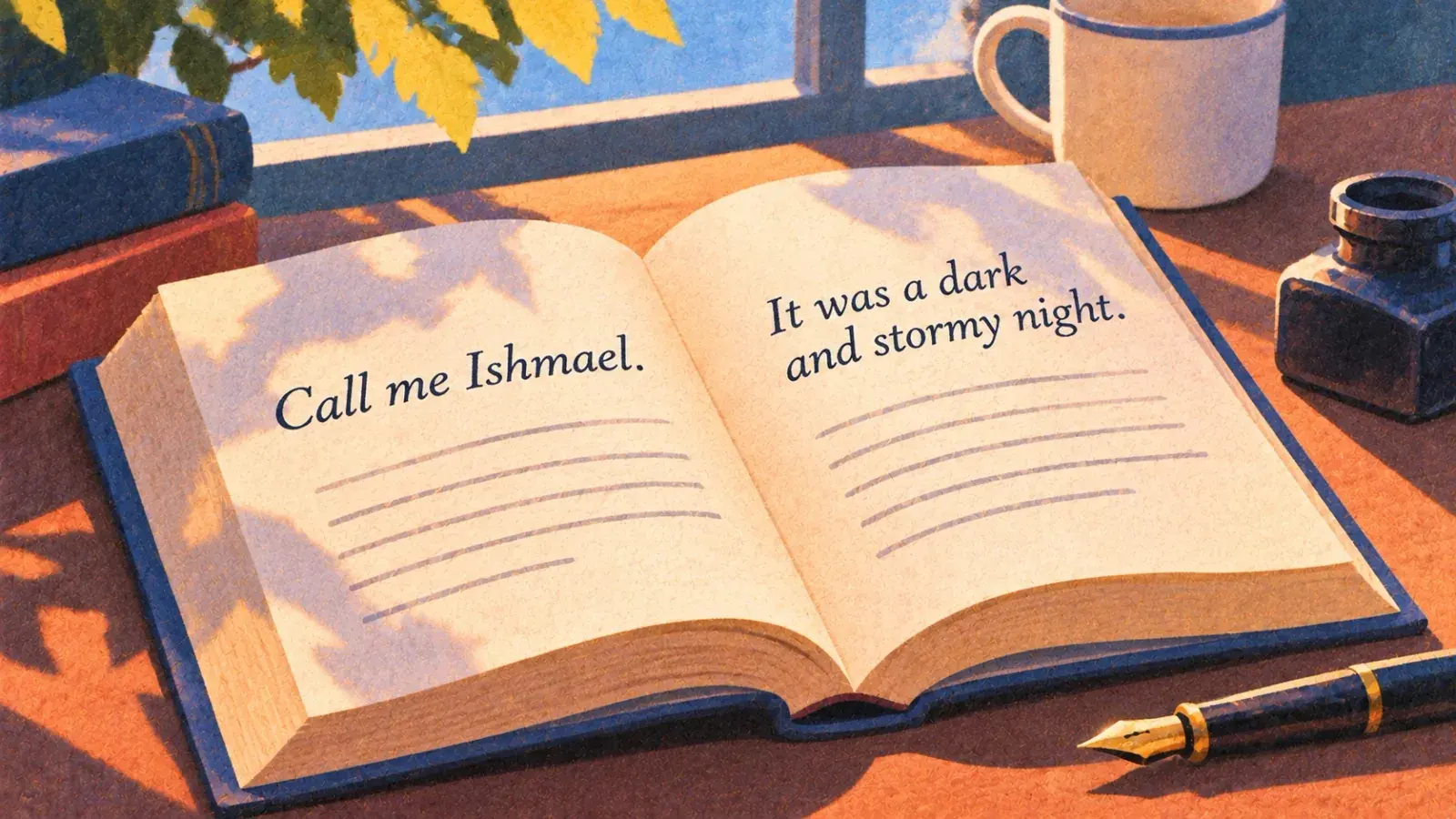
The famous first lines of books are the few that readers can finish from memory: “Call me Ishmael,” “It is a truth universally acknowledged,” “It was the best of times, it was the worst of times,” “Happy families are all alike.” This article is about where those lines come from: the poll that ranked them, the joke that grew out of one bad opening, the front matter printed before some of them, and the translators and editions that change their words. In the best-known ranking, American Book Review's 2006 list of the 100 best first lines from novels, Moby-Dick came first and Pride and Prejudice second.
For the craft side, the guide to famous opening lines sorts 64 of them by the technique each one uses and shows how to write your own.
American Book Review's 2006 top ten
The American Book Review (ABR) list is one editorial poll, not a measure of fame. Its editor, Charles B. Harris, invited reviewers, critics, professors, writers and readers to submit first lines and then vote on the ranking. These are its top ten, and the full list of 100 is on ABR's site.
| Rank | First line | Book |
|---|---|---|
| Rank1 | First line“Call me Ishmael.” | BookHerman Melville, Moby-Dick (1851) |
| Rank2 | First line“It is a truth universally acknowledged…” | BookJane Austen, Pride and Prejudice (1813) |
| Rank3 | First line“A screaming comes across the sky.” | BookThomas Pynchon, Gravity's Rainbow (1973) |
| Rank4 | First line“Many years later, as he faced the firing squad, Colonel Aureliano Buendía…” | BookGabriel García Márquez, One Hundred Years of Solitude (1967) |
| Rank5 | First line“Lolita, light of my life, fire of my loins.” | BookVladimir Nabokov, Lolita (1955) |
| Rank6 | First line“Happy families are all alike; every unhappy family is unhappy in its own way.” | BookLeo Tolstoy, Anna Karenina (1878) |
| Rank7 | First line“riverrun, past Eve and Adam's…” | BookJames Joyce, Finnegans Wake (1939) |
| Rank8 | First line“It was a bright cold day in April, and the clocks were striking thirteen.” | BookGeorge Orwell, Nineteen Eighty-Four (1949) |
| Rank9 | First line“It was the best of times, it was the worst of times…” | BookCharles Dickens, A Tale of Two Cities (1859) |
| Rank10 | First line“I am an invisible man.” | BookRalph Ellison, Invisible Man (1952) |
Two things stand out. The list is old and new at once: three of the ten were published before 1860 and five after the Second World War. And counted as complete first sentences, four of the ten run under ten words: Melville's, Pynchon's, Nabokov's and Ellison's. Dickens's runs to 119. The top two are a three-word introduction and a joke.
Many famous first lines are short enough to remember and odd enough to repeat.
Early examples before 1800
Don Quixote (1605). Cervantes's narrator begins by refusing to say where he is. In John Ormsby's translation: “In a village of La Mancha, the name of which I have no desire to call to mind, there lived not long since one of those gentlemen that keep a lance in the lance-rack, an old buckler, a lean hack, and a greyhound for coursing.” The version on the ABR list, from Edith Grossman's 2003 translation, starts “Somewhere in la Mancha, in a place whose name I do not care to remember…” Both keep the joke that sets the book's tone: a narrator who won't be pinned down, describing a gentleman whose gear belongs to an older age.
Robinson Crusoe (1719). Daniel Defoe's opening reads like a record: “I was born in the year 1632, in the city of York, of a good family, though not of that country, my father being a foreigner of Bremen, who settled first at Hull.” Birth, place, family. Editions differ even here: ABR prints “the Year 1632, in the City of York,” with capitals, and Project Gutenberg's text has neither.
Tristram Shandy (1759–67). Laurence Sterne's narrator starts earlier than anyone: “I wish either my father or my mother, or indeed both of them, as they were in duty both equally bound to it,” had paid attention at the moment he was conceived, because their distraction, he argues, shaped everything that followed. The biographical opening was barely established before Sterne made fun of it.
1800 to 1899: epigrams and front matter
Pride and Prejudice (1813). “It is a truth universally acknowledged, that a single man in possession of a good fortune must be in want of a wife.” The irony is that the people doing the acknowledging are mothers of daughters. Editions disagree even about its punctuation: Project Gutenberg's text has no comma after “fortune,” and the version on the ABR list has one.
A Christmas Carol (1843). “Marley was dead: to begin with.” Dickens follows it with “There is no doubt whatever about that,” and a paragraph of insisting, which is how you open a ghost story without saying so.
Jane Eyre (1847). “There was no possibility of taking a walk that day.” It sounds like a weather report and turns out to be about exclusion: within a page, Jane has been shut out of the family circle by the fire.
Moby-Dick (1851). The line that topped the ABR list isn't the first thing in the book. Before Chapter 1 come an Etymology, credited to “a Late Consumptive Usher to a Grammar School,” and pages of Extracts from “a Sub-Sub-Librarian.” Only then: “Call me Ishmael.”
A Tale of Two Cities (1859). Dickens's opening sentence runs 119 words: seven pairs of opposites, then a sting about the noisiest authorities of the day. It first reached readers in a magazine. The novel ran in 31 weekly installments in Dickens's new journal, All the Year Round, from its first issue on April 30, 1859, to November 26.
Anna Karenina (1878). “Happy families are all alike; every unhappy family is unhappy in its own way,” in Constance Garnett's translation. Then, at once, the particular: “Everything was in confusion in the Oblonskys’ house.” A rule and its exception in two sentences.
Adventures of Huckleberry Finn (1884). Huck's “You don’t know about me without you have read a book by the name of The Adventures of Tom Sawyer” has a warning in front of it. Twain's “Notice” says that persons attempting to find a motive in the narrative will be prosecuted, a moral banished, and a plot shot.
A dark and stormy night
Edward Bulwer-Lytton opened Paul Clifford (1830) with “It was a dark and stormy night; the rain fell in torrents,” then kept going through a gust of wind, the London housetops and the lamps struggling against the darkness, all in one sentence with no person in it. The novel is little read today, but its first seven words are everywhere.
The phrase became shorthand for overwritten openings, and then a running joke. Charles Schulz gave it to Snoopy, whose novels in Peanuts sometimes begin with it, and a 1971 book by Schulz was titled Snoopy and “It Was a Dark and Stormy Night.” Madeleine L'Engle opened A Wrinkle in Time (1962) with it too; her biographer Leonard Marcus calls the choice “a wink to the reader.” In the early 1980s Scott Rice, an English professor at San José State University, started the Bulwer-Lytton Fiction Contest for “the worst possible opening sentences to novels never written.” He ended it in 2025, after more than four decades.
The twist: ABR's voters still ranked Paul Clifford 22nd on their list of the best first lines, above The Sound and the Fury and Beloved. Being famously bad is a kind of fame.
Early twentieth-century openings, 1900 to 1929
Several writers here begin inside a moment or a consciousness rather than with a birth and a family. A few of the lines that stuck:
| First line | Book | The story behind it |
|---|---|---|
| First line“All children, except one, grow up.” | BookJ. M. Barrie, Peter and Wendy (1911) | The story behind itThe whole premise in six words, with the hero hidden in a clause |
| First line“For a long time I used to go to bed early.” | BookMarcel Proust, Swann's Way (1913) | The story behind itC. K. Scott Moncrieff's translation (1922). The ABR list quotes Lydia Davis's: “For a long time, I went to bed early.” |
| First line“This is the saddest story I have ever heard.” | BookFord Madox Ford, The Good Soldier (1915) | The story behind itNumber 18 on the ABR list. The narrator says “heard,” though he lived it |
| First line“Stately, plump Buck Mulligan came from the stairhead…” | BookJames Joyce, Ulysses (1922) | The story behind itThe novel's single Dublin day starts here, with a shaving bowl held up like a chalice |
| First line“Someone must have slandered Josef K.” | BookFranz Kafka, The Trial (1925) | The story behind itAn arrest without a crime, in the first sentence. Breon Mitchell's 1998 translation, number 13 on the ABR list |
| First line“Mrs. Dalloway said she would buy the flowers herself.” | BookVirginia Woolf, Mrs. Dalloway (1925) | The story behind itOne errand opens one June day, the novel's whole span |
| First line“In my younger and more vulnerable years my father gave me some advice…” | BookF. Scott Fitzgerald, The Great Gatsby (1925) | The story behind itComes after an epigraph signed Thomas Parke d'Invilliers |
| First line“He—for there could be no doubt of his sex…” | BookVirginia Woolf, Orlando (1928) | The story behind itA hero whose sex the book will later change, insisted on from the first word |
| First line“Through the fence, between the curling flower spaces, I could see them hitting.” | BookWilliam Faulkner, The Sound and the Fury (1929) | The story behind itGolf, seen by a narrator who doesn't have the word for it |
Translation makes some of these moving targets. Proust wrote his sentence once, in French, but English readers have met it in more than one form, and a reader who quotes the line is quoting a translator too.
Mid-century lines, 1930 to 1959
The Hobbit (1937). “In a hole in the ground there lived a hobbit.” Tolkien recalled writing it on a blank page he found while marking School Certificate exam papers. George Allen and Unwin published the book on September 21, 1937, and the line has outlived the exam.
Finnegans Wake (1939). The seventh line on the ABR list starts in lowercase, in the middle of a sentence. The book's last sentence breaks off unfinished and runs back into that first word, so the novel loops. Joyce described it as ending and beginning in the middle of the same sentence.
The Stranger (1942). Camus's opening is four words of French, short enough to fight over. Stuart Gilbert's 1946 translation gave English readers “Mother died today,” the version on the ABR list. Matthew Ward (1988) wrote “Maman died today,” keeping Camus's word for her, and Sandra Smith (2012) “My mother died today.” In 2012 Ryan Bloom argued in The New Yorker for “Today, Maman died,” which keeps Camus's word order as well.
Besides Finnegans Wake, three more of the ABR top ten come from these years: Orwell's clocks striking thirteen, Ellison's invisible man and Nabokov's Lolita. Other openings from these years that readers still quote:
- “Ships at a distance have every man's wish on board.” — Zora Neale Hurston, Their Eyes Were Watching God (1937).
- “The sun shone, having no alternative, on the nothing new.” — Samuel Beckett, Murphy (1938), 15th on the ABR list.
- “In the town, there were two mutes and they were always together.” — Carson McCullers, The Heart Is a Lonely Hunter (1940).
- “I write this sitting in the kitchen sink.” — Dodie Smith, I Capture the Castle (1948).
- “If you really want to hear about it…” — J. D. Salinger, The Catcher in the Rye (1951).
- “A story has no beginning or end…” — Graham Greene, The End of the Affair (1951).
- “Where's Papa going with that ax?” — E. B. White, Charlotte's Web (1952). The only line here that isn't on the ABR list.
- “It was a pleasure to burn.” — Ray Bradbury, Fahrenheit 451 (1953).
1960 to 2002: the list catches up
One Hundred Years of Solitude (1967). Gabriel García Márquez's novel came out in Buenos Aires in 1967, and English readers met it in 1970 in Gregory Rabassa's translation. Its first sentence, fourth on the ABR list, leaps forward to a firing squad and then back to a childhood afternoon, and the novel's sense of time is in that leap.
If on a winter's night a traveler (1979). In William Weaver's translation, Italo Calvino's first sentence tells you that you are about to begin reading his new novel, and names it. The book is about you, the reader, trying to finish a book.
Beloved (1987). “124 was spiteful.” Three words, one of them a number. Toni Morrison's 124 is a house, 124 Bluestone Road in Cincinnati, and the spite belongs to the ghost in it.
Others from these decades on the ABR list:
| First line | Book |
|---|---|
| First line“It was love at first sight.” | BookJoseph Heller, Catch-22 (1961) |
| First line“They say when trouble comes close ranks, and so the white people did.” | BookJean Rhys, Wide Sargasso Sea (1966) |
| First line“All this happened, more or less.” | BookKurt Vonnegut, Slaughterhouse-Five (1969) |
| First line“You better not never tell nobody but God.” | BookAlice Walker, The Color Purple (1982) |
| First line“The sky above the port was the color of television…” | BookWilliam Gibson, Neuromancer (1984) |
| First line“It was a wrong number that started it…” | BookPaul Auster, City of Glass (1985) |
| First line“Time is not a line but a dimension, like the dimensions of space.” | BookMargaret Atwood, Cat's Eye (1988) |
| First line“It was the day my grandmother exploded.” | BookIain Banks, The Crow Road (1992) |
| First line“Every summer Lin Kong returned to Goose Village to divorce his wife, Shuyu.” | BookHa Jin, Waiting (1999) |
Lists lag behind books. ABR's was drawn up in 2006, and its newest entry was four years old. A first line usually needs time to be quoted, misquoted and parodied before a poll will rank it.
Why these lines stuck
Read the lines above in a row and a pattern shows. Many famous first lines are short, and the long ones are often built from repeated parts you can say aloud, as Dickens's is. Many make a claim about the world (happy families, rich young men, the times) that the book then tests. Others give one strange fact, a clock striking thirteen or a spiteful house, and let the reader ask the question. Few of them explain anything.
Fame helps too. A line becomes famous partly because the book is, and then the line goes on without it: you don't need to have read A Tale of Two Cities to finish “It was the best of times.” A quotation placed above the first line, as in The Great Gatsby, is an epigraph, a separate tradition with its own rules. And if you're sorting the books themselves, the list of book genres shows where each of them sits on the shelf.
Keep a first-lines commonplace book
Copying out sentences you admire is an old habit, and first lines make an easy place to start. Record more than the words: the book, the year, the edition you copied from, the translator if there is one, and a few words on what the line does. The Austen comma and the Camus translations show why. The same famous line can read differently from one edition to the next, and a note of the edition is what lets you quote it accurately later.
If you can't tell which translation a line in your notes comes from, ask the Strokes Assistant to look it up, then check its answer against the edition on your shelf.
Frequently asked questions
What is the most famous first line in literature?
No ranking settles it, but “Call me Ishmael,” the first line of Chapter 1 of Herman Melville's Moby-Dick (1851), topped American Book Review's 2006 list of the 100 best first lines from novels, which was ranked by a vote of critics, writers and readers. Jane Austen's “It is a truth universally acknowledged” from Pride and Prejudice came second, and Thomas Pynchon's “A screaming comes across the sky” third.
What book starts with “It was a dark and stormy night”?
Paul Clifford, an 1830 novel by Edward Bulwer-Lytton. The sentence continues through rain, wind, London housetops and lamps. It became a byword for overwritten openings, a first line Snoopy uses for his novels in Peanuts and the inspiration for the Bulwer-Lytton Fiction Contest, which ran from the early 1980s until 2025. Madeleine L'Engle borrowed it to open A Wrinkle in Time (1962).
What book begins “It was the best of times, it was the worst of times”?
A Tale of Two Cities by Charles Dickens, published in weekly installments in 1859. The full opening sentence is 119 words long, built from seven pairs of opposites, and ends with a dig at the “noisiest authorities” of the age. It ranked ninth on American Book Review's list of the best first lines.
Is the first line of a book the same as its opening sentence?
Usually, but not always. Moby-Dick puts an Etymology and Extracts before “Call me Ishmael,” Huckleberry Finn puts a mock Notice before Huck speaks, and The Great Gatsby has an epigraph. Lists of famous first lines generally quote the first sentence of the story itself, after any front matter.