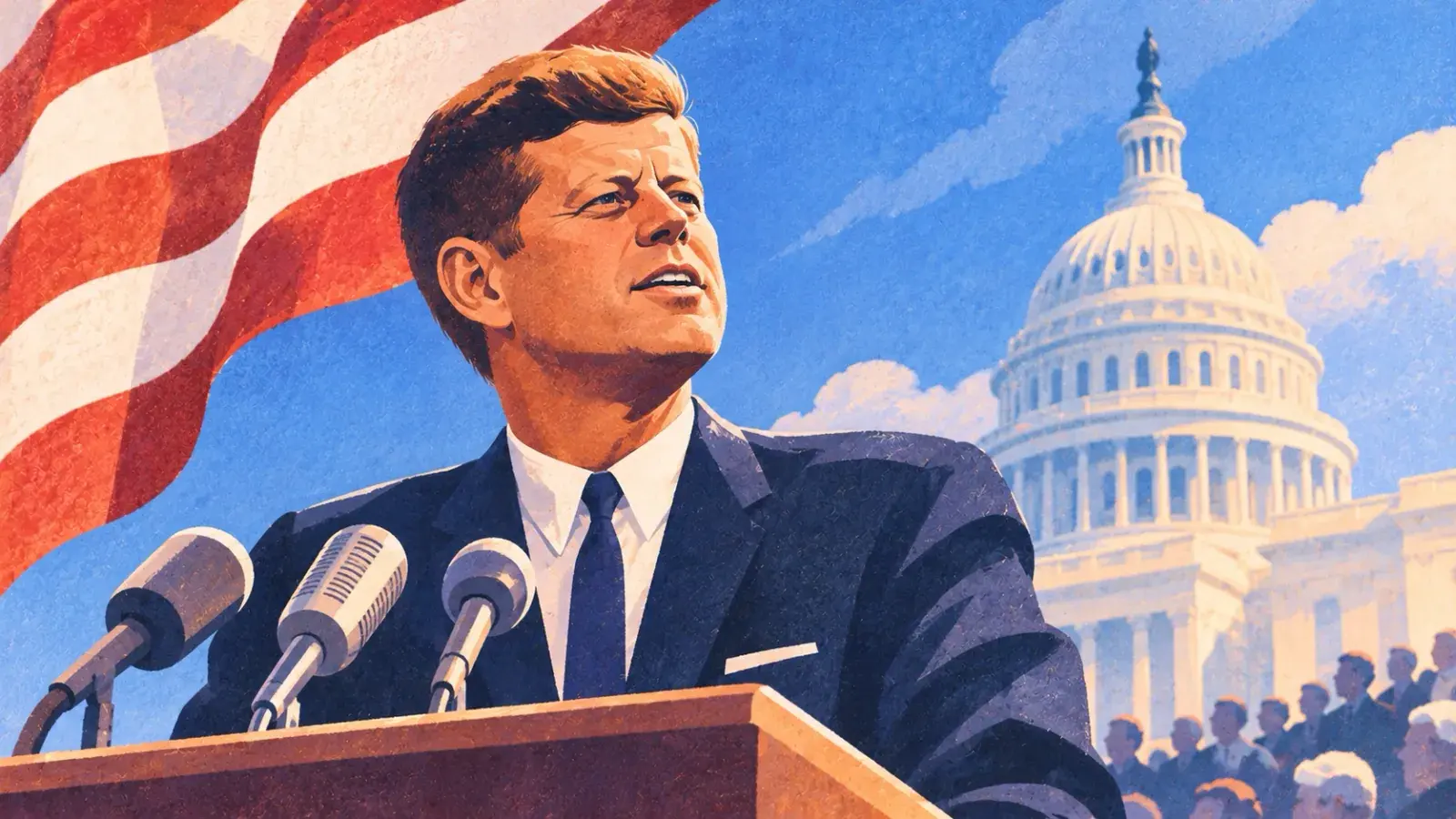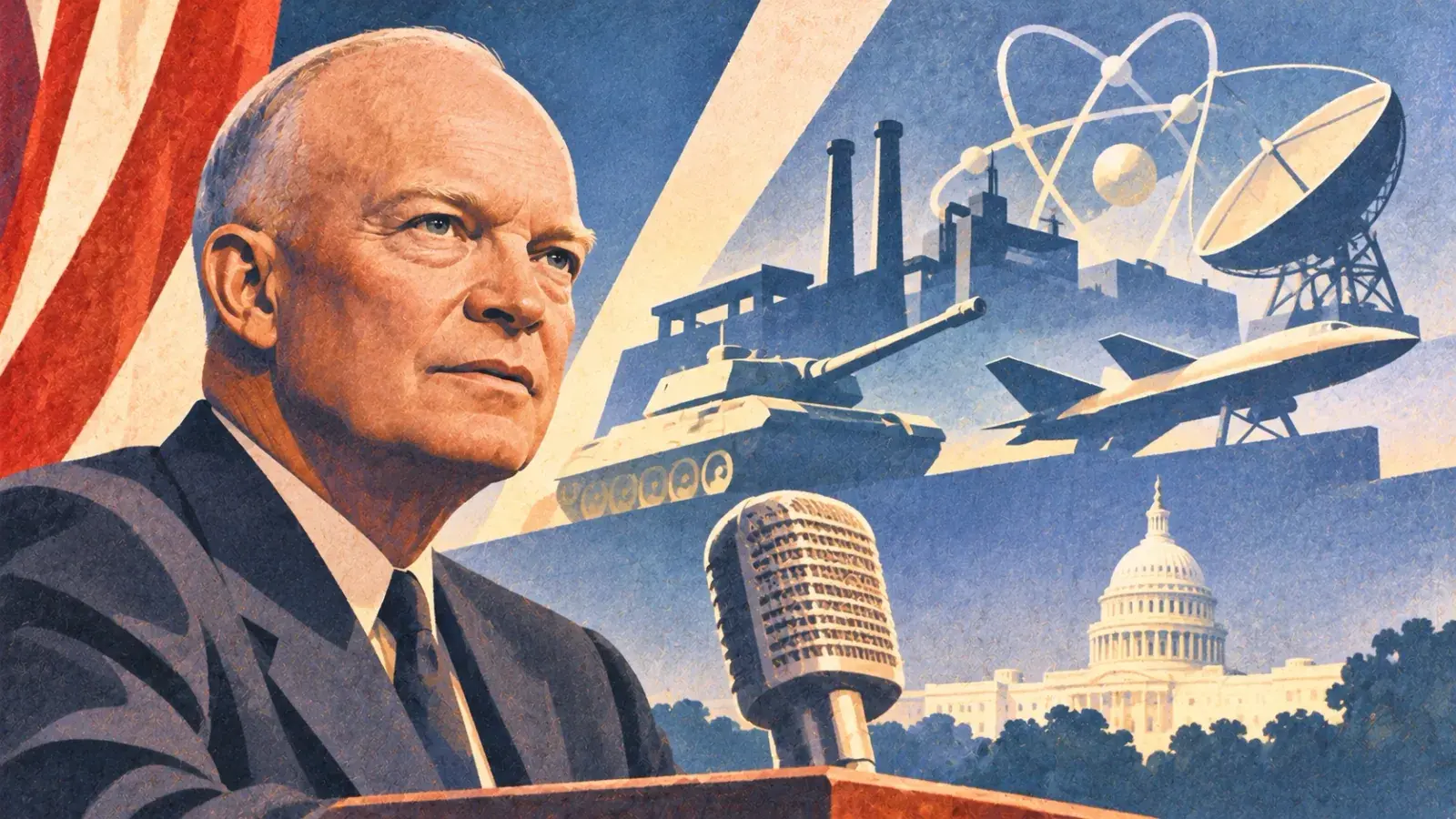
Eisenhower's farewell speech is the radio and television address Dwight D. Eisenhower gave from his office at 8:30 p.m. on January 17, 1961, three days before he handed the presidency to John F. Kennedy. It is remembered for one warning: “In the councils of government, we must guard against the acquisition of unwarranted influence, whether sought or unsought, by the military-industrial complex.” In context the sentence is not an attack on the armed forces. It comes a few paragraphs after Eisenhower insists that “Our arms must be mighty,” and it sits inside a speech whose real subject is balance.
The phrase names a pairing Eisenhower called new in the American experience: a large permanent military establishment and a large arms industry. He said the country needed both. What he asked citizens to watch was their combined influence on government, which could grow whether or not anyone set out to gain it. As the work of a president in office, the address is in the public domain. It is quoted here from the Public Papers text on the American Presidency Project, which numbers its parts.
The address at a glance
| Fact | Detail |
|---|---|
| FactDate and time | DetailTuesday, January 17, 1961, 8:30 p.m. |
| FactWhere | DetailThe President's office in the White House, on radio and television |
| FactLength | DetailUnder 10 minutes, by the National Archives' account |
| FactOccasion | DetailLeave-taking, three days before Kennedy's inauguration |
| FactStructure | DetailAn opening, then parts numbered II to VII in the published text |
| FactThe phrase | Detail“military-industrial complex,” in Part IV |
| FactThe other warning | Detail“the captive of a scientific-technological elite,” also in Part IV |
| FactKey word | Detail“Balance,” nine times: seven in Part III, one each in Parts IV and V, plus one “imbalance” |
The famous passage, step by step
Most quotations start at “In the councils of government.” The passage actually starts at the top of Part IV, several paragraphs earlier, and its order does much of the arguing.
1. The need
A vital element in keeping the peace is our military establishment. Our arms must be mighty, ready for instant action, so that no potential aggressor may be tempted to risk his own destruction.
The section opens with the case for a strong military, in terms a defender of the armed forces could have written. Opening with military readiness makes the warning that follows harder to dismiss as opposition to national defense.
2. What is new
Until the latest of our world conflicts, the United States had no armaments industry. American makers of plowshares could, with time and as required, make swords as well. But now we can no longer risk emergency improvisation of national defense; we have been compelled to create a permanent armaments industry of vast proportions. Added to this, three and a half million men and women are directly engaged in the defense establishment. We annually spend on military security more than the net income of all United States corporations.
The plowshares and swords turn Isaiah's prophecy around. In the King James Version the nations “shall beat their swords into plowshares” (Isaiah 2:4); in Eisenhower's America the plowshare makers could once turn to swords when needed and then go back. That was the old arrangement. The new one is permanent, and he measures it twice, in people and in money, with figures any listener could grasp.
3. The assessment
This conjunction of an immense military establishment and a large arms industry is new in the American experience. The total influence—economic, political, even spiritual—is felt in every city, every State house, every office of the Federal government. We recognize the imperative need for this development. Yet we must not fail to comprehend its grave implications. Our toil, resources and livelihood are all involved; so is the very structure of our society.
Notice the order: the scale of the influence, then the need again (“We recognize the imperative need”), then “Yet.” Eisenhower concedes twice before he warns once. The triple “economic, political, even spiritual” climbs to its strongest word with “even,” and “every city, every State house, every office” moves from the local to the federal in three steps.
4. The warning and the remedy
In the councils of government, we must guard against the acquisition of unwarranted influence, whether sought or unsought, by the military-industrial complex. The potential for the disastrous rise of misplaced power exists and will persist.
We must never let the weight of this combination endanger our liberties or democratic processes. We should take nothing for granted. Only an alert and knowledgeable citizenry can compel the proper meshing of the huge industrial and military machinery of defense with our peaceful methods and goals, so that security and liberty may prosper together.
Three choices shape the warning. The first is “whether sought or unsought.” The phrase makes room for influence that nobody set out to gain, so the warning covers how an arrangement works as well as anyone's intentions, and a listener can take it seriously without first deciding who is to blame. The second is the name. “Complex” turns a description into a thing, a single noun a listener can carry off, and the hyphen fuses two institutions into one. The third is the remedy. He does not propose a law. He hands the job to “an alert and knowledgeable citizenry,” and he ends on a pairing rather than a victory: “security and liberty may prosper together.”
Eisenhower concedes the need twice before he warns once.
The second warning: research and money
The next paragraphs, less quoted, carry the same logic into science. “Akin to, and largely responsible for the sweeping changes in our industrial-military posture, has been the technological revolution during recent decades.” Research had become expensive and government-funded. “Partly because of the huge costs involved, a government contract becomes virtually a substitute for intellectual curiosity. For every old blackboard there are now hundreds of new electronic computers.”
Then the warning cuts both ways. First the danger to scholars: “The prospect of domination of the nation's scholars by Federal employment, project allocations, and the power of money is ever present—and is gravely to be regarded.” Then the danger from them: “Yet, in holding scientific research and discovery in respect, as we should, we must also be alert to the equal and opposite danger that public policy could itself become the captive of a scientific-technological elite.”
“Equal and opposite” is a phrase from physics, and it describes the structure exactly: one danger, then its mirror image, each given the same weight. The section closes on the job Eisenhower assigns to leaders: “It is the task of statesmanship to mold, to balance, and to integrate these and other forces, new and old, within the principles of our democratic system—ever aiming toward the supreme goals of our free society.”
Where the warning sits in the speech
The published text numbers its parts, which is unusual for a speech and shows how deliberately it was assembled.
| Part | What Eisenhower does | Key line |
|---|---|---|
| PartOpening | What Eisenhower doesTakes leave, reflects on his relations with Congress, wishes his successor well | Key line“a message of leave-taking and farewell” |
| PartII | What Eisenhower doesPlaces the country in its century | Key line“a century that has witnessed four major wars among great nations” |
| PartIII | What Eisenhower doesNames the threat abroad and the temptation of the costly quick fix. Asks for balance | Key line“Good judgment seeks balance and progress” |
| PartIV | What Eisenhower doesDefends a strong military, then warns about its influence and about captured research | Key line“the military-industrial complex” |
| PartV | What Eisenhower doesApplies balance to time: do not spend the future | Key line“the insolvent phantom of tomorrow” |
| PartVI | What Eisenhower doesHopes for trust among nations and disarmament; admits disappointment | Key line“a continuing imperative” |
| PartVII | What Eisenhower doesThanks the country and closes with a prayer | Key line“in this my last good night to you as your President” |
Read in order, the parts make one argument, and the famous warning is one application of it. Part III states the principle: “each proposal must be weighed in the light of a broader consideration: the need to maintain balance in and among national programs.” It then lists the balances, between “the private and the public economy,” between “cost and hoped for advantage,” between “the clearly necessary and the comfortably desirable.” Part IV applies the principle to defense and research, Part V to time, Part VI to the world. Seen that way, the warning sounds measured rather than alarmed: it applies a rule the speech has already set out.
Just before the list, Part III explains why Eisenhower thought the rule needed saying: “Crises there will continue to be. In meeting them, whether foreign or domestic, great or small, there is a recurring temptation to feel that some spectacular and costly action could become the miraculous solution to all current difficulties.” The same part holds the maxim that sums up the speech: “Good judgment seeks balance and progress; lack of it eventually finds imbalance and frustration.”
How the warning persuades
The speaker's record does part of the work. A warning about the military carries particular weight from a former general, and Eisenhower draws on that without boasting. He reminds the audience of “half a century in the service of our country,” and later speaks “as one who has witnessed the horror and the lingering sadness of war.” In the terms of ethos, pathos and logos, the ethos is biographical and the logos is balance.
The tone is a briefing, not a sermon. The sentences are mostly plain declaratives: “We should take nothing for granted.” “Crises there will continue to be.” The rare images are domestic and concrete: plowshares, blackboards, a mortgage. In Part V he puts the long-term argument in a household's terms: “We cannot mortgage the material assets of our grandchildren without risking the loss also of their political and spiritual heritage. We want democracy to survive for all generations to come, not to become the insolvent phantom of tomorrow.”
It admits failure. Part VI is unusual for a farewell: “I confess that I lay down my official responsibilities in this field with a definite sense of disappointment.” The confession makes the warnings sound like the conclusions of experience rather than self-congratulation. The tone holds to the end. The opening lines are a plain leave-taking, and the close is a prayer for peace; both are quoted and analyzed in our guides to speech introductions and speech conclusions.
How the address came together
Eisenhower planned this speech for a long time. The Eisenhower Library's online documents on the address start with a memo for the record about a “last speech” dated May 20, 1959, twenty months before the broadcast, and a letter to his brother Milton about a farewell address five days later.
| Date | Document |
|---|---|
| DateMay 20, 1959 | DocumentMemo for the record regarding a last speech |
| DateMay 24–25, 1959 | DocumentA memo from Malcolm Moos on presidential speeches; a letter to Milton Eisenhower on the farewell address |
| DateApril 5, 1960 | DocumentA memo on George Washington's Farewell Address |
| DateOctober 31, 1960 | DocumentA memorandum for the file on the 1961 State of the Union |
| DateDecember 21, 1960 | DocumentA speech draft |
| DateJanuary 6–16, 1961 | DocumentEight draft versions annotated by Eisenhower |
| DateJanuary 7, 1961 | DocumentA draft with handwritten editing by Milton Eisenhower |
| DateJanuary 17, 1961 | DocumentPress release with the text; the broadcast |
Two details in that list are worth a second look. The file includes a memo on Washington's 1796 farewell, the first a president addressed to the country (our analysis of Washington's Farewell Address shows the model: warnings framed as the advice of a departing friend). And the speech was a family project as well as a staff one: Milton Eisenhower edited a draft by hand ten days before the broadcast.
The speechwriters Malcolm Moos and Ralph Williams worked on the drafts. The library's subject guide to the address lists 21 drafts annotated by speechwriters, eight more versions the president marked up himself between January 6 and 16, and Williams's letters from 1985 to 1988 on writing the speech and the origins of the phrase. Drafts made public in December 2010 show the phrase itself being revised. According to the New York Times report on their release, early versions warned of a “war-based industrial complex” and a later one of a “vast military-industrial complex,” before the shorter form he spoke.
How the phrase outlived the speech
The National Archives notes that listeners expecting a nostalgic old-soldier farewell, of the kind General Douglas MacArthur had given, were surprised by the warnings. The Eisenhower Library's documents trace what happened next. In March 1961 Bryce Harlow sent Eisenhower and Richard Nixon a memo on how Congress had reacted. In January 1966 the chairman of the American Veterans Committee's “Special Committee on Military-Industrial Complex” wrote to the former president, and two days later the Senate side of the Congressional Record carried an item titled “Significance of President Eisenhower's Speech on the Military-Industrial Complex.” Eisenhower answered the committee in February, and he was still answering letters about the speech in 1967.
Within five years, in other words, the phrase had a committee named after it, a sign that the coinage had stuck. It had also left its context behind. The sentences around it, “Our arms must be mighty” a few paragraphs before and “security and liberty may prosper together” just after, rarely travel with it.
Three days after the broadcast, Kennedy's inaugural address set a very different tone, a young president's pledge to “pay any price, bear any burden.” Read together, the two speeches show how much the speaker's position can shape a text: one man leaving power and weighing costs, the other arriving and making promises. Our analysis of Kennedy's inaugural reads it the same way this page reads Eisenhower.
What writers can take from it
- Concede before you warn. Eisenhower grants the need for a strong military twice before he names the danger. Starting from what the audience already accepts can make a disagreement easier to hear.
- Give the problem a name. A compound noun is easier to repeat than a paragraph. If your argument has a name, people can carry it out of the room.
- Measure it. Three and a half million people, and more than the net income of all US corporations: two figures in ordinary units let listeners judge the scale for themselves.
- Make room for the unintended. “Whether sought or unsought” covers influence nobody planned, so listeners can weigh the problem without first having to defend anyone's motives.
- Give the warning its mirror when balance is the point. The danger to research comes with its “equal and opposite” danger. In a speech that asks for balance, a two-sided warning practices what it recommends.
We need the audience data. It tells us which stories readers finish, and it paid for two new reporters this year. But the dashboard now sits in every meeting, every pitch and every edit, and nobody chose that; it just happened. I'd call it the metrics habit. Keep the numbers, and keep an editor in the room who can say no to them.
Need first, the scale of the influence second, “nobody chose that” as the version of “whether sought or unsought,” a name for the problem, and a remedy that hands responsibility to people rather than a policy.
If you draft a warning like this in Strokes, ask the Strokes Assistant to list what the draft concedes before it warns, in order. If the list starts with the danger, your draft runs in the opposite order from Eisenhower's.
Frequently asked questions
What did Eisenhower mean by the military-industrial complex?
The combination of a large permanent military establishment and a large arms industry, which he called new in the American experience. He said the country needed both, but warned that together they could gain “unwarranted influence, whether sought or unsought,” over government, and that only “an alert and knowledgeable citizenry” could keep security and liberty prospering together.
Was Eisenhower against the military in his farewell speech?
No. The section opens with “Our arms must be mighty, ready for instant action,” and he says, “We recognize the imperative need for this development.” His concern was influence: that the combined weight of the armed forces and the arms industry could endanger “our liberties or democratic processes” if citizens did not keep watch.
What is the scientific-technological elite in Eisenhower's speech?
It is the second warning in the speech, and it runs both ways. Eisenhower worried that government money could dominate the nation's scholars, and also that public policy could “become the captive of a scientific-technological elite.” He called the second the “equal and opposite danger” and gave statesmanship the job of balancing such forces.
Who wrote Eisenhower's farewell address?
Eisenhower worked on it with his speechwriters, including Malcolm Moos and Ralph Williams, and with his brother Milton Eisenhower, who edited a January 7, 1961 draft by hand. The Eisenhower Library holds 21 drafts annotated by the speechwriters and eight more versions from January 6 to 16 that Eisenhower marked up himself. Planning papers date back to May 1959.