When to use it
- A faculty job application that asks for a statement of teaching philosophy
- A lecturer, adjunct or teaching postdoc application
- The opening document of a teaching portfolio
- A tenure or promotion file that asks you to reflect on your teaching
- Working out what you believe before you design a new course
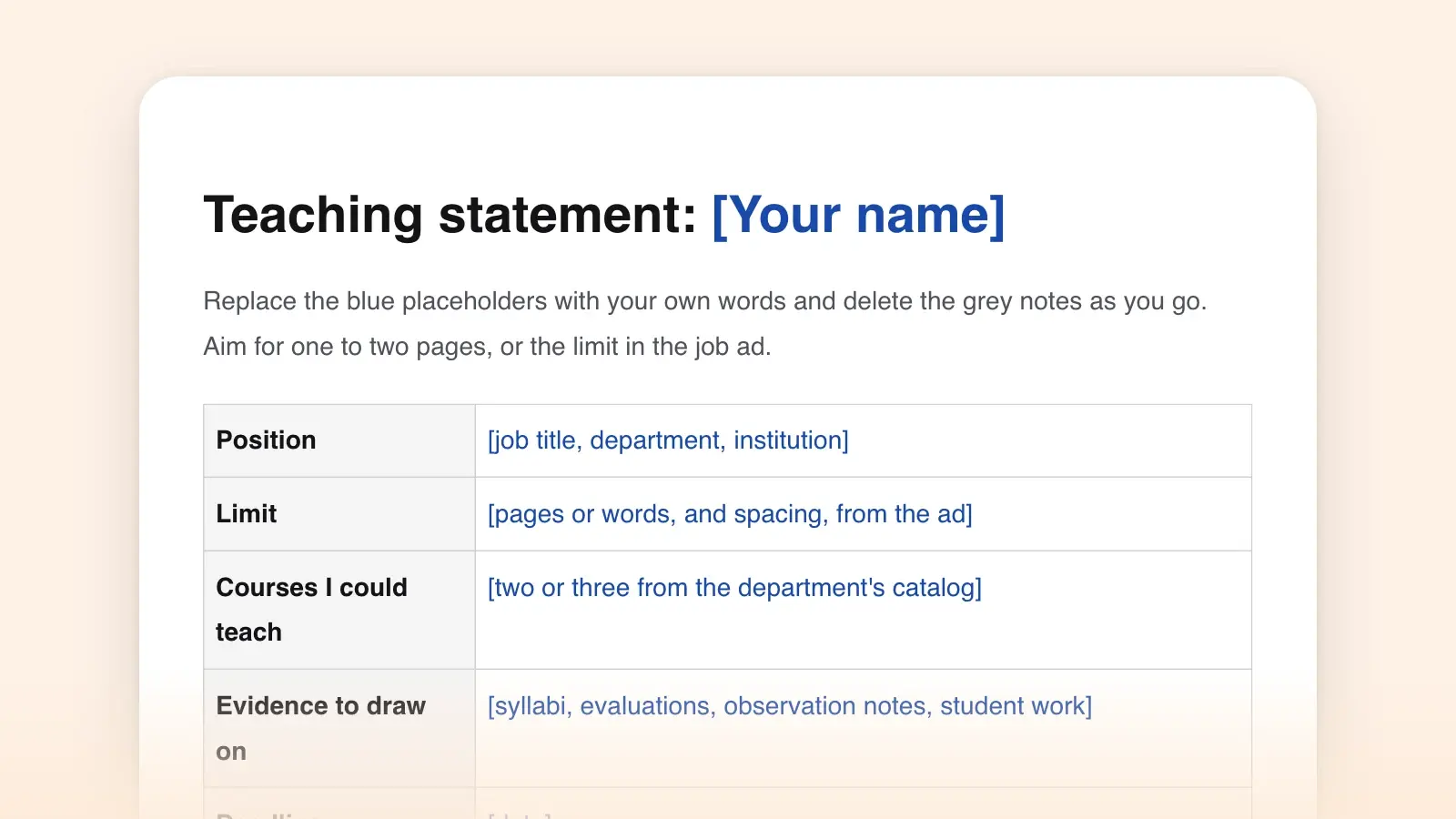
A teaching philosophy statement, usually called a teaching statement, is a one-to-two-page essay in the first person that sets out what you believe about how students learn, how you teach because of it, and how you know it works. Faculty search committees often ask for one, and many universities ask again at tenure and promotion. Strong statements back each belief with a classroom practice and a piece of evidence. Below: a fill-in template, a full annotated example and five shorter samples by field and career stage.
How to use this template
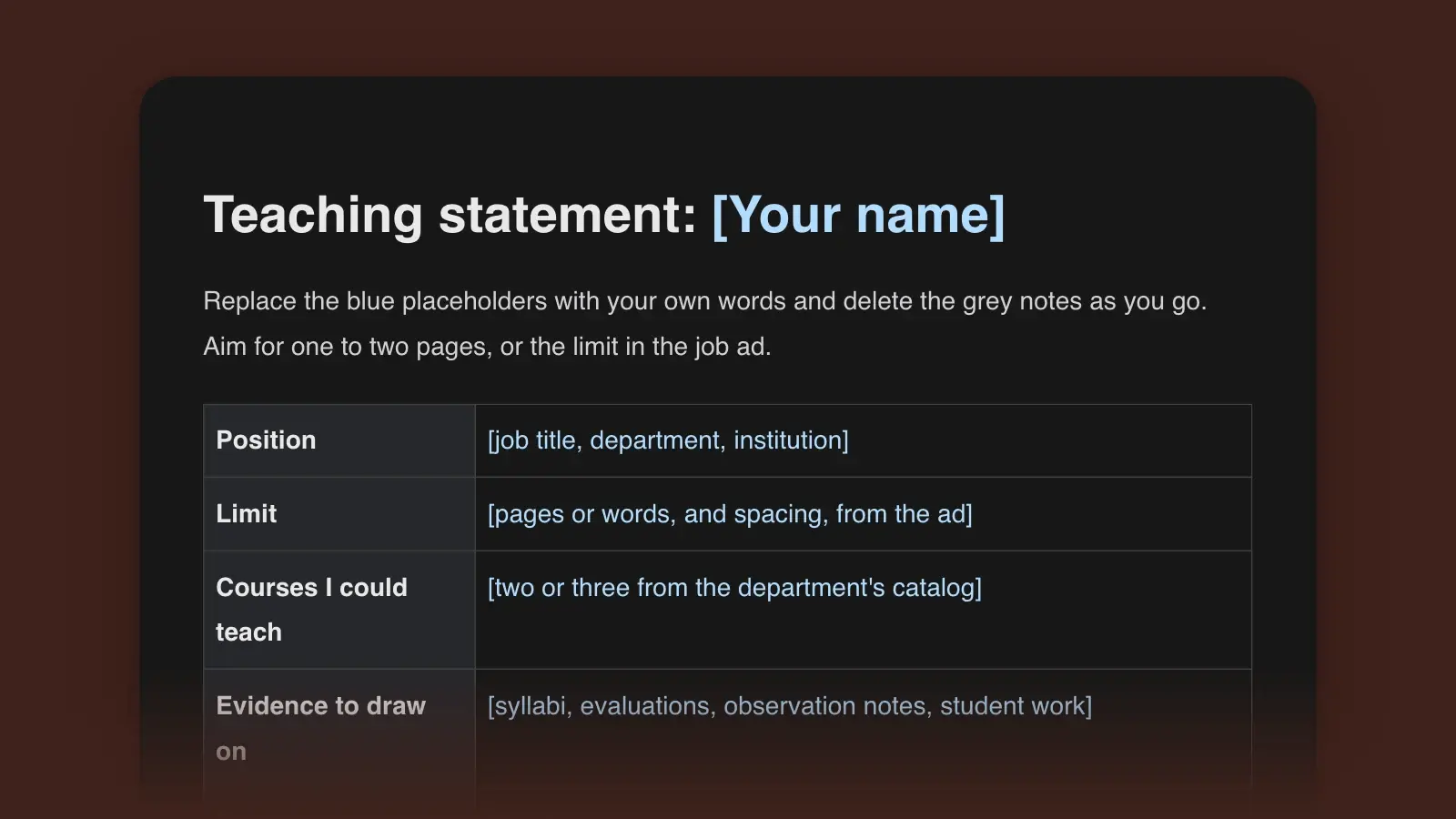
Click Use this template and the fill-in version opens in Strokes as a document you can edit and export.
- Gather the evidence first
Syllabi, an assignment you designed, lines from evaluations, an observation report, a course you changed and what happened next. A belief you can't attach to anything in that pile probably doesn't belong in the statement.
- Give each belief a practice and a proof
The template gives every theme three lines: what you believe, what you do in class because of it, and how you know it works. Two or three themes fill the space; a fourth often repeats one of them. Once you have a draft, attach your evaluation excerpts and observation notes in a chat with the Strokes Assistant and ask which belief in the statement has nothing behind it.
- Open with a moment or a claim
A student's question, a scene from class, or a claim about your discipline that a colleague could dispute. Not a quotation, and not how much you love teaching.
- Tailor the last section to the job
Name courses from the department's catalog you could teach and one you would build; the course outline template helps you sketch it before you promise it. The fit argument for the whole application belongs in your cover letter.
- Test it on an outsider, then cut
A committee may include people outside your subfield. Give the draft to one such reader, ask a colleague to check your field's terms, then cut to the limit in the ad.
What goes in a teaching statement
University guides list much the same parts. Cornell's Graduate School names four: your goals for students, your teaching methods, how you assess student learning and how you assess your own teaching. The University of Minnesota's teaching center adds interactions with students, an inclusive learning environment, professional growth and your approach to generative AI. The template follows that order.
| Section | What it answers | Rough length |
|---|---|---|
| SectionOpening | What it answersYour central idea about learning, shown in one moment | Rough lengthOne paragraph |
| SectionGoals for students | What it answersWhat students should know, do and care about afterward | Rough lengthA few sentences |
| SectionHow you teach (two or three themes) | What it answersFor each: the belief, the practice, the evidence | Rough lengthHalf the statement |
| SectionAssessment and feedback | What it answersHow you find out what students learned, and what you do next | Rough lengthOne paragraph |
| SectionInclusive teaching | What it answersHow you teach students with different backgrounds and preparation | Rough lengthOne paragraph, or woven into the themes |
| SectionImproving your teaching | What it answersWhat you changed after feedback or an observation | Rough lengthOne paragraph |
| SectionTeaching here | What it answersCourses you could teach or build at this institution | Rough lengthA short paragraph |
Cornell advises present tense and the first person in most cases and gives one to two pages as the usual length, as does Penn's career services. Minnesota's center says "usually one to two double-spaced pages," so follow the ad on spacing. The University of Michigan's Center for Research on Learning and Teaching (CRLT) publishes a rubric for evaluating these statements; its categories are goals for student learning, teaching methods, assessment of student learning, creating an inclusive learning environment, and structure, rhetoric and language. If the application also wants a sample syllabus, the syllabus template covers it.
Teaching philosophy statement example
A complete statement for an invented candidate: a sociology PhD who has taught statistics as instructor of record, applying to a teaching-focused liberal arts college. About 520 words.
On the first day of Social Statistics, I ask every student to bring me a number they don't trust. I believe students learn a method when it settles a question they already have, so the numbers come back in week 9, when each student tests theirs and explains in two sentences whether it holds. Last fall a nursing major brought a letter from her landlord: “Average rent in this building rose only 3 percent.” In week 9 she showed how that average hid the units that rose 20 percent. That is what I want from a statistics course: students who use the method to settle a question they care about, and who can say why the answer holds.
Start from a question, not a formula. Every unit opens with a question built on public data, such as whether some bus routes run late more often than others, and the formula arrives when the question needs it. In the final project, pairs of students choose a question, find a dataset and present to a community partner. Two students presented their analysis of branch library hours to the county library board last spring.
Make thinking visible, often and at low stakes. Students end each class by writing the least clear point on an index card, and I open the next class with the three most common confusions. Both midterms are two-stage exams: students take the exam alone, then again in groups of three for a share of the grade. The group stage is the loudest twenty minutes of the semester, and the arguments are about the right things.
Teach the students who are in the room. Most of my students work twenty hours a week or more, and many are the first in their families at college. So every problem set has a ten-minute walk-through video, every student gets two 48-hour extensions with no questions asked, and one weekly student hour is at 7 p.m. in the library. More students came to it than to the afternoon hour. When a student who uses a screen reader enrolled, I gave every chart a table behind it, which also helped everyone who studies on a phone.
How I know it works, and what I've changed. Students should leave able to choose a test, run it in R and explain the result in two sentences a city council member would understand; the project rubric scores all three. Mid-semester feedback told me I talked too long, so no explanation of mine now runs past twelve minutes, and my score for “I felt comfortable asking questions” rose from 3.9 to 4.5 out of 5 the next term.
Teaching at Wrenfield. I am ready to teach Social Statistics and Research Methods, and I would like to build an upper-level seminar, Counting the City, in which students analyze local data with a city office or nonprofit. I have advised four honors theses and would welcome Wrenfield seniors who want to work with public data.
Statistics has a reputation as the course students survive. I want it to be the one where they learned to check a number for themselves.
What makes it work: the opening states one belief about learning, the practice that follows from it and the week-9 check that shows whether it worked. Each theme then pairs a claim with a practice and a proof, such as a presentation to a real board or an evaluation score that moved. Inclusive teaching appears as policies for specific students. The statement admits a weakness and the fix, which Penn's career services says is fine when you show how feedback helped you improve, and it ends on the college's own courses.
Teaching statement samples by field
The structure holds across disciplines. What changes is the evidence each field trusts. Each sample is one paragraph from a longer statement.
In week three of my genetics lab, a third of the crosses produce offspring nobody's Punnett square predicted. That week is designed: students who never see an experiment go wrong learn to treat the protocol as the science. Each group proposes what happened, tests it and writes a one-page methods note graded on reasoning, not on the answer. In the term survey, 41 of 52 students named that week as when they understood what a control is for.
One designed moment carries the belief, and the students supply the evidence.
I teach students to argue with a sentence. Each seminar opens with one sentence from the week's novel and ten minutes of writing about what it does that a plainer sentence couldn't. After midterm, students pick the sentence. Final essays start the same way: one sentence, read closely, carrying an argument about the whole book.
The first line is a claim a colleague could dispute, and the practice is visible down to the minute.
Most of my piano students arrive able to play the notes and afraid of a wrong one. Lessons start with two minutes of improvising around the week's hardest passage, because a student who can play around a hard bar stops fearing it. Each semester ends with a studio class of pieces in progress, where every listener offers one observation and one question.
One-to-one teaching has no grade distribution to cite, so the evidence is a routine a committee could watch.
The most dangerous sentence a nursing student can say is “I didn't want to bother anyone.” My simulation debriefs are built around it: students say what they noticed, what they decided and whom they would have called, in that order, and I grade the reasoning as well as the outcome. By the end of the rotation, every student in my last two clinical groups had raised a real concern with a nurse on their own.
It opens on the stakes of the profession, and the evidence is behavior on the unit.
Sample with little teaching experience
If you have taught recitations or labs rather than whole courses, the task is to make a short record specific.
I have not yet designed a course, but I have taught fourteen recitation sections of Calculus I, and that is where I learned what I believe about teaching: students learn more from examining a wrong first step than from watching a right one. I stopped re-solving the lecture's problems and began each section with a problem students tried before I said anything, then put the three most common wrong first steps on the board and asked why each looked right. I keep a weekly tally of those wrong first steps, and the course coordinator observed the routine in my second semester; her report is in my teaching portfolio.
It names the limit once, without apologizing, and backs the method with evidence a TA really has: a weekly record of students' first steps and an observation report a committee can ask to see. It claims no score gains, which a recitation leader couldn't separate from the lecture. A tenure or promotion statement uses the same structure with different evidence: what you believed at your last review, what you changed since, and what happened to your students as a result.
Strong and weak openings
Your statement is read alongside every other candidate's, so the first lines carry extra weight. The fiction writer's rule, show, don't tell, applies: a classroom moment shows what a sentence about your beliefs only claims.
Openings that work
- A moment from your classroom that shows your main belief
- A claim about your discipline a colleague could dispute
- A student's question or mistake, and what you did with it
- A number with a story behind it
Openings to avoid
- A quotation from a famous teacher or philosopher
- “I have always been passionate about teaching.”
- “Students learn best when they are actively engaged,” which every statement says
- A dictionary definition of education
Tips and common mistakes
- Beliefs with no practice. Cornell's guide warns against concepts that are "idyllic but empty." Every belief needs something you do on a Tuesday because of it.
- Your CV in paragraphs. The list of courses belongs in the CV. The statement picks one and shows it.
- Sweeping claims. Cornell's example is declaring that students don't learn through lecture. Say when you lecture, for how long and why.
- Complaints about bad teachers. Penn's career services says the statement is not the place for them.
- A borrowed philosophy. Penn warns against echoing your advisor, and CRLT reminds readers that copying a sample is plagiarism. Draft yours before you read others.
- Buzzwords. "Student-centered" tells a committee little until you describe what the students do.
What do search committees look for? A CRLT survey of search committee chairs (Meizlish and Kaplan, The Journal of Higher Education, 2008), as summarized by Minnesota's teaching center, found five elements shared by strong statements: evidence of practice with specific examples, a focus on students, reflection, a sense that the writer values teaching, and clear, readable prose. For the feedback paragraph, the student feedback examples show what specific language sounds like.
Frequently asked questions
How long should a teaching philosophy statement be?
One to two pages, according to Cornell's Graduate School and Penn's career services; the University of Minnesota's teaching center says usually one to two double-spaced pages. The job ad overrides all of them. With a one-page limit, keep the opening, two themes with evidence and a short paragraph on the courses you would teach.
Should a teaching philosophy be written in first person?
Yes. Cornell's Graduate School recommends the first person and present tense in most cases, and the University of Minnesota's teaching center describes a confident, professional first-person tone. Use “I” for what you believe and do, and the past tense for specific stories, such as the semester you redesigned a course.
How do I write a teaching statement with no teaching experience?
Use the teaching you have done: recitations, labs, tutoring, writing-center shifts, mentoring undergraduates, guest lectures or workshops. Describe one in detail, say what it taught you, and explain how you would teach a specific course in the department's catalog. For evidence, use what you can show, such as an observation report or student feedback, rather than results you can't attribute to your own teaching.