When to use it
- Planned absences: a conference, a training day, an appointment you booked weeks ago
- An emergency sub folder kept in the office or by the door for the mornings you can't plan
- The first pages of a binder for a long-term sub during a leave
- A colleague or aide covering one period during their planning time
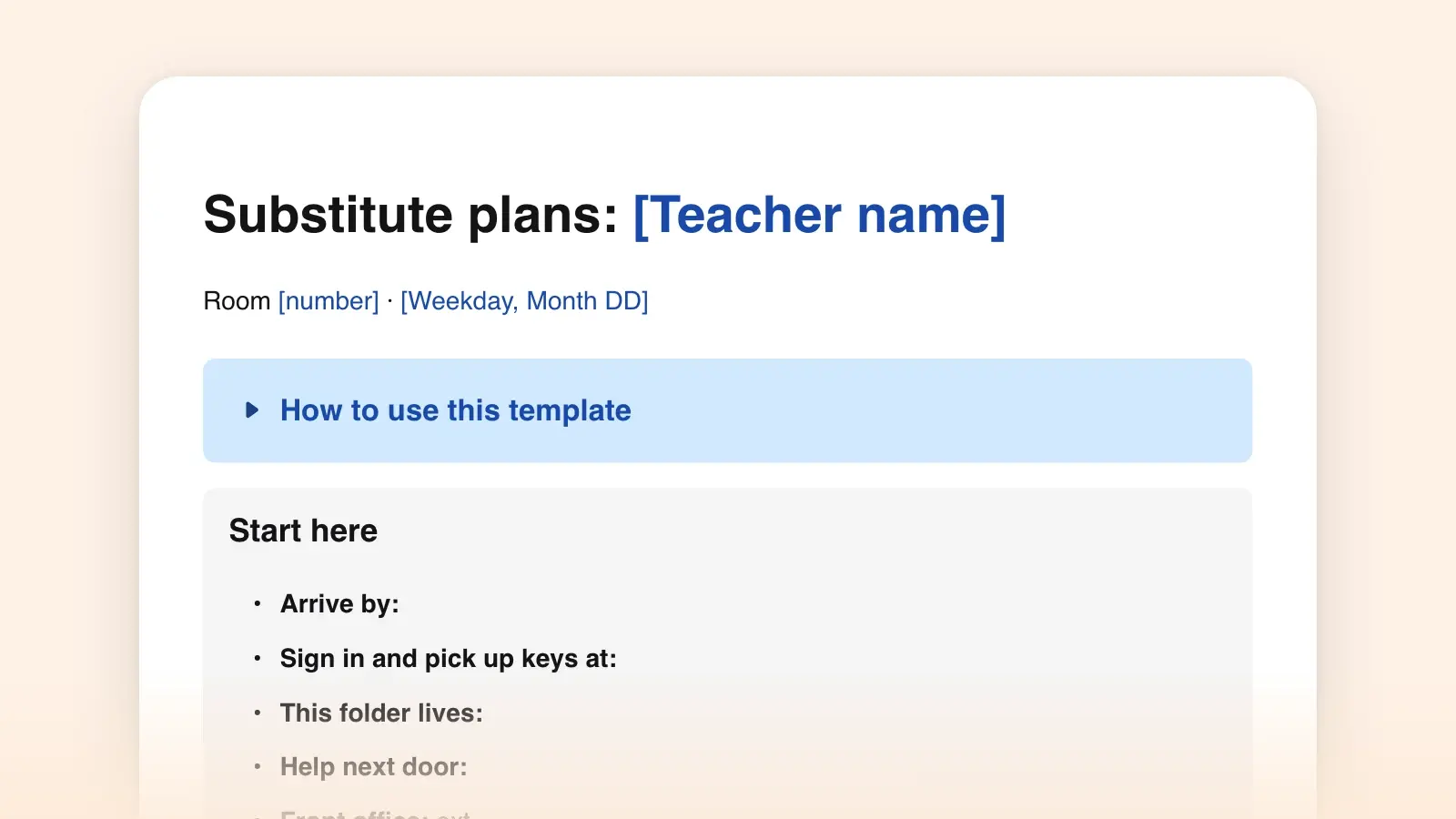
How to use this template
- Fill in the standing sections once
Most of the template stays the same all year: Start here, Routines, Seating charts and helpers, Students to know about, Behavior and Emergencies. Write those at the start of the semester, update them when rosters or seating charts change, and leave a copy with the front office. On the morning you wake up sick, only the schedule and the lesson plans are left to do, and an emergency set can cover even those.
- Write each day's plans as if you can't be reached
Fill in one lesson-plan block per class with minutes, materials and the exact location of every copy. Assume nobody can text you to ask where the worksheets are. Then read the page as a stranger would and circle anything that only makes sense if you know the room.
- Put it where the sub will look first
Print it and leave it in the center of your desk, labeled, with the seating charts and copies behind it. A PDF in someone's inbox is a backup, not a plan. The sub may not get school email or a network login on day one.
- Read the notes before first period
The last section is for the substitute. Read it the morning you return, follow up on the names in "Please follow up on" that day, and thank the students who helped. Classes notice when nobody asks what happened.
Write for a stranger
Most sub plans fail for the same reason: they are written in the teacher's own shorthand. "Do the warm-up" assumes the sub knows where the warm-up is, how long it takes and what students write it in. Every instruction should survive being read by a capable adult who arrived twenty minutes ago and has never met these students.
Clear to a stranger
- Warm-up is on slide 1 of the file named Monday sub on the desktop. Students write in the green notebooks in the bin under the window. Five minutes.
- Worksheets are in the blue folder marked Period 2, 28 copies, answer key behind them. Collect them in the Period 2 tray.
- Attendance is on paper: mark absences on the class list in this folder and send it to the office with the helper by 8:20.
- Maya may ask for a break. Let her walk to the water fountain and back. That is part of her plan.
Clear only to you
- Do the warm-up.
- Pass out the worksheet.
- Take attendance.
- Watch Maya.
Two habits do most of the work. Name the place for every object (the drawer, the folder, the file name), and give every activity a number of minutes. A sub who knows the reading takes 25 minutes knows to start the wrap-up at 8:45 instead of guessing.
Plans a substitute can actually teach
A sub day is not the day to introduce a new concept. Choose work that students can do with the directions on the page: practice on a skill they have already been taught, a reading with questions, a draft revision, a review game with the answers attached. Leave answer keys, because a sub who can check work can keep a class on task. Avoid anything that depends on a login only you have, a video that might be blocked on a guest account, or a discussion you would need to steer.
- Where we are: day 4 of the cells unit. Yesterday the class labeled plant and animal cell diagrams.
- Goal today: finish the reading "Cells Up Close" and answer questions 1–6 in full sentences.
- Materials: 28 copies in the blue folder, Period 3 tab, answer key behind them. Slides: P3 sub, on the desktop.
- Collect: worksheets, in the Period 3 tray.
- If time is left: the cell vocabulary crossword, stacked on the corner of my desk.
- 5 min. Warm-up on slide 1: "Name one thing a plant cell has that an animal cell doesn't." Students write in their science notebooks.
- 5 min. Read the directions on slide 2 aloud. Students may work with the person beside them, but each turns in their own sheet.
- 30 min. Reading and questions. If someone is stuck on question 4, point them to the diagram on page 2 rather than giving the answer.
- 7 min. Partners swap papers and check questions 1–3 against slide 3.
- 3 min. Stools up, worksheets passed to the end of each row, line up at the door. You dismiss the class, not the bell.
For emergency plans, the rule is stricter: the lesson cannot depend on where the class is in the unit. A short story with response questions, a skills review or a writing prompt works in October and in March. Keep a few days of these in the emergency folder, and swap them out each grading period so they don't repeat work the class has done since. The lesson plan template has the fuller version, with objectives and differentiation, for the days you are there to teach.
Students to know about, without oversharing
The sub needs to know what to do, not why. "Extended time on written work" is enough; the student's diagnosis is not. In the US, FERPA lets schools share student records with school officials who have a legitimate educational interest, and it expects schools to use reasonable methods to limit each official to the records they need. For a sub folder, that means the action from the IEP, 504 plan or health plan, and never the whole file. Your district's policy decides the details, so check it before you write the section.
| Instead of | Write |
|---|---|
| Instead of"Has ADHD, see IEP" | Write"May stand at the back table to work. Check in once at the halfway point." |
| Instead of"Anxiety, be careful" | Write"Don't call on him to read aloud. He will volunteer if he wants to." |
| Instead of"Diabetic" | Write"May eat a snack or go to the nurse at any time. Send a buddy with her." |
| Instead of"Behavior issues" | Write"Responds well to a quiet word at the desk, not in front of the class." |
Life-threatening allergies, seizure plans and anything else that needs a quick response go at the top of this table, and in the emergency folder too.
Emergency procedures in your school's words
A substitute may work in several buildings in a month, each with its own drills. Use the exact names your school announces over the speaker, and say what each one means in this room: which way to leave, where the class meets outside, how the door locks and where the key is. If your school uses the Standard Response Protocol from the I Love U Guys Foundation, the five actions are Hold, Secure, Lockdown, Evacuate and Shelter, and Lockdown comes with the directive "Locks, Lights, Out of Sight." List each action your school uses and what students do.
Put the class lists in the emergency folder itself. In an evacuation the sub takes attendance outside, and a list on the desk inside is no help. Mark the rows of students who leave the room during the day, so a student in a pull-out group isn't counted as missing.
Ask for notes you can use
"Kids were good" tells you nothing. The table at the end of the template asks for each class separately: who was absent, how much of the plan got done, and what happened. Names matter most. If a student refused to work in third period, you want that name in writing, so you can talk to the student the same day.
- Period 1: absent Jonah R. and Tess M. Finished the reading; most got to question 5. Quiet and on task.
- Period 3: no absences. Finished everything, including the crossword. Dev and Carla were very helpful with the attendance and the slides.
- Please follow up on: Owen B. used his phone after two reminders and left without his worksheet. I kept it on your desk.
- Messages: Mr. Lowe from the front office asked for the field trip forms by Friday.
Download the .docx to edit the template in Word or Google Docs; the schedule, routines, students and emergency sections come through as real tables you can print. For the comments you write on the collected work afterward, see these student feedback examples.
Frequently asked questions
What should be in a sub folder?
The day's schedule, class lists and seating charts, the main routines, a few students who can help, the students the sub needs to know about, emergency procedures with the evacuation map, and lesson plans with every material ready. Add a page for the substitute's notes back to you.
How many days of emergency sub plans should I keep?
Enough to cover the absences you can't plan for, which for most teachers means a few days of lessons that work at any point in the year. Some schools and districts require emergency plans on file with the office, so check your school's policy.
Should I leave a test for a substitute to give?
Usually not. Only you can answer students' questions about a test, and you won't know how it was supervised. Review, practice and reading assignments are safer choices for a sub day.
Can I use this as a substitute teacher report for notes back to the teacher?
Yes. The last section, Notes from the substitute, is a report form: one row per class for absences, how much of the plan got done and what happened, followed by helpers, names to follow up on and messages.