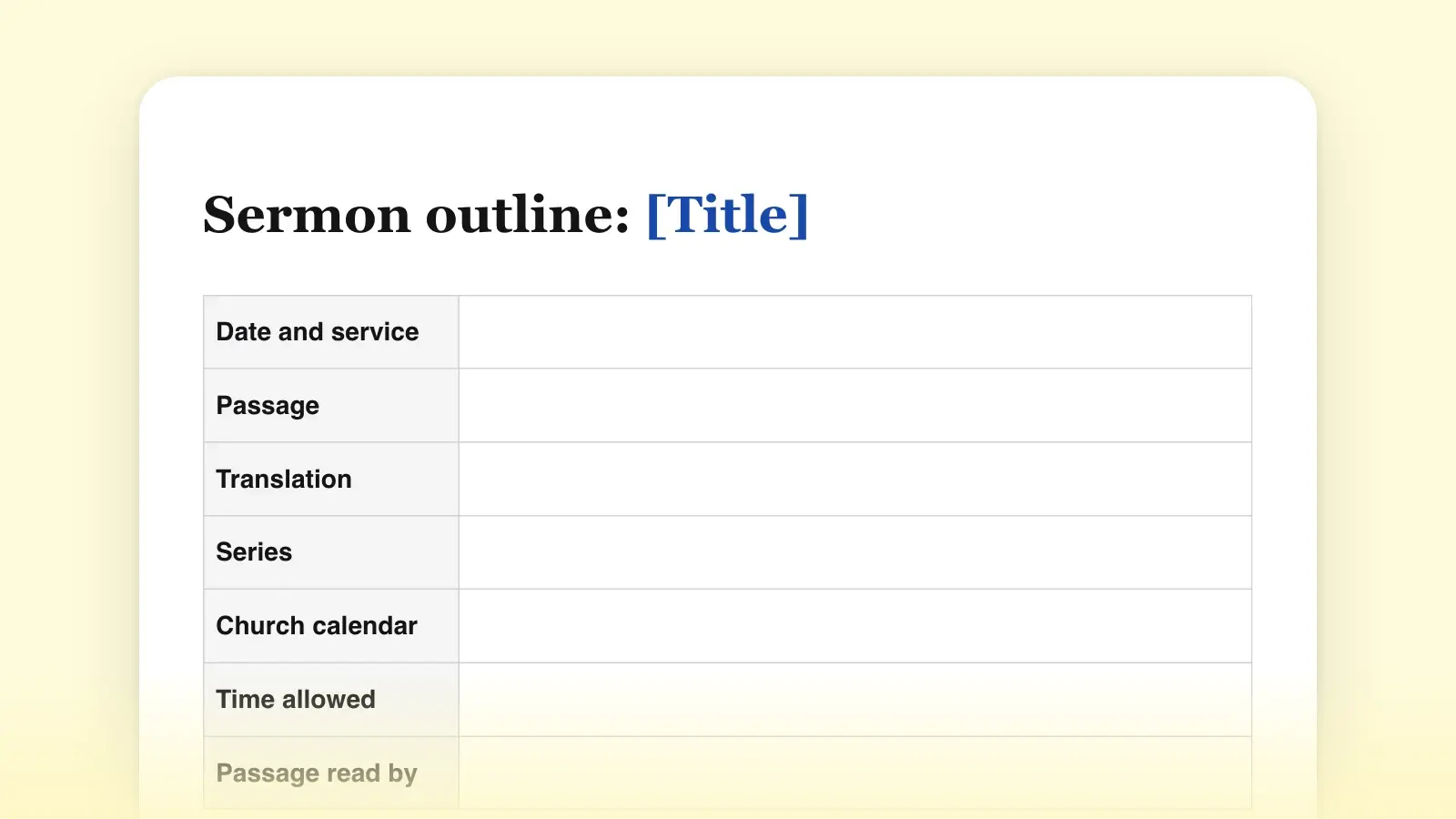
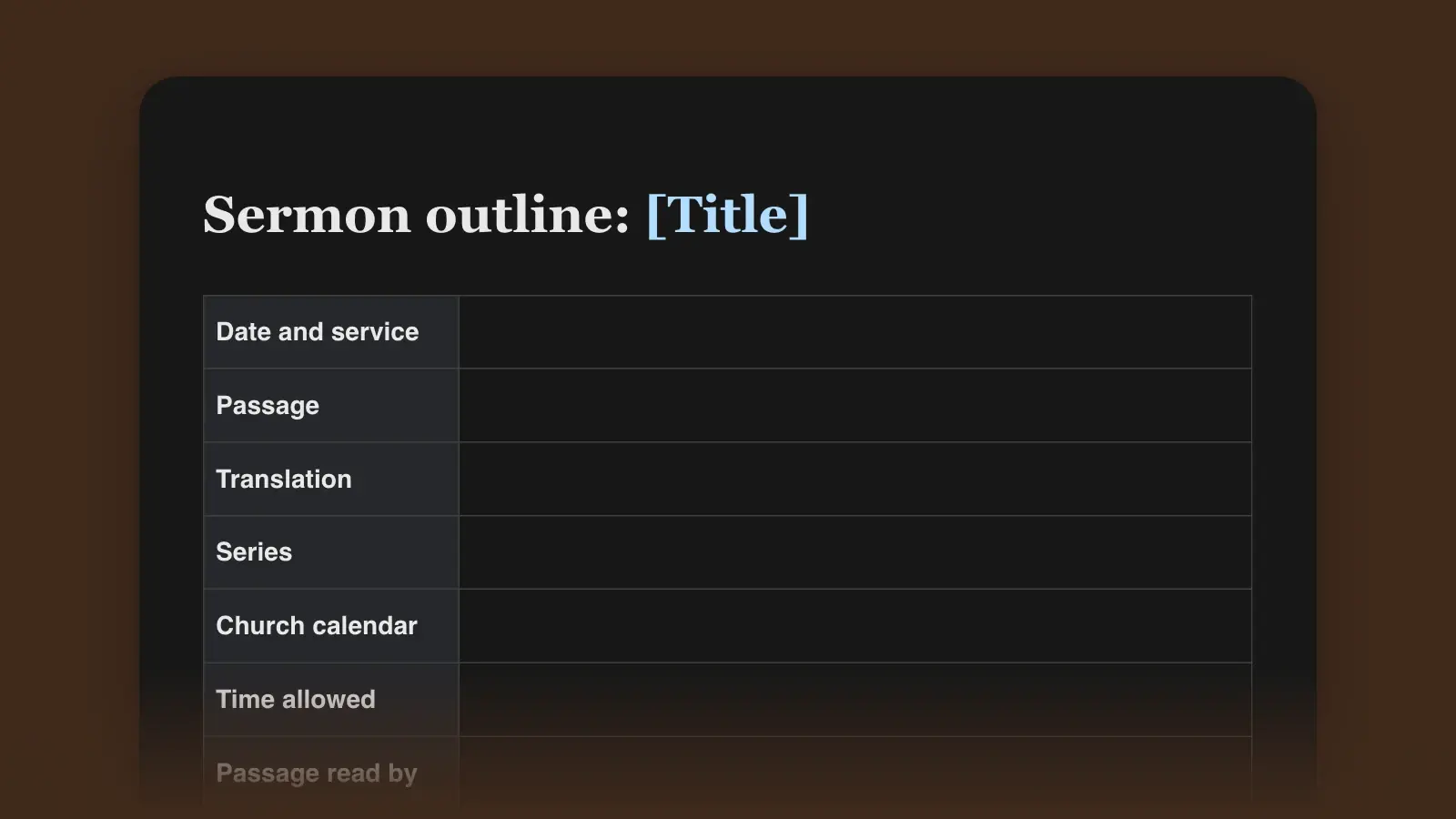
When to use it
- Sunday sermons on a single passage, or one week of a series through a book
- Homilies and short devotions where one idea has to land in ten or fifteen minutes
- Lay preachers and preaching students who hand in an outline before they preach
- Youth talks, chapel services, retreat sessions and small-group teaching
- A sermon archive: one outline per sermon, so you can see what you have preached on each passage
How to use this template
- Start with the text, not the outline
Fill in The text before you open a commentary. Read the passage aloud several times, in more than one translation if you can, and write down what repeats. In 1 Kings 19 God asks the same question twice, "What doest thou here, Elijah?" (verses 9 and 13), and Elijah gives the same answer twice. A repetition like that is a motif the writer wants you to notice. Then put the passage in your own words. Paraphrasing it is the quickest test of whether you understand it yet.
- Write the big idea in one sentence
Haddon Robinson's Biblical Preaching (1980) taught that a sermon should carry one idea, made of a subject and a complement. The subject is what the passage is talking about, put as a question. The complement is the passage's answer. Bryan Chapell's Christ-Centered Preaching adds a second check, the "fallen condition focus": the human condition the first hearers share with yours. The Need line holds it. If you can't write the sentence yet, you aren't ready to outline. You're still studying.
- Let the passage set the points
In a narrative the points usually follow the scenes, in a letter the moves of the argument, in a psalm the turns of the poem. Write each point as a full sentence in the present tense: "God feeds the exhausted before he gives them work," not "Elijah in the wilderness." Then fill in explain, illustrate and apply. A point you can't apply is probably part of another point's explanation.
- Write the opening and close last, then time it
Once you know where the sermon lands, write an opening that raises the need and a close that restates the big idea and asks for one response. Read the whole sermon aloud with a timer. At 130 to 150 words a minute, a 25-minute sermon is about 3,250 to 3,750 words of manuscript. If it runs long, cut a whole illustration rather than trimming sentences everywhere.
How long a sermon runs
Pew Research Center analyzed 49,719 sermons that 6,431 US churches posted online between April 7 and June 1, 2019. The median sermon ran 37 minutes, and tradition made a large difference.
| Tradition | Median length | Manuscript at 130–150 words a minute |
|---|---|---|
| TraditionCatholic | Median length14 minutes | Manuscript at 130–150 words a minute1,800–2,100 words |
| TraditionMainline Protestant | Median length25 minutes | Manuscript at 130–150 words a minute3,250–3,750 words |
| TraditionEvangelical Protestant | Median length39 minutes | Manuscript at 130–150 words a minute5,100–5,850 words |
| TraditionHistorically Black Protestant | Median length54 minutes | Manuscript at 130–150 words a minute7,000–8,100 words |
| TraditionAll sermons in the study | Median length37 minutes | Manuscript at 130–150 words a minute4,800–5,550 words |
The right length is the one your congregation and order of service expect. Write the minutes into Service details before you start, then budget them the way you would for a speech outline. A 25-minute slot might give the opening 3 minutes, each of three points 6 to 7 minutes and the conclusion 3. Pace varies by preacher, so let your own timed reading overrule the table.
Explanation, illustration, application
Outlines usually fail in the sub-points: three points of explanation and no application, or a good story that proves something the text doesn't say. Give each point all three, roughly in that order.
- Explanation is what the verses mean. Bring one detail from your study per point, the one that changes how the verse is heard. In 1 Kings 19 it matters that Elijah's collapse comes straight after his victory on Mount Carmel in chapter 18. The congregation doesn't need the rest of your word study.
- Illustration makes the point visible. Ordinary life usually works better than famous anecdotes, which listeners may have heard before and which often turn out not to be true. Check a story before you tell it, and ask before you tell one about someone in the room. The guide to sermon illustrations covers where to find them.
- Application says what changes, for whom and when. The application grid in the template puts the big idea to five kinds of listener, which keeps you from preaching only to people like yourself.
Specific
- Take the day off you have been skipping, and tell one person you are taking it
- Name someone who already shares the work you think you carry alone, and call them this week
Vague
- Rest in God
- Remember you are not alone
Say the big idea at every transition, in the same words. On paper it looks redundant. From a pew it is how people keep their place: a listener can't turn back a page, so repetition, the plainest of the rhetorical devices, does the work a heading does in print.
Choosing a sermon structure
The template assumes a deductive sermon: the big idea up front, points that unpack it. Other structures use the same parts in a different order.
| Structure | Where the points come from | Works well for |
|---|---|---|
| StructureExpository | Where the points come fromThe passage's own divisions: scenes, paragraphs, moves of an argument | Works well forPreaching through a book week by week |
| StructureTextual | Where the points come fromThe phrases of one or two verses | Works well forA short, dense text: a promise, a command, a blessing |
| StructureTopical | Where the points come fromOne subject, each point from a different passage | Works well forOccasions, doctrines, questions people are asking |
| StructureNarrative | Where the points come fromA plot, from a tension to its resolution | Works well forStories from the Gospels and the Old Testament |
| StructureInductive | Where the points come fromEvidence first; the big idea stated near the end | Works well forListeners who are skeptical or new to the Bible |
Eugene Lowry's The Homiletical Plot made the case for the narrative shape: a sermon that moves like the plot of a story. To outline one here, rename the points as scenes and hold the big idea for the last of them.
If your church follows the Revised Common Lectionary, the passage is chosen for you. It runs on a three-year cycle (Matthew in Year A, Mark in Year B, Luke in Year C) with four readings each Sunday: an Old Testament reading or Acts, a psalm, an epistle and a Gospel. Pick one to preach and note the others under The text; a line that ties them together often makes a good opening. Preaching straight through a book, the old practice of lectio continua, gives you context for free: last week's passage is this week's background.
Sermon outline example
An expository outline of 1 Kings 19:1–18 for a 25-minute slot. Quotations are from the King James Version, which is in the public domain in the United States.
Subject: What does God do with a servant who has quit?
Complement: He feeds him, lets him sleep, speaks quietly and sends him back with company.
Big idea: God meets the exhausted with bread and rest before he gives them work, and he never sends them alone.
Need: We treat exhaustion as a spiritual failure and act as if everything depends on us.
- Opening: A nurse finishes her third double shift of the week, sits in the hospital garage with the engine off, and can't make herself turn the key.
- Into the text: Elijah has just won the biggest public victory of his life on Mount Carmel. One threat from Jezebel, and he runs.
- Point 1, verses 1–4: Exhaustion often follows victory. Explain: he goes a day past Beersheba, leaves his servant behind and asks to die: "It is enough." Illustrate: the Monday after Easter, or after the move, the launch, the wedding. Apply: expect the crash after a big week, and don't read it as proof you have failed.
- Point 2, verses 5–8: God feeds before he speaks. Explain: twice an angel wakes him with "Arise and eat," and the second time gives the reason: "the journey is too great for thee" (verse 7). No rebuke, no lecture. Illustrate: the neighbor who left soup on the step and didn't stay to talk. Apply: treat sleep and meals as obedience, not as a reward for finishing.
- Point 3, verses 9–18: God speaks quietly and sends him back with company. Explain: the Lord is not in the wind, the earthquake or the fire, but in "a still small voice" (verse 12). Elijah insists "I, even I only, am left"; God answers with Elisha to work beside him and seven thousand who have not bowed to Baal (verses 16 and 18). Illustrate: the volunteer who finally shows a worn-out youth leader the sign-up sheet, with eleven names on it. Apply: call one person who already shares the work.
- Conclusion: Restate the big idea. Back to the garage: this time a coworker has left a sandwich and a note on the passenger seat. Response: take the rest you have been skipping, and tell one person you are taking it.
- Last line: "The journey is too great for you. That is why he sends bread first."
Each point is a sentence that could stand alone, each comes from specific verses, and the applications get more concrete as the sermon goes. The guide on how to write a sermon takes an outline like this through the manuscript and into delivery.
Frequently asked questions
What are the parts of a sermon outline?
The text, the big idea, an introduction, two to four main points and a conclusion. Each main point has an explanation of the verses, an illustration and an application. This template adds service details at the top, and an application grid and a checklist at the end.
How many points should a sermon have?
As many as the passage gives you. Three is common because it fits a 20- to 30-minute sermon and is easy to follow, but a narrative may have two scenes and a psalm five turns. If you have more than four, some are probably sub-points of others.
How long should a sermon be?
It depends on your tradition and your service. In Pew Research Center's 2019 study of sermons posted online, the median was 37 minutes: 14 for Catholic, 25 for mainline Protestant, 39 for evangelical Protestant and 54 for historically Black Protestant churches. Time your draft aloud against the slot you actually have.
What is the difference between a sermon and a homily?
A homily is usually shorter and stays close to the readings of the day; the Catholic Church calls the preaching at Mass a homily. Sermon is the broader word. The same outline works for both, and a homily often has a single point.