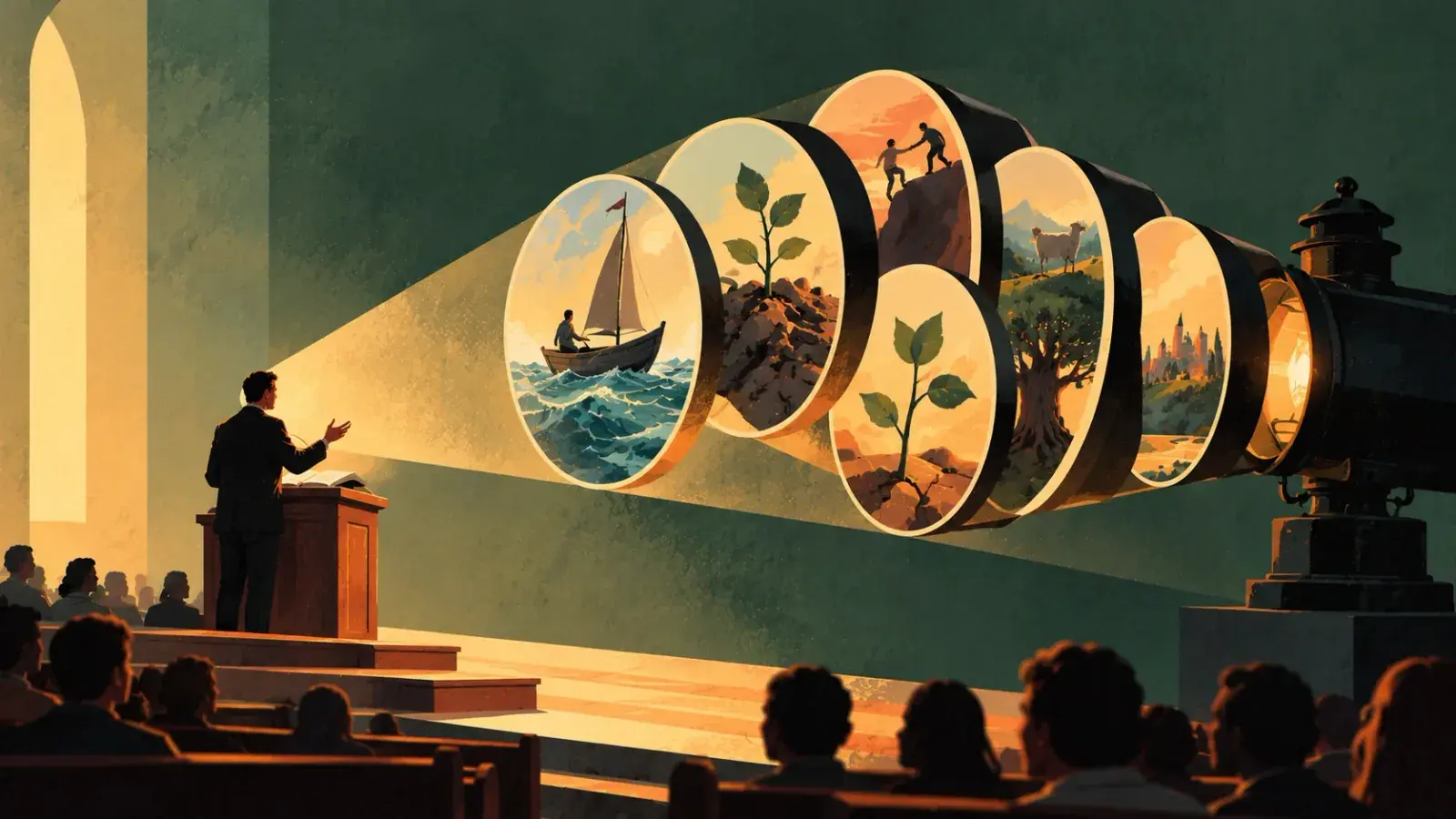
A sermon illustration is a story, image, comparison or fact that makes one point of a sermon concrete enough to see. The best ones come from your own week, from Scripture itself, from history you can verify and from older books that are free to quote. Illustration libraries help when you are stuck. Whatever the source, check that the story is true, ask before you tell anyone's private story, and tie every illustration back to the text in a sentence.
What an illustration is for
Charles Spurgeon lectured on this to the students of his Pastors' College in London. The lectures were published in 1894 as The Art of Illustration. A preacher, he said, can make hearers "see our meaning by opening a window and letting in the pleasant light of analogy." He set the limit in the same lecture: "Illustrate, by all means, but do not let the sermon be all illustrations."
So an illustration has a narrow job: it helps the explanation of the text land, never replaces it. It explains (an analogy for adoption), proves (an example from history), applies (obedience on a Tuesday at work) or fixes the point in memory.
Illustrations also carry feeling, which is where the risk is. A story that moves a room is working on pathos, one of the three classical appeals, and pathos without a point is manipulation. If people leave in tears and nobody can tell you what the passage said, the illustration won.
| Kind | Good for | Watch for |
|---|---|---|
| KindTrue story | Good forShowing a truth lived out | Watch forAccuracy, permission, length |
| KindAnalogy | Good forExplaining an abstract idea | Watch forPushing it past its point |
| KindObject or image | Good forSomething people can see and keep | Watch forProps that upstage the text |
| KindFact or number | Good forProving a claim about the world | Watch forOld or unsourced figures |
| KindQuotation | Good forA sentence someone said better | Watch forMisattribution |
| KindHypothetical | Good forApplying the text to ordinary life | Watch forTelling it as if it happened |
Where to find sermon illustrations
Spurgeon told his students a preacher "has the whole world to go to as a storehouse of illustration." The sources below run roughly from freshest to most worn.
Your own week
The best illustrations are things you noticed: what the mechanic said when he handed back your keys, the toddler in the second row who will not let go of the pew. Nobody has heard them, and you can tell them without notes because you were there. Write them down the same day, with the date and one line on what each might illustrate. A moment you don't capture by Tuesday is gone by Sunday.
Scripture itself
The Bible illustrates the Bible. Preaching Romans 8:28, you can tell Joseph's last conversation with his brothers in Genesis 50 (written out below). These illustrations teach Scripture while they illustrate it. Read the borrowed passage in its own context first.
History, biography and the news
Real events make strong illustrations, and they are where most errors creep in. Find the story in a biography, the newspaper that reported it or the person's own letters, not in someone else's sermon. Spurgeon recommended the daily newspaper. Use the facts of the news, not its politics. Half the room voted the other way.
Older books in the public domain
Works published in 1930 or earlier are in the US public domain as of 2026, so you can quote them at length, print them in the bulletin and post them with the sermon: Bunyan, the Puritans, Spurgeon, Moody, the nineteenth-century hymn writers. Project Gutenberg and the Christian Classics Ethereal Library host many of them. Watch the translation: Augustine is ancient, but a recent translation of the Confessions is still under copyright.
Illustration libraries
Christianity Today's sermon illustration library (where preachingtoday.com now points) lists more than 14,000 editor-screened entries, filtered by Scripture, topic and type. SermonCentral collects illustrations from pastors, some free and some in its paid PRO tier. Treat them as prompts: many entries are unsourced, and a story that was easy for you to find was easy for last month's guest preacher too.
Six original sermon illustrations
These were written for this page, and you are free to use and adapt them. Five are analogies, images, hypotheticals or Bible stories, so tell them as what they are. The sixth is a model to fill with something you actually saw.
Most of us have handed someone a spare key. Not to a guest. Guests ring the bell and wait on the step. You give a key to the people you expect to walk in: a grown son, the neighbor who feeds the cat, the friend who knows where the coffee is. Hebrews says, "Let us therefore come boldly unto the throne of grace." That isn't permission to be careless with God. It is a key. You are not waiting on the step.
If you have kept a sourdough starter, you know how little it takes. A small scoop goes into a big bowl of flour and water and disappears. By morning the whole bowl has risen, and nobody added anything overnight. The small thing simply didn't stay small. Jesus says the kingdom is "like unto leaven, which a woman took, and hid in three measures of meal, till the whole was leavened."
Hold up two pieces of paper. A bill tells you what you owe and by when. A receipt says the matter is closed. You can lose the receipt, crumple it, forget you have it, and the debt is still paid. Paul says God forgave all our trespasses, "blotting out the handwriting of ordinances that was against us," and nailed it to the cross. Some of us are still treating the cross like a bill.
After their father's funeral, Joseph's brothers panic. With Jacob gone, what stops Joseph from paying them back? So they send a message: "Thy father did command before he died." They quote their dead father to save themselves. Joseph weeps. Then he says, "Ye thought evil against me; but God meant it unto good." He doesn't pretend it wasn't evil. He names it. Romans 8:28 doesn't ask you to call the bad thing good either.
Imagine a father who hasn't heard from his son in two years and still drives home past the bus station. One evening there is someone on the bench with a backpack. He leaves the car at the curb, door open, and runs. In Luke 15 the son has a speech rehearsed. The father sees him "when he was yet a great way off," runs, and cuts the speech short with a robe and a ring.
"Last month I sat in a hospital waiting room across from a man who looked up at the status board every few minutes. It said the same thing every time. He kept looking anyway. That's Psalm 13. David asks 'How long?' four times in two verses, and he keeps looking up."
Check the story before you tell it
Spurgeon's rule still holds: "Whenever I have the slightest suspicion about the truth of a story, I drop it at once." Some of the most repeated illustrations in preaching fail that test.
| The illustration | What the record shows |
|---|---|
| The illustrationThe high priest wore a rope on his ankle so he could be pulled out of the Holy of Holies | What the record showsIt isn't in the Bible, the Mishnah or the Talmud. It traces to the Zohar, a medieval mystical text. |
| The illustrationThe "eye of a needle" was a small gate camels knelt to pass through | What the record showsNo evidence such a gate existed. The explanation isn't recorded until the Middle Ages. |
| The illustrationGehenna was Jerusalem's ever-burning garbage dump | What the record showsFirst recorded by Rabbi David Kimhi around 1200, with no direct archaeological or literary evidence from Jesus' time. |
| The illustrationA frog in slowly heated water won't jump out | What the record showsBiologists say it will, as long as it can get out. |
| The illustrationDarwin renounced evolution on his deathbed | What the record showsFrom Lady Hope's account, published in 1915. His son Francis and daughter Henrietta both denied it. |
Most checks take a few minutes:
- Find the earliest source, ideally the letter, the newspaper of the day or the study itself. If the trail ends in other sermons and forwarded emails, treat it as legend.
- Search the story with the word "myth." Historians and fact-checkers have covered most of the classics.
- Tell a legend as a legend. "There's an old story, probably not true, that…" keeps the image and your credibility.
Using other people's stories ethically
The people in your stories are often sitting in the room. Four rules cover most situations.
Ask before you tell a family story
Your spouse and children didn't sign up to be sermon material. Ask first, say exactly what you plan to tell, and accept a no. A story that is sweet at six can mortify at fourteen, and the recording stays online. If a family story makes someone look foolish, let it be you.
Keep pastoral care out of the pulpit
What you heard in counseling or at a hospital bed is not material, even disguised. In a church of a hundred and twenty, a changed name fools nobody, and the next person deciding whether to confide in you is listening. A story about a member needs their permission first.
Never tell a borrowed story as your own
If it happened to another preacher, a friend or a writer, say so in a clause: "a pastor I trained with tells of…" Telling someone else's experience in the first person is a lie, however good the point. The starfish story, about someone throwing stranded starfish back into the sea, has been retold since at least the 1980s, usually uncredited. It is adapted from Loren Eiseley's 1969 essay "The Star Thrower," and the popular versions change his characters. Credit Eiseley, and read what he wrote.
Know the rules for film clips
In the US, the copyright exemption for religious services (17 U.S.C. § 110(3)) covers performing nondramatic literary and musical works, and displaying works, during a service at a place of worship. It does not cover playing a film, which is why many churches buy a church video license such as CVLI's. A livestream raises separate questions, so check your license's current terms before a clip goes online. This is not legal advice.
How to tell an illustration well
- Write the point first
Put the point in one sentence above the illustration in your sermon outline. If the story suggests a better point than the one you are preaching, save it for a different sermon.
- Start late
Begin in the middle: a time, a place, a person doing something. "So a few years ago I was thinking about…" spends the room's attention on nothing.
- Keep one or two concrete details
The make of the truck, the color of the raincoat. Details make a story believable. Ten of them make it a short story. This is show, don't tell at preaching speed.
- Bridge back to the text out loud
One sentence connects the story to the verse: "That's what Paul means by…" Most listeners would make the leap. The ones who don't will remember only the story.
- Say it aloud and time it
An illustration that runs longer than the explanation it supports is out of proportion. Read it to the wall and cut whatever you stumble over.
- Log it after Sunday
Note where and when you used it, so the sourdough doesn't rise twice for the same people.
Before: "So I want to tell you a story. A few years ago, I think it was in the fall, my wife and I were driving to her parents' place, and it was getting dark, and somewhere along the way we got a little bit lost…"
After: "Twenty minutes past the exit, my wife said, 'You missed it.' I said I hadn't. We drove another eleven miles so I could be right."
Keep an illustration file
Preachers who never run short of illustrations write things down. Keep one document per illustration, with a few lines at the top:
| Field | Example |
|---|---|
| FieldTitle | ExampleSpare key |
| FieldTexts | ExampleHebrews 4:16; Romans 8:15 |
| FieldThemes | ExampleAccess, adoption, prayer |
| FieldKind | ExampleAnalogy |
| FieldSource | ExampleOwn observation, March 2026 |
| FieldChecked | ExampleNothing to check (analogy) |
| FieldUsed | ExampleBoth morning services, June 7, 2026 |
Keeping the file in Strokes
Strokes, a desktop editor that keeps documents as files on your own machine, suits this setup: a project for your preaching, with a folder of illustrations beside your sermons. Add a draft sermon to a chat with the AI Assistant and ask which point has no illustration, or for three analogies for adoption. Then choose, rewrite in your own voice, and check any fact it offers.
With the illustrations chosen, the rest is structure and delivery, covered in how to write a sermon.
Mistakes that sink illustrations
- The story outgrows the point. Twelve minutes on the mission trip, ninety seconds on the text.
- You are the hero. Stories where you said the right thing cost credibility. Stories where you got it wrong earn it.
- Borrowed tearjerkers. Deathbed stories from the internet move a room and often fail the truth test.
Frequently asked questions
How many illustrations should a sermon have?
There's no fixed number. A common pattern is one for each main point, plus perhaps one in the introduction. Spurgeon warned against too many anecdotes in one sermon, comparing it to serving dinner guests nothing but salad.
Can I make up a sermon illustration?
Yes, if you present it as invented. Jesus' parables are stories told as stories. 'Imagine a father who…' is honest. 'Last week a man told me…' when no man did is not.
Can I show a movie clip in a sermon?
In the US, the religious-service exemption in copyright law does not extend to films, so churches usually rely on a church video license. Check whether yours covers the livestream as well as the room, and read the current terms. This is not legal advice.