When to use it
- Ongoing writing, editing or design work for one client, billed monthly
- Turning a client who sends a steady trickle of one-off requests into a monthly arrangement
- Consulting or advisory work where the client pays for priority access
- Content retainers with a fixed monthly list: blog posts, a newsletter, social copy
A retainer is a standing arrangement: the client pays a fixed fee at the start of each month, and in return a set amount of your time, or a set list of work, is reserved for them. A project contract ends when the work is delivered. A retainer keeps renewing until someone gives notice, so its terms have to work in month eight as well as in month one.
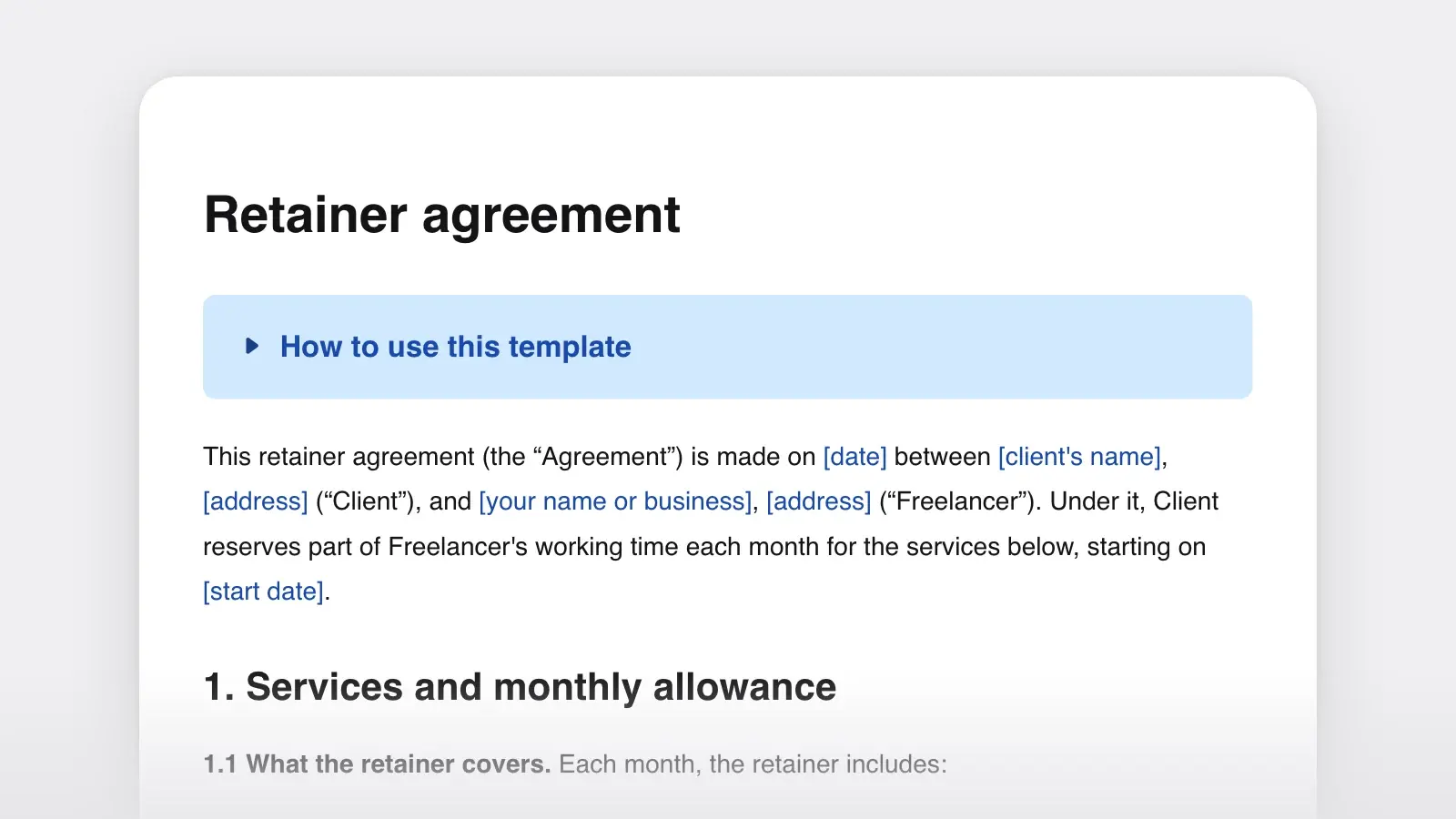
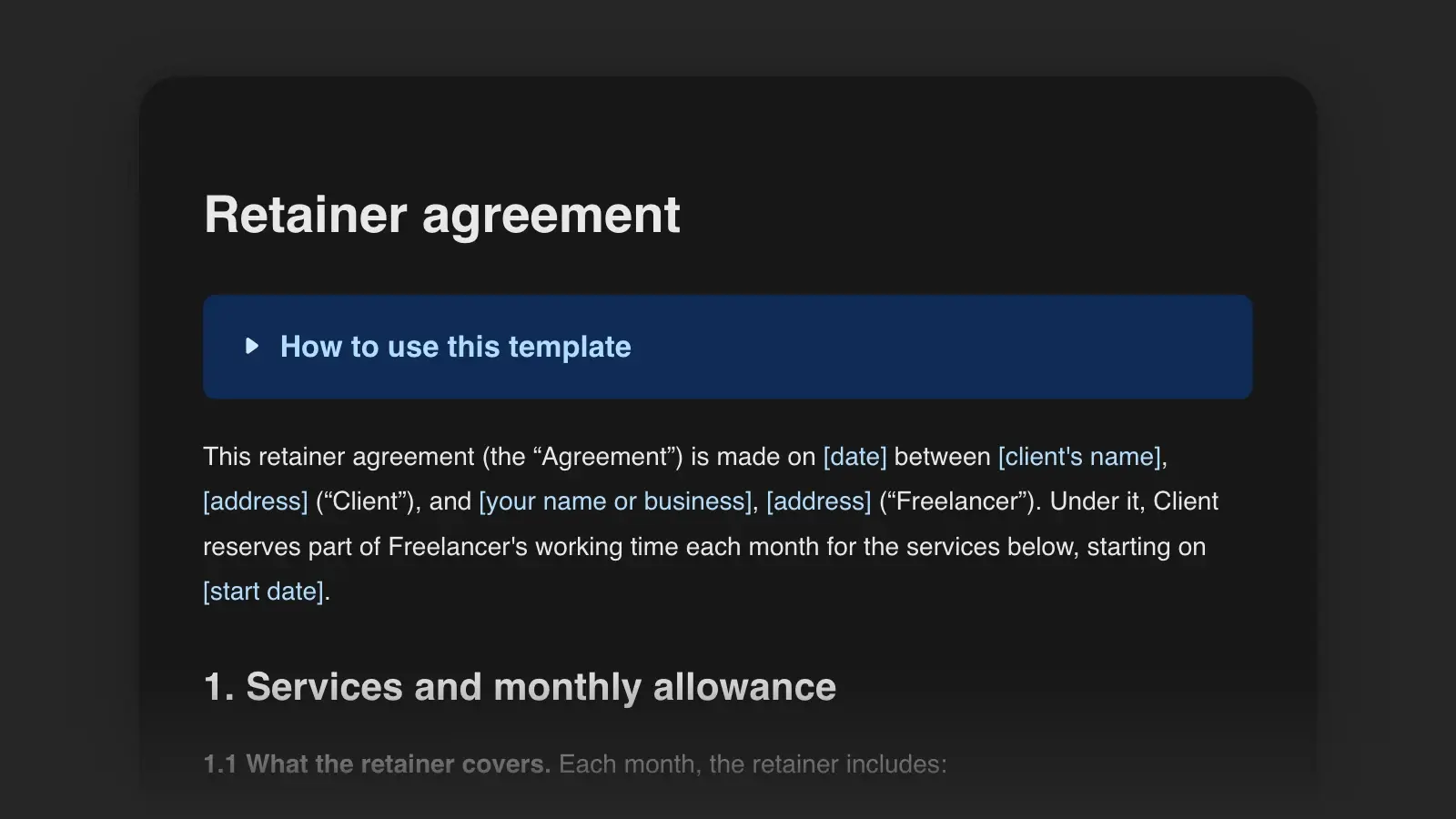
How to use this template
- Decide what the client is buying
Hours, a fixed list of deliverables, or priority access. Write that into section 1 as the monthly allowance, and be concrete: "up to 20 hours" or "four posts of 1,000 to 1,500 words", never "ongoing support". The table below compares the three.
- Price the month, then the overflow
Set the monthly fee, the rate for anything beyond the allowance, and the rule for unused hours. These three numbers decide almost every billing conversation you will have, so settle them before the client asks.
- Name what is out of scope
The sentence after the allowance in section 1 lists work the retainer does not cover. Use real examples from this client. If a large one-off job comes up, quote it separately with a scope of work and keep the retainer for the routine.
- Send an editable copy, sign a PDF
Send the draft as a Word file so the client can mark up changes, and keep each round. In Strokes, version history shows what changed between rounds without a folder of files called "final-v3". When both sides agree, export a PDF, sign it, and keep the signed copy with your invoices.
Three ways to structure a retainer
The template works with any of these. Pick the one that matches how the client's requests actually arrive, not how they say they will.
| Model | Client pays for | Works when | Watch for |
|---|---|---|---|
| ModelHours bank | Client pays forA set number of hours a month | Works whenRequests vary in size week to week | Watch forTime tracking, and what counts as an hour |
| ModelDeliverables | Client pays forA fixed monthly list of outputs | Works whenThe same work repeats every month | Watch forRequests that drift outside the list |
| ModelAccess | Client pays forPriority and response time; work billed separately or capped | Works whenAdvisory work, on-call editing, consulting | Watch forA client who reads it as unlimited work |
An hours bank is the most flexible and the most work to run: you log time and report it. A deliverables retainer is easy to bill and easy to stretch, because "one newsletter" can grow by a third without anyone noticing. If you choose deliverables, define each one by length, rounds of revisions and turnaround.
Example: the money terms, filled in
- Monthly allowance: up to 20 hours of copywriting and editing
- Monthly retainer: $2,400, invoiced on the 1st, in advance
- Work beyond the allowance: $135 an hour, only after the client approves an estimate
- Unused hours: up to 5 roll over to the next month only, then expire
- Payment: due within 15 days by bank transfer; work pauses if an invoice is 30 days late
- Term: three months, then month to month with 30 days' written notice
- Rate changes: once a year at most, with 60 days' written notice
The numbers fit together. Twenty hours for $2,400 works out to $120 an hour, a little under the $135 this writer charges for one-off jobs. The client gets the lower rate for committing. The writer gets income she can plan around. Overage is billed at the full $135, so a client who goes over every month has a reason to move up to a bigger allowance. Without the rollover cap, a slow quarter could turn into a 45-hour month. With the cap, the most the client can claim in one month is 25 hours. Thirty days' notice matches one billing cycle, so neither side is left with a half-paid month.
Clauses that head off arguments
Five terms do most of the work of keeping a retainer friendly. The template settles each one in writing before it can come up.
- Unused hours. Without a rule, clients assume they roll over forever and freelancers assume they expire. Section 3 makes you choose.
- The edge of the scope. A vague allowance invites extra work at no extra charge. Compare the two versions below.
- Late feedback. Section 4 moves your deadline when the client's feedback is late, so a slow approval does not become your missed date.
- Ending it. A notice period, paid, gives you time to replace the income and gives the client time to hand the work to someone else.
- Who owns the work. Section 6 transfers rights when each deliverable is paid for. Under US copyright law a transfer of copyright needs a signed writing, and a commissioned piece counts as "work made for hire" only if it falls into one of nine categories in the statute and both sides sign an agreement saying so. Plenty of freelance work fits none of them, which is why the template uses an assignment. If a client insists on work-for-hire language, see the work-for-hire agreement template.
Clear allowance
- Up to four blog posts of 1,000 to 1,500 words, two rounds of revisions each
- One monthly newsletter, edited and scheduled by the 25th
- Small copy requests under 30 minutes, up to five a month
Open-ended
- Ongoing content support
- Help with the newsletter as needed
- Quick edits whenever something comes up
One more reason to keep section 8 honest: the IRS decides whether a worker is a contractor or an employee by looking at behavioral control, financial control and the type of relationship, and one of the things it considers is whether the relationship is expected to continue. A retainer is, by design, ongoing. Deciding your own hours and methods, using your own equipment and keeping other clients all point the other way, and the clause says so.
If you or your client is in New York
New York State's Freelance Isn't Free Act took effect on August 28, 2024. It requires a written contract whenever a business hires a freelancer for $800 or more, counting all their contracts together over the previous 120 days. A retainer passes that quickly. The contract must include both parties' names and mailing addresses, the services and their value, the rate and method of pay, the payment date, and the date by which the freelancer submits a list of completed work. This template has a line for each. If no payment date is set, the law requires payment within 30 days of the work being completed, and the hiring party must keep the contract for six years. New York City and Illinois have freelance laws of their own, so check the current rules wherever you and your client are based.
Before you send it
If the work is a single project with a delivery date rather than a standing monthly arrangement, a freelance writing contract fits better.
Frequently asked questions
What is the difference between a retainer and a regular freelance contract?
A regular contract covers one defined job and ends when it is delivered and paid for. A retainer reserves your time or a set amount of work every month, is paid in advance, and renews until one side gives notice. Many freelancers use both with the same client: a retainer for the routine work and separate quotes for large projects.
Should unused retainer hours roll over?
It is a business decision. Expiring hours keep billing simple and protect your schedule. Rollover feels fairer to clients and can make the retainer easier to sell. If you allow it, cap the number of hours and limit it to the next month, so unused time cannot pile up into one very heavy month.
Is a retainer fee refundable?
It is whatever the agreement says, so say it plainly. This template treats the monthly fee as payment for reserved time, due whether or not the client uses every hour, with a paid notice period when either side ends the agreement. If you want a different rule, such as refunding unused hours when the client ends early, write it into section 5.
Is this the same as a lawyer's retainer agreement?
No. Lawyers' retainers follow the rules of professional conduct in their state, which can require money paid in advance to be held in a trust account until it is earned. This template is for freelancers and consultants selling their time and work to a business.