When to use it
- Produced :30 and :60 spots with cast voices, music and sound effects
- Live reads and fact sheets for morning hosts and DJs
- Donut spots with a gap for local copy on a regional campaign
- Sponsorship mentions around traffic, weather and news
- Spec spots for a copywriter's portfolio or a voice actor's demo
A radio commercial script is the written plan for an ad people can only hear. It is one column of copy with a cue on the left of every line: ANNCR for the announcer, a name for each character, SFX for a sound effect and MUSIC for the score. It is timed to a slot, usually :15, :30 or :60, and written for the ear: the brand name early, one message, and numbers spelled the way they will be said.
This template adds casting and sound notes, a word budget for each length, and pages for a live read and a donut spot. A complete single-voice :30 comes first, right after the layout; four more sample scripts follow, each with its timing.
Radio commercial script format
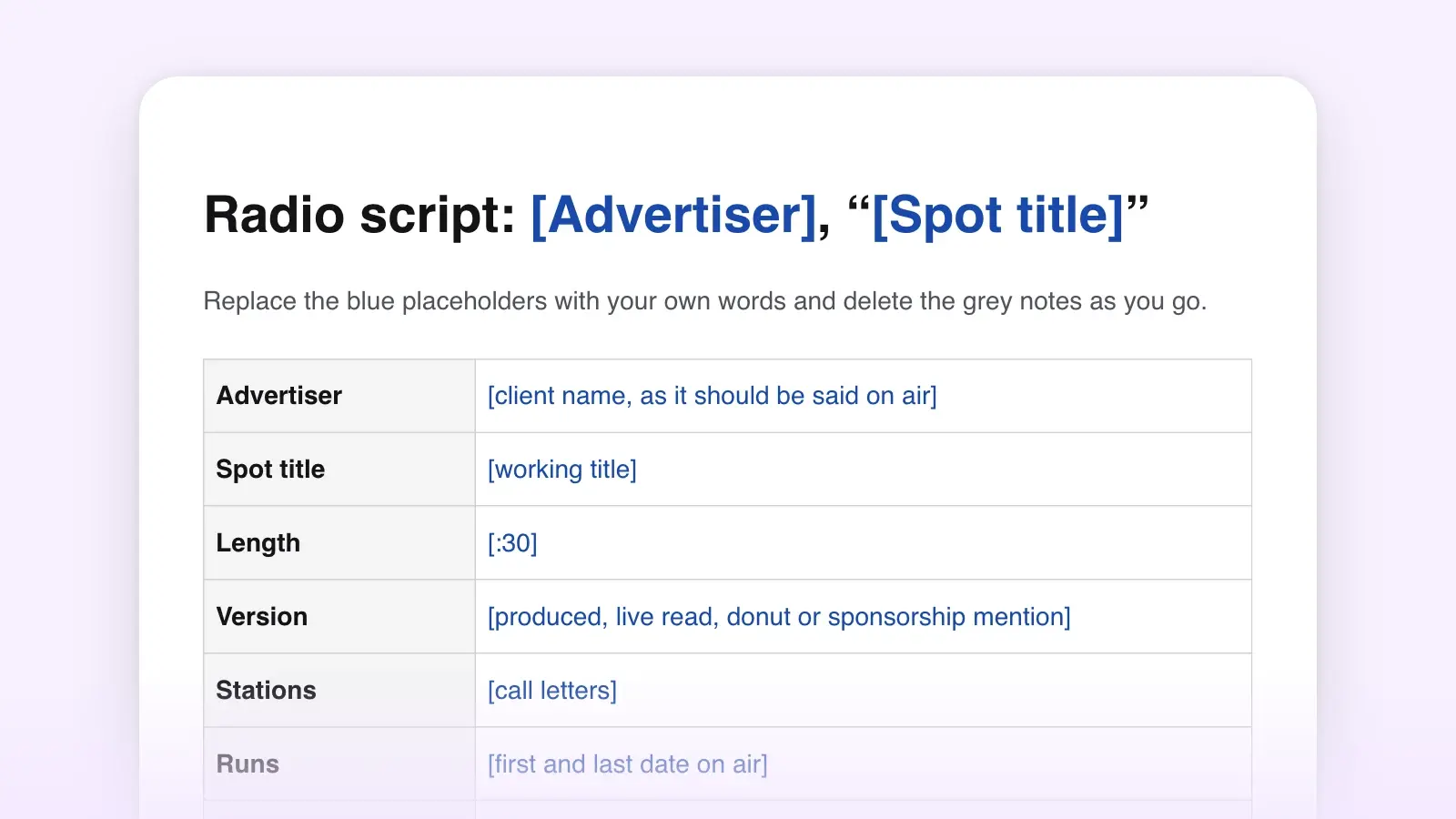
There's no single official layout for radio scripts; agencies and stations use their own. This template keeps what a producer and a station need: a header, casting and sound notes, the copy with a cue on every line, and the count and timed read at the bottom.
Radio script layout
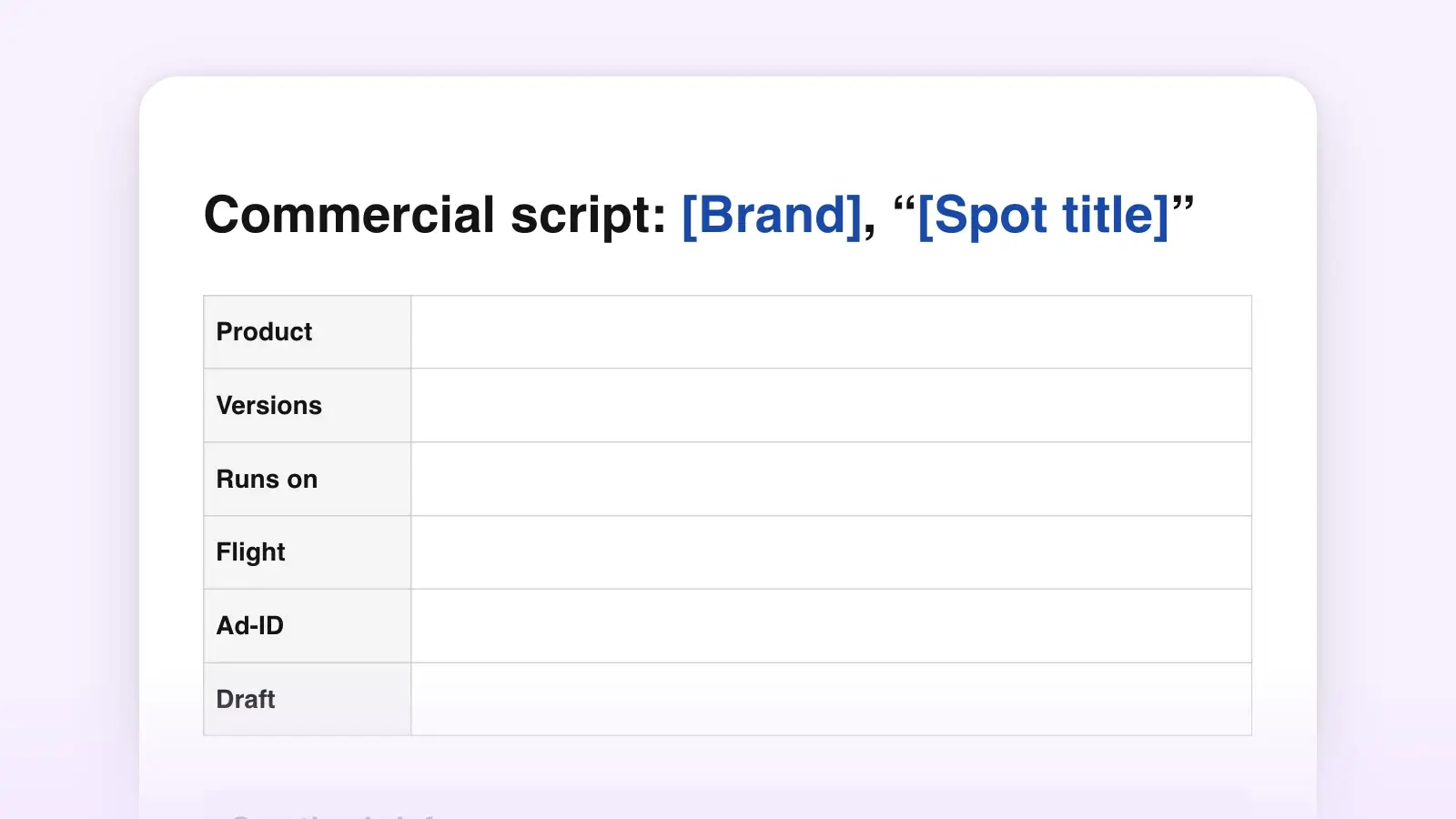
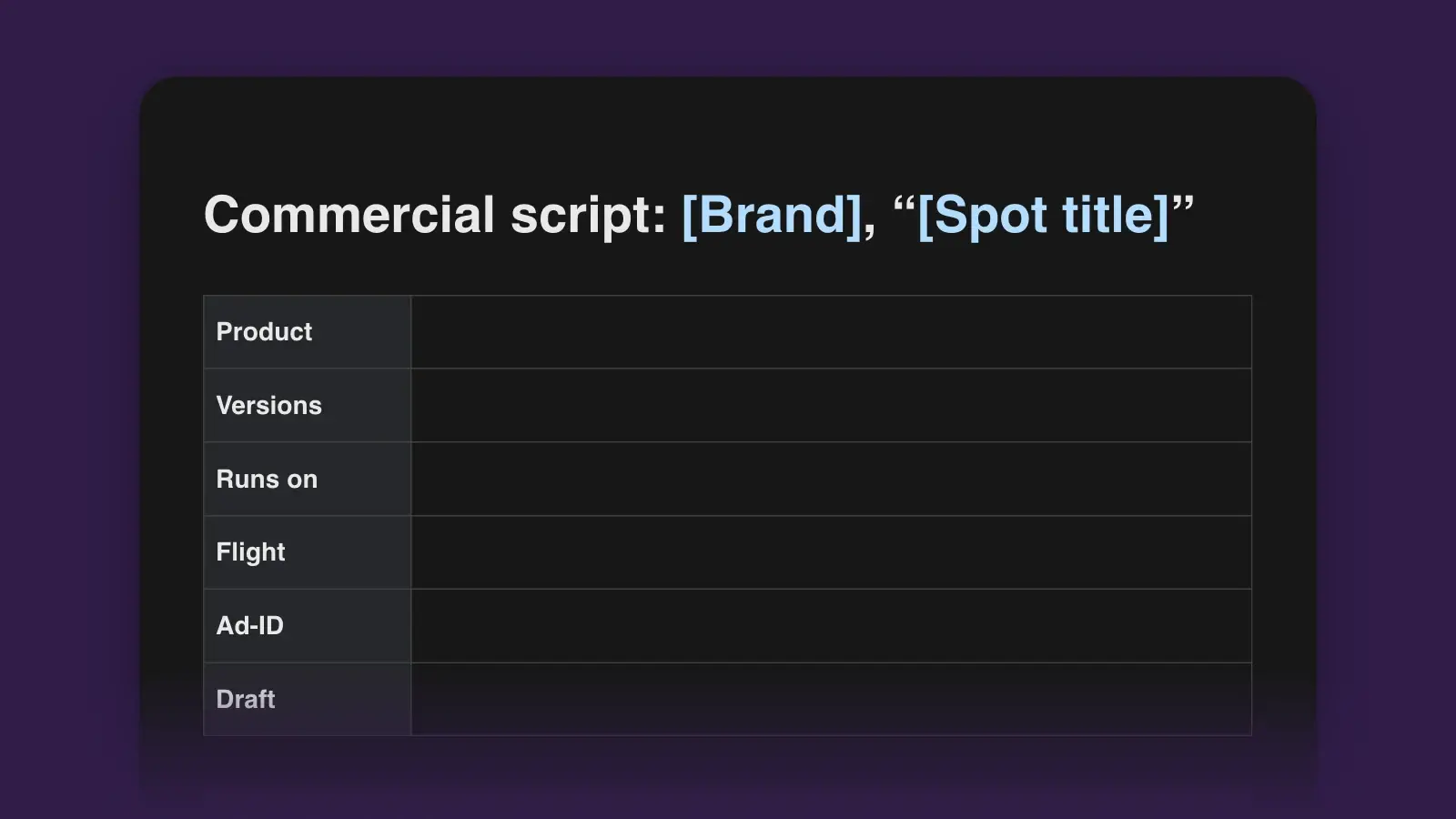
ADVERTISER  Okafor Heating & Air       SPOT     "First Cold Night"
LENGTH      :30                        VERSION  Produced, draft 3
STATIONS    [call letters]             RUNS     Oct 6–31
VOICES      ANNCR: warm, 40s, unhurried, a neighbor, not an announcer
SOUND       SFX: furnace clank and rattle. No music.

SFX:        A furnace clanks on. A long metal rattle. Silence.

ANNCR:      That's the first cold night, and a furnace that
            skipped its tune-up. ...

LEGAL:      [exact wording from the client, read at the same pace]

                                   Words: 56   Timed read: 0:28
Put the header on every page, so nobody records or airs the wrong draft, and give the legal line its own cue and its own seconds. In the sample scripts on this page, lines in italics are for the producer and the cast: sounds, music and how a line should be played. Everything after a bold voice cue is copy, read as written. A live read adds a third kind of text, the fact sheet, which the host works from but doesn't read out.
A single-voice :30 example
One announcer, one sound and an offer with an end date: the simplest spot to produce, and harder to write well than it looks.
SFX: A furnace clanks on. A long metal rattle. Silence.
ANNCR: That's the first cold night, and a furnace that skipped its tune-up. Okafor Heating and Air can stop that sound before it starts. Through October thirty-first, a gas furnace tune-up is eighty-nine dollars. We clean the burners, test for carbon monoxide and change the filter. Okafor Heating and Air. Five five five, oh one six three.
The sound is the problem, so the copy never has to describe it. The offer gets one sentence with its price and deadline, and three services prove the price. The name comes twice and the number once, last, where the listener is ready for it. A :60 would say it twice.
How to use this template
- Fill in the production sheet first
Advertiser, length, stations, run dates and the mandatories: name, address, phone number, offer, end date, legal line. Then write the one message as a single sentence, the way a logline states a story. If the client wants three messages, the Radio Advertising Bureau's Creative Best Practices guide (RAB, 2024) has the answer: “It is better to create multiple spots than to overpack a single spot.”
- Budget the words before you write them
Subtract the seconds that aren't voice (a music open, a sound effect played in the clear, the legal tag) and multiply what's left by two and a half words a second. The table below does the sums.
- Write for the ear
Name the brand in the first few seconds. Write “five five five, oh one six three,” not digits, so every announcer reads it the same way. Give every sound its own line, and say the thing that matters twice: a listener can't scroll back.
- Read it aloud three times with a stopwatch
Read at the talent's pace, sounds and pauses included, and write the middle time at the bottom. If it runs long, cut a sentence. Asking the announcer to read faster is how a spot ends up sounding like small print.
How many words fit a spot
The National Center for Voice and Speech puts the average rate of speech for English speakers in the US at about 150 words a minute: two and a half words a second. So words = seconds of voice × 2.5. The RAB guide also advises speaking slowly to reach listeners who are doing something else at the same time. For a careful read, use 2.2.
| Length | Every second is voice | Seconds that aren't voice | Budget for the copy |
|---|---|---|---|
| Length:10 | Every second is voice25 words | Seconds that aren't voice2: a breath before the next element | Budget for the copyAbout 20 words |
| Length:15 | Every second is voice37 words | Seconds that aren't voice3: an audio logo or one sound | Budget for the copyAbout 30 words |
| Length:30 | Every second is voice75 words | Seconds that aren't voice7: a 3-second open, a 4-second tag | Budget for the copyAbout 55–57 words |
| Length:60 | Every second is voice150 words | Seconds that aren't voice10: an open, two sound beats, a tag, a button | Budget for the copyAbout 125 words |
A produced :60 with sound
A produced spot is recorded once, with cast voices, music and effects, and sent to stations as a finished file. This one sells a library service by acting it out.
SFX: Night in the woods. Crickets. A tent zipper opens.
MAYA: (whispering) Dev. I still can't believe the library lends tents.
DEV: Go to sleep, Maya.
SFX: Something metal clanks.
MAYA: What was that?
DEV: The lantern. Also from the library.
MAYA: The sleeping bags?
DEV: Library.
MAYA: The camp stove?
DEV: Library.
MAYA: The telescope?
DEV: Library. Due back Tuesday.
SFX: An owl hoots, close.
MAYA: (beat) Is the owl from the library?
DEV: Go to sleep, Maya.
MUSIC: Light acoustic guitar, under.
ANNCR: Your Ferris County Library card checks out more than books. Tents, lanterns, telescopes, fishing rods, even a pressure washer for when you get home. More than three hundred things, free for two weeks, at all six branches. Ask at the front desk, or search Ferris Library of Things.
MAYA: Dev. The stars are amazing.
DEV: Don't ask.
MUSIC: Up, then out.
Every sound is one the ear can name (crickets, a zipper, an owl), and the one that could be anything, the clank, is named in the next line. “The library” arrives in the first line, so the joke never hides whose ad it is, and the list of borrowed things doubles as the product list.
Now time the first cue. Crickets and then a zipper, played in the clear before anyone speaks, take two or three of the sixty seconds, and the owl, Maya's beat and the music out take about as long again. At 2.5 words a second, 101 words is about 40 seconds of voice, but the count can't tell you how long the sounds run or how long the pauses in the list take to land. Time a read with the effects played or counted in, and trust that time over the word count.
Live read script and fact sheet
A live read is read on air by the host, in their own voice. It borrows the host's credibility and gives up music, effects and control. Send a short script for what must be exact and a fact sheet for the rest.
Read as written.
HOST: This half hour is brought to you by Tidewater Books on Front Street. (Your own words: one true line about your last visit.) This Thursday at seven, Tidewater hosts Lena Okonkwo-Hart, whose novel about the Halvard Mill flood came out this month. It's free, there's coffee, and she'll sign books afterward. Tidewater Books, two-eighteen Front Street. Thursday at seven.
Fact sheet, for the host, not read on air. Must say: Tidewater Books · Thursday, November 13, 7 p.m. · free · 218 Front Street. Say it like: Okonkwo-Hart is oh-KONG-woh HART; Halvard is HAL-vard. You can add: anything true from your own visits. Don't say: “best bookstore in the state” or “free books.”
The sponsor comes first for a reason. In the US, the FCC's sponsorship identification rule (47 CFR 73.1212) requires a station to announce, at the time of the broadcast, that material was paid for and by whom; for an ad for a product or service, naming the advertiser or its product is enough when it's clear the name identifies the sponsor. The host's own line has to be true: under the FTC's Endorsement Guides (16 CFR 255.1), an endorsement must reflect the endorser's honest opinion or experience, and a host who says they use something must really be a user. Both rules are as of November 2026.
Live read
- Sounds like the station, in a voice listeners already trust
- Cheap to change: send a new fact sheet
- No sound design, and every read is different
Produced spot
- Cast voices, music and effects, identical on every play
- Costs a studio session and talent fees
- One file runs on every station in the campaign
Donut spot and sponsorship examples
Radio people call a produced spot with a hole in the middle a donut. The open and close carry the brand's music and voice; the hole holds copy that changes by station or store. Write it to the exact length of the hole.
0:00 · Produced open. MUSIC: Kessler audio logo, then bed under.
ANNCR: Winter tires go on before the first snow, not after. At Kessler Tire and Auto, they go on in under an hour.
0:11 · Local copy, 12 seconds, 30 words at most.
LOCAL ANNCR: In Marion, that's Kessler Tire on Route twenty-three, across from the fairgrounds. Walk in any weekday from seven, or Saturdays until noon, and ask for Denise.
0:23 · Produced close.
ANNCR: Kessler Tire and Auto. Ready when the weather isn't.
MUSIC: Audio logo.
The local copy runs 26 words in a 12-second hole, so the announcer never rushes. The RAB guide recommends keeping the narrator, the music bed or the audio logo consistent from spot to spot, so listeners don't credit the ad to a competitor; the donut's frame does that while each store gets its own street and hours.
ANNCR: Traffic on the fives is brought to you by Bright Path Driving School: six hours behind the wheel with a certified instructor. Get your passenger seat back. Bright Path, Elm and Fourth.
A mention opens with the sponsor and keeps to one fact; a driving school on the traffic report does half the work.
Writing sound effects and music
Sound is the picture in a radio spot, so write it as precisely as the copy: each cue on its own line, in caps, in the order it's heard. “SFX: Ice into a glass. A can opens. Pour.” gives a producer three sounds to find. “SFX: A refreshing sound” gives them nothing.
- Name the ambiguous sounds. A crackle could be a fire, a frying pan or static. If it matters, a line of dialogue has to say which.
- Give long sounds a length. “SFX: Rain on a car roof, 2 seconds, then under” tells the producer how much time it takes from the voice.
- Use the music words consistently. A bed plays under the voice; “up” brings it forward, “under” takes it back, “out” ends it. A sting is a short hit, a button the final beat after the tag, an audio logo the brand's few notes.
- Fit the station. The RAB guide notes that music should suit the format: a country sound may not play well on a hip-hop station, and the other way around.
- Clear the music. A hit needs permission for both the song and the recording (see the last question below). A licensed production-music track or a bed written for the spot is simpler.
Casting voices for radio
With no faces, the voice is the cast, the setting and half of the brand's tone of voice. Write casting notes by age, energy and attitude: “MAYA: late 20s, quick, delighted by everything. DEV: same age, tired, loves her.” The RAB guide advises avoiding “radio” voices in favor of a real, conversational one, and notes that more than one voice reduces the risk of a spot sounding monotonous. Make voices easy to tell apart by age, pitch or accent, agree usage terms before the session, and send a pronunciation note, as in the voiceover script template.
Legal lines and clearance
Required wording comes from the client's lawyer and goes in word for word, with its own seconds. In the UK, broadcast radio ads in special categories, including gambling, alcohol, financial products, health products and charitable causes, must be cleared by Radiocentre's clearance team before they air. Radiocentre's copy guidelines say terms and conditions must be read so the listener can clearly understand them, and allow music under them as long as the words stay clear. A condition that would exclude a significant number of people who would otherwise expect to qualify is material and has to be in the ad; for the rest, a line such as “terms apply” is accepted. All of that is as of November 2026. The habit works anywhere: say the condition that changes the decision (“gas furnaces only, booked by October thirty-first”) and agree with the client's lawyer where the rest can go. TV and online versions of the same idea belong in the commercial script template, and ads read inside a podcast in the podcast script template.
Frequently asked questions
How many words is a 30-second radio commercial?
At the average US speaking rate of about 150 words a minute, 75 words fill 30 seconds with nothing else in them. Once a sound effect or music open and a legal tag take their seconds, budget about 55 to 65 words for a :30 and 125 to 140 for a :60, depending on how long the sounds run. Time a read before you trust any count.
What is the difference between a live read and a produced spot?
A live read is read on air by the station's host, from a short script and a fact sheet, so it sounds like the show and changes slightly every time. A produced spot is recorded once with cast voices, music and sound effects, and the same file plays on every station in the campaign.
Can I use a popular song in a radio ad?
Only with permission. The US Copyright Office treats the composition and the recording of a song as separate works, so an ad that uses a hit needs permission from whoever owns each, often a music publisher and a record label. The simpler route is a licensed production-music track or a bed written for the spot.