When to use it
- Querying literary agents by email with a finished, revised novel
- A memoir query, once the manuscript is complete
- Filling in an agent's online query form, one field per paragraph
- Keeping one master query that you tailor for each agent in a batch
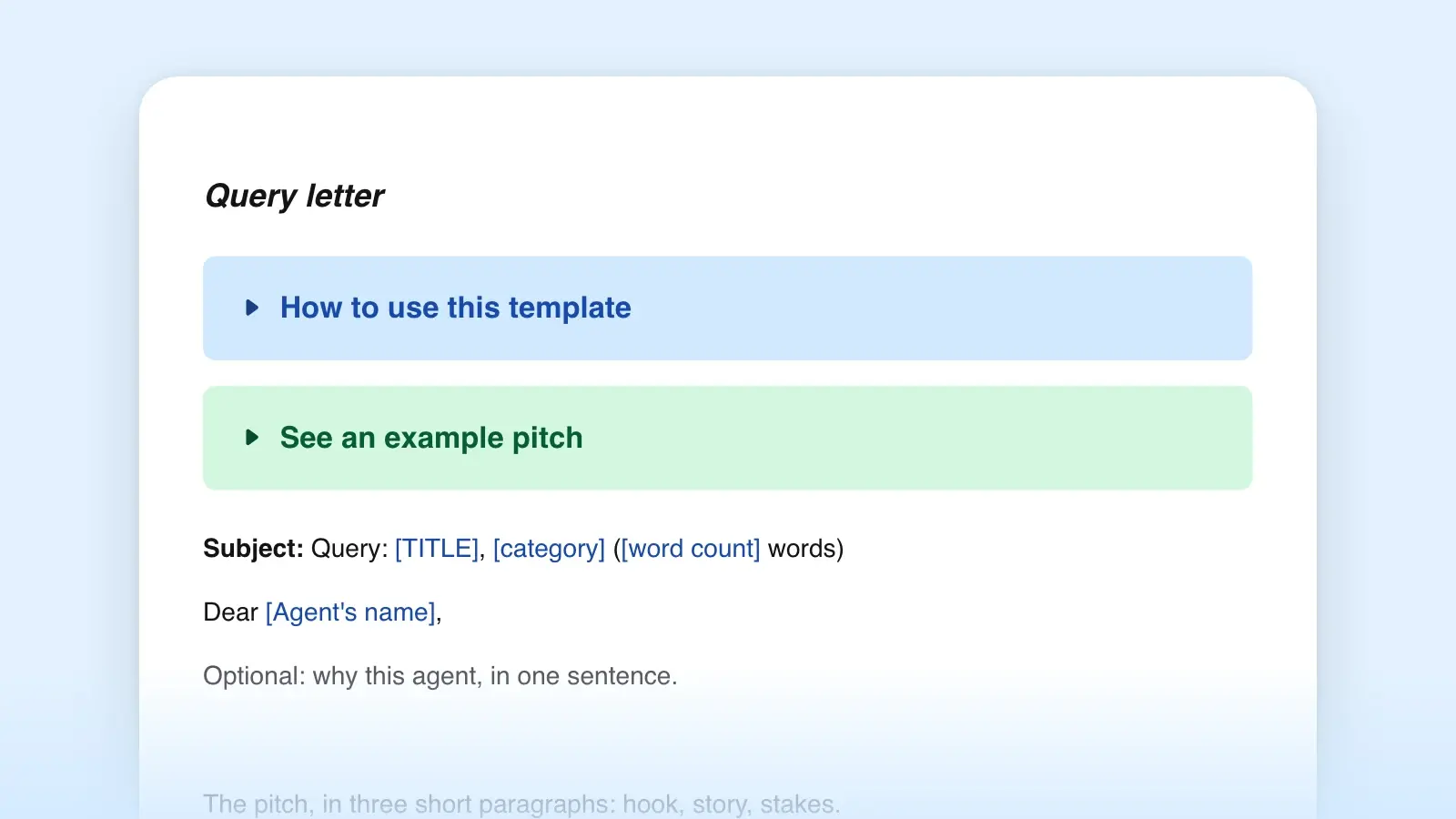
How to use this template
- Start from the agent's guidelines
Before you fill in a word, open the agent's submission page. It tells you the subject line they want, what to paste under the letter (nothing, a synopsis, or the first five, ten or fifty pages) and whether queries go by email or through a form such as QueryManager. Where their instructions differ from this template, theirs win.
- Write the hook and mini-synopsis first
Start from your logline: character, goal, obstacle, stakes. The hook turns it into one to three sentences of prose, and the two synopsis paragraphs follow the character's choices to the point where everything is at risk. Draft long, then cut to the budget below.
- Fill in the book details and bio
Put the title in capitals, name the category the way agents list it, and round the word count to the nearest thousand. Choose two comp titles from your own category, published in the last few years, and say what each one shares with your book. The bio gets credits, relevant experience and one line about you.
- Personalize, paste and test
For each agent, change four things: the name, the personal line, the subject line and the pasted material. Paste the letter into the email body as plain text rather than attaching it, then email a copy to yourself and read it on your phone before the real one goes out.
Word budget for each paragraph
Agents read queries from the slush pile in batches, and the letter has one screen to earn a request for pages. Published advice from agents and editors puts the whole letter somewhere between 200 and 450 words, never more than a page. The budget below lands near the middle and gives most of the room to the story.
| Paragraph | Target | Range | If you are over |
|---|---|---|---|
| ParagraphPersonal line | Target20 | Range0–30 | If you are overDelete it. A generic line is worse than none |
| ParagraphHook | Target40 | Range30–60 | If you are overCut adjectives, keep the one detail only your book has |
| ParagraphMini-synopsis | Target180 | Range150–220 | If you are overCut subplots, backstory and minor characters |
| ParagraphBook details | Target40 | Range30–50 | If you are overDrop the third comp and any explanation of genre |
| ParagraphBio | Target50 | Range25–100 | If you are overKeep credits, relevant experience and one human line |
| ParagraphClosing | Target20 | Range15–30 | If you are overThanks and what is pasted below, nothing more |
The order can flex. This template puts the title, category and word count after the pitch, so the story comes first. Some writers open with them instead, and agents accept both. A referral, or a request from a conference pitch, always goes in the first sentence, because it is the strongest line you have.
Filling in the hard lines
The book details and the bio are the paragraphs writers rewrite most, because they feel like paperwork. Here they are filled in for three invented books. Notice that each comp gets a reason and each bio sticks to what bears on the book.
Adult fantasy. THE GLASSWRIGHT'S DEBT is an adult fantasy, complete at 98,000 words. It will appeal to readers of [Comp title] for its magic built on a real craft and [Comp title] for its crew of misfits on the run. I restore stained glass for churches across Ohio, which is where the book's magic system came from. This is my first novel.
Young adult. SECOND CHAIR is a contemporary young adult novel, complete at 68,000 words, with the competitive edge of [Comp title] and the family humor of [Comp title]. I played viola in a youth orchestra for six years and now work as a school librarian, where I hear a great deal about audition season.
Memoir. WHAT THE TIDE OWES is a memoir, complete at 76,000 words, about the year I ran my father's lobster boat to pay off his debts. My essays on working the water have appeared in two regional magazines, and I write a monthly newsletter for about 3,000 readers in fishing communities.
The personal line is the other place queries go wrong. It is optional, and it only helps when it could not have been sent to anyone else.
Specific
- You represent [Comp title], and my novel shares its small-town courtroom.
- Your agency page asks for heists with a heart, which is exactly what this is.
- You asked to see the full manuscript at [Conference name] in May.
Generic
- I see that you represent thrillers.
- I found your name in an agent directory.
- I think we would make a great team.
For a complete letter filled in from greeting to signature, with notes on every paragraph, read the guide to writing a query letter. If your category's word count is the worry, check the ranges in novel word counts by genre before you fill in the book details. Nonfiction other than memoir is usually sold on a proposal, and the book proposal template covers that.
Frequently asked questions
How long should a query letter be?
Published advice from agents and editors ranges from about 200 to 450 words, and 300 to 350 is a safe middle. It should never run past one page. If yours is longer, the mini-synopsis is almost always where the extra words are.
Should I give the exact word count?
No. Round to the nearest thousand, so 88,620 words becomes 89,000. Agents want to see that the book sits in a normal range for its category, and an exact figure adds nothing.
Do I have to include comp titles?
Most agents expect them, but not all require them. Two recent books from your own category, each with a reason, are ideal. If you cannot find two that fit, leaving them out is better than forcing a weak match or naming a blockbuster.
Can I paste this into an online query form?
Yes. Online forms, QueryManager among them, often ask for parts of the package in separate boxes: the query, a synopsis, the opening pages, and sometimes the bio or comp titles. Each part of this template is its own paragraph, so you can paste them one at a time. Reread every field before you submit.