When to use it
- A first draft as maid, matron or man of honor, when the blank page is the hard part
- A reception toast of three to four minutes, written and timed part by part
- A one-minute rehearsal dinner toast, using only the opening, the story and the toast
- Two co-maids of honor splitting one speech between them
How to use this template
- Fill in the notes first
Before any sentence of the speech, settle the time slot and the one quality you want the room to see in her. That quality is a filter: a story either shows it or it doesn't. It also gives parts 3 to 5 something to return to. If you're not sure what's off-limits, ask the bride in general terms, or ask a sibling who knows both families.
- Write the story before anything else
Part 2 gets the most words, so draft it first and let it run long. Open in the middle of the action, not with the backstory. The opening and the wish are much easier once the story exists, because one sets it up and the other echoes it. If you have ten candidate stories, the maid of honor speech guide has a five-point test for choosing one.
- Replace every bracket, then read it aloud
Rewrite the sample lines inside the brackets in your own words, even the ones you like. Then time a read-through at the pace you'd use in the room. At about 130 words a minute, 500 words takes just under four minutes. If it runs long, cut a whole detail from the story instead of trimming words everywhere.
- Print it and rehearse standing up
Delete the part headings or keep them small as signposts, print in large type, and say it out loud five or so times over a few days. For ways to learn it without sounding recited, see how to memorize a speech.
A filled-in example
Here is the template completed for a childhood best friend. It runs about 320 words, roughly two and a half minutes, so most parts sit at the low end of their budgets.
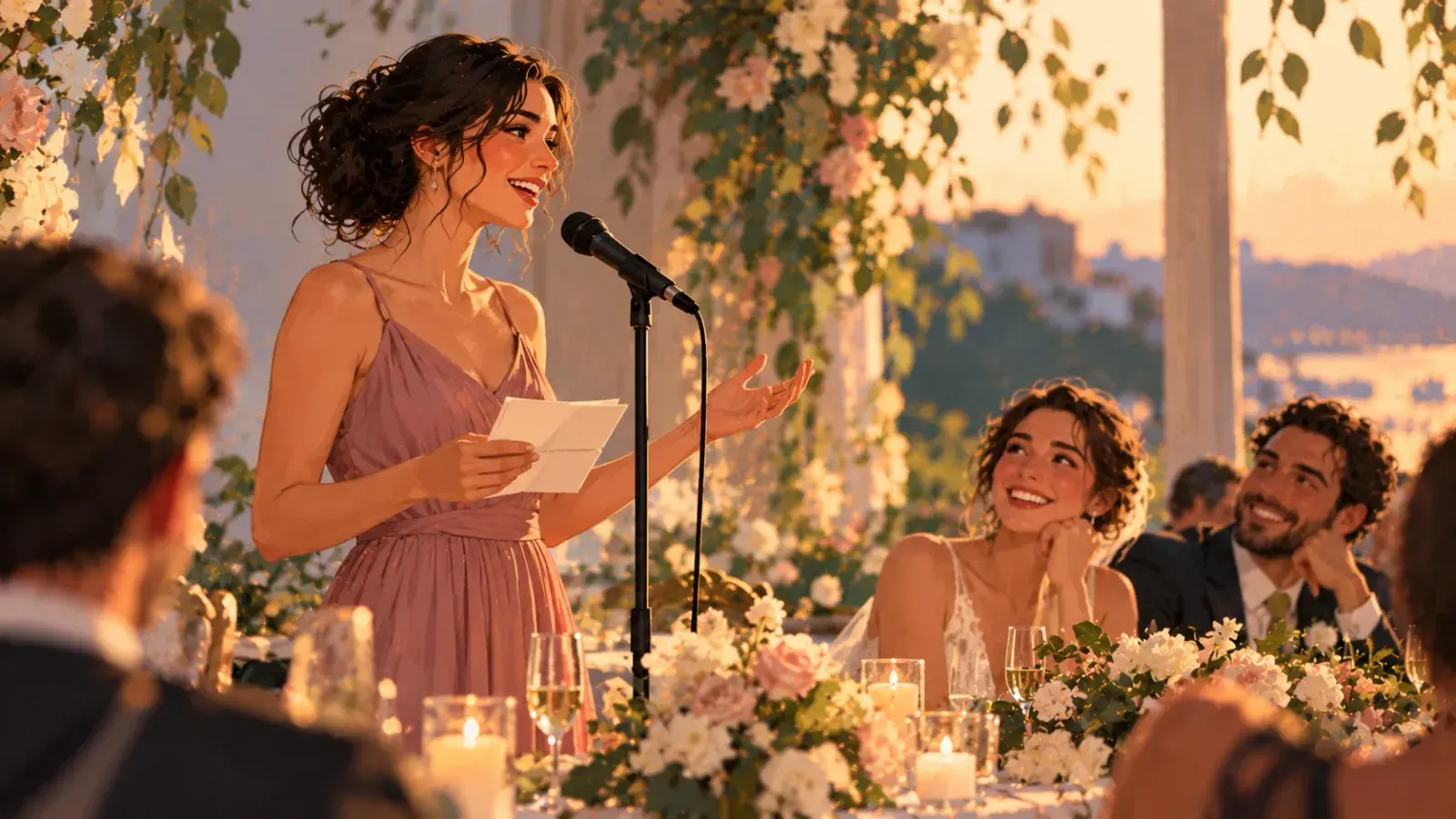
Opening. Good evening, everyone. I'm Maya, Tessa's best friend since second grade, when she sold me a painted rock for my entire allowance. I still have the rock. Thank you to Carol and Dev for tonight, and to all of you for coming.
The story. It's the week before our high school graduation, and I've just found out I didn't get into the nursing program I'd wanted since I was twelve. I didn't tell anyone. I didn't have to. At seven the next morning, Tessa was on my porch with two folding chairs, a thermos of coffee and a stack of brochures from every nursing program within a day's drive. She had made a spreadsheet: deadline, cost, and how far each school was from hers, so we could still visit. Two were still taking applications. We sat on that porch until noon, and I applied to both that afternoon with Tessa reading every line over my shoulder. I've been a nurse for nine years.
What it shows. That's Tessa. When someone she loves gets bad news, she doesn't send a sad face. She shows up at seven in the morning with folding chairs and a plan.
The turn. So when she started dating Ben, I watched for one thing: does he show up? Last fall Tessa ran her first marathon. Ben worked out from the tracking app where she was most likely to hit the wall, and at mile 20 there he was, holding orange slices and a sign that said "Six more miles. Then tacos." She finished. Ben, thank you for showing up for her the way she shows up for everyone else.
The wish. Tessa and Ben, I hope you always have two folding chairs, a thermos and a plan B. And I hope there are always tacos at the finish.
The toast. Would everyone please raise a glass? To Tessa and Ben.
One quality, showing up with a plan, runs through the story, the partner's moment and the wish. The story never names it. Part 3 does, once. That is show, don't tell on a small scale. The folding chairs and the tacos are callbacks, the simplest of the rhetorical devices for a toast: details from earlier that return at the end and make the speech sound finished.
Adapting the template
- For a sister. Open with a line only a sibling could say, and if your parents are hosting, thank them by name. Family stories sprawl, so pick one age and one room.
- Matron or man of honor. The job and the shape are the same. Traditionally, a matron of honor is a married attendant. Change the title in your opening and the pronouns, nothing else.
- Two maids of honor. Split the parts instead of writing two speeches. One of you takes the opening and the story, and the other takes the turn, the wish and the toast. Keep the total near five minutes, not ten.
- The one-minute version. For a rehearsal dinner or a long program, keep the opening, a story of three or four sentences and the toast. Fold parts 3 to 5 into a single line.
- If you barely know the partner. Call the couple before the wedding and ask how they met and when the bride knew. One detail from that call fills part 4 better than anything you could invent.
Filling the blanks well
A blank filled with an adjective tells the room nothing. A blank filled with something you saw tells them who she is. Test each line: could it appear in someone else's speech about someone else? If so, replace it.
Specific
- For three years I watched her alphabetize a refrigerator.
- Ben was at mile 20 with orange slices.
- I hope you always have a plan B.
Generic
- She's the most amazing person I know.
- Ben is a great guy and perfect for her.
- I wish you a lifetime of love and happiness.
If someone else in the wedding party is writing a toast too, the best man speech template and the wedding speech template for any guest follow the same order, which makes it easy to compare notes and avoid telling the same story twice.
Frequently asked questions
How long should a maid of honor speech be?
Three to four minutes is a safe target at most receptions, and shorter is better when several people are speaking. At about 130 words a minute, that is roughly 400 to 520 words, about what the six word budgets in the template add up to. Your own timed read-through is the number that counts.
When should I start writing it?
Three or four weeks before the wedding. That leaves a week to draft, a week to cut and show it to someone, and time to rehearse out loud without cramming the night before.
Should I read the speech or memorize it?
Reading is fine. Know the first and last lines by heart and look up at the end of each sentence. A printed page in large type is safer than a phone, which can dim, lock or light up with messages mid-sentence.
Does the maid of honor have to thank the hosts?
It isn't required, and if the hosts speak first they often thank the guests themselves. A one-line thank-you in the opening is a kind touch, especially when the bride's parents or the couple are hosting. Delete the line if someone before you has covered it.