When to use it
- Licensing an essay, story or poem to a magazine, literary journal or anthology
- Granting reprint rights to a piece that has already been published elsewhere
- Letting a newsletter, website or company republish an article for a fee
- Licensing a book excerpt for a course pack, a newsletter or a promotion
- Turning an email agreement with an editor into one signed document
A licensing agreement lets someone publish your writing without owning it. You keep the copyright; the licensee gets the rights you name (a medium, a territory, a period of time) in exchange for a fee or a royalty. Anything you don't name stays yours, which is why the heart of this template is a rights table rather than a page of boilerplate.
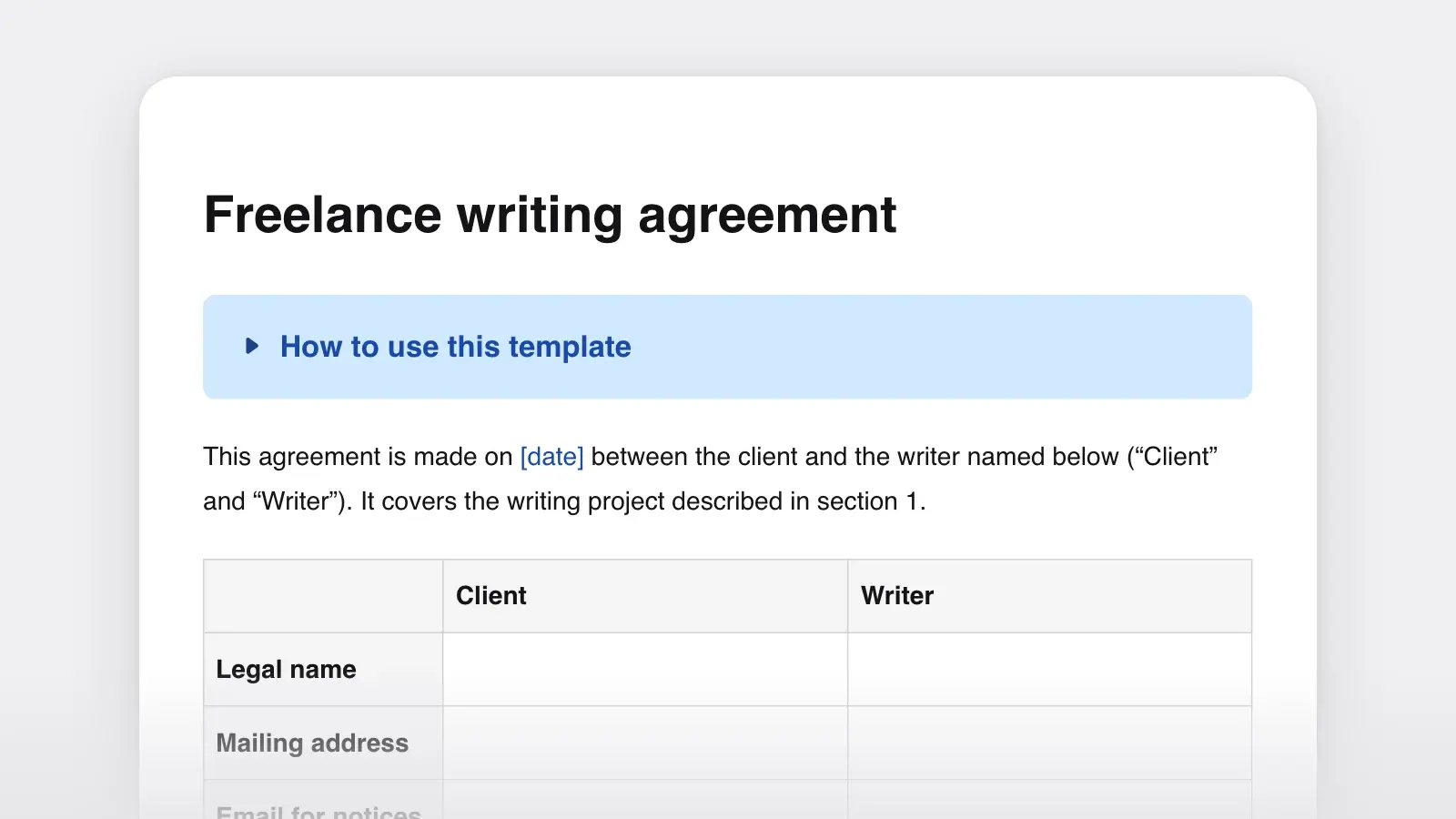
Use it for a piece that already exists. For new work an editor commissions, start with a freelance writing contract, which covers the assignment and the deadline as well as the rights. Still looking for a home for the piece? See how to pitch an article to an editor.
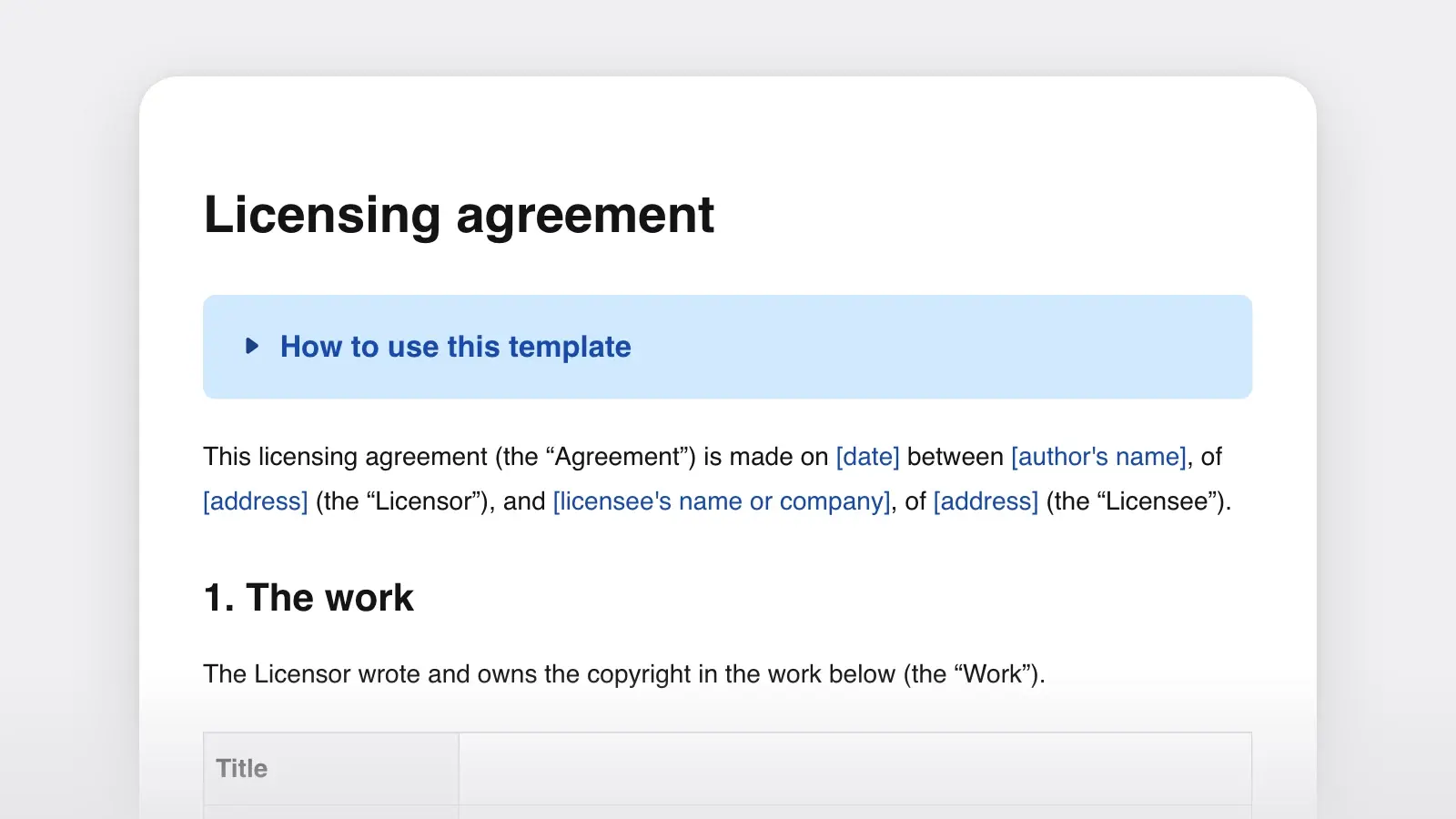
How to use this template
- Name the work and the parties exactly
Use full legal names, the title, the length and whether the piece has been published before. For a reprint, check your first contract: if that publisher's exclusive period hasn't ended, you can't license the piece yet.
- Fill in the rights table narrowly
License what the licensee will actually use. A print quarterly needs print and perhaps its website, not audio or an e-book in EPUB. Each row closes a door: territory, language and duration all limit the grant. If a row doesn't apply, write "None" rather than deleting it, so nobody reads the gap as open.
- Set the money and the exits
Say when the fee is paid (on signing or on publication), what happens if it's late, and the date by which the piece must appear. Without a deadline, a licensee can hold exclusive rights to a piece it never runs.
- Sign it and keep the signed copy
Export the final text to PDF, have both parties sign, and file the signed copy with the piece. If you negotiate in Strokes, version history keeps each round, so you can see exactly what changed between the licensee's markup and yours.
License, assignment or work for hire
Three kinds of deal hand over rights in writing, and they end very differently for the writer. Read the contract you're offered for which one it is, whatever its title says.
| Question | License | Assignment | Work for hire |
|---|---|---|---|
| QuestionWho owns the copyright after? | LicenseYou | AssignmentThe buyer | Work for hireThe hiring party, from the start |
| QuestionCan you sell the piece again? | LicenseYes, outside the rights granted | AssignmentNo | Work for hireNo |
| QuestionSigned writing required (US)? | LicenseYes if exclusive | AssignmentYes | Work for hireYes, for commissioned work |
| QuestionCan you end it after 35 years (US)? | LicenseYes | AssignmentYes | Work for hireNo |
In the US, an exclusive license counts as a transfer of copyright ownership, so it is valid only in a writing signed by the owner or the owner's agent. A commissioned piece can be a work made for hire only if it falls into one of nine categories the law lists (a contribution to a magazine or anthology is one) and both parties sign an agreement saying so. If the contract in front of you says "work made for hire" or "all rights," you are in effect selling the piece, not licensing it; the work-for-hire agreement template covers that case.
"Exclusive" also binds you. The UK's statutory definition, for one, excludes everyone else, including the person who granted the license. While an exclusive period runs, don't post the piece on your own blog or newsletter unless the contract carves that out.
Rights terms in magazine contracts
Magazines and journals use a set of shorthand names for what they buy. They are conventions, not legal definitions, so fill in the rights table even when you use one of them.
| Term | What the publisher gets | What you keep |
|---|---|---|
| TermFirst North American serial rights | What the publisher getsThe right to publish the piece first, in a periodical, in North America | What you keepEverything else, including reprints after publication |
| TermFirst world English-language rights | What the publisher getsFirst publication in English anywhere | What you keepTranslations and later reprints |
| TermOne-time rights | What the publisher getsNonexclusive permission to publish once | What you keepThe right to license it elsewhere at the same time |
| TermSecond serial (reprint) rights | What the publisher getsPermission to publish a piece that has already appeared | What you keepEverything else |
| TermElectronic or archive rights | What the publisher getsOnline publication, often kept in an archive | What you keepDepends on the contract: ask for an end date or a removal clause |
| TermAll rights | What the publisher getsEvery right in the piece, as long as the contract runs | What you keepLittle or nothing |
Dana Okafor licenses her 3,200-word essay "Night Shift at the Seed Library" to Tidewell Quarterly, a print magazine with a website.
- Rights: first North American serial rights
- Media: the Spring 2027 print issue and the magazine's website
- Exclusivity: exclusive until 90 days after the issue date, then nonexclusive
- Territory and language: North America, English
- Duration: signing to December 31, 2028
- Archive: may stay online after 2028 with her byline and copyright notice
- Sublicensing: not permitted
- Fee: $350, paid on publication; rights return if the essay hasn't run by June 30, 2027
Clauses writers wish they'd added
- A publication deadline. For books, SFWA's Writer Beware suggests requiring publication within a set period, such as 12 to 24 months, or the rights come back. For a magazine piece, name an issue or a date.
- A fixed term. "For the full term of copyright" can mean your lifetime and decades after. For small presses, Writer Beware suggests three to five years, renewable only if both sides agree.
- An AI-training clause. The Authors Guild's model trade book contract recommends barring use of the author's work for AI training without express permission. A license that says nothing on the subject settles nothing.
- Limits on sublicensing. Sublicensing lets the licensee pass your rights on: to a sister imprint, a foreign edition, an audio producer. Require your written consent, and ask for copies of any sublicense.
- Approval of changes. Copyedits are normal. A new title, a new ending or cuts that change the argument should need your sign-off.
Narrow and clear
- First North American serial rights, print and web, exclusive for 90 days after publication
- Rights return if the work is not published by June 30, 2027
Rights grab
- All rights, in all media now known or later developed, throughout the universe, in perpetuity
- The Publisher may assign this agreement without notice
Frequently asked questions
Does a licensing agreement have to be in writing?
In the US, an exclusive license is a transfer of copyright ownership and is valid only in a writing signed by the owner (17 U.S.C. § 204). A nonexclusive license is outside that rule, but without a written agreement neither side can prove what was agreed. Other countries set their own rules: the UK, for example, also requires an exclusive licence to be in writing and signed by the copyright owner.
What is the difference between an exclusive and a nonexclusive license?
Under an exclusive license, only the licensee may use the rights granted, for the stated time and territory, and that can shut out the author too. A nonexclusive license lets you grant the same rights to others at the same time. A common middle ground is exclusive for a set period after publication, then nonexclusive.
Can I get my rights back after signing?
Plan for it in the contract: a publication deadline and an end date return the rights without anyone having to agree later. In the US, authors can also terminate most grants signed on or after January 1, 1978, during a five-year window that opens 35 years after the grant, by serving notice two to ten years ahead (17 U.S.C. § 203). Works made for hire are excluded.
Can I use this template for a book deal?
It is built for one piece of writing. A book contract adds an advance, royalty rates by format, subsidiary rights, an option clause and an out-of-print clause, and is usually negotiated by an agent. Authors Guild members can ask the Guild's legal staff to review a publishing contract.