When to use it
- Workplace injuries and illnesses, from a cut finger to a fall
- Near misses: the cart that almost hit someone, the shelf that almost came down
- Property, equipment and vehicle damage, spills and leaks
- Security incidents such as theft, a break-in, a lost key card or a threatening visitor
- Service and IT incidents that need a written record before the postmortem
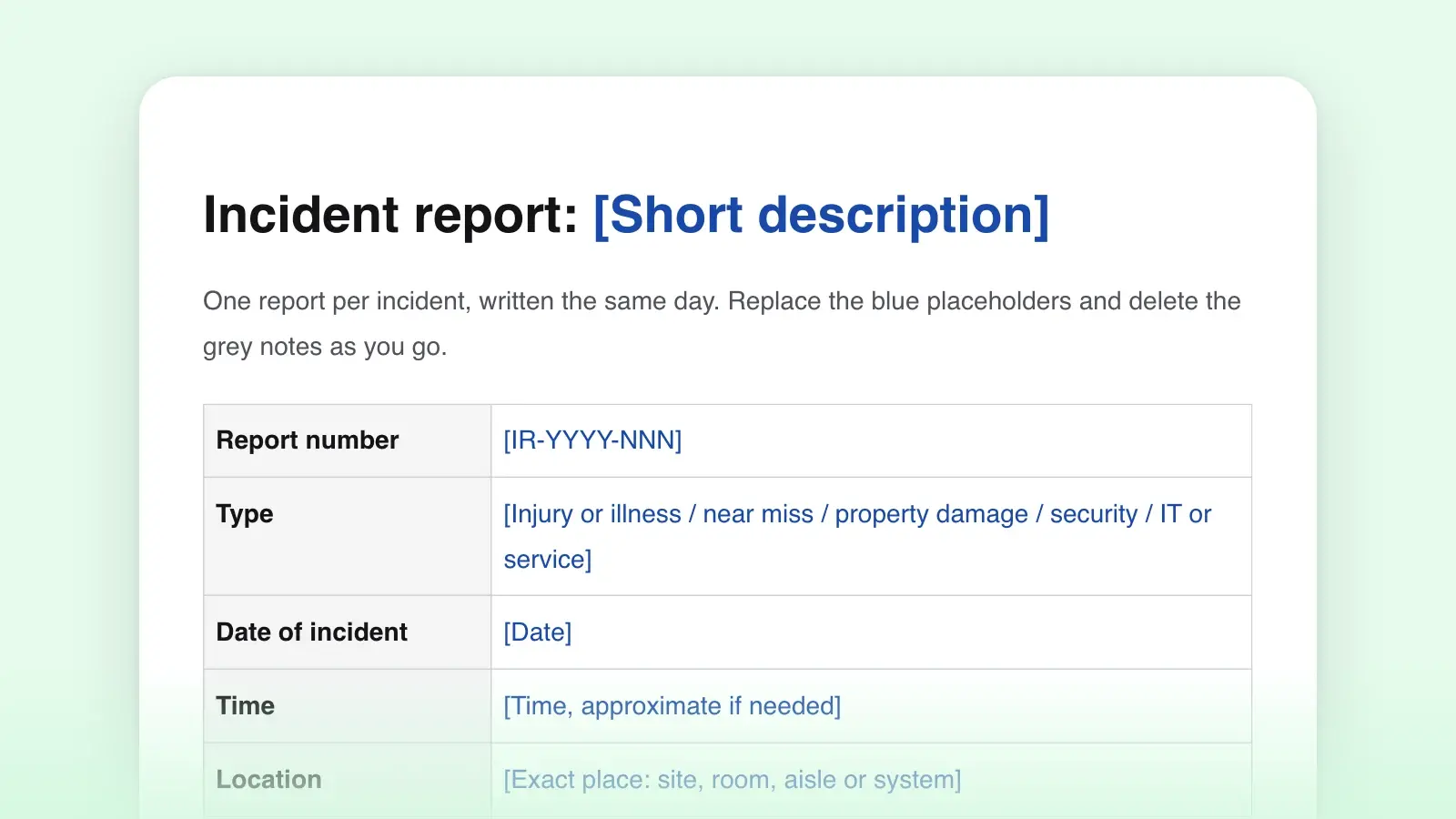
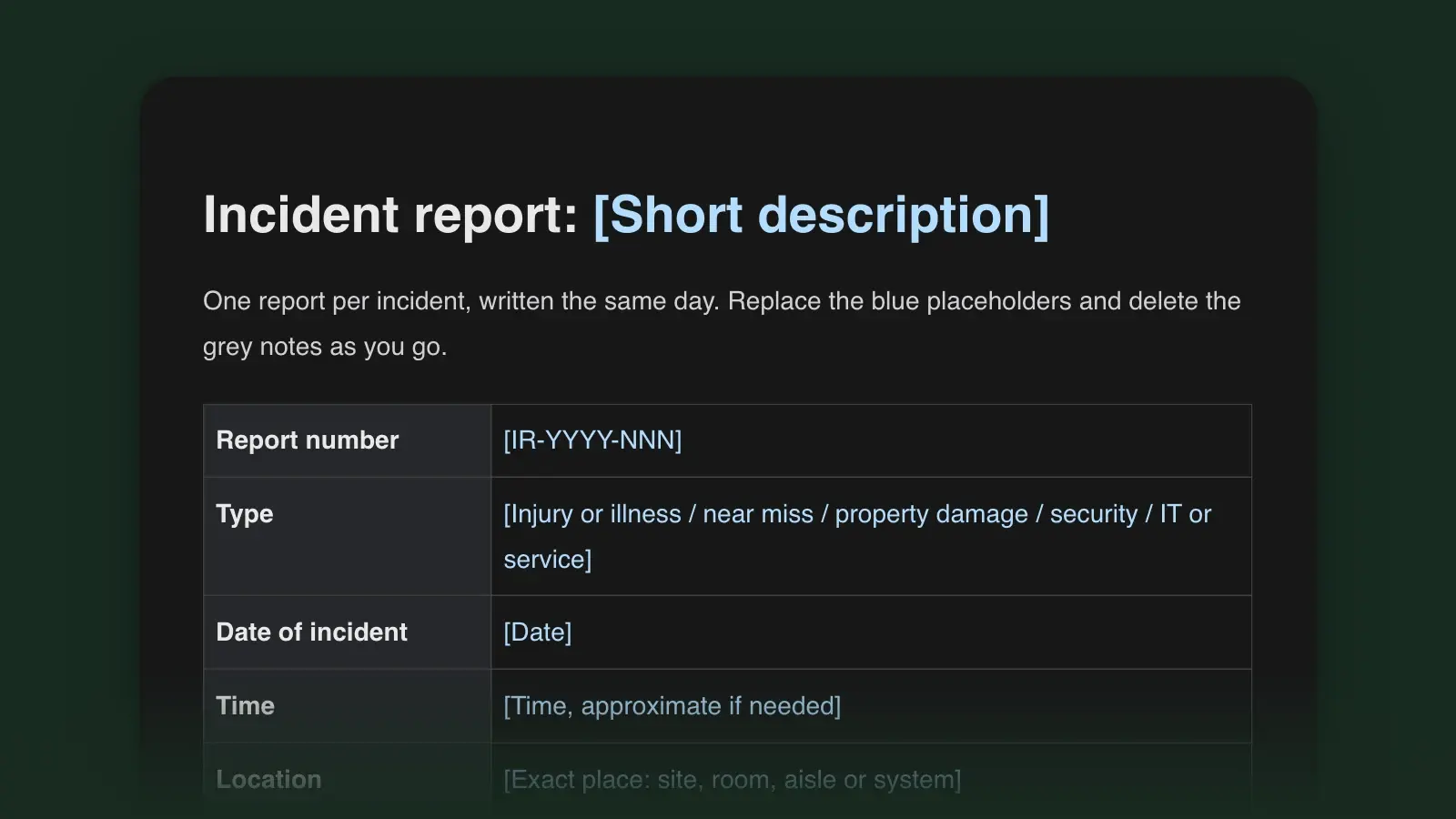
An incident report is a written, factual record of an unplanned event at work, such as an injury, a near miss, damage to property or a security problem, made soon after it happens so the organization can respond, find the cause and stop it happening again. This template has one section for each question a reviewer will ask: what happened, to whom, when and where, what was done straight away, why it happened and what will change.
Start with what happened, when and where. Record who saw it and what was done right away. Put possible causes in a separate section so the reviewer can tell observations from conclusions. The filled-in report below follows that order. If you are a US employer, read the section on OSHA forms too: an internal report like this one doesn't replace them.
Incident report example
Here is the template filled in for a minor stockroom injury at an invented bookstore. Every fact in the description comes from a named source, and blame appears nowhere, not even in the root-cause section.
Report details. IR-2026-014 · Type: injury (minor) · Reported by: Dana Okafor, store manager · Date of report: 9 October 2026
When and where. 9 October 2026, about 10:40 a.m. Stockroom, aisle B, Harbor Street Books.
People involved. Marcus Lee, bookseller (injured). Jo Patel, bookseller (witness).
What happened. Marcus's account, given to Dana at 10:50 a.m.: at about 10:40 a.m. he climbed the two-step ladder in aisle B to reach a carton on the top shelf. As he stepped onto the second step, the ladder's left foot slid on the tile floor. He stepped down quickly onto his right foot and his ankle turned. He did not fall. Jo's account: she was shelving in aisle C, heard the ladder scrape and reached him within a few seconds; she didn't see the slip itself. Marcus told her, “My ankle went over.” Found by Dana when she arrived: the carton was still on the shelf, the floor was dry, and the ladder's left rubber foot was worn through to the metal.
Injuries or damage. Swelling on the outside of the right ankle. Dana, the store's trained first aider, gave him an ice pack and a chair at 10:50 a.m. Marcus went home at 11:30 a.m. and visited an urgent-care clinic that afternoon. He returned to work on 11 October with no restrictions.
Witnesses. Jo Patel: heard the scrape, saw Marcus standing on one foot beside the ladder. Statement taken by Dana at 11:15 a.m.
Immediate actions. First aid given. Ladder tagged “Do not use” and taken out of the stockroom. Cartons on the top shelf of aisle B moved down to waist height until a new ladder arrives.
Root cause (Dana's analysis). Why did the ladder slip? Its foot was worn through. Why wasn't the wear noticed? Ladders weren't on any inspection list. Why not? The opening checklist was written before the stockroom had ladders. Root cause: no inspection routine for ladders and step stools.
Corrective actions. Replace the ladder (Dana, due 12 Oct, done 11 Oct). Check every ladder and step stool in the store (Dana, due 16 Oct). Move heavy stock off top shelves for good (Jo, due 16 Oct). Add a monthly ladder check to the opening checklist (Dana, due 31 Oct).
Follow-up and sign-off. HR to decide by 16 October whether the case is recordable on the OSHA 300 Log. Report read and agreed by Marcus Lee, 11 October. Reviewed and closed by Leah Brooks, owner, 12 October 2026, pending the 31 October action.
Why it works. The description is in time order, and each fact says where it came from: Marcus's account, Jo's statement or what Dana found. Inference starts only in the root-cause section, which is labeled as Dana's analysis. Nobody diagnoses the injury; the report says what could be seen and what treatment was given. The root cause is a missing routine, so the fix is a routine, written into the store's procedures rather than left as a reminder. And the report doesn't decide the legal question of recordability; it hands it to the person whose job that is, with the date it's due.
How to use this template
- Write it the same day
Once everyone is safe, start the report while memories are fresh and the scene hasn't changed. Take photos before anything is moved, if it is safe to do so. Written a week later, the details are harder to check and easier to dispute.
- Describe what happened before you explain it
Write the description in time order: who did what, where, and what happened next. Keep it to what you saw, and mark what someone told you as theirs. Leave the reasons for the root-cause section, where they can be checked.
- Take witness statements one at a time
Ask each witness separately, before they compare notes, and write their account in their own words. Quote anything important exactly, and note when and by whom each statement was taken.
- Find the cause, not the culprit
Ask “why?” until you reach something the organization can change: a missing check, a worn part, a step the procedure never mentioned. “Ana wasn't careful” ends the inquiry. “Nobody inspects the ladders” leads to a fix.
- Give every action an owner and a date
Write each fix with the person who owns it and the date it's due. Close the report only when each action is done or deliberately dropped, and say which.
What goes in each section
| Section | What to write | Example |
|---|---|---|
| SectionReport details | What to writeReport number, type of incident, who is reporting and the date of the report | ExampleIR-2026-014 · Injury · Dana Okafor, store manager · 9 Oct 2026 |
| SectionWhen and where | What to writeDate, time (approximate is fine, say so) and the exact location | Example9 Oct 2026, about 10:40 a.m., stockroom, aisle B |
| SectionPeople involved | What to writeName, role and part played: injured, involved, witness | ExampleMarcus Lee, bookseller, injured |
| SectionWhat happened | What to writeThe events in time order, facts only, each with its source, and exact quotes | ExampleMarcus's account: as he stepped onto the second step, the ladder's left foot slid on the tile. |
| SectionInjuries or damage | What to writeWhat was hurt or damaged, first aid or treatment given, by whom | ExampleSwelling, right ankle; ice pack at 10:50 a.m. |
| SectionWitnesses | What to writeWho saw or heard what, and when each statement was taken | ExampleJo Patel heard a scrape and came over; statement taken 11:15 a.m. |
| SectionImmediate actions | What to writeWhat was done at once to help people and make the area safe | ExampleLadder tagged “Do not use” and removed |
| SectionRoot cause | What to writeThe chain of whys, ending in something the organization controls, and whose analysis it is | ExampleNo inspection routine for ladders |
| SectionCorrective actions | What to writeEach fix, with an owner, a due date and a done date | ExampleAdd a monthly ladder check to the opening checklist · Dana · 31 Oct |
| SectionFollow-up and sign-off | What to writeWho reviews the report, when it is closed, signatures | ExampleReviewed by the owner, 12 Oct 2026 |
Incident report samples by type
The core sections fit every incident. Each type adds a few fields, and each has one mistake that keeps coming up:
| Type | Add these fields | Watch for |
|---|---|---|
| TypeInjury or illness | Add these fieldsBody part and side; treatment given and by whom; whether the person left work or saw a clinician; days away or on restricted work | Watch forDon't write a diagnosis unless a clinician gave one, and share medical details only with the people who need them |
| TypeNear miss | Add these fieldsWhat could have happened, and what stopped it | Watch forReport them at all: a near miss is the cheapest lesson an incident can teach |
| TypeProperty or vehicle damage | Add these fieldsThe asset and its ID, the damage, photos, an estimated cost, whether the insurer was told; for vehicles, the other party's details | Watch forPhotograph before anything is moved, if it is safe to do so |
| TypeSecurity incident | Add these fieldsWhat was taken, opened or seen; how entry happened; police report number; camera time range; keys or cards involved | Watch forDescribe people by what was seen, not by guesses about who they were |
| TypeIT or service incident | Add these fieldsStart and end time, how it was detected, who or what was affected, a timeline, the workaround | Watch forKeep this as the first record; the full analysis belongs in a postmortem |
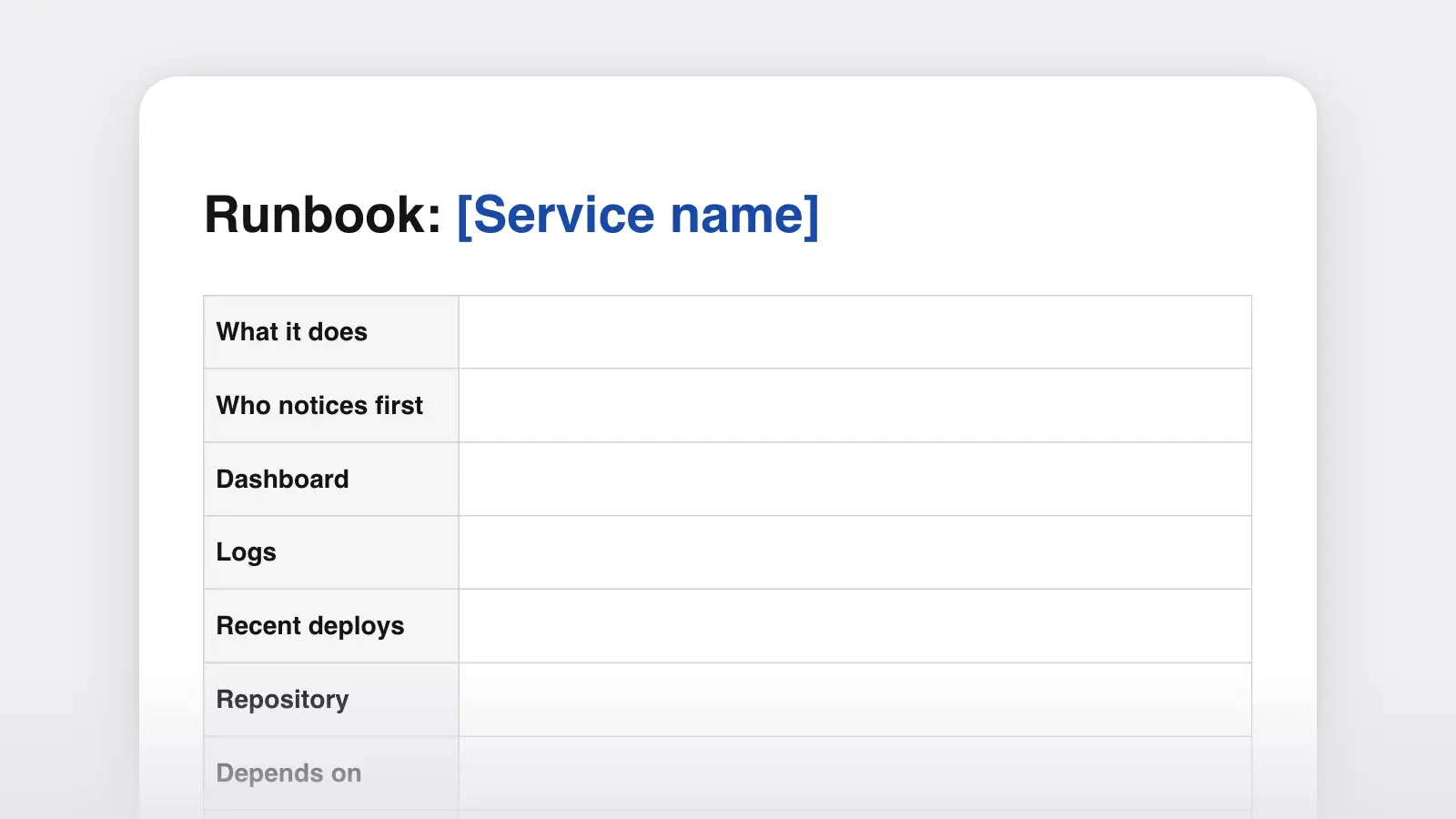
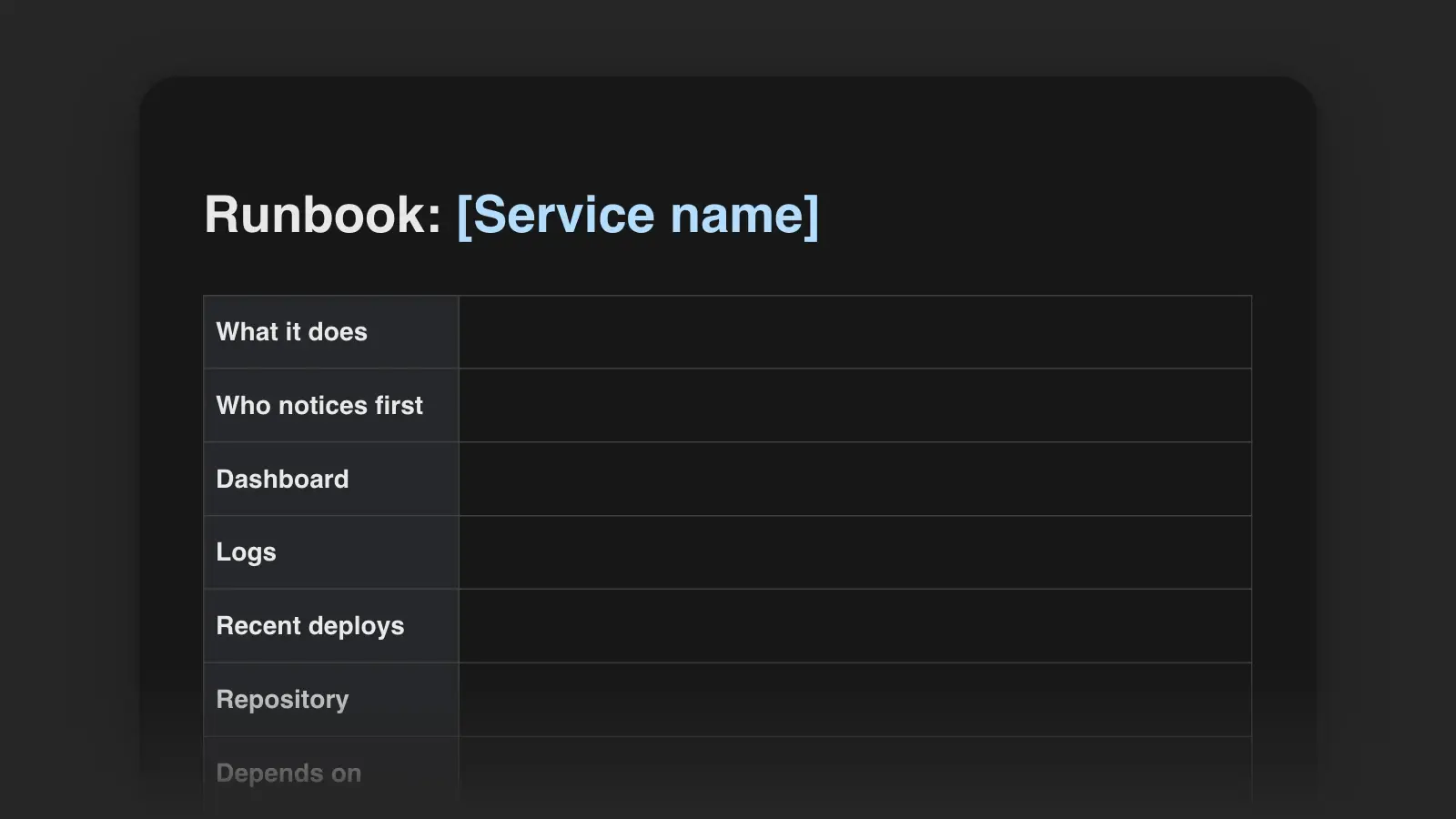
For service and IT incidents, the incident report is the record made while things are still unfolding. The steps the on-call engineer follows belong in the service's runbook, and anything that changes how the system is built belongs in a postmortem written afterwards. Link all three to each other.
How to describe what happened
The description decides whether a report helps or starts an argument. Compare two versions of the same moment:
Facts a stranger could check
- Marcus says the ladder's left foot slid on the tile as he stepped onto the second step, at about 10:40 a.m.
- Jo said she heard a scrape and reached him within a few seconds.
- Swelling on the outside of the right ankle.
Blame, guesses and diagnoses
- Marcus was rushing and didn't take care on the ladder.
- Someone must have left the floor wet.
- Sprained ankle (written by a colleague, not a clinician).
- Use time order. Start before the incident (what the person was doing and why) and end when the area was made safe.
- Separate seeing from hearing. “I saw” and “Jo told me” are different kinds of evidence. Label which is which.
- Quote exactly. Put what people said in quotation marks, word for word. Paraphrases drift.
- Be specific about place and time. “Aisle B, top shelf” and “about 10:40 a.m.” beat “in the back” and “this morning”.
- Keep opinions out of the description. If you think you know the cause, write it in the root-cause section, where it can be tested with the whys.
“Use this template” opens the blank report in Strokes as a document you can edit and export to PDF or Word for the insurer or the safety committee. Before you send it for review, ask the Strokes Assistant to point out any sentence that assigns blame, states a guess as a fact or puts a cause into the description.
OSHA forms and reporting deadlines
In the United States, employers covered by OSHA's recordkeeping rule (29 CFR Part 1904) keep three forms for recordable work-related injuries and illnesses. As of November 2026:
| Form | What it records | When |
|---|---|---|
| FormOSHA 300, Log of Work-Related Injuries and Illnesses | What it recordsOne line per recordable case | WhenWithin seven calendar days of learning about the case |
| FormOSHA 301, Injury and Illness Incident Report | What it recordsThe details of each recordable case | WhenWithin seven calendar days. An equivalent form is allowed if it has the same information, is as readable and follows the same instructions; many employers use an insurance form |
| FormOSHA 300A, Summary of Work-Related Injuries and Illnesses | What it recordsThe year's totals, certified by a company executive | WhenPosted in the workplace from February 1 to April 30 of the following year |
Some establishments must also submit their data to OSHA online by March 2 each year: those with 250 or more employees, and those with 20 to 249 in designated industries, submit the 300A; those with 100 or more employees in another list of designated industries submit their 300 and 301 information as well. Companies with 10 or fewer employees at all times during the last calendar year, and establishments in certain low-hazard industries, are partially exempt from keeping the records unless OSHA or the Bureau of Labor Statistics asks them to in writing.
That exemption covers recordkeeping only. Every employer covered by the OSH Act must report a work-related fatality to OSHA within 8 hours, and an in-patient hospitalization, an amputation or the loss of an eye within 24 hours, by phone, in person or online. States that run their own OSHA-approved plans can set stricter or additional reporting rules.
This template is an internal report. It records what happened and what you will change. It doesn't decide whether a case is recordable, and it doesn't replace Form 301, a workers' compensation claim, an insurer's form or any state or national form you are required to file. Other countries have their own rules and forms.
Frequently asked questions
How soon should an incident report be written?
The same day if you can, once everyone is safe, because memories fade and scenes change. Set a deadline in your own procedure, such as the end of the shift. For US employers covered by OSHA's recordkeeping rule, recordable injuries and illnesses must be entered on the 300 Log and Form 301 within seven calendar days of learning about them.
Who should write an incident report?
Usually the supervisor or manager responsible for the area, using accounts from the person involved and from witnesses. The person involved can write their own account, and each witness should give a separate statement. One person should own the report until it is closed.
What is the difference between an incident and an accident?
Definitions vary between organizations, but an incident is usually any unplanned event that caused or could have caused harm, damage or loss. An accident is an incident that did cause harm or damage, and a near miss is one where nothing was harmed, often by luck. Report all three with the same form: near misses often show where the next accident could happen.
Does this template replace OSHA Form 301?
No. It is an internal report for describing what happened and fixing the cause. If you are a US employer covered by OSHA's recordkeeping rule, recordable cases still need Form 301 or an equivalent form with the same information, plus an entry on the 300 Log. Check with HR or your insurer which forms apply to you.