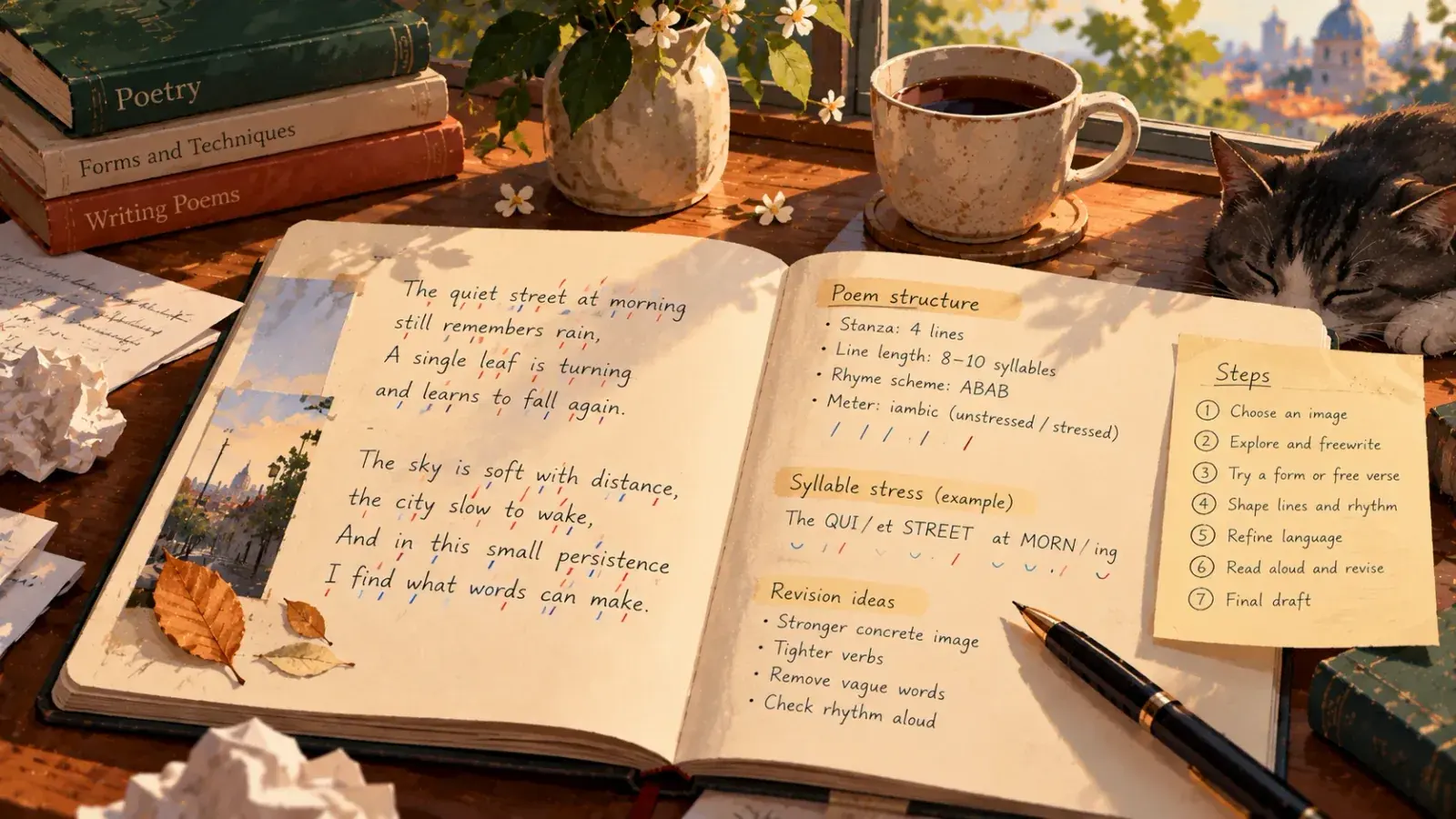
An AI poem generator writes a poem from a topic and a few settings in seconds, and the main ones cost nothing. ToolBaz offers 19 forms with menus for rhyme scheme and meter and no sign-up. Grammarly and QuillBot each have a free generator built around a prompt box, and a chat assistant such as ChatGPT, Claude or Gemini will attempt any form you can describe. A 2024 analysis of poems written by GPT models found one default style, rhymed four-line stanzas in familiar words, so the form and the freshness are what you check by hand.
This page sets four generators side by side on what their own pages state, lists the forms they name with the rule to check for each, summarizes two studies, and gives a prompt and an editing pass. The vendor facts were read on November 18, 2026. No generator was run for this page, and the sample poem below was written by hand to show a pattern. For prose, see AI story generators.
Poem generators at a glance
| Generator | How you set the form | Forms it names | Sign-up and price |
|---|---|---|---|
| GeneratorToolBaz AI Poem Generator | How you set the formMenus for poetry style, rhyme scheme, meter, mood, imagery and point of view | Forms it names19: sonnet, haiku, free verse, limerick, acrostic, villanelle, sestina, ode, epic, ballad, elegy, terza rima, quatrain, pantoum, tanka, ghazal, cinquain, clerihew, spoken word | Sign-up and price“No Sign-Up Required”; described as “100% free” with “no daily limits” |
| GeneratorGrammarly AI poem generator | How you set the formTwo fields, theme and style | Forms it namesSonnets, haiku, limericks and free verse | Sign-up and priceFree, with no ads or hidden fees, the page says; it is not clear whether an account is needed |
| GeneratorQuillBot AI poem generator | How you set the formOne prompt box; you name the rhyme, length, style or a poet, then follow up | Forms it namesHaikus, rhyming couplets, free verse, romantic stanzas, limericks | Sign-up and priceDescribed as “completely free to use with no limits”; sign-up not stated |
| GeneratorPoem Generator (Aardgo) | How you set the formPick a poem type and supply keywords | Forms it namesHaiku, didactic cinquain, sonnet, villanelle, rhyming couplets, limerick, acrostic, tanka, narrative, concrete, free verse, love poem | Sign-up and priceNot stated on the home page |
The ToolBaz generator goes furthest in settings. Its rhyme menu runs from ABAB and AABB to the limerick's AABBA, and its meter menu offers iambic pentameter, trochaic tetrameter, anapestic tetrameter and dactylic hexameter among others. There is no length setting. The page says the tool is optimized for English, exports to TXT, DOC and HTML, and advises adding a personal touch before publishing a poem commercially.
Grammarly's generator and QuillBot's are simpler: you describe what you want in words. Grammarly's hub page says a monthly allowance of prompts comes with signing up, and its plans page puts the Free allowance at 100 prompts a month. QuillBot says that if you name a poet, the tool will try to match that voice.
Poem Generator is a different kind of tool. Its maker, Aardgo, says the first of its generators began in 2002 as a student magazine project, and the site describes writing each poem from “our extensive word lists” and the keywords you supply. Nothing on the page mentions a language model; by its own description it assembles a poem from stored words and your keywords.
Chat assistants have no poem menu at all. The form, the subject and the constraints all go into the prompt, which is the reason the prompt further down is long.
Forms and what to check
Choosing “Villanelle” from a menu tells the generator which form you want. None of the three AI generator pages read for this comparison says the result is checked against the form's rules afterward. These are the rules, as this site's guides give them, and the check for each.
| Form | The rule | Check in a generated poem |
|---|---|---|
| FormSonnet | The ruleFourteen lines of iambic pentameter; the Shakespearean scheme is ABAB CDCD EFEF GG, with a turn at line 9 or in the closing couplet | Check in a generated poemCount the lines, letter the rhymes, scan three lines for five beats, find the turn |
| FormHaiku | The ruleThree lines; 5-7-5 syllables in the classroom version | Check in a generated poemCount each line aloud; look for one concrete moment and no stated feeling |
| FormLimerick | The ruleFive lines rhymed AABBA; three beats in lines 1, 2 and 5, two in lines 3 and 4 | Check in a generated poemRead it aloud for the bounce; see that line 5 is a punchline |
| FormVillanelle | The ruleNineteen lines on two rhymes; line 1 returns as lines 6, 12 and 18, line 3 as lines 9, 15 and 19 | Check in a generated poemCompare each refrain with its first appearance, word for word |
| FormAcrostic | The ruleThe first letters of the lines spell a word or name | Check in a generated poemRead down the left margin |
| FormCinquain | The ruleFive lines; in Adelaide Crapsey's form, 2, 4, 6, 8 and 2 syllables | Check in a generated poemCount the syllables in every line |
| FormFree verse | The ruleNo regular meter and no rhyme scheme | Check in a generated poemCircle any end rhymes; the study below found GPT models favor rhyme |
Scanning a line takes a minute once you know how: read it as ordinary speech, mark the stresses, count the feet. The guide to meter in poetry walks through it.
What two studies found
The first study is about readers. In a paper published in Scientific Reports in November 2024, Brian Porter and Edouard Machery asked ChatGPT 3.5 for poems “in the style of” ten poets, among them Chaucer, Dickinson and Plath, and used the first five outputs for each, with no selection. Its 1,634 participants judged whether each poem was written by a person or by AI and were right 46.6% of the time, below chance. A second group of 696 rated the AI poems higher on 13 of 14 qualities; rhythm showed the largest gap, and “original” was the one quality with no significant difference. Readers who were told a poem was written by AI rated it lower, whoever had written it.
The authors' explanation is that non-expert readers found the AI poems easier to understand and may have taken their own preference as a sign of human authorship. The participants were not poets or critics, and every AI poem came from one model, ChatGPT 3.5. The finding describes what general readers preferred in that set of poems.
The second study is about the poems. For “Does ChatGPT Have a Poetic Style?”, Melanie Walsh, Anna Preus and Elizabeth Gronski generated 5,700 poems with GPT-3.5 and GPT-4 across 24 forms and styles and compared them with 3,700 poems from the Poetry Foundation and the Academy of American Poets. The models could produce the right length for fixed forms, such as 14 lines for a sonnet and 19 for a villanelle. Otherwise they leaned on rhyme, four-line stanzas, iambic meter and the first-person plural, and reused words such as “heart”, “embrace”, “echo” and “whisper”. The authors call the result much more constrained and uniform than human poetry. The study dates from 2024; newer models may differ, which is one reason to run the test further down. The wider vocabulary habit has its own page, AI words.
A prompt that sets the form
A one-line request leaves the model to its defaults. This prompt states the form in full, supplies the images and rules out the habits the second study measured.
Prompt
Write a poem about my grandmother's kitchen on a winter morning.

Form: Shakespearean sonnet. Fourteen lines of iambic pentameter, rhymed ABAB CDCD EFEF GG, with a turn at line 9.
Use these details: the blue enamel kettle with a chipped lid, flour on the radio dial, the back door that sticks in cold weather.
Speaker: her grandson, forty, clearing the house. Say "I", never "we". Do not say that she has died; let the objects show it.
Avoid: the words heart, soul, whisper, echo, embrace and dance; any line that states a lesson; rhymes on love/above or light/night.
After the poem, list each line with its syllable count and mark any line that does not scan.
Original example, written for this page. The last line of the prompt does not make the count correct. It gives you a list to check against your own ear, starting with the lines the model marked.
What to fix by hand
The pair below shows the kind of revision those findings point to. The first quatrain was written for this page in the default style the Walsh study describes. The second is a rewrite from the same kitchen.
In Grandma's kitchen, warm and bright,
the kettle sang its morning song.
Her love still fills the room with light,
and in our hearts she lives on strong.
The kettle's lid still wears its chip. I fill
it to the line she scratched there with a key.
The back door sticks, the way it always will
in frost. I set two cups out. One's for me.
- Swap the abstractions for objects. Love, light and hearts became a chipped lid, a scratched line and two cups. The guide to writing a poem starts from the same rule: one thing you saw or held.
- Fix the meter the form asks for. The first version has four beats to a line; a sonnet needs five. Each line of the rewrite has ten syllables with the stress on every second one.
- Name the speaker. “Our hearts” became “I”, and the poem gained someone standing in the room.
- Cut the line that explains. “She lives on strong” tells the reader what to feel. The second cup does that work without saying it.
- Let a rhyme go if it bends the sentence. Bright and light chose the words in the first version. In the second, the sentences run across the line ends and the rhymes fall where the sense does.
Test it yourself
Three requests to any generator, about ten minutes in all.
- Ask for a villanelle on a small subject
Defrosting a freezer will do. Count nineteen lines, then compare lines 6, 12 and 18 with line 1 and lines 9, 15 and 19 with line 3.
- Ask for free verse with no rhyme
Same subject. Circle every pair of line endings that rhyme, and note whether the poem fell into four-line stanzas anyway.
- Ask for a 5-7-5 haiku
Count the syllables in each line aloud, and check whether the last line names a feeling or draws a moral.
- Repeat with a full brief
Run the long prompt above with your own subject and details, and put the result beside the first three. The difference shows how much of the poem came from you.
We make Strokes, a desktop writing app, so read this part as the maker's view. Strokes is for people who write the poem themselves. Documents are files on your own computer, and the editor works offline and without an account. Built-in AI readers, an editor and a skeptic among them, read the whole document and comment; they never change the text. Version history is kept on your device.
Frequently asked questions
Is there a free AI poem generator?
Several. ToolBaz describes its poem generator as 100% free with no daily limits and no sign-up, QuillBot calls its tool completely free with no limits, and Grammarly says its generator costs nothing and carries no ads. The free plans of ChatGPT, Claude and Gemini will also write a poem from a prompt. The generator pages read for this comparison do not say what happens to the text you type, so leave private details out of the prompt.
Can AI write a good poem?
It can write one that general readers like. In the 2024 Scientific Reports study, non-expert readers rated poems from ChatGPT 3.5 above poems by ten well-known poets and could not reliably tell which was which. The same study found no difference on originality, and its authors put the preference down to the AI poems being easier to understand. The raters were general readers, not editors or poets.
Why do AI poems rhyme so often?
The habit has been measured, though its cause has not been established. In an analysis of 5,700 poems from GPT-3.5 and GPT-4, the models favored rhyme, four-line stanzas and iambic meter across many of the 24 forms and styles requested. To work against it, ask for unrhymed lines in plain terms, name the stanza length you want, and paste in a few lines of the kind of verse you mean.
Can I submit an AI-generated poem to a contest or magazine?
Read the rules of the contest or magazine first, because each sets its own terms on AI. In the United States there is also a copyright question: the Copyright Office concluded in January 2025 that prompts alone do not make the person prompting the author of the output, while your own creative changes to it can be protected. That is general information, not legal advice.