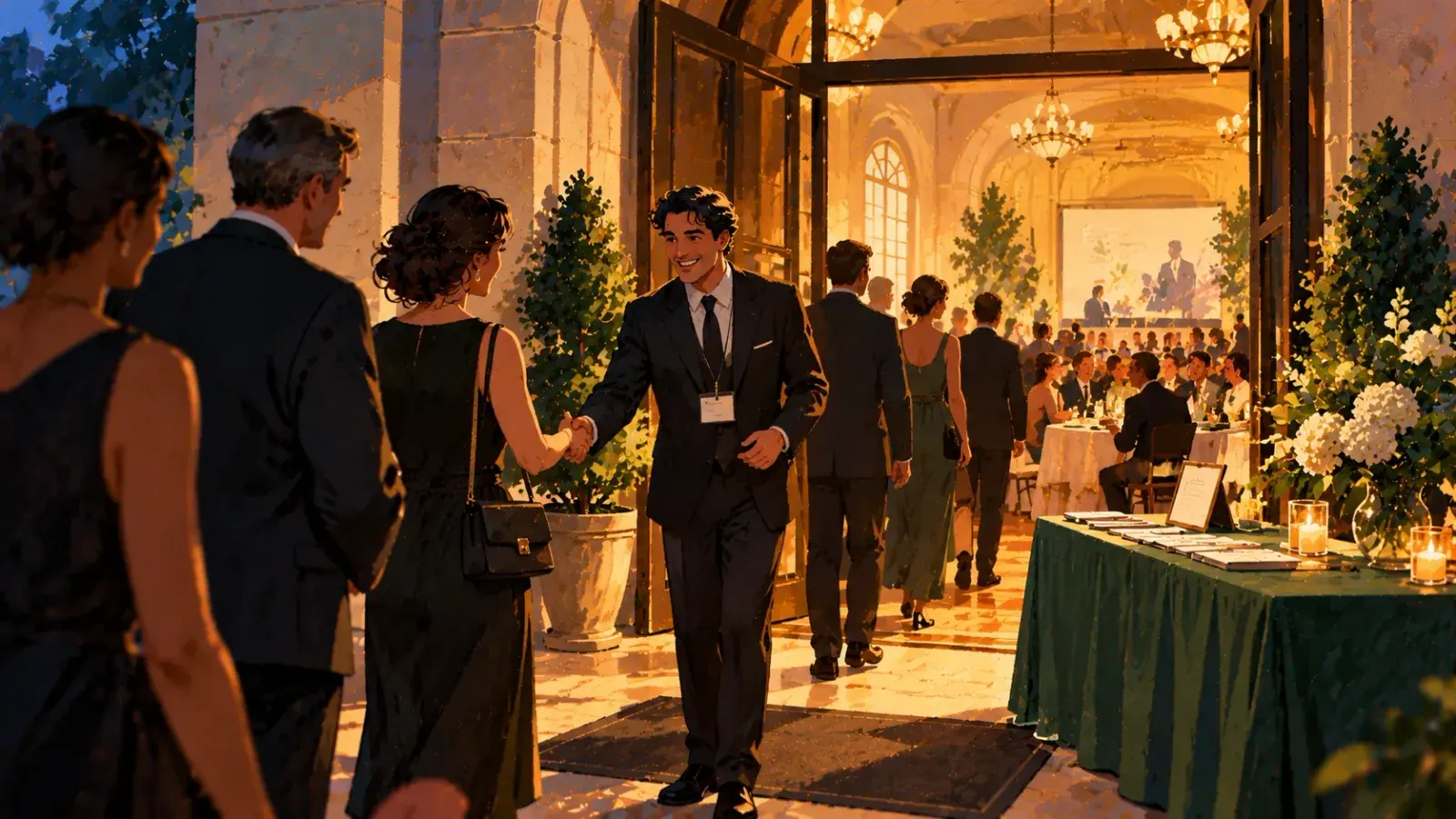
A welcome speech is the short address that opens an event. It greets the room, says why everyone is there, thanks the people who made it happen, tells guests what comes next and hands over. Most need a minute or two, roughly 100 to 300 words. Below are twelve original examples grouped by occasion, each with its length, then a method for writing your own.
The five parts of a welcome speech
A good welcome does the same five jobs in this order, at a board meeting or a family reunion. Greeting, purpose and handoff are essential. Thanks and logistics depend on the event.
| Part | What it does | Sample line |
|---|---|---|
| PartGreeting | What it doesGets attention and says who you are, if the room doesn't know | Sample line"Good morning. I'm Dana Ruiz, and I chair the planning committee." |
| PartPurpose | What it doesNames the occasion and why it matters today | Sample line"We're here to mark twenty years of the Eastside Food Bank." |
| PartThanks | What it doesNames the few people the room would notice you missed | Sample line"Thank you to Riverside Library for hosting us." |
| PartWhat's next | What it doesOnly the logistics people need in the next hour | Sample line"Lunch is at 12:30 in the atrium." |
| PartHandoff | What it doesCloses cleanly or introduces the next speaker | Sample line"Please welcome our first speaker, Dr. Lena Ortiz." |
Welcome speeches for work events
At work, the welcome comes from whoever owns the event. People are there on company time, so get to the agenda fast.
Good morning, and welcome to the ninth Northfield Library Technology Conference. I'm Priya Nair, director of the Lakeshore Library Consortium, and on behalf of the planning committee, I'm glad you're here.
This year 340 of you registered, from libraries in six states, and at least one of you flew in from Anchorage.
This conference began as one afternoon in a branch library basement. It grew because the people in this room keep bringing problems worth solving: aging catalogs, tight budgets, patrons who need far more than a book. Over the next two days, forty sessions take them on.
Thank you to Fairview College for lending us this hall, to our sponsors, who are listed in your program, and to the volunteers in green lanyards, who have been here since six. If you need anything, find a green lanyard.
The Wi-Fi password is on the back of your badge, and lunch is at 12:15 in the east atrium.
Now it's my pleasure to introduce our opening speaker. Marcus Bell has spent fifteen years rebuilding rural library networks. Please welcome Marcus Bell.
Morning, everyone, and welcome to those of you joining from Denver and Lisbon. To the six people who started since our last all-hands: welcome. Nobody expects you to know the acronyms yet.
We have an hour, and the point is to look at the quarter honestly: what shipped, what slipped and what we're changing. Hannah will walk through the numbers, Theo will demo the new onboarding flow, and the last fifteen minutes are for your questions. Drop them in the chat as we go.
Hannah, over to you.
Good morning, and welcome to Harbor & Pine. I'm Jordan Reyes from people operations. Every one of our three hundred employees once sat where you're sitting, holding a badge that didn't open the right doors yet.
By four o'clock, you'll know who to ask, where things live and what your first week looks like. You won't remember all of it, and that's fine: it's in your welcome packet, and your onboarding buddy will check in on Thursday.
One request: ask the questions you think are too basic. Half the room is wondering the same thing.
Let's start with introductions: your name, your team and one thing you'd recommend we read, watch or eat.
Hi, everyone, and welcome. I'm Sam Lee from the Tri-County Small Business Network. According to the chat, you're joining from forty-one towns today, which is a record for us.
Three quick notes before we begin. Everyone is muted. Questions go in the Q&A box rather than the chat, so they don't scroll away, and we'll answer as many as we can in the last twenty minutes. And yes, this session is being recorded, and everyone who registered will get the link by email tomorrow.
Our speaker is Amara Diallo, who has spent ten years helping local shops move their bookkeeping online. Amara, the floor is yours.
Welcome speeches for schools
A school welcome speaks to students who want it short and adults who want the occasion taken seriously. At a formal ceremony, the salutation names the most senior guests first.
Good morning, students, teachers and staff. Welcome back to Westbrook Middle School, and to our new sixth graders, welcome for the very first time.
A few things changed over the summer. Every hallway has a fresh coat of paint, the library has two hundred new books, and the vending machine by the gym finally takes cards.
This year, I'm asking each of you for one thing: be the person who makes someone's first week easier. Show a new student where the gym is. Save a seat at lunch. You remember how it felt.
Teachers, thank you for the long hours you put in last week getting ready. And now, please welcome our student council president, Aisha Rahman.
Good evening. Superintendent Hall, members of the Board of Education, faculty and staff, families and friends, and most of all, the Class of 2027: welcome to the commencement exercises of Ridgeview High School.
Tonight we celebrate 312 graduates. Behind each of them are people who drove to early practices, signed late permission slips and checked homework at the kitchen table. Families, tonight belongs to you too.
Please silence your phones. As names are read, we ask that you hold your applause until the end of each row, so every graduate's name can be heard. There will be plenty of time to cheer when the whole class stands.
It is my honor to introduce our valedictorian, Daniel Cho.
Giving the main address rather than the welcome? Our graduation speech examples cover the longer form.
Community and faith welcomes
Community events mix regulars with people who know no one. Speak to both, and tell newcomers exactly what to do.
Good morning, and welcome to Grace Community Church. Some of you have been worshiping here for forty years, and some of you found us this week. We're glad you're all here.
If you're visiting, please fill out the card in the pew rack in front of you and drop it in the offering plate. You won't be singled out. We'd just like to know your name.
Children are welcome to stay with their families or head to Sunday school after the first hymn. Their teachers will meet them at the side door. After the service, coffee is in the fellowship hall.
Please stand as we begin with our opening hymn.
Good evening, and welcome to the Harvest Table dinner. I'm Ben Adeyemi, and I chair the board of Second Street Kitchen.
Two years ago, we served about 150 meals a day from a church basement with one stove. Tonight you're sitting in the dining room of our new kitchen, which serves more than 400. Many of the chairs you're sitting on were paid for by people in this room.
Thank you to our host committee, led by Grace Tanaka, and to the volunteers who cooked tonight's meal, the same one our guests eat every Tuesday.
Dinner will be served shortly. Later, you'll hear from Lorraine, who came to us for a meal four years ago and now runs our morning shift. Enjoy your evening.
Good morning, Maple Grove, and welcome to the eleventh Riverside 5K. We have 620 runners, walkers and stroller-pushers registered, the most we've ever had, and about as many people here to hold the coffee.
Every dollar from today's entry fees goes to the public library's summer reading program. Last year, that bought books for 900 children.
Thank you to the police department for closing River Road this morning, to Hartley's Bakery for the muffins at the finish line and to the forty volunteers in yellow vests. If you get lost, follow a yellow vest.
Water stations are at mile one and mile two, and the course closes at ten. Runners, please make your way to the start. We go in five minutes.
Welcome speeches for family occasions
At a family event, speak as a relative, not an official: first names, one or two specific details, and the long stories saved for the toasts.
Good evening, everyone. I'm Michael, Emma's father, and on behalf of our family and Tomás's, welcome.
Some of you came from down the street and some from the other side of the world. Thank you, all of you, for being here.
Linda and I have watched Emma grow into someone we admire. Today we watched her marry someone who clearly admires her too, which is all a parent could ask for. Rafael and Carmen, thank you for raising Tomás, and for welcoming our family into yours.
Dinner will be served table by table in a few minutes. The toasts come after the main course, and the dance floor opens after that. Please eat, drink and stay late.
Would you all raise a glass: to Emma and Tomás.
A parent who is also giving the main toast can fold this welcome into it. The father of the bride speech guide shows how.
Welcome, everyone, to the first Whitfield family reunion in eight years. Look around: there are four generations under this pavilion, from Grandma Ruth, who is ninety-one, to Junie, who is eleven weeks old and has already been held by about thirty of you.
Thank you to cousin Denise, who found this park, booked the pavilion and sent forty-two reminder emails. Denise, we read about half of them.
Lunch is at one, the family photo at three and the talent show after that. If you can name anyone in the unlabeled pictures on the memory table, tell Aunt Carol.
We've lost people since the last reunion, and before we eat, we'll take a moment to remember them. But first: welcome home.
Thank you for being here. My name is Paul, and I'm Margaret's brother. On behalf of her family, welcome.
Margaret would have been embarrassed to see this many people in one room for her, and secretly pleased. She was a nurse for thirty-four years, a terrible singer and a very good friend, and I can see all three parts of her life in the faces here.
This afternoon is a celebration of her life, so laughter is welcome. After a few readings, anyone who would like to share a memory is invited to come up. Afterward, please stay for coffee and her lemon cake. Her granddaughter found the recipe.
Thank you for coming to remember her with us.
The welcome is not the eulogy. If you are giving both, keep the welcome to a minute and see how to write a eulogy for the rest.
Opening lines and handoffs
The first and last sentences carry the most weight, so write them word for word even if you speak the middle from notes. Match them to the tone of voice the room expects.
| Tone | Opening line | Last line |
|---|---|---|
| ToneFormal | Opening line"Good evening. Mayor Ellis, members of the council, honored guests: welcome." | Last line"It is my honor to introduce…" |
| ToneWarm | Opening line"Thank you for coming. It means a great deal to see this room full." | Last line"Please, enjoy your evening." |
| ToneLight | Opening line"Good morning, and welcome to the only meeting this month with free pastries." | Last line"That's enough from me. Let's get started." |
| ToneVirtual | Opening line"Hi, everyone. While people join, tell us in the chat where you're watching from." | Last line"I'll hand over to Amara now. See you in the Q&A." |
Skip elaborate rhetorical devices. One concrete image (green lanyards, a stove in a church basement) does more than any adjective. For more ways to begin, see how to start a speech.
How to write your own
- Find out where you sit in the program
Ask how long you have, who speaks before and after you, and whether an emcee handles introductions and housekeeping. Several government protocol guides advise that once dignitaries have been acknowledged at the start, later speakers need not repeat the list.
- Write the purpose in one sentence
Why are these people here today? "We're here to celebrate 312 graduates" is a purpose. "We're here for an exciting evening" is not.
- Choose who to name
Name the host, the guest of honor and the people who did the work, and thank everyone else as a group. At formal events, address the most senior guest first and work down. Many governments, universities and school districts publish an order of precedence, so ask whether yours has one.
- Keep only the next hour's logistics
Meals, restrooms, Wi-Fi, phones on silent, whether the session is recorded. Anything that matters later belongs in the program.
- Write the last line, then time it aloud
End with the handoff, word for word, then read the speech aloud with a timer. Most speakers deliver a prepared text at roughly 120 to 150 words a minute, so 260 words runs about two minutes. If it runs long, cut names before you cut the purpose.
For a longer address, the speech outline template lays out an opening, middle and close with timings.
What to leave out
Keep
- One sentence on why everyone is here
- Thanks to groups, plus the few names that matter
- Logistics for the next hour
- A clear last line that hands over
Cut
- A dictionary definition of "welcome"
- The full sponsor list, read aloud
- A preview of every session on the agenda
- Apologies for nerves, the weather or the microphone
- Inside jokes half the room won't get
Frequently asked questions
How long should a welcome speech be?
A minute or two for most events, roughly 100 to 300 words. A conference opening or formal ceremony with acknowledgments can run three to five minutes. A welcome at a team meeting can take thirty seconds.
How do you start a welcome speech?
Greet the audience, say who you are if they don't know you, and name the occasion in the first two or three sentences: "Good evening, I'm Rosa Delgado, president of the PTA, and welcome to our fall meeting."
Who gives the welcome speech?
Usually the host: the organizer, chair, principal, pastor or, at a private event, a family member. At larger events an emcee often gives the welcome and then introduces each speaker.
Is a welcome speech the same as opening remarks?
Often, yes. Many programs use the terms interchangeably. When both appear, the welcome is the host's short greeting and the opening remarks are a longer address that sets out the themes. A keynote is the main talk.
Should I memorize a welcome speech?
No. Reading from a card is normal for a welcome. Learn the first and last lines well enough to look up while you say them, and print the rest in large type.