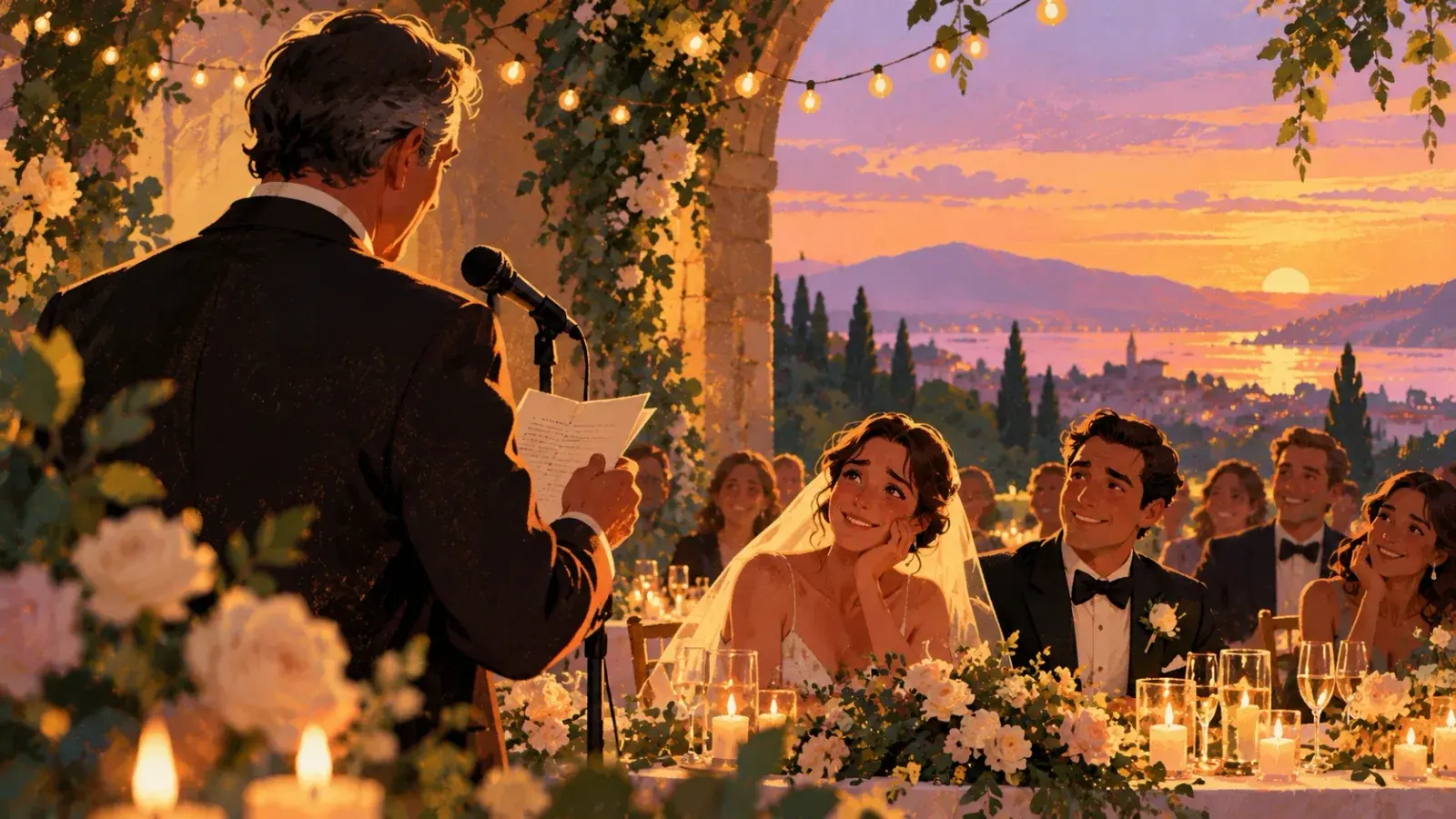
A father of the bride speech does five things: it welcomes the guests, thanks the people who made the day happen, tells one story about your daughter, welcomes the person she married, and ends with a toast to the couple. Keep it to three to five minutes, which is about 400 to 650 words spoken at a calm pace. The speeches people remember are rarely the most polished. They are built on one specific memory, told plainly.
What the speech is for
Your speech has a different job from the best man's or the maid of honor's. They speak as friends. You often speak as the host: traditionally the bride's parents hosted the reception, and even when the couple pays for everything, the father of the bride's speech keeps the host's duties of welcoming people and thanking them.
It is also often the first speech of the evening. In the traditional British order the father of the bride speaks first, then the groom, then the best man. American receptions vary more: a parent or host often opens with a welcome toast and the friends follow, though plenty of couples rearrange things. Ask the couple or their planner where you fall and who comes after you. It changes how much welcoming you need to do, and whether you should hand the microphone to someone by name.
Speaking first also sets the tone for everyone else. A warm, brief father of the bride gives the next speakers permission to be warm and brief. A father who runs twelve minutes has just told the best man that fifteen is fine.
How long it should be
Aim for three to five minutes. American wedding guides generally say to keep any reception toast under five minutes. British guides give the father of the bride more room, often seven to nine minutes, because his is traditionally the longest of the speeches. Running short is the rarer mistake.
To turn minutes into words, read your draft aloud with a timer. Most people speak at somewhere between 120 and 150 words a minute, and slower in front of a crowd, especially when they pause for a laugh or wait out a lump in the throat. Planning on 130 words a minute gives you a realistic budget.
| Length | About | Works for |
|---|---|---|
| Length2 minutes | About250 words | Works forA welcome toast before other speeches |
| Length3 minutes | About400 words | Works forMost American receptions |
| Length4–5 minutes | About500–650 words | Works forThe full five-part speech |
| Length7–9 minutes | About900–1,150 words | Works forTraditional British receptions |
The five parts, in order
Nearly every good father of the bride speech follows the same order, because the order follows what the room needs. Guests want to know who you are, then they want to hear about the bride and the person she married, then they want a glass in the air. Here are rough timings for a four-minute speech.
| Part | Time | What it does |
|---|---|---|
| Part1. Welcome | Time20 seconds | What it doesSays who you are and greets the room |
| Part2. Thanks | Time30 seconds | What it doesNames the few people who made the day |
| Part3. Your daughter | Time90 seconds | What it doesOne story and what it shows about her |
| Part4. Her partner | Time60 seconds | What it doesWelcomes them and their family |
| Part5. The toast | Time20 seconds | What it doesGets every glass up, ends on their names |
1. Welcome the room
Stand, wait for quiet, and say who you are. Half the room may know you only by sight and the other half not at all. Welcome everyone, and single out the people who traveled far or the partner's family, if this is the first time the two families have filled a room together.
"Good evening. For those who don't know me, I'm Tom, Emma's dad. On behalf of Linda and me, welcome. Some of you flew in from Seattle, and one of you drove nine hours with a cooler of brisket in the back seat, which we'll get to later."
2. Thank a few people
Thank the partner's parents, anyone who helped pay for or plan the day, and the people who did the work. Three or four names or groups is plenty. If the couple or the groom speaks later, leave the wedding party's thank-yous to them. It is traditionally their job, and a long list from you takes the moment away from them.
3. Tell one story about your daughter
This is the heart of the speech, and the part where most fathers go wrong by starting in the delivery room and working forward. Skip the biography. Pick one moment that shows a quality she still has, tell it in under a minute, then say what it showed you and connect it to today.
One story, then what it shows
- At nine, Emma ran a lemonade stand all July to pay for a dog we had already said no to.
- She kept a ledger and paid me back for the folding table.
- We got the dog. That's still how she works: she makes a plan, then she outlasts you.
A list of qualities
- She was always kind, clever and determined.
- She has grown into an amazing young woman.
- We're so proud of everything she has achieved.
If you can, plant a detail in the story and bring it back in the toast. The callback is one of the oldest rhetorical devices, and it makes a short speech feel finished.
4. Welcome her partner
Say something specific about the person your daughter married: the first time you met, something they do that tells you she is in good hands, or the moment you knew. Then welcome them into the family by name and say something gracious about their parents. Gentle teasing is fine if it fits your relationship. Their mother is in the room.
"Daniel, the first time you came to dinner you asked for seconds of my chili. Nobody in this family has done that since 2004. You were in from that night. Welcome to the family."
5. Raise the toast
If you want to give advice, make it one sentence you have actually lived and put it just before the toast. Then tell the room exactly what to do: "Please raise your glasses," or, if you want everyone on their feet, "Please stand, if you're able, and raise your glasses." By etiquette the couple stays seated and doesn't drink to themselves, and anyone not drinking can raise whatever is in front of them. End on their names. For other ways to land the last line, see how to end a speech.
Three example speeches
These are original and fictional. Borrow the shape and the pacing, not the details: a speech only works when the story is yours.
Good evening, everyone. For those who don't know me, I'm Tom Hale, Emma's dad. On behalf of Linda and me, welcome. Some of you flew in from Seattle, and Uncle Pete drove nine hours from Asheville with a cooler in the back seat, so if you smell brisket later, that's why.
Thank you to Ray and Carol Okafor, who have been generous and very good company through every part of this. And thank you to the staff here, who have stayed calm all day while I have not.
When Emma was nine, she decided we needed a dog. We said no. She said nothing, which should have worried us. That July she opened a lemonade stand at the end of the driveway. She kept a ledger in a spiral notebook. She borrowed a folding table from me and wrote "Loan, no interest" in the margin. By the end of the summer she had $212 and a written plan covering walks, feeding and vet bills. By September we had a beagle named Ledger.
I tell that story because it is still exactly how Emma works. She decides what matters, she makes a plan, and then she quietly outlasts everyone in the room. She did it with nursing school, she did it with her first half marathon, and Daniel, I suspect she did it with you.
Daniel, the first time you came to dinner you asked for seconds of my chili. Nobody in this family has done that since 2004. You were in from that night. But what I really noticed came later. The winter Emma's grandmother was sick, you drove her four hours each way, every other weekend, and never once mentioned it to us. Emma did. That told me everything I needed to know. Welcome to the family. We are so glad it's you. Ray, Carol, we're glad it's all of you.
Linda and I have been married thirty-one years, and the best advice I have is this: keep a ledger of what the other person does for you, and never show them the balance.
Emma, your mom and I are so proud of you. You were a determined nine-year-old and you are a remarkable woman, and today you look as happy as I have ever seen you.
So would you all please stand, if you're able, and raise your glasses. To Emma and Daniel.
Good evening. I'm Michael, Priya's father, and on behalf of Anita and me, welcome. We're so glad you're here, and especially glad to share tonight with the Brennan family, who have treated us like relatives since the day we met.
I'll keep this short, because the people after me have better stories than I do, and I'm told they're funnier.
Priya, when you were six you left a note on my desk that said, "Dad, I will marry someone who laughs at your jokes." I kept it. I've watched Sean for three years now, and he laughs at every one of them, which means he is either very kind or very brave. Either way, he is the right man for you.
Sean, welcome to our family.
Please raise your glasses. To Priya and Sean.
Good evening. I'm Greg, Jess's father. Some of you know me as the man who has been asking the DJ for the same song since five o'clock. He has been very patient.
Thank you all for coming, and thank you to Marisol and Luis, Andrea's parents, for the most competitive game of cornhole I have ever lost.
I was asked to keep this short and to avoid embarrassing stories, which rules out most of my material. So here is the one Jess approved.
When Jess was fourteen, she took apart our lawn mower to find out why it was making a noise. She did not put it back together. It sat in the garage in eleven pieces for three weeks while she watched repair videos and ordered a part on my credit card. Then one Saturday morning I heard it start. It is still running. I have since learned that when Jess goes quiet for three weeks, something is about to work better than it did before.
Andrea, I'm told you two met when Jess fixed your bike chain on the side of a trail and then talked you into a fifteen-mile loop you hadn't trained for. I want you to know that this is normal, and you will never fully recover. You've been part of this family for a while. Today it's official, and we couldn't be happier.
My one piece of advice: when something breaks, let Jess fix it, and stay out of the garage.
Please raise your glasses. To Jess and Andrea.
Lines for harder situations
Families are complicated, and the speech has to work for everyone in the room. A few situations come up often enough to plan for. In each case, ask your daughter what she wants before you write a word.
Her mother has died. Mention her once, early, near the thanks, and keep it to two or three sentences. A long passage can turn the mood of the room in a way the couple didn't choose. For example: "Emma's mom would have loved today. She'd have cried in the first five minutes and been the last one off the dance floor. We miss her, and we feel her here."
You and her mother are divorced. Say nothing about the divorce. Thank her mother by name for raising your daughter with you, and her partner too if they are part of the family. Generosity here is noticed more than anything else in the speech.
You're her stepfather, or two fathers are speaking. Talk to the other father first, so you don't tell the same story or both welcome the guests. A stepfather can name the relationship simply: "I came into Emma's life when she was eleven, and she let me stay."
You don't know the partner well yet. Talk about what you've seen in your daughter since they met, and ask the partner's friends for one small, kind story you can tell.
How to write yours
- Ask the couple three questions
Before you write, find out where you are in the order of speeches, how long they want you to speak, and whether anything is off limits: an old nickname, a family situation, a story she has already heard too many times. Five minutes of asking prevents most regrettable lines.
- Collect more stories than you need
For a week, write down every memory that comes to mind, in a notebook or on your phone. Ask her mother, her siblings and her oldest friend for one each, and ask the partner's friends how the couple met. You will use one or two.
- Choose the story, then name the trait
Pick the story that shows something still true about her, and write one sentence naming that quality. If you can't write the sentence, the story is cute but not doing any work. Choose another.
- Draft the five parts out loud
Write the parts in order, saying each sentence aloud as you go. Short sentences survive nerves. Long ones with three clauses don't. Keep your contractions, because they sound like you. If you want a fill-in outline, the wedding speech template follows the same order.
- Cut to time
Read it aloud with a timer. If it runs long, cut the thanks and the background first, and protect the story and the toast. Most first drafts lose a third of their words here, and they get better.
- Make a speaking copy and rehearse
Print it in large type, or put one part on each numbered index card. Rehearse it five or six times, at least once standing up and once in front of someone who will tell you the truth. You don't need to memorize the speech. Knowing it well enough to look up at the end of each sentence is plenty.
- Prepare for the day
Give a spare copy to the planner or the best man. Find out where the microphone will be, hold it a few inches from your mouth, and keep it there when you turn your head. Wait for quiet before your first word, and look at your daughter when you talk about her.
Mistakes to avoid
- The life story. Birth, first steps, braces, college. Guests want one good scene, not a timeline.
- Exes and old relationships. No mention of anyone she dated before, even as a joke.
- Money. Jokes about what the wedding cost land differently on whoever paid, and the partner's family may have paid too.
- "Losing a daughter." Lines about giving her away or finally getting her off the payroll are dated, and the partner's family hears them as well. Say what your family is gaining instead.
- Inside jokes. If a line needs an explanation, most of the room is left out of it.
- Shortchanging the partner. Four minutes on your daughter and twenty seconds on the person she married reads as a verdict. Give them real time and one real detail.
- Borrowed quotes. A famous line about marriage from the internet is the least personal sentence you could say. Use one only if it genuinely belongs to your family.
- Drinking for courage, or reading from a phone. One drink before you speak is plenty. Screens dim, lock and buzz. Paper doesn't.
If you are coordinating with the other speakers, the best man speech and maid of honor speech guides cover what they are likely to say, which makes it easier to avoid telling the same story twice.
Frequently asked questions
Does the father of the bride speak first?
Traditionally, yes. In the classic British order the father of the bride speaks first, followed by the groom and the best man. At American weddings a parent or host often opens with a welcome toast, but the order varies, so ask the couple or their planner where you fall.
How long should a father of the bride speech be?
Three to five minutes is safe almost everywhere, which is about 400 to 650 words at a calm speaking pace. British receptions traditionally give the father of the bride more time, often seven to nine minutes, but a shorter speech is rarely a mistake.
Is it all right to read the speech from notes?
Yes. Most fathers read from printed pages or index cards, and guests expect it. Print it in large type rather than reading from a phone, and know it well enough to look up at the end of each sentence.
Should I also give a toast at the rehearsal dinner?
Often, yes, but keep it short. The host of the rehearsal dinner traditionally gives the first toast, and the bride's father may answer with a brief toast of his own. Save your best story for the wedding.
What if the bride's mother wants to speak too?
Give one speech together or speak back to back, and divide the parts so you don't repeat each other. One of you can welcome and thank the guests, the other can tell the story, and you can raise the toast together.