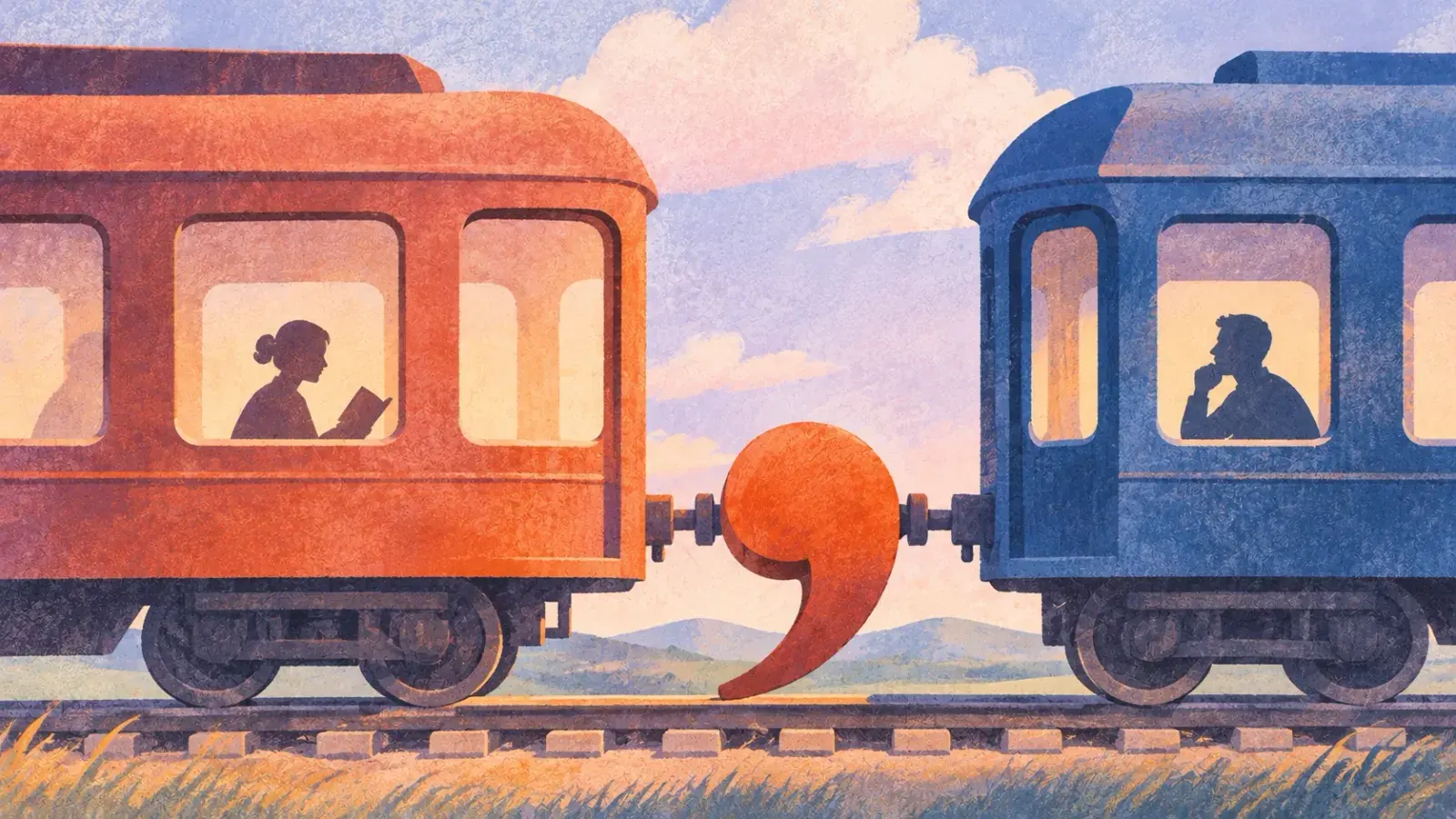
Use that for a clause that tells the reader which things you mean, and which, with commas, for a clause that adds information about things already identified. The memory trick: if you can delete the clause and still know which thing you mean, it gets commas and which. One sentence written both ways shows the difference.
Restrictive: The trains that run on diesel will be retired by 2030.
Nonrestrictive: The trains, which run on diesel, will be retired by 2030.
In the first, the clause picks out a group within the fleet: the diesel trains are retired and the electric ones stay. In the second, the clause identifies nothing. The whole fleet is retired, and the clause adds, in passing, that it all runs on diesel. Two commas and a pronoun change the policy.
So the commas follow the meaning: none around a clause that identifies, a pair around a clause that adds. British English, and plenty of good American prose, also uses which without commas for the first kind (the trains which run on diesel). Restrictive which is a usage choice, not an error, although many American house styles prefer that. The grammar names are restrictive and nonrestrictive, or defining and non-defining, the terms Henry Fowler used.
That vs which at a glance
| Restrictive (defining) | Nonrestrictive (non-defining) | |
|---|---|---|
| What it does | Restrictive (defining)Identifies which thing you mean | Nonrestrictive (non-defining)Adds information about a thing already identified |
| Commas | Restrictive (defining)None | Nonrestrictive (non-defining)A pair of commas, or dashes, or parentheses |
| Pronoun for things | Restrictive (defining)that, or which (common in British English) | Nonrestrictive (non-defining)which only, never that |
| Pronoun for people | Restrictive (defining)who or that | Nonrestrictive (non-defining)who only |
| Delete test | Restrictive (defining)Deleting it changes the meaning | Nonrestrictive (non-defining)Deleting it leaves the meaning intact |
| Example | Restrictive (defining)The trains that run on diesel will be retired. | Nonrestrictive (non-defining)The trains, which run on diesel, will be retired. |
Restrictive and nonrestrictive clauses
A restrictive clause narrows a noun down: without it, the reader doesn't know which one you mean. A nonrestrictive clause hangs extra information on a noun the reader can already identify.
The test Purdue's Online Writing Lab gives for any element of a sentence works here: “If you leave out the clause, phrase, or word, does the sentence still make sense?” If deleting the clause loses information the reader needs to identify the noun, it is restrictive. If the sentence still points at the same thing, it is nonrestrictive.
A noun that is already unique, such as a name or the only one of its kind, almost always takes a nonrestrictive clause: my mother, who lives in Ohio; her first novel, which she wrote at nineteen. Leave out the commas in my sister who lives in Leeds and you imply a second sister who lives somewhere else.
The comma rule
Purdue's writing lab puts the restrictive half plainly: “Do not use commas to set off essential elements of the sentence, such as clauses beginning with that (relative clauses).” The nonrestrictive half is the mirror image:
- Use a pair. A nonrestrictive clause in the middle of a sentence needs a comma at each end:
The report, which I wrote in May is late. - Dashes and parentheses also work, and mark the aside more strongly, as Mill does below. The guide to em dashes and en dashes covers the dash.
- No commas around a restrictive clause.
The report that I wrote, is lateputs a comma between the subject and its verb.
Restrictive: no commas
- Writers who miss deadlines lose work.
- The book that won the prize is out of print.
- Use the template that matches your journal.
Same words, nonrestrictive: commas
- Writers, who miss deadlines, lose work. (All writers miss deadlines.)
- The book, which won the prize, is out of print. (There is only one book.)
- Use the template, which matches your journal. (There is only one template.)
British and American practice
The rule that reserves that for restrictive clauses comes from the Fowler brothers (the history is below), and in British usage it never took hold. The Oxford Learner's Dictionaries, a British reference, illustrate the defining sense of which with Houses which overlook the lake cost more, and note that that can be used instead, except immediately after a preposition. For the non-defining sense, Oxford says flatly that that cannot replace which.
In American English the rule is a matter of house style: if your publisher or journal follows it, a copy editor is likely to change a restrictive which to that, even though Merriam-Webster calls restrictive which “now common and accepted.” In practice:
- American English: that for restrictive clauses, which with commas for nonrestrictive ones. It is the safe choice, and the pronoun then signals the comma decision to the reader.
- British English: which or that for restrictive clauses, by ear; which, with commas, for nonrestrictive ones. In both varieties, never that with commas.
When only which will do
- After a preposition. The Declaration of Independence speaks of “the separate and equal station to which the Laws of Nature and of Nature's God entitle them.” That can't follow a preposition directly; to use it, move the preposition to the end: the station that she was heading to.
- In a nonrestrictive clause, about things: The archive, which opened in 2019, holds his letters.
- When it refers to a whole clause: The train was late, which meant a two-hour wait. Oxford gives a fixed form of this: in which case.
- After the pronoun that: “That which we call a rose,” in Shakespeare's Romeo and Juliet (first printed 1597), not
that that.
We have now recognised the necessity to the mental well-being of mankind (on which all their other well-being depends) of freedom of opinion…
Parentheses do the commas' job; the preposition makes which the only choice.
That and which in sentences
Restrictive, no commas:
- The chapter that introduces the twins needs a new opening.
- Most of the characters that perform in this book still live. (Mark Twain, The Adventures of Tom Sawyer, 1876, “Conclusion”)
- (British) Houses which overlook the harbour sell first.
Nonrestrictive, with commas:
- The novel, which took her nine years, came out in March.
- Our office in Lagos, which opened last spring, now has twelve staff.
- My editor, who lives in Denver, reads everything on paper.
Which after a preposition, or for a whole idea:
- This is the archive in which the letters were found.
- She missed the deadline, which cost her the slot.
The same clause, both ways:
- The essays that were published in 2019 are online. (Only some essays.)
- The essays, which were published in 2019, are online. (All of them.)
Old usage, for recognition:
- Our Father which art in heaven. (King James Version, 1611, Matthew 6:9: which for a person, now archaic; today it would be who)
Common that and which mistakes
The draft, which I sent on Friday has errors.→ The draft, which I sent on Friday, has errors.The archive, that opened in 2019, holds his letters.→ The archive, which opened in 2019, …Passengers, who booked online, can board first.→ Passengers who booked online can board first (unless every passenger booked online).the box in that she kept her letters→ the box in which she kept her letters, or the box that she kept her letters inthe editor which hired me→ the editor who hired me, or the editor that hired meShe sent the contract to the lawyer, which was a mistake.→ It's unclear what the mistake was. Write: Sending the contract to that lawyer was a mistake.
If your house style wants that for restrictive clauses, select a paragraph, press ⌘K and ask the Strokes Assistant to change restrictive which to that. Check each suggestion against what you meant: whether you were retiring the diesel trains or all of them is a fact about your plan, and the sentence alone doesn't say. The same care helps with comma splices and with rules that have a similar history, like fewer vs less.
Quick quiz: that or which?
Fill the gap with that or which, and add commas where the clause is nonrestrictive. Write for an American publication.
- The laptop ____ I bought in May has already failed.
- My laptop ____ I bought in May has already failed. (You own one laptop.)
- This is the café in ____ she wrote the first draft.
- The meeting ran two hours over ____ nobody minded.
- Delete every comment ____ mentions the old title.
- The Corliss Diner ____ opened in 1952 still closes on Sundays.
- The proposal ____ the board rejected came back in a new form.
- Her first book ____ sold eleven copies is now a set text.
- that, no commas: it identifies which laptop
- My laptop, which I bought in May, has already failed: there is only one
- which: after a preposition
- The meeting ran two hours over, which nobody minded: which refers to the whole clause
- that, no commas: only some comments
- The Corliss Diner, which opened in 1952, still closes…: a name, so the noun is already identified
- that, no commas: it identifies which proposal
- Her first book, which sold eleven copies, is now…: there is only one first book
Where the that-or-which rule came from
In earlier English, as Merriam-Webster points out, that and which were used for restrictive clauses more or less interchangeably. The King James Bible puts both into a single verse.
Render therefore unto Caesar the things which are Caesar's; and unto God the things that are God's.
Both clauses identify which things are meant, neither has a comma, and nothing in the meaning explains the switch of pronoun.
The modern rule was proposed by two British brothers. In The King's English (1906), Henry and Francis Fowler wrote that “That should never be used to introduce a non-defining clause,” and that “Which should not be used in defining clauses except when custom, euphony, or convenience is decidedly against the use of that.” Twenty years later, in A Dictionary of Modern English Usage (1926), Henry Fowler made the case again and admitted it hadn't caught on:
…if writers would agree to regard that as the defining relative pronoun, & which as the non-defining, there would be much gain both in lucidity & in ease. Some there are who follow this principle now; but it would be idle to pretend that it is the practice either of most or of the best writers.
The first half of the rule, never that in a nonrestrictive clause, became standard everywhere. The second half, never which in a restrictive one, stayed a preference. Merriam-Webster notes that some grammarians want that only, but calls restrictive which “now common and accepted.” American founding texts use it.
All legislative Powers herein granted shall be vested in a Congress of the United States, which shall consist of a Senate and House of Representatives.
Representatives and direct Taxes shall be apportioned among the several States which may be included within this Union…
Section 1 is nonrestrictive: there is one Congress, and the comma adds a fact about it. Section 2 is restrictive: the clause defines which states count, with no comma.
…to be dedicated here to the unfinished work which they who fought here have thus far so nobly advanced.
A restrictive which, with no comma. The speech's famous “proposition that all men are created equal” uses that as a conjunction, not a relative pronoun, so the rule doesn't apply to it.
Frequently asked questions
When should I use which instead of that?
Use which in nonrestrictive clauses, set off by commas; after a preposition, as in the house in which she grew up; and when the clause refers to a whole idea, as in he was late, which annoyed everyone. In restrictive clauses, that is the safer choice in American English, while British writers use which freely.
Does which always need a comma?
No. A nonrestrictive which clause needs commas, but which can also introduce a restrictive clause with none, as in the Constitution's “the several States which may be included within this Union.” After a preposition in a restrictive clause, there is no comma either: the work for which they were paid.
Do British writers use which instead of that?
Often, in restrictive clauses. The Oxford Learner's Dictionaries give which as a normal choice there and treat that as an alternative, except straight after a preposition, where only which works. Henry Fowler, who proposed reserving that for restrictive clauses, conceded in 1926 that most writers, including the best, did not follow the rule.
Can that refer to people?
Yes, in restrictive clauses. That has been used for people for centuries: the King James Bible has “thou that art highly favoured” (Luke 1:28). Who is always an option instead, and in a nonrestrictive clause it is the only one: my editor, who lives in Denver, never my editor, that lives in Denver.