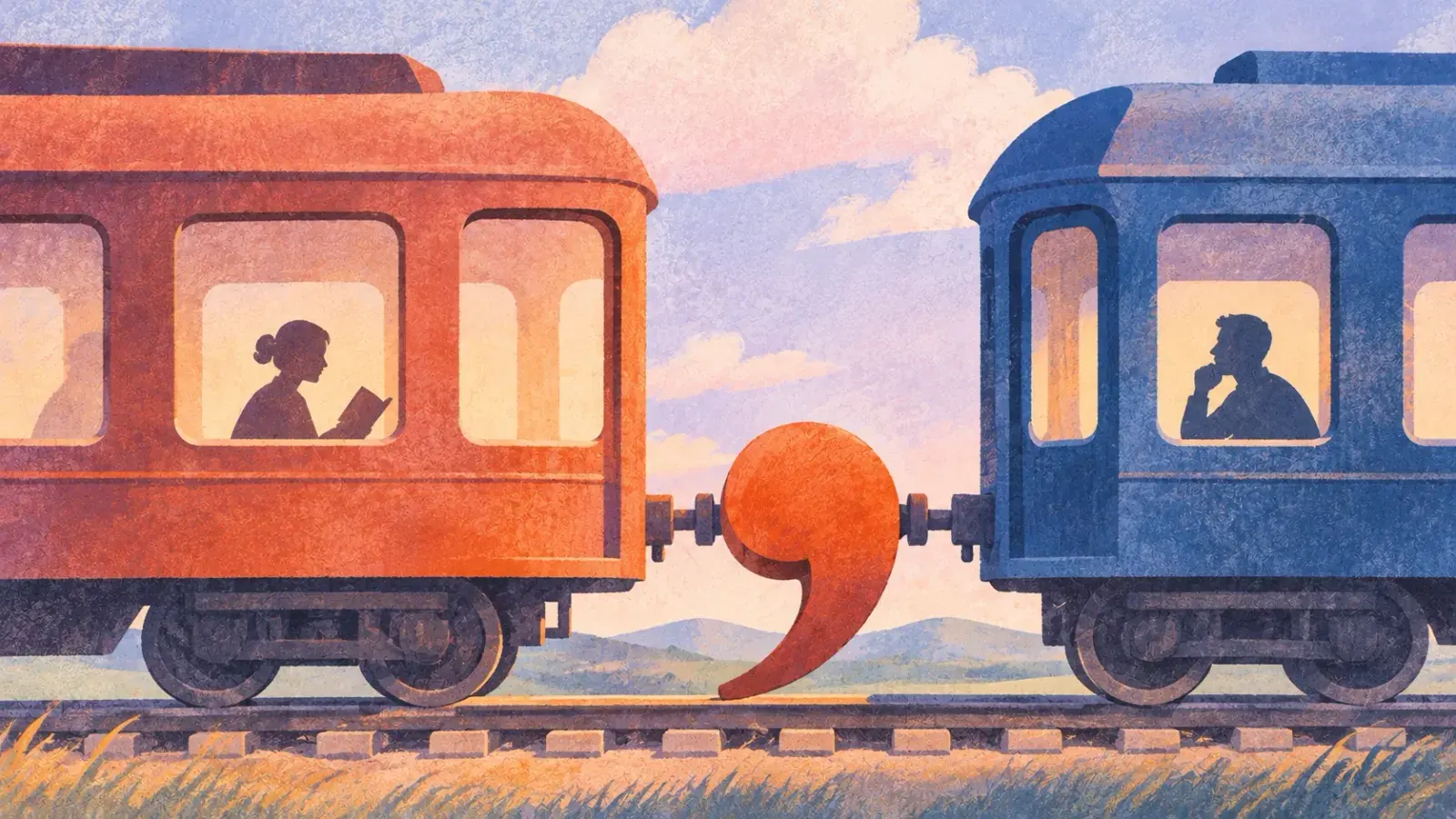
A comma splice joins two complete sentences with only a comma: “I missed the train, it left two minutes early.” Each side could stand alone, and a comma can mark a pause inside a sentence but can't hold two sentences together by itself. A period gives the bluntest fix: “I missed the train. It left two minutes early.” A semicolon, a conjunction such as so, a word like because or, when the second clause explains the first, a colon will also do it.
Splices are hard to see in your own draft, because you read for the meaning. They are one of the slips a copy edit exists to catch.
Five ways to fix a comma splice
Each fix below repairs the same splice, I missed the train, it left two minutes early, and each one is correct. They differ in rhythm and in how much they tell the reader about the link between the two facts, so choose by the effect you want.
- Use a period
I missed the train. It left two minutes early. The bluntest fix. The full stop gives each fact its own beat and leaves the reader to connect them, so the second sentence lands as a short, flat explanation. Use it when the clauses are long, or when you want the second one to stand on its own.
- Use a semicolon
I missed the train; it left two minutes early. One sentence, with a lighter pause than a period. The semicolon says the clauses belong together without saying how. It suits two closely related clauses of similar weight.
- Add a coordinating conjunction
The train left two minutes early, so I missed it. Keep the comma and add one of the seven coordinating conjunctions: for, and, nor, but, or, yet, so, often remembered as FANBOYS. The conjunction names the relationship, so the choice matters. So marks a result, which here means putting the cause first. For keeps the original order (I missed the train, for it left two minutes early) but sounds formal, and and would make the early departure sound like a second, unrelated event.
- Make one clause depend on the other
I missed the train because it left two minutes early. A word such as because, although, when, unless or after turns one clause into the background for the other and ranks the ideas: the main clause carries the news, and the dependent clause explains it. Move the dependent clause to the front (Because the train left two minutes early, I missed it) and the weight shifts to the end of the sentence, where the missed train now lands.
- Use a colon when the second clause explains
I missed the train: It left two minutes early. A colon promises that what follows explains or spells out what came before, and here the second clause delivers the reason. It is the most emphatic of the five and the most formal. The 18th edition of the Chicago Manual of Style (2024) capitalizes a complete sentence after a colon, as here, a change from earlier editions, so check your house style. An em dash does a similar job less formally (see em dash vs en dash).
What counts as a comma splice
An independent clause has a subject and a verb and makes sense alone. “We missed the deadline” is one. “Because the printer jammed” is not: it leaves the reader waiting for the rest. A splice happens only when the clauses on both sides of the comma are independent.
| Sentence | Splice? | Why |
|---|---|---|
| SentenceThe printer jammed, we missed the deadline. | Splice?Yes | WhyTwo independent clauses, only a comma between them |
| SentenceThe printer jammed, and we missed the deadline. | Splice?No | WhyA coordinating conjunction follows the comma |
| SentenceBecause the printer jammed, we missed the deadline. | Splice?No | WhyThe first clause depends on the second |
| SentenceThe printer jammed and stayed jammed for an hour. | Splice?No | WhyOne subject with two verbs |
| SentenceThe printer jammed, however, we made the deadline. | Splice?Yes | WhyHowever is an adverb, not a conjunction |
| SentenceThe printer jammed again, didn't it? | Splice?No | WhyA tag question belongs to the same clause |
Splices gather in a few predictable places:
- A second clause that opens with a pronoun: The draft is finished, it just needs a title. Check any comma followed by he, she, it, they, this or there.
- A second clause that opens with an adverb such as however, therefore or then. These get their own section below.
- Two short clauses that feel like one thought: The office was empty, everyone had gone home. The closer the link, the easier the comma is to read past.
The however and therefore trap
Words like however and therefore feel like connectors, so writers put a comma in front and keep going. But they are adverbs, not conjunctions, so the comma still splices two sentences.
Spliced: The grant covered travel, however, it didn't cover the archive's copying fees.
Semicolon: The grant covered travel; however, it didn't cover the archive's copying fees.
Period: The grant covered travel. However, it didn't cover the archive's copying fees.
Conjunction: The grant covered travel, but it didn't cover the archive's copying fees.
Dependent clause: Although the grant covered travel, it didn't cover the archive's copying fees.
The colon is the one fix that doesn't fit here: the second clause contrasts with the first instead of explaining it. The usual suspects, called conjunctive adverbs, are however, therefore, moreover, consequently, nevertheless, meanwhile, otherwise, instead, thus and then. Phrases such as in fact and as a result behave the same way.
The test: a conjunctive adverb can move. “It didn't, however, cover the fees” and “It didn't cover the fees, however” both work; a true conjunction can't move like that. A word that can slide needs a semicolon or a period in front of it when it starts a new clause. When it only interrupts one clause, use a pair of commas: The grant, however, was small.
Then is the sneakiest, because “We ate, then we left” looks so natural. Formal style treats it as a splice: write We ate, and then we left, or drop the second subject, We ate and then left. For openers that start the second idea as a fresh sentence, see the sentence starters list.
Comma splice vs run-on sentence
A fused sentence runs two independent clauses together with no punctuation at all: The lights went out the band kept playing. A comma splice puts only a comma there: The lights went out, the band kept playing. Some teachers call both run-ons; others keep run-on for the fused kind. The fixes are the same either way.
Length has nothing to do with it. A seventy-word sentence with its clauses properly joined is grammatical, whatever its readability, and a six-word sentence can be a run-on.
Comma splices in dialogue
Fiction hides a splice around dialogue tags. When a character speaks two sentences and the tag sits between them, end the first with a period:
Spliced: “We're going to miss the ferry,” Dara said, “the last one leaves at nine.”
Fixed: “We're going to miss the ferry,” Dara said. “The last one leaves at nine.”
Also correct, one sentence interrupted: “If we don't leave now,” Dara said, “we're going to miss the ferry.”
To check, read the speech without the tag. One sentence: the comma after said is right, and the second part starts lowercase. Two sentences: you need a period. The guide to formatting dialogue covers tags, beats and interruptions in full.
Inside the quotation marks, the rules loosen. People talk in splices, and a character who says “I'm fine, it's nothing, go back to bed” sounds more like a person than one who pauses for semicolons. Leave those even when you fix every splice in the narration.
Using comma splices on purpose
Some splices confuse no one. The classic deliberate splice joins short clauses with the same shape, so the matching grammar does the work of a conjunction.
It was the best of times, it was the worst of times, it was the age of wisdom, it was the age of foolishness, it was the epoch of belief, it was the epoch of incredulity, it was the season of Light, it was the season of Darkness, it was the spring of hope, it was the winter of despair…
Every clause has the form “it was the ___ of ___,” so the reader never loses the thread, and the commas keep the pairs moving faster than semicolons would. The same shape carries Julius Caesar's report of a quick victory in 47 BC, usually given in English as I came, I saw, I conquered, and the last words of Samuel Beckett's novel The Unnamable: “I can't go on, I'll go on.” The guide to parallel structure explains why matched grammar reads so easily.
Close narration uses splices to copy the rush of a character's thoughts: She checked the stove, she checked the back door, she checked the stove again. A tidy and would smooth the compulsion away. If you splice on purpose, keep the clauses short and parallel, use the effect rarely, and note it on your style sheet so the copy editor leaves it alone. In a thesis, a report or a cover letter, expect a splice to be read as an error.
Comma splice examples, with fixes
Eight splices from everyday writing, each with one good repair:
| Comma splice | One good fix |
|---|---|
| Comma spliceThe meeting ran long, I missed my train. | One good fixThe meeting ran long, so I missed my train. |
| Comma spliceThe results were significant, the effect was small. | One good fixThe results were significant, but the effect was small. |
| Comma spliceOur lab moved in March, the freezers came later. | One good fixOur lab moved in March; the freezers came later. |
| Comma spliceSales rose 4 percent, however, margins fell. | One good fixSales rose 4 percent; however, margins fell. |
| Comma spliceThe editor cut the prologue, the book opens with the storm now. | One good fixThe editor cut the prologue, so the book now opens with the storm. |
| Comma spliceThe bridge was closed, we took the ferry. | One good fixBecause the bridge was closed, we took the ferry. |
| Comma spliceThe server is down, therefore the site is offline. | One good fixThe server is down; therefore, the site is offline. |
| Comma spliceIt's not a bug, it's a feature. | One good fixOften left as it is: short, parallel and idiomatic. |
Practice: find and fix the splices
Some of these are spliced and some are correct. Decide which, then fix the splices.
- The proofs arrived on Monday, the author returned them on Friday.
- The proofs arrived on Monday, and the author returned them on Friday.
- Although the proofs arrived on Monday, the author kept them until Friday.
- The index was missing, nobody had noticed.
- The index was missing, wasn't it?
- The cover looked great, however, the spine was crooked.
- “I'll call the printer,” Jo said, “they owe us an answer.”
- Her deadline moved again, yet she didn't complain.
- Splice. The proofs arrived on Monday; the author returned them on Friday.
- Correct: a comma plus and.
- Correct: although makes the first clause depend on the second.
- Splice. The index was missing, and nobody had noticed.
- Correct: wasn't it is a tag question.
- Splice. The cover looked great; however, the spine was crooked.
- Splice. “I'll call the printer,” Jo said. “They owe us an answer.”
- Correct: yet is a coordinating conjunction.
Find splices in a long draft
On a reread, check the places splices gather: a comma followed by he, she, it, they, this or there, and every comma in front of however, therefore or then. Searching the document for “, however” and “, then” finds the adverb kind.
For a chapter or a report, you can also ask the Strokes Assistant to list every sentence where two complete clauses are joined only by a comma, and tell it to skip the dialogue if your characters are allowed to talk in splices.
Frequently asked questions
Is a comma splice a run-on sentence?
It's usually counted as one kind. A fused sentence runs two independent clauses together with no punctuation; a comma splice puts only a comma between them. Some teachers call both run-ons, others only the fused kind. The fixes are the same, and no sentence is a run-on just because it is long.
Do you need a semicolon before however?
When however starts a new independent clause, yes, or a period: “The data looked clean; however, two files were corrupt.” A comma alone before however makes a comma splice, because however is an adverb, not a conjunction. When however only interrupts one clause, a pair of commas is right: “The data, however, looked clean.”
Are comma splices ever acceptable?
In fiction and informal writing, yes, when the clauses are short, parallel and closely linked, as in “It was the best of times, it was the worst of times.” Writers also use them in dialogue and close narration for speed or voice. In academic, legal and business writing, readers are likely to take a splice as an error.