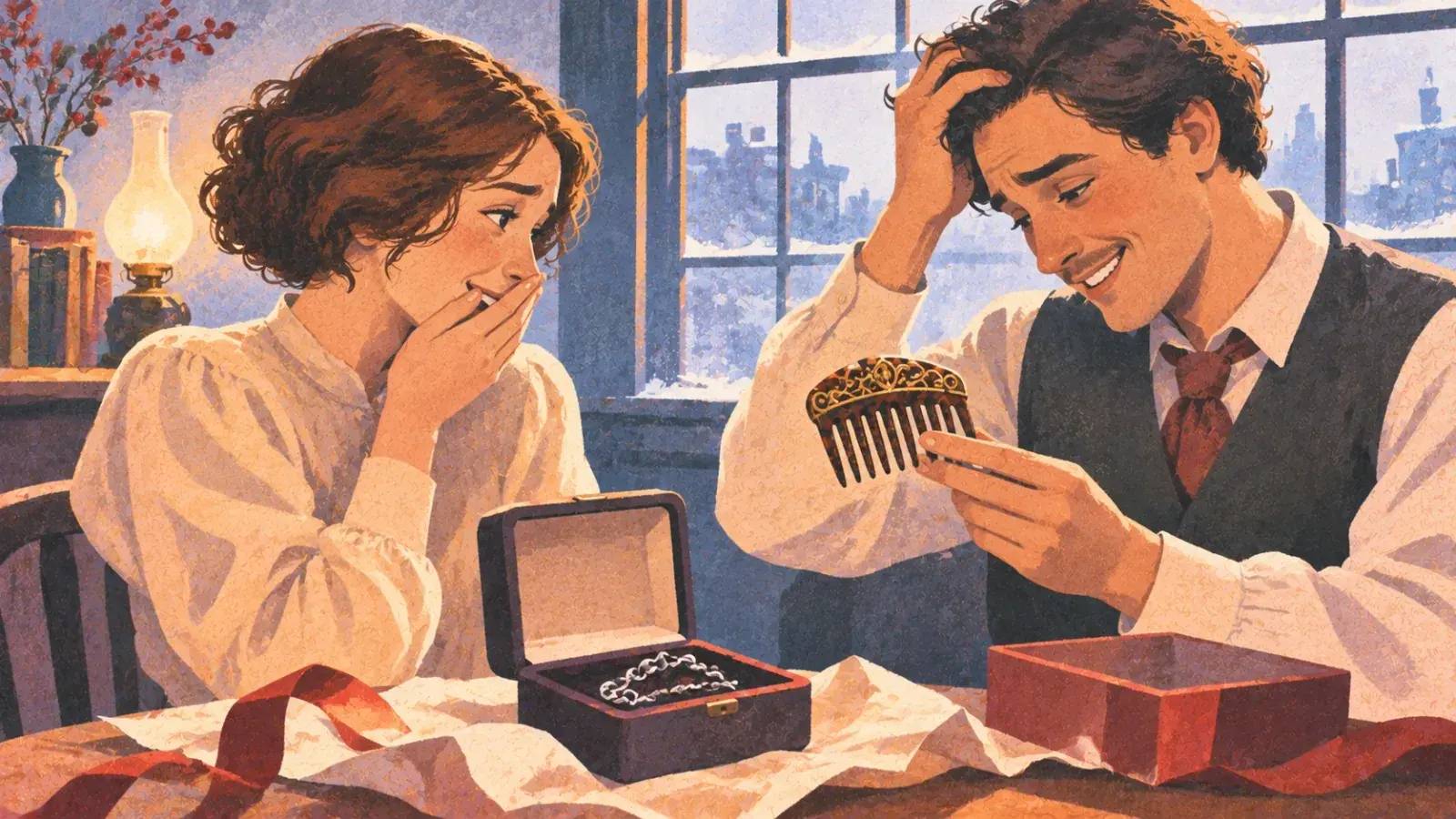
Situational irony is when the outcome of a situation is the opposite of what the characters, or the reader, had good reason to expect. In O. Henry's “The Gift of the Magi” (1905), a young wife sells her hair to buy a chain for her husband's watch, while he sells the watch to buy combs for her hair. Each sacrifice cancels the other's gift. It is one of the three main kinds of irony, with verbal irony and dramatic irony.
This guide sets the three side by side, explains how situational irony is built, and works through examples from Sophocles to O. Henry, then everyday cases, what doesn't count, and how to write it.
Situational, dramatic and verbal irony
All irony is a gap between what seems and what is. The three kinds differ in where the gap sits.
| Kind | Where the gap is | Example |
|---|---|---|
| KindVerbal irony | Where the gap isBetween what a speaker says and what they mean | ExampleMark Antony repeating “Brutus is an honourable man” over Caesar's body until it means the opposite |
| KindDramatic irony | Where the gap isBetween what the audience knows and what a character knows | ExampleRomeo believes Juliet is dead; the audience knows she has taken a sleeping potion |
| KindSituational irony | Where the gap isBetween what was expected to happen and what does | ExampleDella and Jim each sell their treasure to buy a gift for the other's |
The kinds often travel together. When Romeo kills himself beside Juliet's sleeping body, the audience's knowledge makes it dramatic irony, and the fact that Friar Laurence's plan to save the lovers is what kills them makes it situational. Some critics also speak of cosmic irony, or the irony of fate, when the reversal seems arranged by the universe itself, as in Thomas Hardy's novels.
How situational irony works
Situational irony needs three things. Take one away and what is left is a surprise, bad luck or a twist.
- A clear expectation. A plan, a hope, a purpose or a belief the reader understands. Della expects her gift to be used.
- A reversal. The outcome is not just different but opposite: the gift becomes useless.
- A connection. The reversal comes out of the expectation itself. Della's sacrifice is what makes Jim's gift useless, and his makes hers useless.
The same handful of patterns turns up again and again:
| Pattern | What happens | Example |
|---|---|---|
| PatternThe plan that backfires | What happensThe effort to avoid a fate brings it about | ExampleOedipus |
| PatternThe sacrifice that cancels itself | What happensTwo people give up what the other's gift needed | Example“The Gift of the Magi” |
| PatternThe loss for nothing | What happensYears are spent paying for something that was never worth it | Example“The Necklace” |
| PatternThe tables turned | What happensThe victim ends up in control of the people who preyed on them | Example“The Ransom of Red Chief” |
| PatternThe boast outlived | What happensA claim to permanence survives only as a ruin | Example“Ozymandias” |
| PatternThe wish granted | What happensA character gets exactly what they asked for, in the worst way | Example“The Monkey's Paw” |
Situational irony examples in literature
“The Gift of the Magi” by O. Henry (1905)
With a dollar and eighty-seven cents saved for Christmas, Della Young sells her hair, which reaches below her knee, and buys a platinum fob chain for her husband Jim's gold watch. A reader expects the sacrifice to pay off: whatever else happens, Jim will have a chain worthy of his watch. The reversal is that he no longer has the watch. Jim comes home with the tortoiseshell combs she has longed for, bought with the money from selling it. The narrator closes on the irony, then turns it inside out:
And here I have lamely related to you the uneventful chronicle of two foolish children in a flat who most unwisely sacrificed for each other the greatest treasures of their house. But in a last word to the wise of these days let it be said that of all who give gifts these two were the wisest.
The gifts fail, and the giving succeeds. That second reversal keeps the story from being only a trick ending.
“The Necklace” by Guy de Maupassant (1884)
Mathilde Loisel, a clerk's wife who longs for luxury, borrows a diamond necklace from a rich friend, Madame Forestier, to wear to a ball, and loses it. Rather than confess, she and her husband buy a replacement on credit and spend ten years in hard work and poverty paying for it. Through all ten years a reader assumes, as Mathilde does, that the debt bought back something of equal value. When Mathilde finally meets her friend again and tells her the story, Madame Forestier reveals that the original was paste, worth a small fraction of what they paid. The vanity that made the borrowed jewels matter is what cost Mathilde her youth.
Oedipus Rex by Sophocles (c. 429 BC)
The play is a chain of plans that bring about what they were meant to prevent. Running from a prophecy sounds like the sensible way to beat it, and Oedipus left Corinth to escape one: that he would kill his father and marry his mother. The flight led him to do both. As king of Thebes he curses the unknown killer of the old king Laius, and the curse falls on himself. A messenger arrives with news meant to free him from fear, and it gives him the clue that exposes the truth. In the Poetics, Aristotle held up the discovery in Oedipus, arriving together with a reversal, as the finest kind.
“The Ransom of Red Chief” by O. Henry (1907)
Two small-time crooks kidnap the son of a prosperous man in a small Alabama town and demand a ransom. Kidnapping stories usually run one way: the kidnappers hold the power and the family pays. Here the boy, who calls himself Red Chief, loves being kidnapped and torments his captors so thoroughly that they keep lowering their price. His father answers with a counteroffer: he will take the boy back if they pay him. They pay, and run. The kidnappers end up the victims of the child they meant to profit from.
“Ozymandias” by Percy Bysshe Shelley (1818)
The hand that mocked them and the heart that fed:
And on the pedestal these words appear:
“My name is Ozymandias, king of kings:
Look on my works, ye Mighty, and despair!”
Nothing beside remains. Round the decay
Of that colossal wreck, boundless and bare
The lone and level sands stretch far away.
The irony comes in layers. The boast was carved to make rival kings despair at his works, and now the works are gone. The sculptor who “mocked” the king's passions in stone is the one whose work has lasted. And the king's claim to be remembered survives only as a story a traveler tells secondhand.
“The Story of an Hour” by Kate Chopin (1894)
Told that her husband has died in a railroad accident, Louise Mallard grieves, then feels an unexpected joy at her freedom. In most stories a husband's safe return would be the happy ending. An hour later he walks in the door, never having been near the accident, and she dies. The last line adds a second irony on top of the first:
When the doctors came they said she had died of heart disease—of joy that kills.
The return that should bring joy kills her, which is situational irony. The doctors think she died of happiness at seeing him; the reader knows it was the loss of the freedom she had just found, which is dramatic irony.
Three shorter examples
- “The Rime of the Ancient Mariner,” Samuel Taylor Coleridge (1798). Becalmed at sea, the sailors are dying of thirst in the middle of the ocean: “Water, water, every where, / Nor any drop to drink.”
- “The Monkey's Paw,” W. W. Jacobs (1902). Mr. White wishes for two hundred pounds, and gets exactly that, as compensation for his son's death at work. The guide to plot walks through the story step by step.
- Romeo and Juliet, William Shakespeare (c. 1595). The Friar's potion is meant to reunite the lovers; because his letter never reaches Romeo, the plan is what kills them both.
Everyday examples of situational irony
These are original, written for this guide. Each one has the three parts: an expectation, a reversal and a link between them.
- A fire station burns down because of a faulty kitchen stove.
- A time-management workshop runs an hour over schedule.
- A meeting is called to cut down the number of meetings.
- A traffic-safety billboard is so distracting that drivers rear-end each other in front of it.
- An anti-litter campaign leaves its flyers all over the town square.
- A lifeguard has to be pulled out of the pool.
- A new security system locks the security guard out of the building.
- A shortcut, taken to save ten minutes, adds forty.
- A password-reset email can't be opened without the password.
- A store's grand-opening sale draws so many shoppers that it has to close its doors.
In each case the outcome turns against the very purpose it was meant to serve, and in the strongest ones, like the billboard and the sale, the purpose is what causes it. That link is what separates irony from mere bad luck.
What isn't situational irony
Plenty of unhappy or surprising events get called ironic. Most of them are something else. One morning shows the difference. You have a job interview at nine:
- Bad luck. A nail in the road gives you a flat tire on the way. Unfortunate, and nothing more.
- Coincidence. The driver who stops to help turns out to be the person interviewing you. Two paths crossed by chance, but no expectation was reversed.
- Surprise. You arrive late and learn the interview had been moved to the afternoon anyway. Unexpected, but it doesn't grow out of anything you planned.
- Situational irony. You left an hour early to be safe and took the back road to dodge traffic, and the back road's potholes gave you the flat. The precaution caused the lateness it was meant to prevent.
One more near neighbor: saying “great weather” in a downpour is sarcasm, which is verbal irony, not situational.
Situational irony
- There was a clear expectation, plan or purpose
- The outcome is its opposite
- The outcome comes from the plan itself
- The reversal says something about the people involved
Not irony
- Something bad happened at a bad time
- Two unrelated events lined up by chance
- The outcome was merely different, not opposite
- Nothing links the result to what was intended
How to write situational irony
- Make the expectation explicit
Let the reader see the plan, the hope or the belief clearly, in a scene if you can. Irony depends on the reader sharing the expectation it overturns.
- Give the character a good reason
The plan should be sensible from inside. If the reader thinks the character is a fool, the reversal can read as punishment instead of irony.
- Let the reversal grow from the plan
Ask what the character's own action could cause. Della's sale of her hair is the cause; a stolen watch would only have been bad luck.
- Plant it fairly
Mention the objects, rules or facts the reversal depends on before it arrives, so the ending feels inevitable on a second reading: the principle of Chekhov's gun. The foreshadowing examples show how O. Henry names Jim's watch and Della's hair side by side early on.
In a long draft, attach the chapter that plants the expectation and the one where it turns, and ask the Strokes Assistant whether the payoff is supported by what comes before it.
- Don't explain it
End on the reversal or one beat after it. If a character has to say “how ironic,” the scene hasn't done its work. The irony often carries the story's theme, so let the reader draw it.
For thirty years Walt had kept the old maple at the edge of the yard, though his wife wanted it gone; he said it shaded the house. In June he finally paid a crew to take it down, worried that a storm would drop it on the roof. The first storm of July came straight across the open lawn and peeled the shingles off like pages.
The expectation is stated (the tree is a danger), the plan is reasonable, and the reversal comes from the plan: the tree that threatened the roof was also what sheltered it.
Practice: is it situational irony?
Decide for each, then check the answers.
- A marathon runner sprains her ankle stepping off the curb on the way to the start.
- A locksmith locks himself out of his own shop.
- It rains on the day of the town picnic.
- A writer's book on beating procrastination comes out two years late.
- Two strangers on a train discover they share a birthday.
- A man buys a smoke alarm, and its faulty wiring starts a fire.
Answers. 2, 4 and 6 are situational irony: the expert, the subject and the safety device each produce their own opposite. 1 is bad luck, unless she skipped her warm-up to protect the ankle. 3 is bad luck. 5 is coincidence.
Frequently asked questions
What is the difference between situational and dramatic irony?
Situational irony is about events: the outcome reverses what was expected. Dramatic irony is about knowledge: the audience knows something a character doesn't, such as that Juliet is only drugged when Romeo finds her. The two often appear together, as in the last scene of Romeo and Juliet.
Is situational irony the same as a plot twist?
Not always. A twist is any surprising turn in a plot. It becomes situational irony when the surprise reverses a clear expectation and grows out of it, as when the Loisels' ten years of sacrifice turn out to have paid for a fake. A twist that contradicts nothing the reader expected is just a surprise.
Is rain on your wedding day ironic?
On its own, no. Rain on a wedding day is bad luck, and it is a common example of what people call ironic when it isn't. It would become situational irony if the expectation were part of the cause: say, the couple chose an outdoor date because the forecast promised the driest week of the year, and skipped the tent on the strength of it.