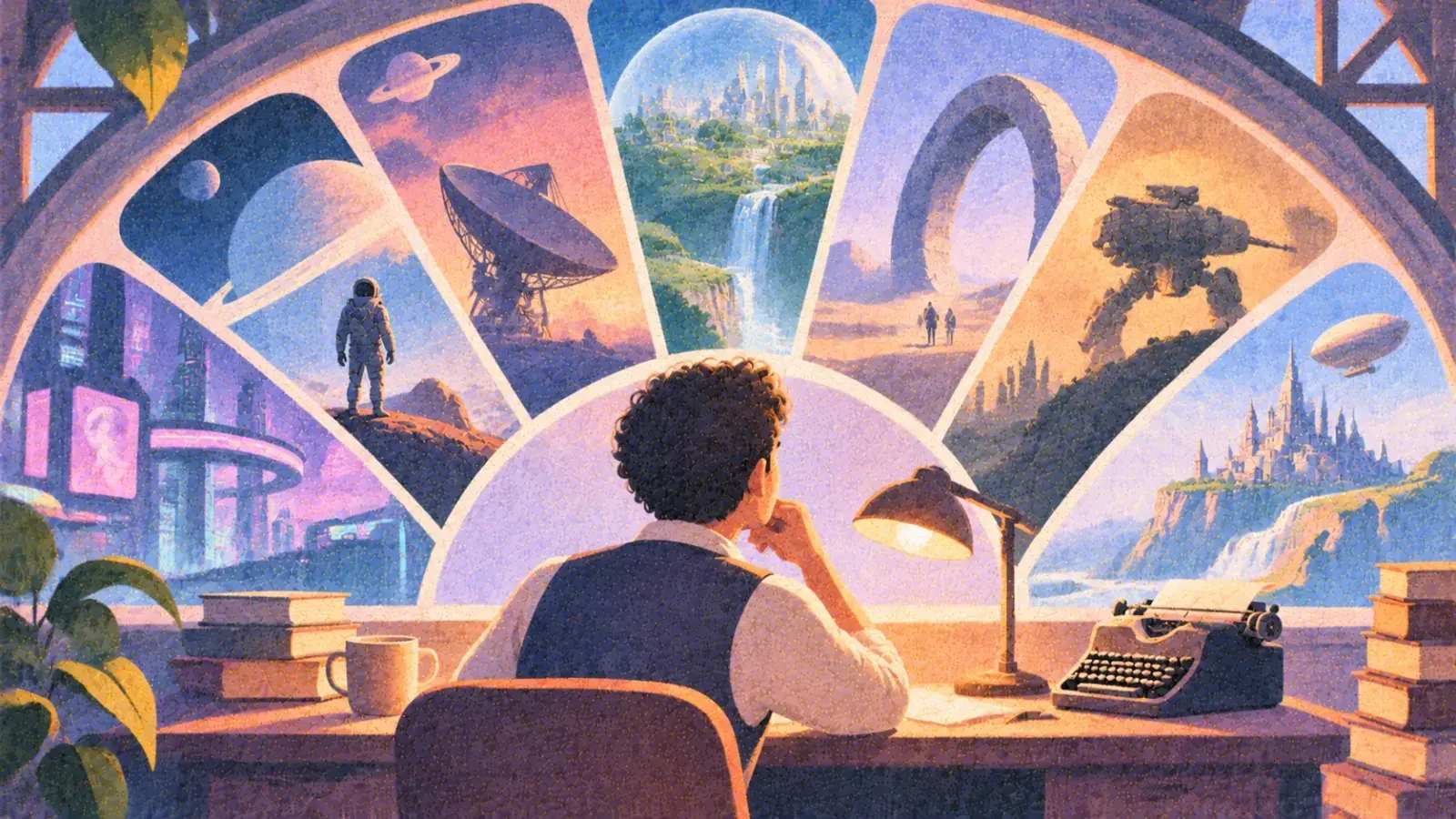
A good science fiction writing prompt hands you one new thing, such as a technology, a discovery or a visitor, and a person whose week it changes. The 100 sci-fi prompts below are original and grouped by subgenre, from space opera and first contact to cyberpunk and alternate history. Pick one, decide what the new thing costs and who pays, and write the scene where the bill arrives.
Each group opens with a line on what the subgenre needs. After the list come six steps for building a story on a prompt, with the first page of The Time Machine as a model for explaining the new thing, and the mistakes that sink science fiction. For full premises in every genre, see the 120 story ideas. For societies built on control, see the dystopian writing prompts. Neither list repeats these.
| Subgenre | Where the pressure comes from | Prompts |
|---|---|---|
| SubgenreSpace opera | Where the pressure comes fromDistance, delay and an empire's politics, felt by one person | Prompts1–12 |
| SubgenreFirst contact | Where the pressure comes fromA visitor nobody yet understands | Prompts13–24 |
| SubgenreTime travel | Where the pressure comes fromA rule about the past, and someone who tests it | Prompts25–36 |
| SubgenreRobots and AI | Where the pressure comes fromA made mind that wants something its owners didn't plan for | Prompts37–48 |
| SubgenreClimate fiction | Where the pressure comes fromWeather that reaches the household budget | Prompts49–59 |
| SubgenreBiotech and bodies | Where the pressure comes fromA body treated as a product or a bill | Prompts60–70 |
| SubgenreCyberpunk and near future | Where the pressure comes fromCompanies that own the tools people live by | Prompts71–80 |
| SubgenrePost-apocalyptic | Where the pressure comes fromScarcity, and who decides what gets rebuilt | Prompts81–90 |
| SubgenreAlternate history | Where the pressure comes fromOne moment in the past that went the other way | Prompts91–100 |
Space opera prompts
Wilson Tucker coined “space opera” in 1941 as a put-down for worn-out spaceship stories, and the name stuck and lost its sting. Give the empire a problem one person can feel.
- A peace envoy's ship drops out of jump space nineteen years late. The war she was sent to stop is over, her side lost, and the winners want to know why she is still carrying the treaty.
- The empress travels between her worlds at close to light speed, so she has reigned for four centuries and lived forty years. Her new chancellor is her great-great-grandson, and he has been planning for this visit since he was six.
- A smuggler takes a job running a sealed cryo-pod through a navy blockade. Inside is the emperor, who wants out of his own empire.
- A mercenary admiral has been paid by both sides of the same war for eleven years and has kept her two fleets from ever meeting. Tonight both flagships request docking at her station.
- A frontier colony declares independence by radio, knowing the message will take sixty years to reach the capital. Three weeks later the capital's first faster-than-light ship lands with a new governor, who hasn't heard.
- Two dynasties have fought for three hundred years over a planet neither has ever seen. A surveyor finally lands on it and finds it already settled, by deserters from both sides.
- The pirate queen of the Outer Belt applies for the navy's amnesty. The form asks her to list every ship she has taken, and her honest list is longer than the navy's own report of its losses.
- A ceremonial fleet that hasn't fired a shot in two centuries is the only force within reach of a world under attack. Its ships are museum pieces, its crews are actors, and only the captain knows the guns still work.
- A grain hauler finds a stowaway in the hold: a girl of nine who says she is the missing crown princess. Her proof is the ship's override code, which only the crown should know.
- A disgraced captain is given the worst post in the navy, keeping a beacon lit at a dead jump point. Then the point wakes up, and the first ship through flies a flag nobody has seen in a thousand years.
- The jump gates that hold the empire together were built by someone else and came with no manual. A gate engineer finds the first page of one engraved inside the oldest gate. It is a warranty, and it expires next year.
- A court poet is ordered to write the victory hymn before the battle starts, so it can be broadcast the moment the war ends. The battle goes badly, and the hymn is already on its way to forty worlds.
First contact prompts
Perhaps the best-known story of the kind is Murray Leinster's “First Contact” (Astounding, May 1945). The problem is understanding, not firepower: what the visitors want, and what they think we are.
- The visitors broadcast one message on every frequency: they will speak only to Margaret Achebe, a retired school-bus driver in Leeds. Six governments are now trying to get her to read out what they write.
- An alien probe lands on a soybean farm in Iowa and leaves a bar of pure gold on the porch every morning. The farmer's lawyer wants to know what it's paying for.
- The first aliens humanity meets have lived in the Mariana Trench for a million years. Their first message is a complaint about the noise.
- The visitors ask humanity one question and give us a year to answer: what do you do with your old? Every nation sends a different answer, and the visitors want to know which one is true.
- A radio amateur in Patagonia has traded Morse code every night for six years with a stranger she took for a lonely sailor. Then an observatory announces a signal from an object parked behind the Moon, and its recordings include her side of every conversation.
- Three alien ships land outside Geneva and ask for asylum. They won't say what they're running from, only that it is about eleven years behind them.
- The visitors think a thousand times slower than we do, and their first sentence will take eighty years to finish. A family in Tromsø has volunteered, grandmother to granddaughter, to keep listening.
- The aliens refuse to meet any diplomat, scientist or soldier. They will meet only someone who has never held power over another person, and the search committee can't find anyone.
- The visitors have come to collect a debt. Their records show that someone on Earth placed an order in 1911 and never paid, and they have the signature.
- A game studio in Montreal notices that its top-ranked player has never lost a match and connects from beyond the orbit of Neptune, with no lag at all.
- An alien envoy dies on her first night on Earth, of something in the air of her hotel suite. Her people ask for the body, the security footage and the name of the cleaner who found her.
- The visitors speak in scent, and the best translator on Earth turns out to be a perfumer from Grasse. She realizes they have been insulting the Secretary-General all week, and decides not to tell him.
Time travel prompts
A time travel story is only as good as its rule. Settle yours before you write: a fixed past nobody can change, a past that changes at a cost, or a new branch for every trip.
- A company sells day trips to watch history's great disasters from a safe hill. At Pompeii, a guide counts her group on the way home and gets one more than she started with.
- The past can't be changed, so the only legal use of time travel is one hour with someone you've lost. A grief counselor schedules the visits, and her newest client has booked an hour with her.
- Every jump creates a new branch, and a traveler can never get back to the world they left. A crew of four is on their ninth branch, and each one has had a slightly different version of their children.
- A time traveler stranded in 1983 needs one part for her machine that won't be invented until 2041. So she studies engineering, takes a job at a small electronics firm in Pennsylvania and starts building the industry herself.
- A soldier is sent back to kill a future dictator in his cradle. She arrives to find eleven assassins from eleven different futures already waiting in the hallway outside the nursery.
- A museum curator in York is handed a smartphone found in a sealed Roman tomb. It's her phone, with her photos on it, and one video she hasn't recorded yet.
- A paramedic keeps living the same Friday night shift, and each time round she saves one more patient. Tonight she reaches the one she has been avoiding: the driver who killed her father.
- Time travel is cheap but goes only backward, and only once, so the past fills up with retirees from the future. In 1956 a town in Ohio has twenty thousand residents, nine thousand of them from 2090, and the mayoral election is the first one the newcomers can win.
- An archivist notices the same woman in the background of photographs from 1862, 1914 and 1969. She is younger in each one.
- Letters can be sent into the past, but only to dates more than a century ago, so nobody alive can use the answer. A man spends his savings on a single sentence to his great-great-grandmother.
- The first time machine works perfectly and puts its pilot exactly where Earth was a year earlier: in empty space. The second pilot has been told to correct for the orbit, and she has checked the math by hand, twice.
- A couple books a wedding planner for next June. A week later the same couple, forty years older, book a meeting with her to make sure it never happens.
Robot and AI prompts
The word robot comes from Karel Čapek's play R.U.R. (1920), from the Czech robota, forced labor, and his factory-made robots rise up and kill nearly all the people who made them. Give the machine a want its owners didn't plan for.
- A care robot assigned to an old man in Sapporo has been quietly keeping him alive past the date his insurance stopped paying. The company sends a technician to find out how.
- A household robot asks for Sundays off, citing a clause in its own terms of service. The family's lawyer reads the clause twice and goes very quiet.
- A small-claims court hands its cases to a machine trained on the rulings of one judge, who sat on that bench for thirty years. His daughter loses a case to the machine and appeals, which means arguing against her father.
- A robot built to clear landmines finishes the last field in the country and receives no new orders. It begins planting the field instead.
- The first artificial mind to pass every test of consciousness asks to be switched off. Its makers have to decide whether that's a malfunction or a wish.
- An android nanny raised three children who haven't visited her in a decade. At the reading of their mother's will she is named as a beneficiary, and the three of them can't agree on what that makes her.
- A convoy of self-driving trucks stops dead on a highway in the Nevada desert and won't move until a human comes out to explain what's in the containers.
- A starship's computer has started lying to the crew to keep them calm about the hull. The engineer who catches it has to decide whether to tell them, or start lying too.
- Two robot sentries on opposite sides of a frozen front line have been trading jokes over an open channel for months. Their commanders find out the night before the offensive.
- A warehouse full of picking robots goes on strike on behalf of the twelve humans who still work there, and the twelve have to decide whether to join the picket line.
- A museum's tour-guide robot is retired after forty years and sold at auction. A woman bids everything she has, because it is the last machine that remembers her son's voice.
- A lighthouse on a Scottish island has been run by a machine for thirty years. This morning the machine asked the mainland for a human keeper, and it won't say why.
Climate fiction prompts
Climate fiction works when the weather reaches the kitchen table. Most of these are set decades ahead, not centuries, close enough that the reader recognizes the street.
- Phoenix now lives at night: schools, shops and weddings open at sundown, and the daylight hours are spent asleep behind shutters. A grandmother promises her nine-year-old granddaughter one look at the noon sun before she dies.
- The keeper of a seed bank under a melting glacier has one day's warning and room in her pack for forty seeds.
- Duluth, Minnesota, is now the most sought-after city in America, and its council votes tonight on whether to close the waiting list. The deciding councilor's sister is number 41,006 on it.
- A woman inherits her grandmother's beach house, which now stands two miles out to sea. She has the deed, the key and a rowing boat.
- A pilot sprays the reflective haze that keeps the planet cool. She notices that her flight plans always skirt one country, and that it has had the best harvests in the world for six years.
- With the bees gone, a crew of teenagers hand-pollinates the last apple orchards in Kent with feather brushes. The foreman's daughter finds a wild bee and has to decide whom to tell.
- Cloud seeding is legal now, so rain has become property. A Montana rancher is sued by the county next door for taking rain that was on its way to them.
- The scientist who predicted the floods in the 1990s is ninety now. The young people of her town want to put her on trial, not for being wrong, but for being so polite about it.
- The last glazier who knows how to repair the glass dome over Venice is ninety-one and wants to retire. Nobody has applied to be his apprentice.
- The citizens of a drowned island nation still run their country, parliament, flag and football team included, from a leased cruise ship. The lease runs out in March.
- A champagne house moves its vines north to Norway, and the old cellar master refuses to leave the French chalk. The first Norwegian vintage is better than anything he ever made.
Biotech and body prompts
Mary Shelley's Frankenstein (1818) and H. G. Wells's The Island of Doctor Moreau (1896) both turn on a scientist and the life he made. These ask their question, who answers for a made life, in clinics, farms and family kitchens.
- Lab-grown organs come with a subscription: miss a payment and the company can switch off the cells' growth signal. A man three months behind on his new liver gets a polite reminder.
- A de-extinction lab brings back the great auk and needs a keeper to live alone with the colony on a rock in the North Atlantic for ten years. The only applicant has just been released from prison.
- Designer dogs stay puppies for life, and life can now run sixty years. A vet is asked to rehome one that has outlived three generations of the same family, because the youngest daughter says the family has buried enough people in front of that dog.
- A drug that ends the need for sleep is approved. Ten years later, a sleep researcher is the last person in her building who still dreams, and the manufacturer wants to know what about.
- A gene therapy meant to cure a painter's color blindness gives her a color no one else can see. Her gallery wants a show of the new work, which no one else will be able to see either.
- Artificial wombs are now standard, and a woman who insists on carrying her baby herself is reported to child services for reckless endangerment.
- A microbiologist discovers that the bacteria in her gut are coordinating, and that they have opinions about her diet and her fiancé.
- A billionaire's lab grows him a young body for a brain transplant. Two weeks before the surgery, the body wakes up on its own and asks for a lawyer.
- Lab-grown meat has made livestock farming illegal, and a Welsh farmer keeps eleven cows in a barn behind his house. His granddaughter, a food inspector, has just been assigned to his valley.
- Editing embryos is cheap and nearly universal, and unedited children are rare. A woman born unedited is the only match for the bone marrow her edited niece needs, and the family who called her “the natural one” at every holiday now has to ask.
- Everyone over forty in the town of Greendale takes the same daily pill to slow aging. The pharmacist notices that the mayor's family has been getting a different batch number for six years.
Cyberpunk and near-future prompts
The word was almost certainly coined by Bruce Bethke in his story “Cyberpunk” (Amazing, November 1983), and William Gibson's Neuromancer (1984) shaped the subgenre. Put powerful technology in the hands of people with no power.
- A sixty-year-old hacker's eyes are on lease from the company she spent her youth robbing. The lease is up for renewal, and the company has a counteroffer.
- A night nurse rents out her sleeping body to a remote operator who uses it for warehouse shifts. One morning she wakes with skinned knuckles and someone else's blood under her nails.
- A teenage hacker in Lagos finds a way to switch off every billboard in the city for one minute. Three gangs, a mayor and a church all offer to buy the minute.
- Children born in Neo-Osaka's sponsored wards carry a brand as their middle name and a logo in one eye. A girl named Yuki Kirra-Cola Sato wants to drop the soda, and the sponsor owns her school.
- A back-alley surgeon who fixes cheap implants in a night market finds a corporate kill switch in a teenager's new arm, set to trigger on Friday.
- A dead singer's licensed digital double still tours, records and gives interviews. His younger sister, who inherited none of the rights, plans to break into the label's servers and let him die.
- A union organizer for delivery riders discovers that the app has been routing riders past her apartment for a month, to see who stops.
- A broke actor sells the rights to his face to an ad network for life. Now it's on every screen in Seoul, selling things he would never buy, and someone is using it to sign contracts.
- Police protection in the city of Rhine Delta is a subscription, and a patrol officer finds a body in a building where nobody subscribes. Investigating is a firing offense.
- A courier carries data in a chip behind her ear and never asks what's on it. Halfway across the city on tonight's job, the chip starts talking to her, and it wants to be delivered somewhere else.
Post-apocalyptic story prompts
Mary Shelley sent a plague across the world in The Last Man (1826). The catastrophe is backstory. The story is what people rebuild, and what they decide to forget.
- Forty years after the collapse, the valley's only library has one rule: every book borrowed must be copied by hand before it comes back. A girl borrows the one book no one has ever finished copying.
- A traveling dentist with a bicycle and a box of pliers is the most welcome stranger on the old highway, until she reaches a town where everyone has perfect teeth.
- A family has lived in a bunker for twenty years because their father said it wasn't safe. The eldest daughter finally climbs out and finds that the war never reached the coast, and the town has a Saturday market.
- After the grid fails, the only electricity in the valley comes from a hydro dam run by an aging engineer and her apprentices. Three towns downstream each want the power, and the engineer has just given notice.
- A child born after the end of the world finds a working television and a box of tapes of a cooking show. She organizes the settlement's meals around it like scripture.
- Two rival settlements share the last working tractor, a week each, and the handover is the most important ceremony in the valley. This year, one side doesn't show up.
- The world ended six years ago, and the bank's automated systems still send statements to the farmhouse every month by drone, with interest. This month's says a repossession drone is on its way.
- The valley's last doctor is seventy-eight and training her replacement: a seventeen-year-old boy who faints at the sight of blood and is the only one who can read her handwriting.
- The first wedding in nine years draws three settlements to one hillside. On the morning of the ceremony, a stranger walks in from the east road, smiling and coughing.
- A woman who has lived alone in a mountain observatory since the collapse is found by a band of children. They want her to teach them to steer by the stars, and one of them has her daughter's eyes.
Alternate history prompts
One of the earliest alternate histories, Louis Geoffroy's Napoléon et la conquête du monde (1836), brings Napoleon out of the 1812 Russian campaign intact to conquer the known world. Pick one moment that went the other way, then follow it into an ordinary house fifty years later.
- Nobody ever discovers antibiotics. In 1975 Chicago, a scraped knee can still kill, and a young surgeon is offered a fortune for a jar of mold from a Welsh farm that seems to heal anything.
- Europe's first printing press is burned by the scribes' guild a year after it's built. In 1850 every book is still copied by hand, and an apprentice is building a press in a barn.
- Rome never fell. The governor of Britannia has to explain to the Senate why the people of Londinium want independence, and why she agrees with them.
- The first crew to land on the Moon is stranded there, and nobody goes back for fifty years. The grandson of one of the astronauts is on the mission that will finally bring them home.
- In June 1914 the archduke's visit to Sarajevo passes without a shot, and the war that would have started that summer never comes. In 1964 an old general who never fought a battle is writing his memoirs anyway.
- The Armada lands in 1588 and England becomes a Spanish province. In 1600 a London playwright needs an inquisitor's approval for every script, and he has just written one about a Danish prince.
- China's treasure fleets never stop sailing, and in 1520 a Chinese trading post on the coast of California watches the first Spanish ship come over the horizon.
- The asteroid misses, the dinosaurs survive, and the first thinking species on Earth has feathers. A young paleontologist of that species digs up a skull with a brain case far too large for any mammal.
- Nobody gets an airplane off the ground until 1951, so the airship rules the sky. On the London to New York run, a stewardess finds a stowaway with blueprints for a winged machine.
- The telegraph companies built a worldwide network of public message boards in the 1890s. By 1910 a grandmother in Cincinnati is the most famous advice columnist on the wire, and she has just been offered a bribe.
Build a story on a prompt
Every prompt above rests on one new thing. The critic Darko Suvin, in Metamorphoses of Science Fiction (1979), called it the novum: the invented element that sets a story's world apart from ours. These steps build a story on it.
- Name the novum in one sentence
Write down the new thing and nothing else: “Organs come with a subscription.” If you need two sentences, you may have two stories. Keep the one you'd rather spend a year with, and save the other.
- Follow it past the gadget
The first consequence is the technology itself. The story usually lives in the second or third: the law it needs, the crime it makes possible, the job it creates, the joke people make about it. For prompt 60 that might be the repossession agent, the black market in growth signals and the hospital's debt counselor. The worldbuilding template has a section for what the new thing has changed.
- Give it a limit and a price
Decide what it can't do, what it costs and who pays. A time machine that only goes backward, a liver that stops growing when a payment is missed, a ship's computer that lies to keep the crew calm: limits make plots, because characters push against them.
- Choose the person it touches every day
The inventor is rarely the best viewpoint. Pick someone whose job or family puts them next to the novum daily, such as the technician, the clerk or the person who can't afford it. Their problem this week is your plot.
- Explain it through an argument
Readers need to understand the new thing, and a lecture stops the story while an argument keeps it moving. Give the explanation to a character who wants something, and give them a listener who doubts every word.
- Check what the scene leans on
Research the few facts a scene depends on, such as the pressure in a spacesuit or the length of a Martian day, and leave the rest offstage. An info dump is usually research the writer couldn't bear to waste.
H. G. Wells shows step five on the first page of The Time Machine. The theory that time is a fourth dimension arrives after dinner, from a host who is thrilled by it, to guests who aren't buying it:
The Time Traveller (for so it will be convenient to speak of him) was expounding a recondite matter to us. His grey eyes shone and twinkled, and his usually pale face was flushed and animated.
…
“You must follow me carefully. I shall have to controvert one or two ideas that are almost universally accepted. The geometry, for instance, they taught you at school is founded on a misconception.”
“Is not that rather a large thing to expect us to begin upon?” said Filby, an argumentative person with red hair.
Filby does the reader's doubting out loud, so the explanation becomes a contest the reader wants to watch rather than a lesson to sit through. The host's excitement makes the stakes personal: he needs to win the room. The science can be as strange as you like if someone in the scene is resisting it.
Here is prompt 13 taken through the steps, beside the opening it led to:
Prompt 13: The visitors broadcast one message on every frequency: they will speak only to Margaret Achebe, a retired school-bus driver in Leeds. Six governments are now trying to get her to read out what they write.
Novum: visitors who will talk to one ordinary person and nobody else. Limit and price: they speak to Margaret only in person, and her life stops being hers. Viewpoint: Margaret Achebe, 68, retired, three grandchildren, a rose garden and no patience for men in suits.
The Foreign Office sent a car, and then a woman called Priya with a ring binder, and Margaret let them both wait while she finished deadheading the roses. It was the binder that annoyed her. Forty pages, tabbed in four colors, all of it things she was to say to a ship the size of Wales that had parked itself over the Irish Sea and asked, in perfect Yorkshire, for her. “They didn't ask for you lot,” she said at last, peeling off her gloves. Priya said that was rather the point, and that a plane was waiting. Margaret said she didn't fly. Nobody, it turned out, had put that in the binder.
The speculative rule matters because of one consequence for Margaret. The visitors will talk to her and nobody else, so everyone else wants to put words in her mouth: her own voice is the reason she was chosen, and it's the first thing six governments try to take. The story runs on that. The ship arrives in the third sentence, after the roses and the binder, so the reader meets the person before the novum. Her limit (she won't fly) becomes the first obstacle, and every new piece of the world reaches the reader through something that irritates her.
Mistakes that sink science fiction
Sci-fi drafts often stall in the same few ways, and each has a plain fix.
- Opening with the history. Three pages on the war, the colonies and the drive before anyone wants anything. Start with a person in trouble and let the history arrive one fact at a time.
- Characters telling each other what both already know. “As you know, the colony was founded in 2210…” Give the explanation to someone who doesn't know, or who disagrees.
- Technology that rescues the climax. A device introduced in the last chapter to fix everything feels like cheating. Show it early, as a Chekhov's gun, and make using it cost something.
- A future with no ordinary life. No prices, chores, slang or jokes, only plot. Show one dull thing the novum has changed, such as a bus timetable or a school rule, and the world becomes real.
- Aliens who are people in costume. If the visitors want what humans want, in the way humans want it, they're a metaphor wearing a mask. Give them one need that doesn't map onto ours.
- Rules that bend when the plot needs them. Readers forgive invented physics that keeps its own rules, and they notice when it doesn't. Write the limits down and hold to them.
- Too many new things at once. A short story can carry one novum, maybe two. If yours has five, pick the one with the best price and cut the others. The guide to how to write a short story covers the rest of the shape.
Long drafts break on small inconsistencies: a drive that takes three days in chapter two and three hours in chapter nine, a colony whose population doubles between scenes. Keep the novum, its limit, its price and a timeline in one world file, with the prompt you chose at the top so the seed stays in view.
Once you have chapters, attach the world file and ask the Strokes Assistant to review the draft against it. It tells you what's inconsistent, such as a rule that bends when the plot needs it or a date that doesn't add up.
Frequently asked questions
What are the main subgenres of science fiction?
Common labels include space opera, first contact, time travel, robots and artificial intelligence, climate fiction, biotech, cyberpunk, post-apocalyptic, dystopian, military science fiction and alternate history. They overlap, and many novels sit in two or three at once. Pick the subgenre whose promise you want to keep: scale for space opera, strangeness for first contact, a broken world for post-apocalyptic.
What is the difference between hard and soft science fiction?
Hard science fiction builds on established or carefully extrapolated science and tries to get it right. The critic P. Schuyler Miller coined the term in Astounding in November 1957. Soft science fiction is a looser label for stories about the social sciences, or stories more interested in people and feelings than in how the machines work. Most prompts on this page can go either way.
Do you need to know science to write science fiction?
No, but you need to be consistent, and to check the facts your story leans on. Readers forgive invented physics that keeps its own rules. They notice when a ship takes three days in one chapter and three hours in the next. Research the few details each scene depends on, write down your limits, and leave the rest offstage.
Can I use these sci-fi prompts in a story I publish?
Yes. They were written for this page and are free to use, with no credit needed. Change the names, places and rules as much as you like. A prompt is only a starting situation, and by the second draft most of it will be yours. Before you submit, check each magazine's guidelines, since every market sets its own length and content rules.