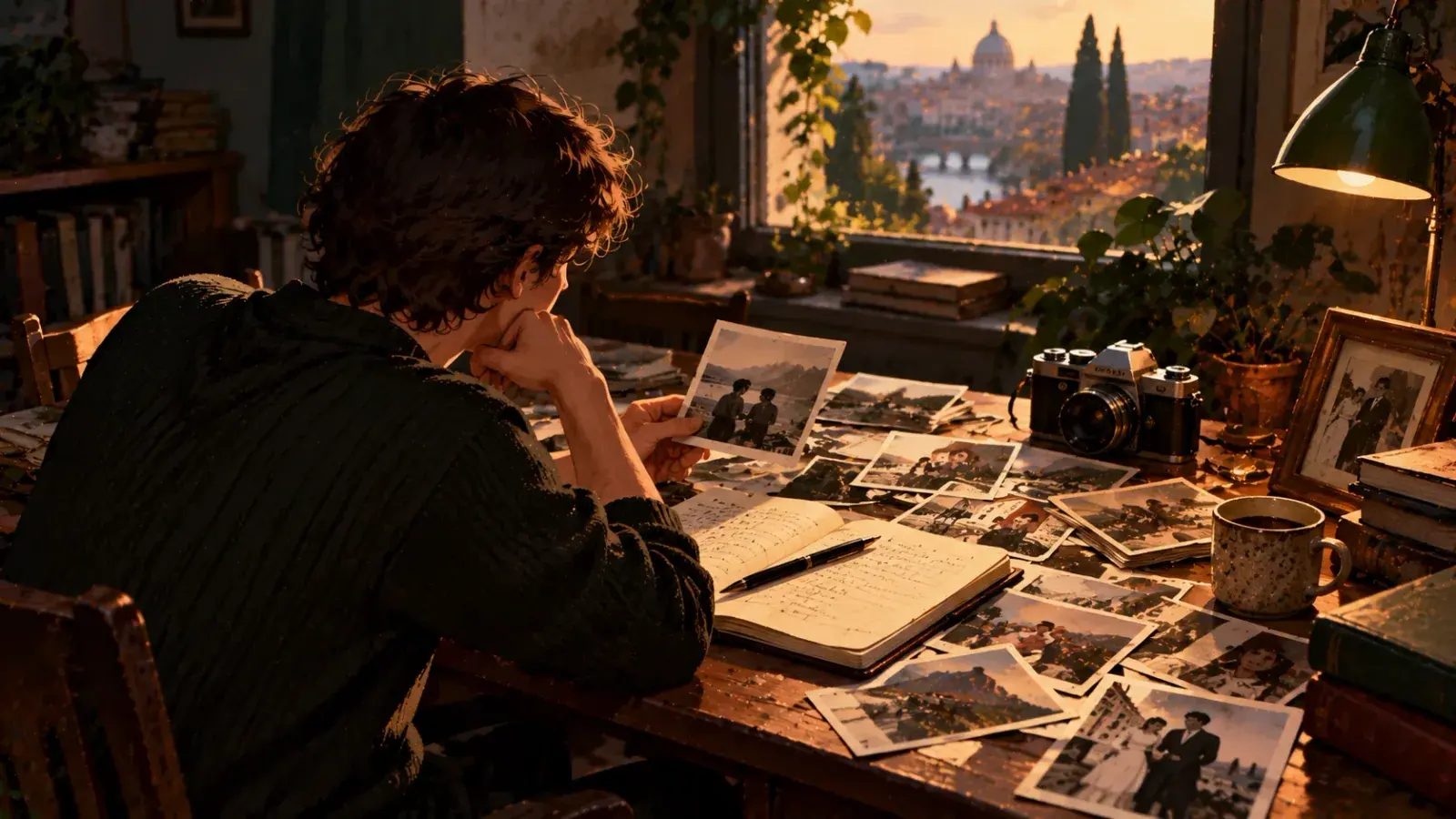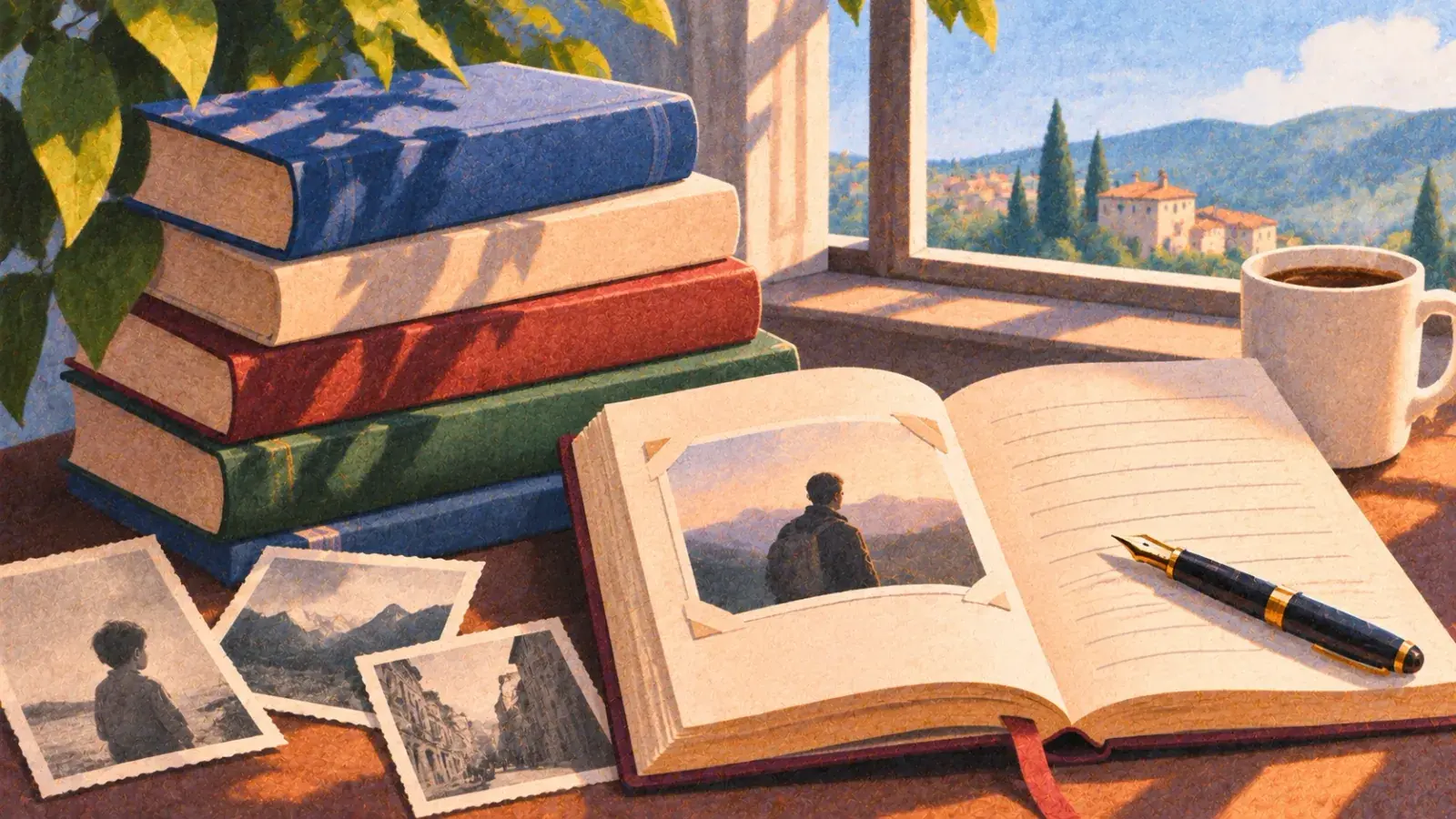
A memoir is a true story from the writer's own life, told in the first person and focused on one part of it: a childhood, a loss, a job, a place, one hard year. Famous examples include Frederick Douglass's Narrative (1845), Henry David Thoreau's Walden (1854), Maya Angelou's I Know Why the Caged Bird Sings (1969) and Joan Didion's The Year of Magical Thinking, which won the National Book Award for Nonfiction in 2005.
The page has two halves. First, 22 famous memoirs to read, sorted by type, and what separates a memoir from an autobiography. Then the passages: three from public-domain classics and three originals written for this guide to show scene, reflection and braiding, plus a dozen six-word memoirs. For the writing process itself, see how to write a memoir.
| Type | What it's about | Examples |
|---|---|---|
| TypeChildhood and coming of age | What it's aboutGrowing up, and the moment it ended | Examples1–4 |
| TypeFamily and home | What it's aboutA family's history, a house, a letter to a child | Examples5–6 |
| TypeGrief and loss | What it's aboutA death, and what came after | Examples7–8 |
| TypeWitness and survival | What it's aboutHistory lived from inside: slavery, war, the camps | Examples9–12 |
| TypePlace, nature and adventure | What it's aboutA pond, the West, the Antarctic ice, a creek | Examples13–16 |
| TypeWork and vocation | What it's aboutLearning a trade or becoming an artist | Examples17–19 |
| TypeComics and verse | What it's aboutMemoir told in panels or in poems | Examples20–22 |
Famous memoirs by type
Years in parentheses are first publication. The books published before 1929 are in the US public domain and free to read online; for recent books, the year given is the prize year.
Childhood and coming of age
Growing up, told by the adult looking back at the child.
- The Story of My Life (1903), Helen Keller — her deaf-blind childhood, her teacher's arrival and the road to college. She calls it an autobiography; its scope is a memoir's.
- I Know Why the Caged Bird Sings (1969), Maya Angelou — the first of her autobiographies, about her childhood, ending with the birth of her son. It was nominated for a National Book Award.
- Angela's Ashes, Frank McCourt — a childhood of poverty in Limerick, Ireland, told close to the boy's eye level. Pulitzer Prize for Biography, 1997.
- Stay True, Hua Hsu — a coming-of-age account of an intense youthful friendship and the random violence that ended it. Pulitzer Prize for Memoir or Autobiography, 2023.
Family and home
Books where the subject is other people, seen by the one who lived with them.
- The Yellow House, Sarah M. Broom — about a century of one family's history in New Orleans East, told through the house that Hurricane Katrina destroyed. National Book Award for Nonfiction, 2019.
- Between the World and Me, Ta-Nehisi Coates — a letter to his teenage son about racism in America, braiding memoir with history. National Book Award for Nonfiction, 2015.
Grief and loss
A death, and how the writer lived through what followed it.
- The Year of Magical Thinking, Joan Didion — the year after her husband's sudden death, examined with an investigator's precision. National Book Award for Nonfiction, 2005.
- Liliana's Invincible Summer, Cristina Rivera Garza — a genre-bending account of her sister, murdered at 20 by a former boyfriend. Pulitzer Prize for Memoir or Autobiography, 2024.
Witness and survival
History seen from inside by someone who lived through it. These books carry the heaviest subjects in the genre, and several were written partly as testimony.
- Narrative of the Life of Frederick Douglass, an American Slave (1845) — his life in slavery in Maryland up to his escape north in 1838, published in part to answer people who doubted he had been enslaved at all.
- Incidents in the Life of a Slave Girl (1861), Harriet Jacobs — written as Linda Brent, it shows what slavery meant for women and mothers, including the years she spent hiding before she reached freedom.
- Personal Memoirs of U. S. Grant — the general's account of his campaigns from the Mexican-American War through the Civil War, written in 1884–85 while he was dying of throat cancer, and published with Mark Twain's help.
- Night (1958, in French as La Nuit), Elie Wiesel — his experiences as a teenager in the Nazi camps. He was liberated from Buchenwald in 1945 and received the Nobel Peace Prize in 1986.
Place, nature and adventure
Memoirs where the setting is a character, and sometimes the antagonist.
- Walden (1854), Henry David Thoreau — two years in a house he built on the shore of Walden Pond, shaped into a single year.
- Roughing It (1872), Mark Twain — a comic account of his years in the American West in the 1860s, from a stagecoach ride to Nevada to a trip to Hawaii.
- South (1919), Ernest Shackleton — the Endurance expedition: the ship crushed by Antarctic pack ice and the crew's long fight to survive.
- Pilgrim at Tinker Creek, Annie Dillard — a year of close attention to the natural world around a creek in Virginia. Pulitzer Prize for General Nonfiction, 1975.
Work and vocation
How someone learned a trade, and what the trade taught them.
- Life on the Mississippi (1883), Mark Twain — his apprenticeship as a steamboat pilot before the Civil War, then his return to the river decades later.
- The Spirit of St. Louis, Charles A. Lindbergh — his account of the 1927 solo flight from New York to Paris. Pulitzer Prize, 1954.
- Just Kids, Patti Smith — becoming an artist in New York alongside her friend Robert Mapplethorpe. National Book Award for Nonfiction, 2010.
Comics and verse
Memoirs where the form does part of the telling.
- Maus, Art Spiegelman — his father's survival of the Holocaust, told in comics. A special Pulitzer citation, 1992.
- March: Book Three, John Lewis and Andrew Aydin, art by Nate Powell — the last volume of Lewis's civil rights memoir in comics, ending with Selma and the Voting Rights Act of 1965. National Book Award for Young People's Literature, 2016.
- Brown Girl Dreaming, Jacqueline Woodson — a memoir in verse about growing up in South Carolina and New York in the 1960s and 1970s, and finding her way to writing. National Book Award for Young People's Literature, 2014.
Memoir or autobiography: scope and stance
Look at the time spans in the list. Didion takes a year, Thoreau two, Grant his campaigns and not his presidency. None of them tries to fit in everything, and that is the usual line between a memoir and an autobiography: an autobiography generally covers the writer's whole life so far, in order, while a memoir takes one part of it and is organized around what that part meant. The line blurs. Helen Keller called The Story of My Life an autobiography, though it stops in her college years, and dictionaries also list memoirs, in the plural, as another word for autobiography.
The second choice is stance: where the narrator stands in relation to the events. Every memoir has two narrators, the person who lived it and the person writing now, and the writer decides how much of the later knowledge to let in. Keller's opening names both, and admits what memory can't do:
It is with a kind of fear that I begin to write the history of my life. I have, as it were, a superstitious hesitation in lifting the veil that clings about my childhood like a golden mist. The task of writing an autobiography is a difficult one. When I try to classify my earliest impressions, I find that fact and fancy look alike across the years that link the past with the present. The woman paints the child's experiences in her own fantasy.
Keller admits her memories may be partly invented, which makes the rest more believable, not less. “The woman paints the child's experiences” names memoir's two narrators in six words. A narrator who stays inside the moment gives you scene; one who speaks from now gives you reflection, and most memoirs move between the two. The guide to first-person narrative covers that retrospective voice in fiction too.
Two classic memoir passages
Two more public-domain passages, each doing something you can borrow.
When I wrote the following pages, or rather the bulk of them, I lived alone, in the woods, a mile from any neighbor, in a house which I had built myself, on the shore of Walden Pond, in Concord, Massachusetts, and earned my living by the labor of my hands only. I lived there two years and two months. At present I am a sojourner in civilized life again.
…In most books, the I, or first person, is omitted; in this it will be retained; that, in respect to egotism, is the main difference. We commonly do not remember that it is, after all, always the first person that is speaking. I should not talk so much about myself if there were anybody else whom I knew as well.
In three sentences Thoreau gives the frame a memoir needs: where, how far from other people, how he lived, for how long, and where he is now, writing. The last one separates the man who lived at the pond from the one telling it. His defense of “I” is still a good answer to anyone who calls memoir self-indulgent. And in “Where I Lived, and What I Lived For” he admits shaping the book “for convenience, putting the experience of two years into one.”
You have seen how a man was made a slave; you shall see how a slave was made a man.
Douglass puts this line in the middle of Chapter X, just before he tells how he fought back against Covey, the man who had been beating him. It sums up everything so far and promises what comes next, and its mirrored grammar makes it hard to forget. The “you” is a reminder that the book was written to persuade.
Original memoir excerpts by technique
These three are not from published memoirs; they were written for this guide. The first two use the same memory, once as scene and once as reflection. The third braids three strands.
The hill behind the Lutheran cemetery was the steepest in Steele County, which is not saying much, and my father had picked it for that reason. He stopped the truck halfway up, set the brake and got out. “Your turn,” he said through the window.
I slid over. The seat was warm from him. I pushed the clutch to the floor and kept it there while I looked at the stone angel by the fence, the one with the broken wing.
“Ease it out. Give it gas when she shivers.”
She shivered. I gave it gas. We rolled back two feet, the engine died, and the angel stayed where it was.
“Again.”
On the fourth try the truck jerked forward, gravel spat behind us, and I heard him laugh once, the way he laughed at the TV. At the top I stopped and waited for him to walk up and get in. He lit a cigarette instead and waved me on. I drove home alone, eleven miles, in second gear the whole way.
Everything happens in time: place, dialogue, action, and no explaining. The stone angel gives the failed tries something to measure against, and the turn comes when the father doesn't get back in. The last line is funny and proud at once, which tells you how the fifteen-year-old felt without saying it.
For years I told the cemetery hill as a funny story, and it is one. I have told it at two weddings. What I left out, because I didn't know it, was in the pocket calendar my mother kept for him, which I found last spring in a coffee can of washers. Under April 9, 1987, in his square capitals: LAST DAY FOSSUM. The feed store had let him go that morning. He drove home, said nothing to anyone, and took me out to the hill.
I can see now that the lesson wasn't about the clutch. He had just learned that the thing he counted on could stop, and he wanted to know, that afternoon, that I could get myself home. Or that is the story I tell now. My brother, who was nine and asleep on the couch when we came in, says Dad was cheerful at dinner. He may have been. Both things can be true of the same evening.
This is the narrating self, writing from now. The reflection is earned by a piece of evidence, the calendar, rather than a moral, and the narrator admits it is an interpretation and lets her brother's different memory stand. Readers trust a narrator who shows where the knowing stops.
The pool, 2019. The instructor at the Y in Tacoma is twenty-three and calls me ma'am. “Your body wants to float,” she says. “You're stopping it.” I am forty-one. I hold the wall.
Ballard, 1961. My grandfather fished out of Seattle for thirty years and never learned to swim. When my grandmother asked him why, he said that if the boat went down in the Gulf of Alaska, swimming would only make it take longer.
Lane 4, last Thursday. My daughter, who is six, jumps in feet first and comes up laughing, and doesn't look to see if I'm watching.
The pool. At the eighth lesson I let go of the wall. I don't float. I sink, slowly, until the instructor's hand finds my back.
Ballard. He kept a photograph of his boat, the Solveig, above the sink, and he said “she” about her the way he said it about my grandmother.
Lane 4. “Mom,” she says, when I tell her I'm learning too. “You're a grown-up.” As if that settled it.
The pool. At the twelfth lesson I lie back and look at the ceiling tiles, and nothing holds me, and I stay up.
Each strand is slight alone. Together they make an argument about fear handed down and then broken, and they never explain each other: the reader makes the connection. Labels keep the reader oriented, and the strands meet when the narrator floats. Braids are often built from short vignettes like these.
Six-word memoir examples
In November 2006, SMITH Magazine, founded by Larry Smith, asked its readers to describe their lives in exactly six words, and the six-word memoir became a form of its own. It is also a good test of whether you know what your longer memoir is about. Twelve originals:
- Left Ohio twice. Ohio kept me.
- Accent from there. Mortgage from here.
- Learned Dad's recipes after his funeral.
- Night nurse. Day mother. Sleep pending.
- Lost the farm, kept the dog.
- Married my pen pal. Still writing.
- Quit law. Bought sheep. No regrets.
- Sober eleven years. Counting still helps.
- The twins were planned. Nothing else.
- Born in Lagos. Still learning snow.
- Late bloomer, early riser, mostly tired.
- Wrote the book Mom wouldn't read.
The ones that work hold a turn or a contradiction and a concrete noun. “Life was hard, but I survived” is six words that summarize instead of choosing. Write twenty and keep the one that would make a stranger ask a question.
Read memoirs like a writer
The list is also a reading list. Pick two books from the type closest to yours and take them apart:
- Read the first and last chapters first
They show where the writer chose to begin, how far from their birth, and which question the ending answers.
- Find the vantage point
Note when the narrator is writing from. Thoreau says so on the first page, Keller in her first paragraph.
- Mark scene, summary and reflection
Mark ten pages in three colors. The proportions teach more than any rule: where the writer slows to a scene, where a paragraph covers a year, how short the reflection usually is. If you keep notes in Strokes, paste a public-domain passage such as the opening of Walden into a document, ask the Strokes Assistant to mark the same three, and compare its marks with yours.
- Watch the real people
Note what the other people are allowed to say, and what the narrator admits about their own part. Then sketch your book in the memoir outline template.
If your material is a single episode rather than a book, the narrative essay examples show the same techniques at essay length.
Mistakes the best memoirs avoid
What the examples do
- Open close to the moment the story's question appears.
- Put the turning points on the page as scenes.
- Earn reflection with a fact or a later discovery.
- Admit what memory can't confirm, as Keller does.
- Let other people keep their own version of events.
What first drafts often do
- Spend the first chapter on background before anything happens.
- Summarize the moments that changed everything.
- End each scene with a lesson: “I learned that…”
- Braid strands that never answer each other.
- Cast the narrator as right in every argument.
A braid works when each strand changes how you read the others, as the grandfather changes the pool. If a strand can go without loss, it was decoration.
Frequently asked questions
Can a memoir include dialogue you don't remember word for word?
Yes, within limits. Memoirists commonly reconstruct conversations from memory, notes and other people's accounts, and readers accept that when the speaker and the gist are true. What breaks a memoir's promise is inventing events or people. Where your memory is uncertain, say so on the page, as Keller does in her opening and the reflection excerpt does with the brother's version.
What is a six-word memoir?
A six-word memoir is a life, or one part of it, told in exactly six words. The form took off in November 2006, when SMITH Magazine asked its readers to describe their lives in six words. Good ones hold a turn or a contradiction and at least one concrete noun, as in “Lost the farm, kept the dog.”
Do you have to be famous to write a memoir?
No. Readers pick up a memoir for the story and what it means, not for the name on the cover. A clear question, turning points written as scenes and a narrator who is honest about their own part matter more than a public profile. Publishers do weigh platform, but the manuscript comes first.