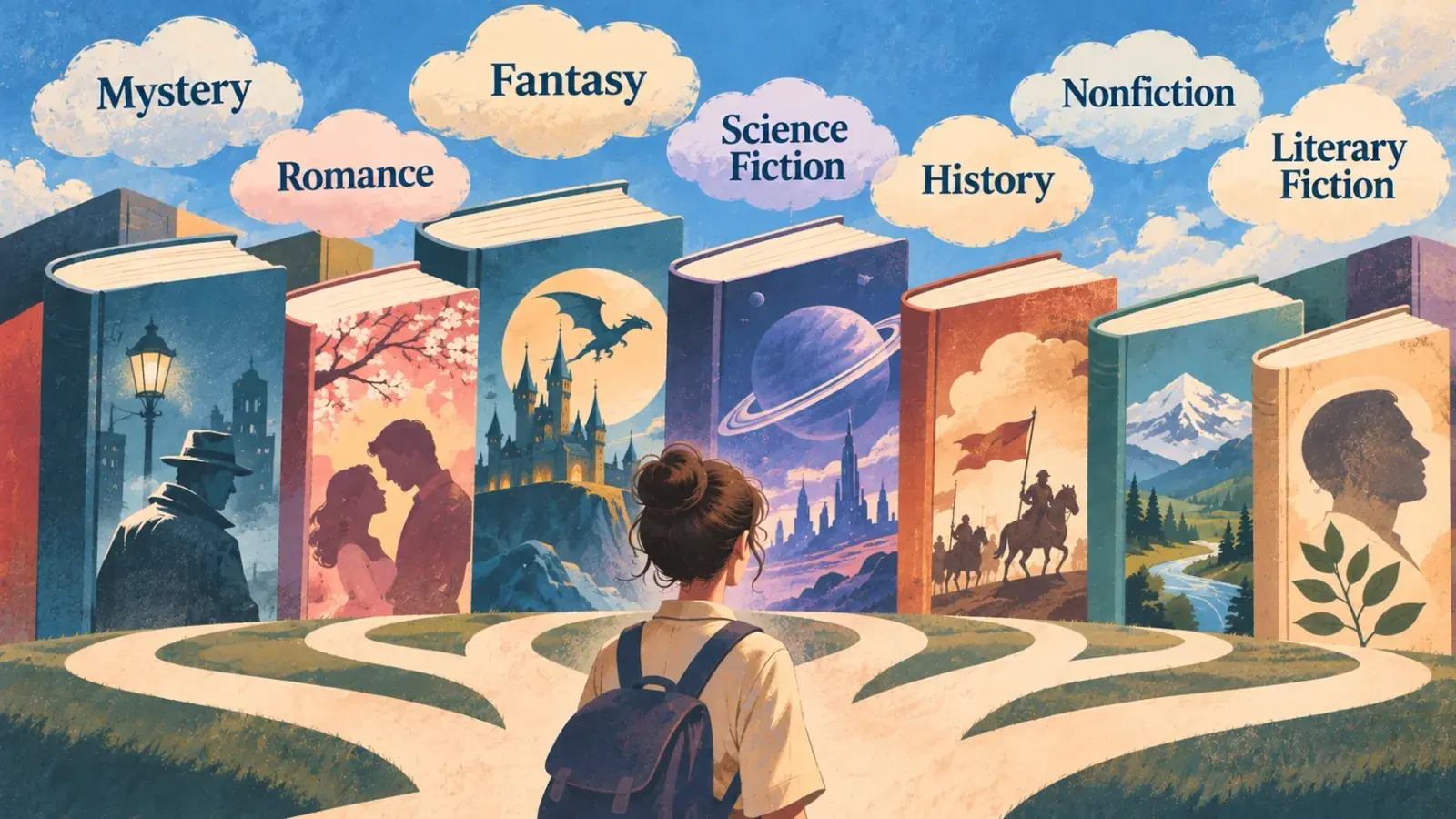
Literary fiction is fiction read mainly for how it is written: its style, its characters' inner lives and the questions it leaves open. Genre fiction follows the conventions of a category, such as mystery, romance, fantasy or the thriller, and promises a particular experience: a crime solved, lovers united, a world saved. To remember the difference, look at the names. Genre fiction is named for what happens in it, literary fiction for how it is told. Between them sits upmarket fiction, a publishing label for books that pair a hook you can pitch in one sentence with literary prose.
Neither label is a grade. A great thriller and a great literary novel are great at different things, and many well-loved books sit on the line between them.
Literary vs genre at a glance
| Literary fiction | Genre fiction | |
|---|---|---|
| Readers come for | Literary fictionStyle, character, ideas | Genre fictionA promised experience: a puzzle, fear, love, wonder |
| The plot | Literary fictionOften quiet and inward | Genre fictionDrives the book toward a climax |
| The ending | Literary fictionMay stay open | Genre fictionAnswers the genre's question |
| Conventions | Literary fictionFew; each book sets its own | Genre fictionShared, and readers expect them kept |
| Bookstore heading | Literary fictionFICTION / Literary | Genre fictionFICTION / Mystery & Detective, Romance, Fantasy… |
| Debut length | Literary fiction80,000–100,000 words, some 60,000 | Genre fictionAbout 70,000 to 120,000, by genre |
| Its prizes | Literary fictionBooker, Pulitzer, National Book Awards | Genre fictionEdgars for mystery; Hugos and Nebulas for SF and fantasy |
One premise, three shelves
Here is one premise written three ways. Nell Avery comes home to Astoria, Oregon, for her father's funeral and finds a stranger living in his house.
Literary. The man who answered her father's door was wearing her father's cardigan, the green one with the leather buttons, and Nell could think of nothing to say that wouldn't sound like an accusation. Behind him the barometer still pointed to Change, as it had for thirty years, because nobody had ever thought to tap it. “You must be Eleanor,” he said, and she understood that her father had talked about her to this man, and that she would never know what he had said.
Genre (mystery). The man who answered her father's door was wearing her father's cardigan. “You must be Eleanor,” he said. Nobody had called her Eleanor since 1998. Behind him, where the barometer used to hang, there was a pale square of unfaded wallpaper and a single brass screw. Her father had died on Monday. The lawyer had shown her the deed that morning, signed over to a Walter Brandt on Tuesday.
Upmarket. The man who answered her father's door was wearing her father's cardigan. “You must be Eleanor,” he said, and stepped aside as if it were his house to let her into. As of last spring, it was. Nell had come home to bury her father and sell the house, and she was learning on his doormat that he had given it to a man she had never heard of, and that he must have had a whole second life.
All three share a doorway, a cardigan and a line of dialogue, and each makes a different promise. The literary version promises understanding: the question is what this moment means to Nell, and its barometer is a symbol of a house where nothing moved. The mystery promises a solution: the same barometer becomes a clue, a dead man can't sign a deed, and the reader's question becomes who did it. The upmarket version promises a hook and an inner question at once: a stranger owns the house, and Nell will have to find out who her father was. None of the three is the better book. Each is the right opening for a different one.
What makes fiction literary
The book trade's own definition rests on reputation, not features. The BISAC subject list that US booksellers and libraries use has a heading for it, FICTION / Literary (FIC019000). Its notes pair it with FICTION / Classics and leave both to the classifier's discretion, for works “generally considered to be classics or of literary value.” Readers recognize a literary novel by its habits:
- The inner life is the action. What a character notices, misreads and decides weighs as much as what happens.
- The sentences carry meaning. A summary of the plot loses most of the book.
- Ambiguity is allowed. Motives stay mixed, and the ending may not answer every question.
- Form can change. Time jumps, narrators multiply, a chapter becomes a letter.
The Great Gatsby has a mystery man, a love affair and a hit-and-run, enough for a genre novel, and it opens and closes on none of them:
In my younger and more vulnerable years my father gave me some advice that I've been turning over in my mind ever since.
So we beat on, boats against the current, borne back ceaselessly into the past.
The opening promises reflection: a narrator still turning something over years later. The last line doesn't resolve the plot, which is already over. It reaches for what the story meant, and that move from incident to meaning is typical of literary fiction.
What makes fiction genre
Genre fiction is defined by a promise, and it usually makes the promise early. A mystery promises a solution the reader could have guessed, a romance a happy ending, a thriller a threat stopped in time. The conventions that come with each promise work like the fourteen lines of a sonnet: a shared form that lets readers see what a writer does inside it. The book genres list sets out each genre's promises and subgenres.
“Footprints.”
“A man's or a woman's?”
Dr. Mortimer looked strangely at us for an instant, and his voice sank almost to a whisper as he answered.
“Mr. Holmes, they were the footprints of a gigantic hound!”
Doyle ends the chapter on the clue that turns a family legend into a case, with the key word last. John Buchan's The Thirty-Nine Steps (1915) moves as fast: its hero opens the book “pretty well disgusted with life” and ends the first chapter beside the man he has been hiding, with “a long knife through his heart.” Both books make their genre's promise within pages.
Upmarket, book club and crossovers
Upmarket and book club fiction are publishing categories rather than literary terms, and their borders are fuzzy. Agents generally use upmarket for the middle ground: a premise strong enough to pitch in a sentence, written with literary care. Book club fiction usually means a book of that kind with a question readers split on. Agents draw these lines differently and the labels shift with fashion, so before you borrow one, read how each agent uses it on their agency page or in their Manuscript Wish List entries.
The line moves both ways. Cormac McCarthy's post-apocalyptic The Road won the 2007 Pulitzer Prize for Fiction, and Colson Whitehead's The Underground Railroad won in 2017 for what the board called “a smart melding of realism and allegory.” Hilary Mantel's Wolf Hall, a historical novel about Thomas Cromwell, won the 2009 Booker Prize. In 2003 the National Book Foundation gave Stephen King its Medal for Distinguished Contribution to American Letters.
Writers have drawn the line themselves. Graham Greene called several of his books, among them Stamboul Train (1932) and The Ministry of Fear (1943), “entertainments”: thrillers that Britannica credits with greater moral complexity and depth than the usual kind. Henry James wrote The Turn of the Screw (1898) as a ghost story told around the fire on Christmas Eve, then left readers arguing about whether the ghosts are real.
Literary and genre fiction examples
| Book | Shelf | What puts it there |
|---|---|---|
| BookMiddlemarch (George Eliot, 1871–72) | ShelfLiterary | What puts it thereA town's inner lives, with a narrator who comments |
| BookMrs. Dalloway (Virginia Woolf, 1925) | ShelfLiterary | What puts it thereOne day in London, told from inside several minds |
| BookThe Great Gatsby (F. Scott Fitzgerald, 1925) | ShelfLiterary | What puts it thereA love affair told by a witness still trying to understand it |
| BookThe Moonstone (Wilkie Collins, 1868) | ShelfMystery | What puts it thereA stolen diamond and a solution laid out in clues |
| BookThe Hound of the Baskervilles (Arthur Conan Doyle, 1902) | ShelfMystery | What puts it thereA legend, a moor and a detective's answer |
| BookThe Thirty-Nine Steps (John Buchan, 1915) | ShelfThriller | What puts it thereA man on the run with a secret and a deadline |
| BookDracula (Bram Stoker, 1897) | ShelfHorror | What puts it thereDread built from letters, diaries and journals |
| BookThe Time Machine (H. G. Wells, 1895) | ShelfScience fiction | What puts it thereOne invention followed to the end of the world |
| BookFrankenstein (Mary Shelley, 1818) | ShelfClassic, claimed by horror and SF | What puts it thereA genre premise asked as a moral question |
| BookThe Turn of the Screw (Henry James, 1898) | ShelfClassic ghost story | What puts it thereA genre setup with literary ambiguity |
| BookThe Road (Cormac McCarthy, 2006) | ShelfLiterary | What puts it thereA post-apocalyptic premise; the 2007 Pulitzer Prize |
How to tell which you're writing
If you still can't tell, rewrite the opening both ways. With the novel as a Strokes project, ask agent mode to copy chapter one as “Chapter 1, upmarket,” put the hook on the first page of the copy, and read the two versions back to back.
Practice: literary, genre or upmarket?
Decide which shelf each invented pitch belongs on, then check the answers.
- A retired lighthouse keeper on Lake Superior writes letters to his late wife for a year, and the letters slowly admit what happened the night she drowned.
- A forensic accountant in Phoenix finds that three of her firm's clients died within a week of changing their wills, and the next name on the list is her mother's.
- Two estranged sisters inherit their grandmother's failing vineyard in the Finger Lakes on one condition: they must run it together for one harvest.
- A disgraced astronomer is the only one who believes the signal from Proxima Centauri is a warning, and she has nineteen days to prove it.
- In 1950s Lisbon, a fado singer's daughter grows up believing her father was lost at sea, until a stranger arrives at her mother's funeral.
Answers. 1 leans literary: the plot is a confession, and the interest is how the voice changes over the year. 2 is genre, a thriller with a mystery inside it: bodies, a clock and a personal threat. 3 is upmarket or book club fiction: a high-concept setup and a family conflict readers take sides on. 4 is genre, science fiction with a thriller's clock. 5 could go either way: written for the secret, it is upmarket historical fiction; written for the daughter's slow reckoning with her mother, it is literary.
The label in your query
In a query letter the category sits beside the title, word count and comps, and an agent reads it as a filter. Three habits help:
- Use the agent's words. If the agency page says “upmarket” and your book fits, say upmarket.
- Don't use “literary” to mean “good.” A thriller with fine sentences is a thriller with fine sentences, and calling it literary fiction sends it to agents who expect a different book. Blends such as the literary thriller exist; use them when your comps are shelved that way.
- Match the comps and the length to the label. Comp titles show the shelf, and a literary novel comped to two genre bestsellers can suggest you aren't sure where it goes. Literary fiction usually runs 80,000 to 100,000 words; the genre ranges are in how many words is a novel.
The guide to writing a query letter shows where the category line goes.
Frequently asked questions
Is literary fiction a genre?
In bookstores it works like one: the BISAC subject list that stores and libraries use has a heading for it, FICTION / Literary. But it is defined by approach rather than subject, so a literary novel can be about a murder, a war, a marriage or the end of the world.
Can genre fiction be literary fiction?
Yes. Many novels have a genre premise and literary ambitions, from Henry James's ghost story The Turn of the Screw to Cormac McCarthy's post-apocalyptic The Road, which won the 2007 Pulitzer Prize for Fiction. When you query, blended labels such as literary thriller exist for these books; use one when your comp titles are shelved that way.
Is literary fiction the same as general fiction?
No, though they overlap. FICTION / General (FIC000000) is the broadest BISAC fiction heading, while FICTION / Literary (FIC019000) is meant for works considered to have literary value. The Book Industry Study Group recommends no more than three headings per title, so a novel can carry both.