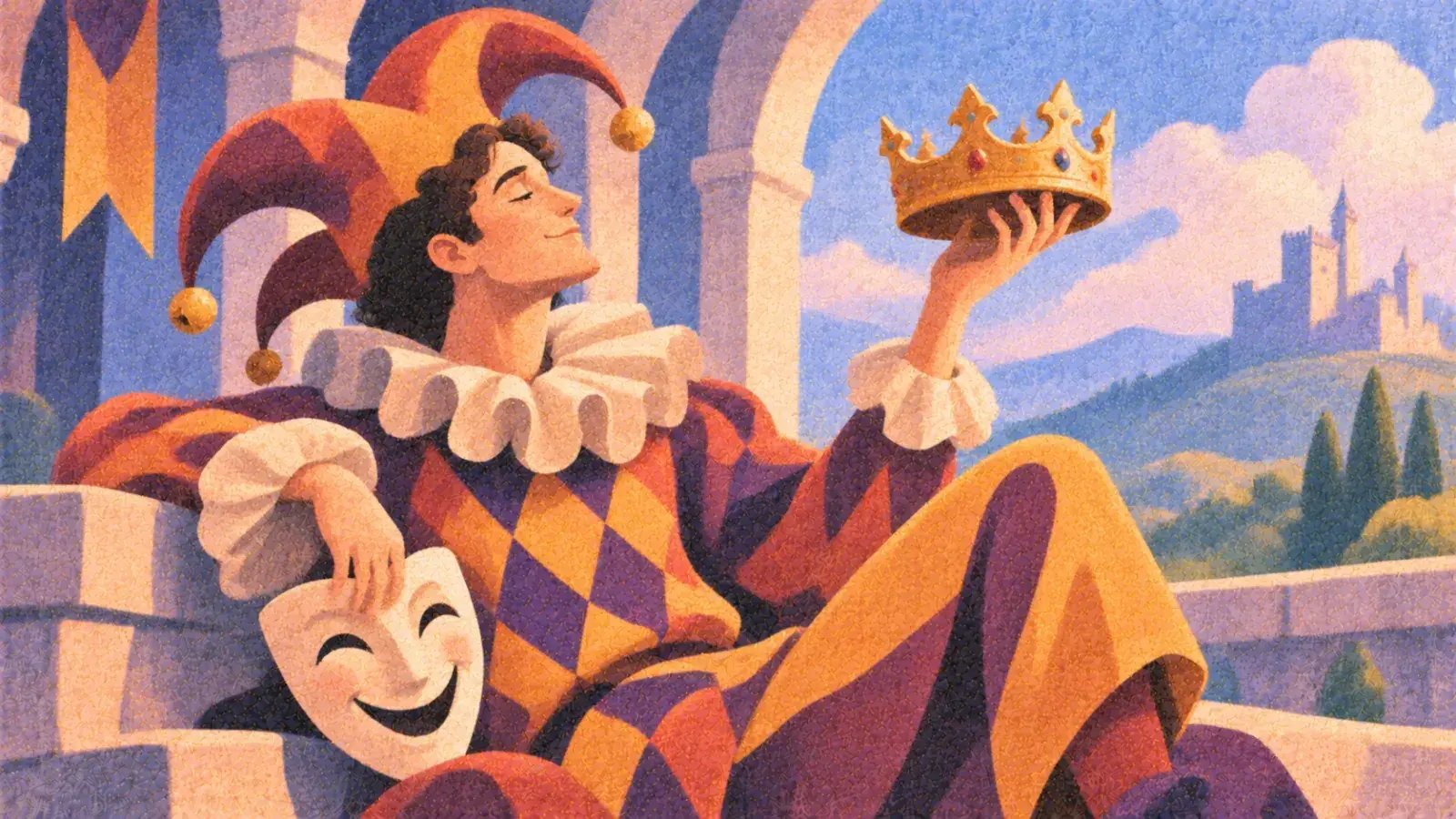
A jester is a professional fool: an entertainer kept by a royal court or a great household to amuse it with jokes, songs, mimicry and tricks. Merriam-Webster defines this kind of fool as a retainer “formerly kept in great households to provide casual entertainment,” commonly dressed “in motley with cap, bells, and bauble.” The job came with a license: the fool could mock the powerful and tell them the truth, as long as it sounded like a joke.
Touchstone, the court fool in Shakespeare's As You Like It (c. 1599), shows the license at work, and its limit. He tells a story that makes a fool of a knight the duke is fond of, and Celia warns him he'll “be whipped for taxation one of these days.” His answer: “The more pity, that fools may not speak wisely what wise men do foolishly.” The joke lets him say it, and the whip marks how far a joke can reach.
That is the jester in history and in literature. The Jester of the twelve-archetype model is a third thing: a personality built around play, with no court and no master. This page keeps the three apart, then shows how to write a jester.
Where the word jester comes from
Jester comes from Middle English gestour, a “reciter of romances, minstrel, entertainer,” from a verb meaning to recite romances. Merriam-Webster dates the word to the 15th century. It meant a storyteller before it meant a comedian.
The costume is what most people picture: bright clothes in a motley pattern, a cap with bells and a mock scepter, called a bauble or a marotte. The cap and the scepter mirrored the king's own crown and scepter, so the fool's outfit was itself a joke about power. In fiction the costume is optional. The license is what makes a jester.
Court jesters in history
Courts kept professional fools for centuries, sometimes called licensed fools. Henry VIII employed a jester named Will Sommers. Triboulet served two kings of France, Louis XII and Francis I, and James VI and I kept Archibald Armstrong. Not every fool was a performer: Thomas More's household fool, Henry Patenson, was described as a “natural” fool, one whose folly was taken to be real rather than played. By the 18th century court jesters had died out except in Russia, Spain and Germany. In France the tradition ended with the monarchy, in the Revolution.
Folly as a cover for truth had a famous book behind it. Erasmus wrote In Praise of Folly in Latin in 1509, while staying at More's house in London, and it was printed in 1511. Folly herself narrates, as a goddess praising her own power, and the satire takes in princes, scholars and the church. The Latin title, Moriae Encomium, puns on More's name.
On the English stage, Shakespeare's fools are tied to one actor. Around 1600 Robert Armin became the leading comic actor of Shakespeare's company after Will Kempe left. Armin was the company's expert on jesting and wrote Foole upon Foole (1600), about natural fools, some of whom he knew. He is thought to have played the licensed fools Shakespeare wrote after Kempe's departure, and Feste was almost certainly written for him.
Shakespeare's wise fools
Shakespeare's fools are mostly clever commoners who outwit their social betters. The best of them know exactly how much truth a joke will carry, and what happens when it carries too much.
Touchstone: wit behind a stalking-horse
I must have liberty
Withal, as large a charter as the wind,
To blow on whom I please, for so fools have. (Jaques, 2.7)
The fool doth think he is wise, but the wise man knows himself to be a fool. (Touchstone, 5.1)
Jaques, the play's melancholy lord, meets Touchstone in the forest and envies him the one thing a fool has that a lord doesn't: a charter to mock anyone. “Motley's the only wear,” he decides. By the last act the Duke has seen the method: “He uses his folly like a stalking-horse, and under the presentation of that he shoots his wit.” A stalking-horse was the cover a hunter hid behind to get close to game. The joke is the cover. The truth is the shot.
Feste: the fool who works for a living
Feste, in Twelfth Night (c. 1601), is a professional. He moves between two households, sings for coins and, in his first scene, proves his mistress a fool for mourning a brother whose soul she believes is in heaven.
Better a witty fool than a foolish wit. (Feste, 1.5)
There is no slander in an allowed fool, though he do nothing but rail; nor no railing in a known discreet man, though he do nothing but reprove. (Olivia, 1.5)
This fellow is wise enough to play the fool,
And to do that well, craves a kind of wit: (Viola, 3.1)
Olivia's line is the license in one sentence: an “allowed” fool can rail all day and it isn't slander. Viola's is the craft: playing the fool well takes more wit than playing the lord. Feste also shows the jester's edge. He helps torment the steward Malvolio, who sneered at him in the first act, and at the end throws it back: “And thus the whirligig of time brings in his revenges.” Malvolio's exit line, “I'll be revenged on the whole pack of you,” is the bill for the joke.
Lear's Fool: truth under the whip
The Fool in King Lear (c. 1606) never gets a name. He arrives after Lear has divided his kingdom between the two daughters who flattered him and banished the one who wouldn't, and nearly every joke he makes is about that mistake.
Lear: Dost thou call me fool, boy?
Fool: All thy other titles thou hast given away; that thou wast born with.
Kent: This is not altogether fool, my lord.
I marvel what kin thou and thy daughters are: they'll have me whipped for speaking true; thou'lt have me whipped for lying; and sometimes I am whipped for holding my peace.
That last speech is the jester's whole position. The truth, a lie and silence can all be punished, so he chooses the truth and makes it rhyme. The license is real but thin. In the same scene Lear warns him, “Take heed, sirrah, the whip,” and the Fool knows which dog gets beaten: “Truth's a dog must to kennel; he must be whipped out.” He also loves the daughter Lear exiled: since Cordelia left for France, a knight reports, “the fool hath much pined away.”
Then he vanishes. His last line is “And I'll go to bed at noon,” in the third act, as Lear's own madness takes over his part, and the play never says what became of him. In the final scene Lear, over the dead Cordelia, cries, “And my poor fool is hang'd!” He most likely means Cordelia, since “fool” was also a word of tenderness. It is hard not to hear the Fool in it too.
Yorick: the jester remembered
Hamlet (c. 1600) has a jester who never speaks: he is a skull. The gravedigger says it has lain in the earth three-and-twenty years: “This same skull, sir, was Yorick's skull, the King's jester.” Hamlet, the sharpest wit in the play, holds what is left of the man who carried him: “He hath borne me on his back a thousand times.”
Alas, poor Yorick. I knew him, Horatio, a fellow of infinite jest, of most excellent fancy. … Where be your gibes now? your gambols? your songs? your flashes of merriment, that were wont to set the table on a roar?
Jester vs trickster, clown and fool
| Figure | Where they stand | Answers to | Main tools | Example |
|---|---|---|---|---|
| FigureJester | Where they standInside the court, by license | Answers toA master | Main toolsWit, songs, mockery, truth as a joke | ExampleFeste, Twelfth Night |
| FigureTrickster | Where they standOutside the rules | Answers toNo one, or no one for long | Main toolsDeception, theft, disguise, shape-shifting | ExamplePuck; Loki; Anansi |
| FigureClown | Where they standAmong ordinary people | Answers toThe audience | Main toolsBlunders, slapstick, mangled words | ExampleDogberry, Much Ado About Nothing |
| FigureFool | Where they standAnywhere | Answers toDepends on the sense | Main toolsThe umbrella word: a jester, a dupe or a simpleton | ExampleSir Andrew Aguecheek, Twelfth Night (a dupe) |
| FigureComic relief | Where they standWherever tension builds | Answers toThe plot | Main toolsAny humor that lets the pressure out | ExampleThe Porter in Macbeth |
The line that matters most is between jester and trickster. A jester's power is borrowed. It depends on a master who can laugh, and it ends when the master stops laughing. A trickster's power is their own. Puck serves Oberon but treats the errand as a game, Loki answers to no one for long, and a trickster's mischief can break an old order open. Carl Jung counted the trickster among his archetypes, and Christopher Vogler made it a story role in The Writer's Journey. The character archetypes guide covers both. The Jester among the twelve archetypes is a third thing again: a personality, not a job.
The Jester among the 12 archetypes
The twelve archetypes most writing guides use come from marketing, not from literary criticism. Margaret Mark and Carol S. Pearson set them out for brands in The Hero and the Outlaw (2001), reworking a model for personal growth that Pearson had published a decade earlier. In that model the Jester wants to enjoy the moment and fears boredom, and its flaw is frivolity, the joke as a way to dodge pain and duty. What a Jester gives a story is perspective: the joke that shows a situation from a side no one else will look at. The archetype needs no court and no cap. Mercutio, in Romeo and Juliet (c. 1595), is pure Jester, and he jokes through his own death scene.
No, 'tis not so deep as a well, nor so wide as a church door, but 'tis enough, 'twill serve. Ask for me tomorrow, and you shall find me a grave man.
A plague o' both your houses.
The pun on “grave” is the archetype at its best and worst: brave, funny and refusing to feel it. Then the mask slips, and his curse on both families is the play's verdict on the feud. Shakespeare earns that moment by letting Mercutio joke through everything before it. Modern Jesters include Fred and George Weasley, Hawkeye Pierce in M*A*S*H and Chandler Bing. The Joker is the dark inversion: the jester's license with no master and no limit.
How to write a jester
- Decide who grants the license
A court jester's freedom comes from a master who can take it back. In a modern story the master might be a boss, a parent, a ship's captain or a whole friend group. Decide who can stop the jokes, and what would make them do it.
- Aim the jokes at something true
Lear's Fool has one subject: the king's mistake. Give your jester a target the story cares about, and the jokes start doing plot work.
- Make the truth cost something
The Fool is threatened with the whip. Feste's prank earns him an enemy for life. If the jester's honesty is free, it is only decoration.
- Give them a want of their own
Feste wants paying. Lear's Fool wants the king to see his mistake, and pines for the daughter he lost. A jester with no want is comic relief, not a character, and the character profile template has a field for it.
- Let the mask slip once
Write one scene where the jester isn't joking, and put it where it costs the most: Mercutio's curse, the Fool pining for Cordelia.
- Plan the exit
Lear's Fool disappears when the king's madness takes over his role. Mercutio's death is where the play stops being funny. Decide what the story loses when the laughter stops.
The council had argued about the bridge toll for an hour when Tam Hollin, the queen's fool, climbed onto the map table in his stockinged feet.
“Majesty, I have solved it. We toll the tide instead. It comes under the bridge twice a day and has never paid a penny.”
The lords laughed. The queen smiled. Lord Ivers, who owned both banks of the river, did not.
“Of course,” Tam went on, stepping between the little lead armies, “the tide may refuse. Tides do whatever the man who owns both banks tells them.”
Nobody laughed at that. The queen looked at Ivers for a long moment. “Get down, Tam.” He got down. That night her steward brought him a purse and a warning, and he kept both.
The first joke is for the room. The second is for the queen: it names the man blocking the toll without accusing him of anything. Then look at what Tam gets for it, a purse and a warning. The license holds, and the reader can see exactly how thin it is. If you want a premise to put him in, one of the fantasy writing prompts begins with a dying king who names his jester regent.
Mistakes with jester characters
- Comic relief only. The jester pops in for a laugh and leaves. Without a want or a stake, they are a sound effect.
- Telling the reader it was funny. “Everyone laughed” in narration is a promise the page didn't keep. Put the joke in the dialogue or cut it. The guide to writing dialogue covers timing and subtext.
- The author's mouthpiece. A jester who delivers the writer's opinions and is never wrong stops being a character. Let your fool misjudge someone at least once.
- The sad clown as a surprise. The jester who is secretly in pain is a well-worn trope. It still works if it is set up early and costs the jester something in a scene, not just a confession.
- Jokes from the wrong century. In historical fiction, a joke that needs a modern reference breaks the period. Wordplay, riddles and songs travel better.
Jokes are the hardest lines to judge in your own draft, because you already know the punchline. Keep a short list of the jester's best lines with the chapter each one lands in, so a joke spent in chapter 3 doesn't come back in chapter 19, and give the chapter to a reader who doesn't know the punchlines.
You can also ask the Strokes Assistant to review the chapters the jester appears in and list each joke with its target. A joke with no target is usually the first one to cut.
Frequently asked questions
What is the difference between a jester and a fool?
Fool is the broader word. A jester is a fool by profession, kept to entertain and often licensed to mock. Fool can also mean a dupe or a person lacking judgment. Shakespeare's licensed fools, such as Feste and Touchstone, are jesters; Sir Andrew Aguecheek in Twelfth Night is a fool of the other kind.
What is the jester archetype?
It is one of the twelve archetypes Margaret Mark and Carol S. Pearson set out in The Hero and the Outlaw (2001), the model most writing guides now use. The Jester wants to enjoy life in the moment and fears boredom. It brings joy and perspective to a story, and its flaw is frivolity: using jokes to dodge pain or responsibility. Mercutio and Falstaff are classic Jesters.
Is a jester a trickster?
Not quite. A jester works inside a court or community and depends on a master's tolerance. A trickster works outside the rules and answers to no one for long, using deception and disguise. The roles overlap: Feste plays the trickster when he torments Malvolio in Twelfth Night, and Puck is a trickster who serves a king.
What is a wise fool?
A wise fool is a character who seems foolish but sees more clearly than the people around them, and says so through jokes, riddles or songs. The tradition runs through Erasmus's In Praise of Folly (1511) and Shakespeare's fools, above all the Fool in King Lear, who tells the king the truth no courtier will.