To write a scene, give one viewpoint character a goal they could fail at in the next few minutes, put a person or a force in the way, and play the attempt out moment by moment until it turns: the character wins at a cost, fails, or learns something that changes the plan. Start as late as the reader can follow and leave as soon as the turn has landed.
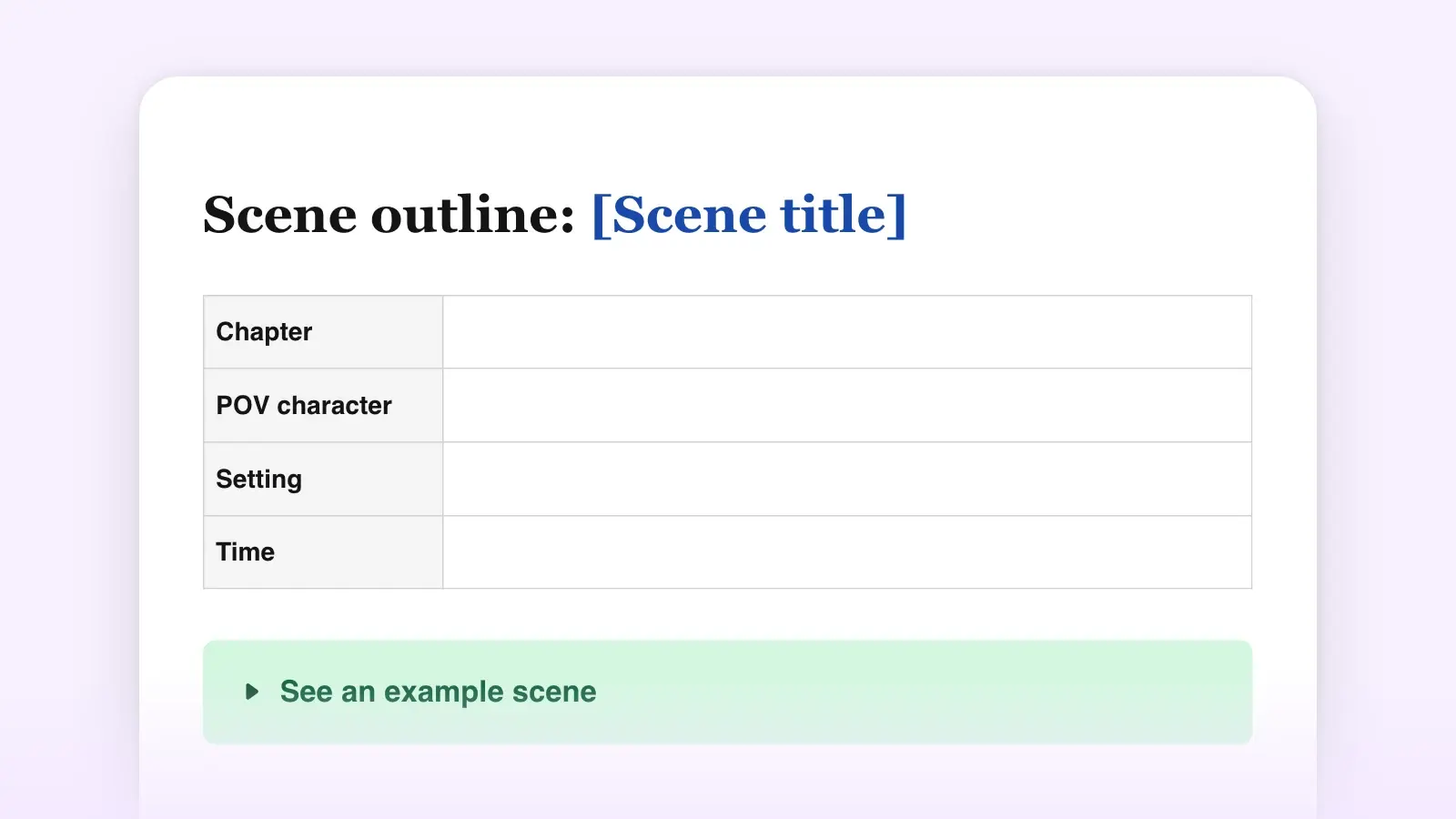
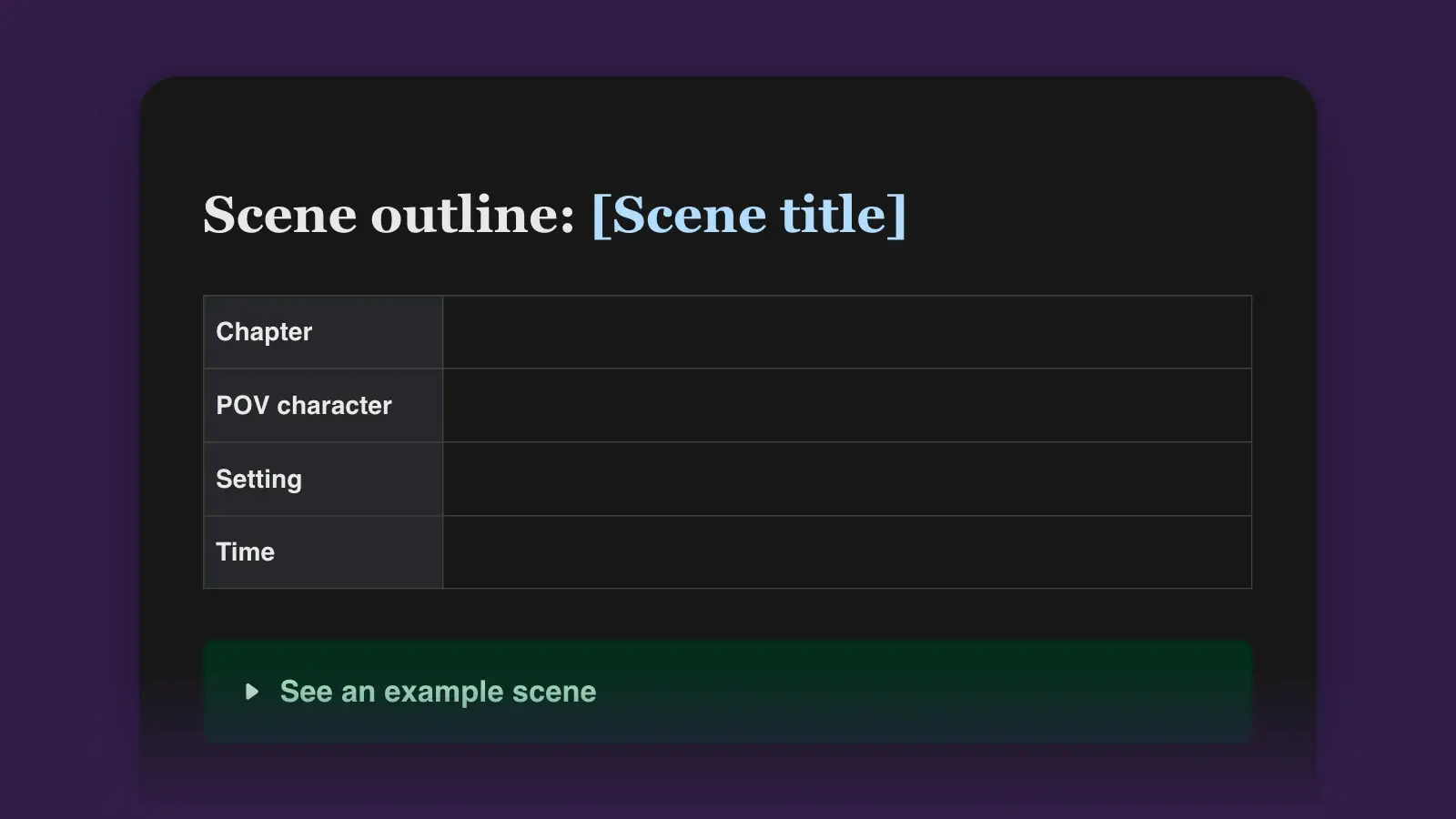
This guide is about drafting: where a scene starts and stops, how to build its middle and what to do with the aftermath. A rough scene and its revision come first, then the model behind the revision. To plan a scene on one page first, use the scene outline template.
What makes a passage a scene
A scene is continuous action in one time and place, told from one point of view, in roughly the time it would take to happen. Summary covers a week in a sentence. A scene shows a change as it happens, which is why readers believe it: they watched.
The test for any scene is the note you would write in its margin. Before: she trusts her brother. After: she knows he lied. If the before and the after are the same, the passage is a conversation, not a scene. It needs a turn, or it may belong in summary.
| Unit | What happens | Story time | Use it for |
|---|---|---|---|
| UnitScene | What happensA character pursues a goal against opposition, and the attempt turns | Story timeAbout real time | Use it forDecisions, confrontations, discoveries |
| UnitSequel | What happensThe character reacts, weighs the options and decides | Story timeOne line to a chapter | Use it forAftermath, and the choice that starts the next scene |
| UnitSummary | What happensEvents are reported, not shown | Story timeHours to years in a paragraph | Use it forTravel, routine, anything that changes nothing |
How to balance the three across a book is a question of pacing. How scenes sit inside chapters is covered in chapter structure.
One scene, drafted and revised
Here is a scene from an invented newspaper novel, first in rough draft. Delia Moretti, a reporter on the Ashford Courier, has a photocopy of a county inspection log and a 9:45 p.m. deadline.
The budget hearing ran until nine. Delia sat in the back row with her third cup of vending-machine coffee, taking notes on road salt and a new library roof. When Commissioner Kessler finally closed the session, she packed up her laptop and followed him outside. It was cold. She asked him about the Mill Street bridge. He said it was a matter for Public Works and got into his car. Delia drove back to the newsroom thinking about the log in her bag, and about her father, who had inspected bridges for the county for thirty years, and about how much she hated this part of the job.
Everything happens, and almost none of it on stage. The confrontation, the only part with conflict, gets two sentences of summary, and the most important fact arrives last, as a thought.
Kessler had his keys out before Delia reached the bottom of the steps.
"Commissioner. Thirty seconds on the Mill Street bridge."
"Public Works handles inspections." He didn't slow down. The lot lights buzzed over a row of county sedans, and his was the only one with the engine already running.
"Public Works says the 2025 inspection is on file." She held up the photocopy. "This is the file. The signature line is blank."
That stopped him, one hand on the car door. He looked at the page, not at her. "You're on deadline," he said, almost kindly. "Nine forty-five, isn't it? Your publisher and I sat on the hospital board for six years. He likes his facts checked."
"Then check this one for me. Was it inspected or not?"
Kessler took the photocopy from her hand, folded it once and gave it back. "Run it. The inspector's name is right there. Ask Frank Moretti why he didn't sign."
He got in and shut the door. Delia stood under the buzzing light with the page in her hand and her father's name on it.
The revision opens on motion and puts the setting into two working details: the buzzing lights, and a car with its engine running, which says Kessler planned his exit. Each exchange raises the cost: a deflection, the evidence, a threat dressed as advice, then the turn. Delia gets her answer on the record, so the outcome is "yes, but": the answer points at her father, and Kessler knows it. The scene ends on that line.
Two cuts made that possible. The draft's first four sentences, from the budget hearing to "It was cold," are gone because nothing in them is at stake: the coffee and the road salt come before Delia's goal meets any resistance. Its last sentence, the drive back and the thought about her father, is gone too. That thought is the scene's most important fact, and the draft delivers it after the scene is over, as a memory. The revision hands it to Kessler, so it arrives as the turn.
Scene and sequel: Swain's model
The revision follows a model from Dwight V. Swain's craft book Techniques of the Selling Writer (1965). Swain divided a story into two kinds of unit that alternate:
- The scene has a goal (what the viewpoint character wants as it opens), conflict (the obstacles between them and the goal) and a disaster (the attempt fails, or succeeds in a way that makes things worse).
- The sequel has a reaction (the emotional hit), a dilemma (a choice between options that all cost something) and a decision. The decision is the goal of the next scene.
In Delia's scene the goal is Kessler on the record, the conflict is his deflection and then his threat, and the disaster is that "yes, but." Linked this way, scenes stop being episodes: each one happens because of the one before. "Disaster" sounds operatic, but it only means the character doesn't get what they came for, at least not cleanly. The scene outline template sets out four ways a scene can end, from a plain yes to a "no, and". Delia's sequel comes straight after the scene:
In the car she sat with the engine off until the windshield fogged. File by 9:45, and the paper would print her father's name beside the word "negligence." Hold the story, and Kessler would have his vote on Thursday. Call her father first, and she would be a reporter who had warned the subject of her own story. At 9:31 she called the city desk. "It's Delia. I need the night editor, and I need to tell him why I can't write this one."
Reaction, dilemma and decision fit in one short paragraph, and the decision sets the next goal: get another reporter on the story before Thursday.
Motivation and reaction, beat by beat
Swain also worked at the smallest scale of a scene, the single beat, which he called the motivation-reaction unit. Randy Ingermanson's article "Writing the Perfect Scene" summarizes it. The motivation is external: something the viewpoint character sees, hears, smells or feels, written the way a camera would record it. The reaction is internal, and it has up to three parts in a fixed order: feeling, then reflex, then rational action and speech. You can leave any part out, but the ones you keep stay in that order, which is the order in which a body responds.
Out of order. Delia stepped back, her stomach dropping. "You can't do that," she said. Kessler had slammed the car door.
In order. Kessler slammed the car door.
Delia's stomach dropped. She stepped back before she could stop herself. "You can't do that," she said.
In the first version the cause arrives after the effect, so the reader rebuilds the moment backward. In the second, the slam lands, then the fear, the flinch and the words. It also follows Ingermanson's rule of thumb: each motivation and each reaction gets its own paragraph.
Writing a scene, step by step
- Write the change in one line
Finish the sentence: at the start of this scene ___; by the end ___. Name something concrete that a character knows, has, wants or believes. If you can't fill in the second half, cut or merge the scene before you spend a day on it.
- Choose whose scene it is
Tell it from the character with the most to lose, and stay with them to the end. A second viewpoint calls for a scene break. Switching in mid-scene is head-hopping.
- Give them a goal they could fail at today
The goal is what they want in this room, not in life: get the quote before the 9:45 deadline, make her sister admit she sold the house. The reader should be able to tell whether it was reached.
- Give the opposition a reason
Conflict is two goals that can't both happen. An opponent who wants something, even just to get home on time, pushes back with tactics instead of plain refusal.
- Start at the first moment of pressure
Skip the arrival, the greetings and the coffee. Open where the goal meets resistance, then orient the reader within two or three sentences: who, where, roughly when. A detail of setting worked into the action does this faster than description.
- Raise the cost with every exchange
Build the middle in beats. Every round should leave the character worse placed or more committed: a deflection, then evidence, then a threat. If two exchanges could swap places unnoticed, cut one. The guide to writing dialogue covers the lines themselves.
- Turn it on a specific moment
The turn is something that happens, not a mood: a line, an object, a discovery. If you can't underline the sentence where the scene turns, the reader may not feel a turn either.
- Leave once it has turned
End on the turn or one beat after it. The drive home and the recap belong in the sequel or nowhere.
- Decide what the sequel needs
A big turn earns room to react and choose, from a paragraph to a chapter. A small one needs a line. The decision is the part you can't drop: without it, the next goal comes from nowhere.
A turn without spectacle
Quiet scenes turn too. The turn doesn't need a slammed door, only an event: a refusal, a decision, something learned or let slip.
The week after the funeral, Ruth and June sort their mother's closet. Ruth wants June to agree to sell the house, and June agrees to everything: the coats to the church sale, the shoes to the curb. Then Ruth holds up their mother's gardening jacket. June takes it, folds it and lays it on the bed beside her own coat. "I'll need this in April," she says.
Nobody raises a voice, and the scene has still turned: June isn't selling, and she has said so without mentioning the house. One jacket moved to one pile does the work a confrontation would do in a louder book.
Scene and sequel in Jane Eyre
Charlotte Brontë's Jane Eyre (1847) has one of the clearest scene-and-sequel pairs in fiction, and a sequel as long as the decision deserves.
| Part | Chapters 26 and 27 | What it does |
|---|---|---|
| PartGoal | Chapters 26 and 27Jane wants to marry Rochester, and the wedding is under way. | What it doesThe highest stakes so far |
| PartConflict | Chapters 26 and 27A solicitor named Briggs interrupts: “The marriage cannot go on: I declare the existence of an impediment.” | What it doesThe obstacle arrives at the worst moment |
| PartDisaster | Chapters 26 and 27Rochester is already married. Mason, his wife's brother, confirms she is alive and living at Thornfield. | What it doesNo, and: no wedding, and she has been deceived |
| PartReaction | Chapters 26 and 27Chapter 26 ends in Jane's grief. Chapter 27 opens as she raises her head in the afternoon. | What it doesTime to feel the blow |
| PartDilemma | Chapters 26 and 27Stay with Rochester, who begs her to, or leave with nothing. | What it doesBoth choices cost her |
| PartDecision | Chapters 26 and 27“I will keep the law given by God; sanctioned by man.” She slips away from Thornfield before dawn. | What it doesIt drives the next part of the novel |
Brontë stages the disaster as a full scene, down to Rochester's bitter "Bigamy is an ugly word!" Then she gives the sequel a whole chapter, in which Jane argues with herself as a quick sequel never could: "The more solitary, the more friendless, the more unsustained I am, the more I will respect myself." A thriller might give this a paragraph in a moving car. Here the decision is the turning point of Jane's life, so it gets the room.
A short scene by Dickens
A scene doesn't have to belong to the person with the goal. In Stave One of Charles Dickens's A Christmas Carol (1843), two gentlemen visit Scrooge's counting-house to raise "a fund to buy the Poor some meat and drink, and means of warmth." Their goal is a donation. Scrooge's is to be left alone. The scene is the collision.
"Are there no prisons?" asked Scrooge.
"Plenty of prisons," said the gentleman, laying down the pen again.
"What shall I put you down for?"
"Nothing!" Scrooge replied.
"You wish to be anonymous?"
"I wish to be left alone," said Scrooge.
"If they would rather die," said Scrooge, "they had better do it, and decrease the surplus population."
Seeing clearly that it would be useless to pursue their point, the gentlemen withdrew.
Each round raises the stakes: the gentlemen move from an appeal to a direct request, Scrooge from sarcasm to refusal to cruelty. The scene ends the moment its question is answered, with one sentence of exit. The real turn happens in the reader, who now knows who Scrooge is, and the scene pays off later. In Stave Three the Ghost of Christmas Present quotes his words back to him, and Scrooge "hung his head to hear his own words quoted by the Spirit."
Common scene mistakes
- Nobody wants anything. Two characters chat over coffee and the scene drifts. Give one a goal the other blocks, and the same talk becomes a contest.
- The weather report. A paragraph of sky before anyone moves. Anchor the place in a working detail instead.
- The easy win. The character asks and gets. A clean yes releases the tension, so make the win cost something.
- Talking it over afterward. Characters recap what just happened. The reader was there.
- The same scene twice. A second argument that ends where the first did. Merge them, or make the second turn.
- Summarizing the big moment. The confrontation the book has promised arrives in three sentences. Slow down there.
To run the checklist across a whole chapter, ask the Strokes Assistant to go through it scene by scene and say what the viewpoint character wants in each and which sentence turns it. Start revising with any scene where neither of you can point to a turn.
Frequently asked questions
What are the parts of a scene?
In Dwight V. Swain's model a scene has three parts: a goal the viewpoint character wants, conflict that stands in the way, and a disaster, an outcome that denies or complicates the goal. A sequel follows with reaction, dilemma and decision.
How long should a scene be?
As long as the conflict needs to escalate and turn, and no longer. In most novels that means a few pages, but a tense exchange can turn in a paragraph and a set piece can fill a chapter. If a scene feels long, look for exchanges that repeat.
Does every scene need conflict?
Every scene needs something that could go another way, but the opposition doesn't have to be a fight. In a quiet scene it can be a reluctance, a silence or a question someone avoids, and the turn can be as small as a decision. What a scene can't do without is a change: if nothing is different at the end, the passage may belong in summary.
What is a sequel in writing?
Not a follow-up book. In scene-and-sequel structure, a sequel is the passage after a scene in which the character reacts, faces a dilemma and makes a decision. It can be a single line or a whole chapter. The decision becomes the next scene's goal, which is what links scenes into a plot.