When to use it
- Planning a scene before you draft it, so you know what has to change by the last line
- Diagnosing a drafted scene that feels flat, slow or pointless
- Building a chapter from scenes, with one outline per scene
- Tracking POV, setting and story time in a novel with more than one viewpoint character
How to use this template
- Fill in the goal and the outcome first
If you know what the POV character wants walking into the scene and what they have walking out, the middle can be found while drafting. If those two lines describe the same situation, the scene has no reason to exist. Cut it, or merge what it does into a scene that needs it.
Scene planning also works in reverse. If you are more of a pantser than a plotter, fill in the template for a scene you have already written. The blank lines show what the scene is missing.
- Choose the viewpoint on purpose
The POV character should be the person with the most to lose in this scene, or the one whose mistaken reading of events the reader needs to share. Keep one viewpoint per scene. If you need another, that calls for a scene break, not a paragraph break, which is how you avoid head-hopping.
- Write the turning point as a moment
"Things go wrong" is a summary. "The box cutter is on the desk, still open" is a turning point. A specific line or action gives the draft something to aim at, and you will know when you have reached it.
- Carry the decision forward
The decision at the end of the sequel is the goal of the next scene. Copy it into the next outline before you close this one. A run of outlines linked this way is a plot, and stacked in order they become a chapter outline.
Scene and sequel, briefly
The template follows scene and sequel, the scene-structure model that Dwight V. Swain set out in his craft book Techniques of the Selling Writer (1965). In Swain's terms, a scene is a unit of conflict in three parts: the character's goal, conflict with whatever opposes it, and a disaster at the end. A sequel is a unit of transition that links one scene to the next, also in three parts: an emotional reaction to the setback, a dilemma in which every option costs something, and a decision that sets up the next goal.
The two alternate. The scene applies pressure. The sequel gives the reader time to feel it and watch the character choose what to do next. Its length is flexible, and it is one of the main levers of pacing. A thriller might give a sequel one sentence in a moving car, while a quieter novel might give it a whole chapter. For more depth, Randy Ingermanson's free article "Writing the Perfect Scene" summarizes Swain's model in a few pages, and Jack M. Bickham's Scene & Structure (1993) covers the same ground at book length.
Four ways a scene can end
"Disaster" sounds operatic, but in Swain's model it only means the character does not reach the goal. The novelist Jim Butcher, in a December 2006 post titled "Scenes" on his LiveJournal, widens that into four possible answers to the question a scene asks. He rates a plain yes the weakest and calls the last one his favorite.
| Outcome | What happens | Use it when |
|---|---|---|
| OutcomeYes | What happensThe character gets what they wanted, at no cost | Use it whenRarely: it releases the tension |
| OutcomeYes, but | What happensThey get it, and the win creates a new problem | Use it whenThe plot needs progress without relief |
| OutcomeNo | What happensThey fail and have to try another way | Use it whenThe failure itself is news |
| OutcomeNo, and | What happensThey fail, and things get worse | Use it whenThe story is slowing and needs pressure |
Decide the outcome in the outline, before you draft. At the keyboard it is tempting to let the character win, because winning is pleasant to write.
A filled-in scene outline example
Here are the main fields filled in for one scene of an invented mystery. Ines, a junior archivist, needs a photograph of an old harbor ledger before the reading room locks for the night.
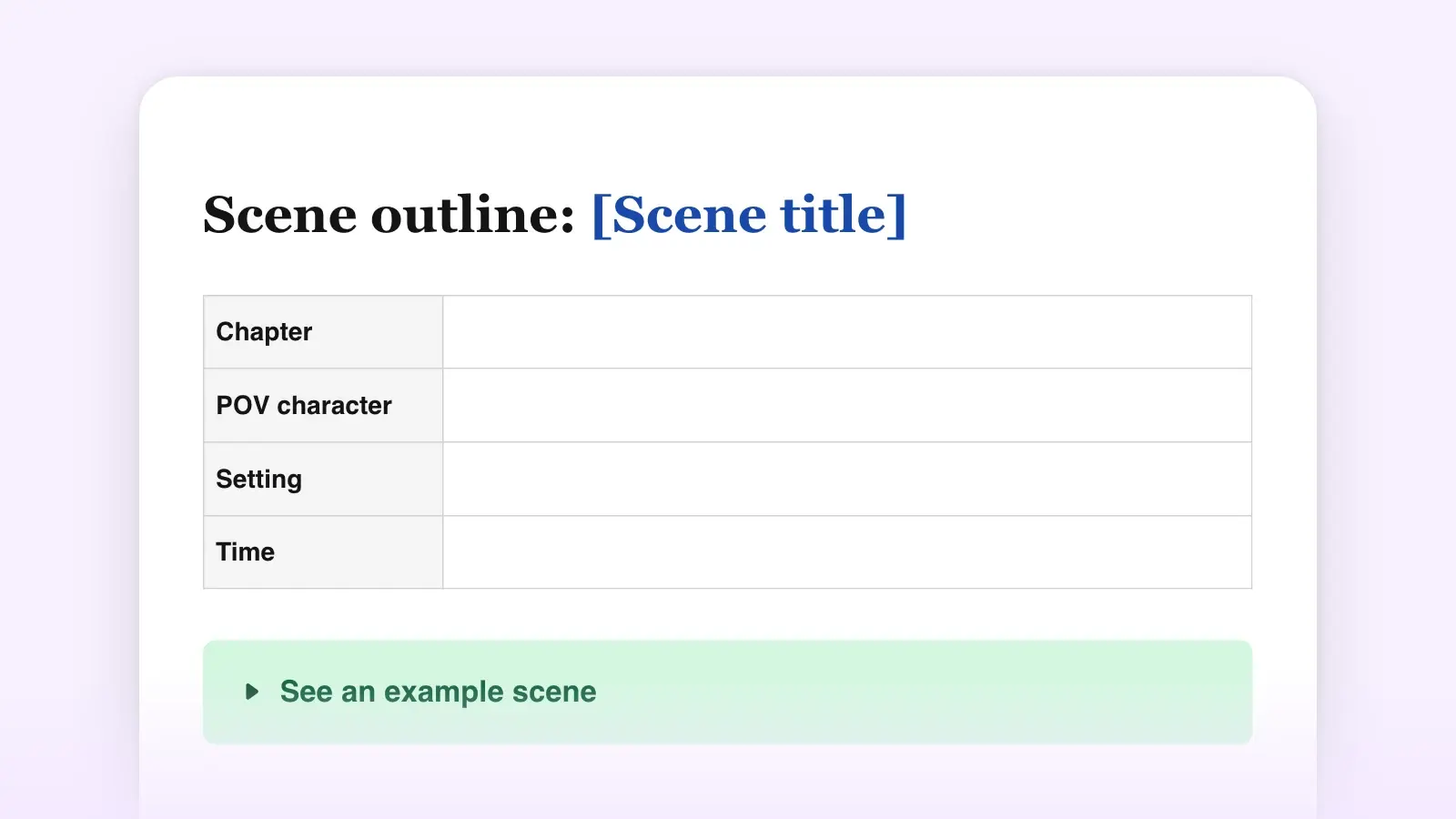
At a glance. POV: Ines. Setting: the county archive's basement reading room. Time: Thursday, 5:20 p.m., the day after the funeral.
Goal. Photograph the 1952 harbor ledger before the room locks at six. Stakes: the ledger leaves the collection on Monday, and with it the only record of who owned the boat.
Conflict. Ines has to sign a request slip for the ledger, and Marsh, the director, comes down early to lock up. Teodor, the volunteer, keeps Ines talking. The page she needs is not where the index says it is.
Turning point. She finds the stub where the page was cut out, and Teodor's box cutter open on the desk beside it.
Outcome (no, and). No photograph, and Marsh now knows Ines asked for the ledger.
Sequel. Reaction: anger at herself, then cold fear. Dilemma: tell Marsh, who may be involved; confront Teodor, her only friend in the building; or go to the police with nothing to show them. Decision: follow Teodor home tonight.
Sensory details. The radiator ticking. A vinegar smell from the film vault next door. The stub of the missing page, sharp under her thumb.
What makes a scene outline work
Most weak scenes trace back to the goal line. A goal the reader can check gives the scene a finish line. A vague one lets it wander.
Concrete goals
- Photograph the ledger before the room locks at six
- Get her sister to admit she sold the house
- Cross the border before the passport is flagged
Vague goals
- Learn more about the past
- Have a talk with her sister
- Keep traveling
- Give the opposition a goal of its own. Marsh is not an obstacle. She wants the room locked and the ledger gone. Opponents with reasons push back harder than furniture does.
- Plan the dialogue through what people want. The "Wants in this scene" column is where good dialogue starts: two characters who want different things will argue without being told to. The guide to writing dialogue covers the lines themselves.
- Pick sensory details that do a job. One exact detail per sense does more than a paragraph of description. Choose details that reveal the POV character's state of mind, which is show, don't tell applied to setting: Ines notices that the stub is sharp because she is already afraid.
Frequently asked questions
What is the difference between a scene and a chapter?
A scene is a unit of story: one continuous stretch of action in one place and time, usually from one point of view. A chapter is a unit of the book. A chapter can hold one scene or several, and a scene can be split by a chapter break when you want a cliffhanger.
Does every scene need a sequel?
Not a full one. A sequel can shrink to a single sentence, or fold into the opening lines of the next scene. What should not go missing is the decision. Without it, the next goal arrives from nowhere and the character looks pushed by the plot instead of choosing.
How detailed should a scene outline be?
Detailed enough that you can start drafting without stalling, which for most scenes is one page. The goal, the turning point and the outcome matter most. Leave the sensory table blank if you would rather discover those details on the page.
Can I use this template for a screenplay?
Yes, with two changes. Replace Setting and Time with the scene heading (interior or exterior, location, day or night). And treat the sequel as something the audience can see: on screen, a reaction and a decision have to show up in what the character does.