To write a prologue, first make sure the book needs one. A prologue earns its place when it shows something chapter one can't: an event long before the main story, a scene far away from it, or a viewpoint the book won't return to. Write it as one short scene with its own time, place and viewpoint, shorter than your typical chapter, and end it on a question the novel will answer. If chapter one works just as well without it, cut it.
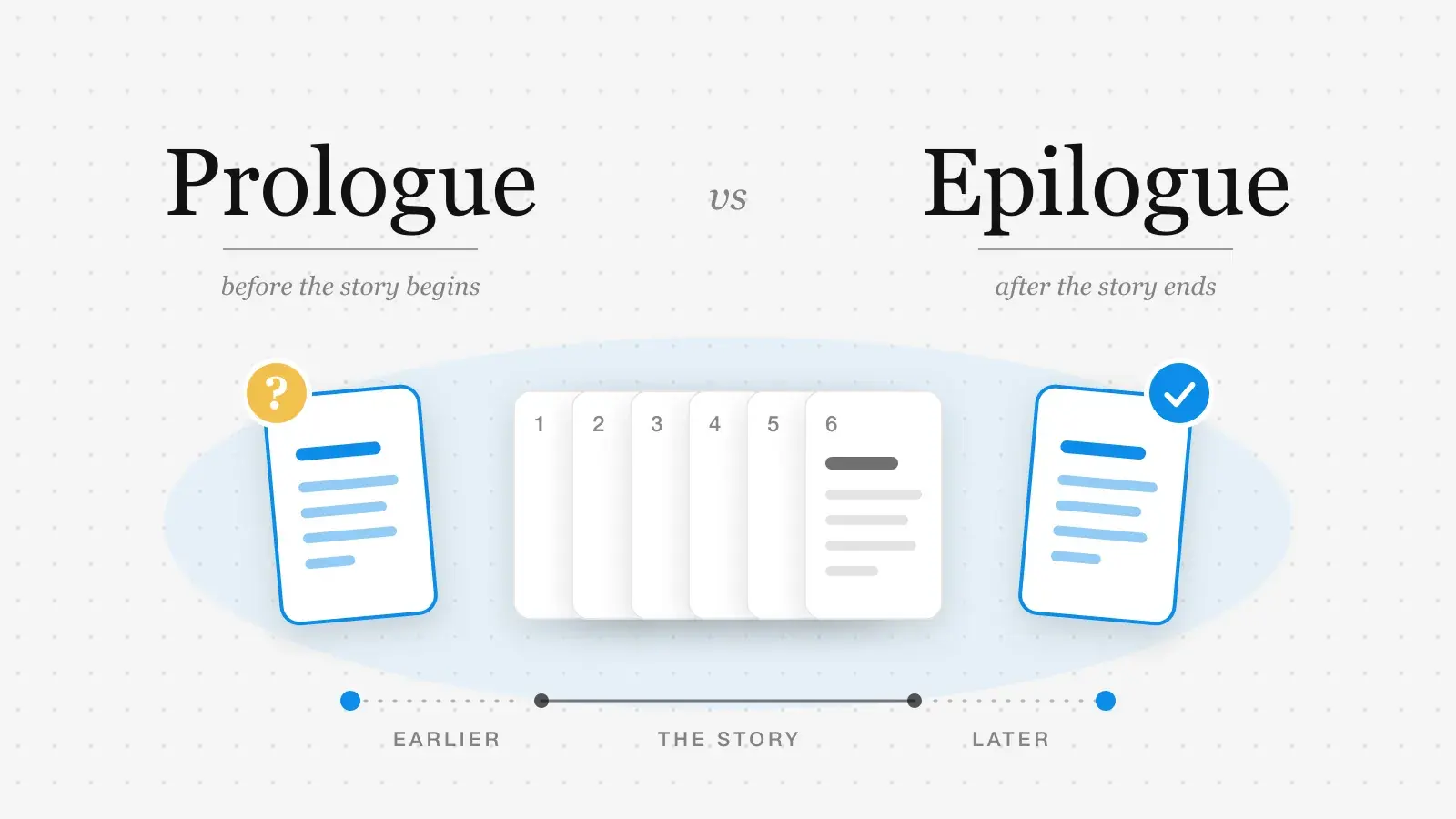
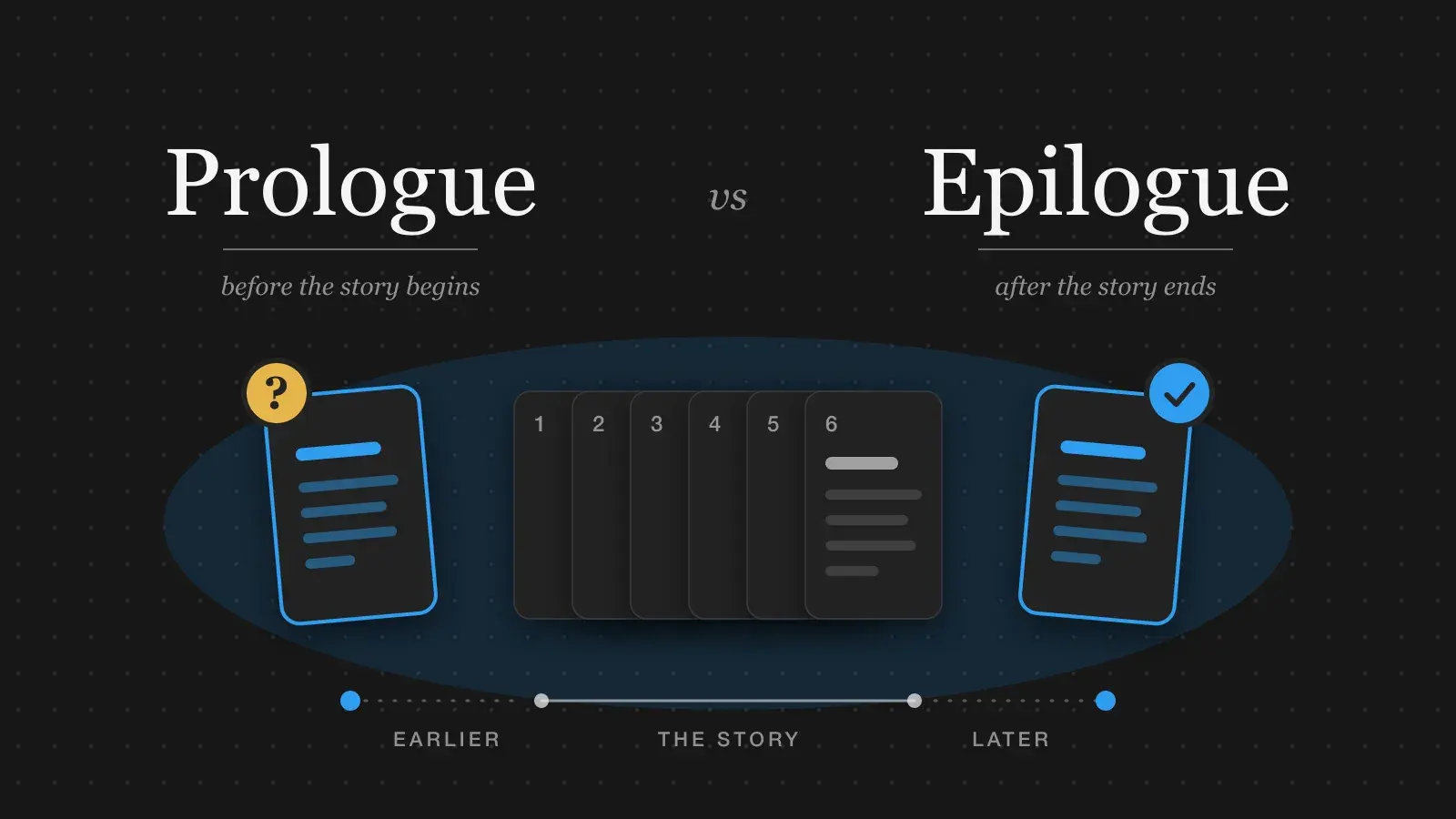
How a prologue differs from an epilogue, a preface and a foreword is covered in prologue vs epilogue. This guide is the practical side: deciding whether you need one, the six kinds that work, how to write yours, and the mistakes that send readers straight to chapter one.
Do you need a prologue?
Answer with the finished draft in front of you, not the plan. Until you know the ending, you can't know what the opening has to set up.
Keep it if
- It is set far from chapter one in time or place, and the gap matters.
- It shows an event no main character witnesses but the reader needs to know.
- It uses a viewpoint the book won't return to, such as the victim or the threat.
- Chapter one reads differently, and better, because of it.
Cut it if
- It summarizes history the story explains anyway.
- It is a scene from later in the book, lifted to make a slow opening exciting.
- Chapter one reads just as well without it.
- It only sets a mood, and chapter one already does.
There's a practical reason to be strict. Agents' sample pages usually start on the book's first page, so a prologue is the opening they judge, and many are wary of prologues that only deliver backstory. A prologue that passes the test above is a different matter: it is simply a strong opening with a heading.
Six kinds of prologue, by job
Most prologues that work do one of six jobs. Knowing which one yours does tells you how long it should be and where it should end.
1. Show a danger the characters can't see yet
A short scene, often from the viewpoint of a victim or a bystander, that shows the danger before the main characters know it exists. It's a fixture of thrillers, horror and epic fantasy. George R. R. Martin's A Game of Thrones (1996) opens beyond the Wall with a ranger whose viewpoint the book never returns to, and shows the reader the Others long before the lords in the south believe in them.
Prologue. Tallis Reservoir, March 2019. The night guard at the Tallis pumping station had worked the late shift for nine years and had never once heard the door at the bottom of the stairwell open from the inside. He heard it at 2:40. Then he heard someone start to climb.
The guard's nine years tell you the door isn't supposed to open, and the stairs do the rest. Chapter one can now start somewhere calm, because the reader knows what is coming up those stairs and the characters don't.
2. Show the event that set the story going
A scene from years or generations before the main story, showing the event that shapes it: a crime, a promise, a disappearance, a fire. The test is distance. If the event happened last month, it belongs in chapter one, or in the chapter where someone finally talks about it. The before-and-after example below is this kind.
3. Show where the story is heading
A scene from late in the story, often the crisis, shown first so the reader reads the early chapters knowing where they lead. It is the prologue form of the flash-forward that in medias res openings use. Write it so it means one thing now and another when the book catches up, and make sure the chapters between are worth reading for their own sake.
4. Introduce the teller of the tale
A narrator outside the main story sets it up: someone who tells it, finds it or reads it aloud, as in a frame story. Henry James's The Turn of the Screw (1898) opens with an unnumbered section on Christmas Eve, in which a guest named Douglas promises the company a ghost story written by his sister's governess, dead twenty years, and kept “in a locked drawer.”
The story had held us, round the fire, sufficiently breathless, but except the obvious remark that it was gruesome, as, on Christmas Eve in an old house, a strange tale should essentially be, I remember no comment uttered till somebody happened to say that it was the only case he had met in which such a visitation had fallen on a child.
The frame raises the stakes before the governess says a word: this story will be worse than the one that just held a room breathless, and it involves children. James never closes the frame. The book ends inside her account, with no one left to tell the reader what to believe.
Nathaniel Hawthorne's The Scarlet Letter (1850) opens with “The Custom-House,” labeled “introductory,” in which the narrator finds in an upstairs room of the Custom-House a piece of faded red cloth shaped like a letter, among the papers of a former surveyor, Jonathan Pue. The novel is presented as the story those papers told.
5. Let a document state the facts
A letter, a police report, a news item or a fictional foreword: something from inside the story's world, shown before the story starts. Vladimir Nabokov's Lolita (1955) opens with a foreword by a fictional editor, John Ray Jr., who reports that the author of the memoir that follows died in jail awaiting trial. A document can state facts no narrator would say plainly, and its flat official voice makes any personal detail stand out.
MISSING. Ada Lind, 16. Last seen Friday, June 12, 1987, near the Ferris wheel at the Clay County Fair. Blue windbreaker, white sneakers, one silver earring. Anyone with information, call the Clay County Sheriff's Office.
The notice gives the facts and one detail that isn't quite a fact: one earring. Chapter one can open decades later with the woman who still keeps the other one in a drawer.
6. Set the terms for the audience
The kind the word comes from, a voice before the curtain. In the theater, a speaker stepped out before the play to tell the audience what they were about to see and how to watch it. Shakespeare's Chorus in Henry V apologizes for the size of the theater (“Can this cockpit hold / The vasty fields of France?”) and recruits the audience to help:
O for a Muse of fire, that would ascend
The brightest heaven of invention
…
Piece out our imperfections with your thoughts
It is a contract with the audience: imagine the horses, let an hour stand for years, and the play will do the rest. Goethe's Faust, Part One (1808), goes further and stacks three openings: a Dedication, a Prelude at the Theatre and a Prologue in Heaven, in which the Lord gives Mephistopheles leave to tempt Faust. The rest of the play follows from that permission.
In a novel the same job falls to a narrator who addresses the reader before the story proper begins, like George Eliot's Prelude to Middlemarch. It works when the voice is the book's main pleasure and the address is short.
Writing a prologue, step by step
- Write its job in one sentence
“This prologue shows ___ so that chapter one reads as ___.” If you can't fill both blanks, the prologue doesn't have a job yet.
- Make it a scene
One place, one time, one viewpoint, happening now. History, summary and lore belong in your notes or later chapters. A prologue is the worst place in the book to tell instead of show (see show, don't tell).
- Head it clearly
Call it Prologue, and give the place and year when the gap matters, as in “Tallis Reservoir, March 2019.” The reader should never wonder whether this is chapter one. In a chapter outline, give the prologue its own row with its date and viewpoint, so the gap stays visible while you plan.
- Keep it short
Shorter than your average chapter, often only a few pages. A prologue that runs as long as a full chapter and follows the main characters is probably chapter one. The guide to chapter length gives the norms by genre.
- End on a question
The last line should open something the book will close: a disappearance, a promise, an object handed over. An explanation in the final paragraph is a quick way to waste a prologue.
- Build a bridge to chapter one
Give chapter one its own hook, then connect it to the prologue through an object, a name, a place or a phrase. Readers enjoy making the connection more than being told it. The guide to writing a first chapter covers what that hook has to do.
- Read chapter one without it
Then give chapter one to a reader who hasn't seen the prologue. If they aren't lost and don't miss anything later, the prologue is optional, and optional prologues are usually better cut.
Before you hand it over, attach chapter one and ask the Strokes Assistant what the prologue tells the reader that chapter one doesn't, and where in the book each of those facts comes up again. If every one returns by chapter three, the prologue may only be repeating the story.
A prologue, before and after
The draft below shows the event that set a story going. It does the hard part well and then gives everything away in its last sentence.
Before. By morning there was nothing left of the barn but the stone footings and her husband's pocket watch, still ticking in the ash. Eliza Harlan never told anyone what she had seen in the hayloft before the fire took it, and so began the feud between the Harlans and the Pruitts, a feud that would last forty years and cost both families everything.
After. By morning there was nothing left of the barn but the stone footings and her husband's pocket watch, still ticking in the ash. Eliza wound it, put it in her apron and walked the baby across the frozen field to the Pruitt place. When Ada Pruitt opened the door, Eliza held out the watch. “You'll want to keep this,” she said.
The first version ends by telling the reader what the prologue means and what the book is about, which leaves chapter one nothing to reveal. The second ends on an act nobody explains: why would a widow give her husband's watch to the neighbors? Chapter one, forty years later, can open with a Pruitt grandson who still winds it every night.
Could chapter one raise that question on its own? Only half of it. A Pruitt grandson winding a Harlan watch makes a reader curious, but not about a fire that nobody in the main story saw, or about the widow who walked across the field. That gap in time, and an event no main character witnessed, are two of the reasons to keep a prologue in the test at the top of this page, and they're why this one earns its place.
Common prologue mistakes
- The history lecture. Centuries of kingdoms, wars and treaties before anyone appears. Put a person in a scene, and let the history leak out through what they fear.
- The preview. A dramatic scene lifted from chapter twenty, then “Eight months earlier.” It can work, but it often tells the reader the early chapters are only a wait.
- The wrong genre. A horror prologue on a family drama, or a battle on a quiet literary novel. The prologue is a promise, and readers hold you to it.
- The faceless killer. An unnamed “he” watching a victim, in italics. It has been done often enough that it needs something fresh to work.
- Two openings. A prologue that hooks, followed by a chapter one that starts slowly from scratch, so the reader has to be won twice.
- The stack. A foreword, an introduction and a prologue before chapter one. Goethe could put three openings in front of Faust. A debut novel can't afford one that isn't working.
- Chapter one in disguise. Same time, same viewpoint character, same story line. If it doesn't stand apart, call it chapter one.
Frequently asked questions
What is a prologue in a book?
A prologue is a short opening section before chapter one, set apart from the main story by time, place or point of view. It might show an event years earlier, a threat the characters don't know about yet, or a narrator setting up the tale. Unlike a preface or foreword, it is part of the story, not commentary on the book.
Do literary agents dislike prologues?
Many are wary of prologues that only deliver backstory, because sample pages usually start on page one and a weak prologue is a weak opening. A prologue with its own tension, a clear reason to exist and a strong chapter one behind it is a different matter. Check each agent's guidelines, since a few ask you to start at chapter one.
What is the difference between a prologue and chapter one?
Chapter one starts the main story in its main time, usually with the protagonist. A prologue stands outside that line: it is set earlier or later, somewhere else, or with a viewpoint the book won't use again. If a section shares chapter one's time and viewpoint, it isn't really a prologue, whatever its heading says.
Can a prologue be from the villain's point of view?
Yes, and it's a common choice in thrillers, horror and fantasy, because it shows the reader a danger the heroes can't see yet. Keep the scene short, give the villain a specific goal in it rather than vague menace, and don't reveal so much that the main story has nothing left to uncover.