To write a picture book, write a story short enough to read aloud in a few minutes and shape it for the 32 pages most picture books have: about 12 to 15 two-page spreads, each with a picture and a few lines of text. Current advice from editors puts fiction texts under about 600 words. Leave what things look like to the illustrator, end each spread where turning the page adds a surprise, and read every draft out loud. If you don't illustrate, you don't need an illustrator to submit: send the text alone, and a traditional publisher picks the artist.
Picture book format and word count
Most picture books run 32 pages, and the reason is paper. Printers fold printed sheets into signatures, and the children's book editor behind the Editorial Anonymous blog explains in a 2008 post that a signature holds 16 pages and splitting one costs extra: “So most picture books have 32 pages.” Page counts move in multiples of eight, as Laura Belgrave notes on Harold Underdown's site The Purple Crayon, so 24- and 48-page books exist too.
Endpapers, the title page, copyright and dedication take their share of the 32, depending on whether the endpapers are part of the pages (a self-ended book) or added by the printer:
| Self-ended book | Separate endpapers | |
|---|---|---|
| Endpapers | Self-ended bookPages 1–3 and 30–32 | Separate endpapersAdded by the printer, outside the 32 |
| Title, copyright, dedication | Self-ended bookSpread 4–5 | Separate endpapersPages 1–3 |
| Left for the story | Self-ended book12 spreads, pages 6–29 | Separate endpapersUp to 15 spreads |
Designers paginate the book, but a story that can't be split into a dozen different pictures probably isn't a picture book yet. For other ages, see how to write a children's book.
How many words is a picture book?
Fewer than most first drafts. In 2008 Underdown's guide to children's publishing described picture books from a few hundred words up to 2,000. Current advice for fiction clusters under 600, and the Good Story Company blog sees a trend toward “shorter and shorter manuscripts, targeting younger readers.”
| Book | Suggested length | Source |
|---|---|---|
| BookBoard book | Suggested length100 words at most | SourceMary Kole, Kidlit.com (2009); the same in her current guide |
| BookEarly picture book, for younger listeners | Suggested length400 at most | SourceMary Kole, Kidlit.com (2009) |
| BookFiction picture book | Suggested length600 at most (“Seriously. Max.”) | SourceMary Kole, Kidlit.com (2009); the same in her current guide |
| BookNonfiction picture book | Suggested lengthCloser to 1,000–2,000; 3,000 at most | SourceMary Kole, Kidlit.com (2009) |
| BookNonfiction picture book, later advice | Suggested lengthUp to about 1,200 or 1,500 | SourceMary Kole, Good Story Company blog |
Underdown quotes the author Jane Yolen on what the numbers can't tell you: “A book should be as long as it needs to be, not some arbitrary length.”
Write for the page turn
Whatever waits after a page turn arrives as a reveal, so strong picture book texts often end a spread on a question or an unfinished action and let the next one answer it. Beatrix Potter was doing it in 1902. The Tale of Peter Rabbit comes in short blocks of text, one for each picture. These are blocks six to ten:
- Flopsy, Mopsy, and Cotton-tail, who were good little bunnies, went down the lane to gather blackberries:
- But Peter, who was very naughty, ran straight away to Mr. McGregor's garden, and squeezed under the gate!
- First he ate some lettuces and some French beans; and then he ate some radishes;
- And then, feeling rather sick, he went to look for some parsley.
- But round the end of a cucumber frame, whom should he meet but Mr. McGregor!
| Block | Where it stops | What comes after the turn |
|---|---|---|
| Block6 | Where it stopsOn a colon, as the good bunnies set off | What comes after the turn“But Peter”: the one who goes the other way |
| Block7 | Where it stopsPeter squeezing under the gate | What comes after the turnThe garden, and the feast |
| Block8 | Where it stopsOn a semicolon, mid-feast | What comes after the turnThe stomachache |
| Block9 | Where it stopsPeter going to look for parsley | What comes after the turnMr. McGregor, saved for the last words |
| Block10 | Where it stops“Mr. McGregor!” | What comes after the turnThe chase: he jumps up waving a rake and calling out “Stop thief!” |
Each block stops with something unfinished. Twice in five pictures the sentence itself runs across the turn, on a colon and then a semicolon, so the listener turns the page to hear the end of it. Elsewhere Potter stops on an action under way, and in block ten she holds Mr. McGregor back to the last two words, so the sentence lands on him. Other ways to build a turn:
- The question. “Who ate the last strawberry?” The culprit, sticky-faced, after the turn.
- The rule of three. Two tries that fail the same way, then a third that breaks the pattern.
- The quiet before the loud. A spread of tiptoeing makes the crash on the next one louder.
- The changed refrain. On the last spread, the refrain with one word different.
Nine steps from idea to submission
- Read recent picture books aloud
Start with a stack from the library published in the last five years, and keep reading while you draft. Type out the text of two or three you love to see how little is there.
- Find a child-sized problem
A wobbly tooth, a lost bus pass, a sister who always gets the window seat: small to an adult, enormous to a five-year-old.
- Let the character solve it
Grown-ups can help or get in the way, but the choice that fixes things belongs to the hero.
- Draft it whole, then cut
Write it in one sitting, then cut toward half: explanations, adjectives the art will show, feelings the character announces.
- Split it into spreads
Twelve to fifteen chunks, each with a picture unlike the one before: a new place, a new moment or a change in the character. A table helps: spread number, text, any art note, and what the turn reveals.
- Write for the page turn
End spreads on a question or an unfinished action, and answer it after the turn.
- Read it aloud
To yourself, to an adult who hasn't seen it, to a child if you can. Mark every stumble.
- Make a dummy
Turn real pages to find the spreads that run long and the turns that fall flat.
- Submit the text alone
A clean manuscript and a short query to agents or open publishers. The publisher chooses the illustrator.
Write for the ear
Picture books are read aloud, often for the fortieth time, so a text has to work in an adult's mouth as well as on the page. Refrains are the classic tool. In Millions of Cats, an old man goes looking for one cat and finds rather more:
He walked a long, long time and at last he came to a hill which was quite covered with cats.
Cats here, cats there,
Cats and kittens everywhere,
Hundreds of cats,
Thousands of cats,
Millions and billions and trillions of cats.
The last line is the longest, and its numbers climb as fast as a child can say them. The refrain returns as the story goes on, so a child who can't read yet can join in.
Rhyme is where many texts go wrong: the story bends to reach the rhyme, or a line stumbles when a parent reads it cold. If you rhyme, keep the story first and scan every line (the guide to meter in poetry shows how). Prose with rhythm, a refrain and deliberate repetition gives you most of the music with less risk.
Leave room for the pictures
Harold Underdown describes true picture books as told at least as much by the pictures as by the words, and the American Library Association's Caldecott Medal, awarded since 1938, goes to the artist of “the most distinguished American picture book for children.” So the text says what a picture can't: speech, sound, time, wants and secrets. Compare:
Before. Maya put on her yellow raincoat with the ducks on it and her red boots, and she ran out into the big gray puddle at the bottom of the garden, and the water splashed all over her and all over the dog, who was brown and very fluffy.
After. Maya found the biggest puddle in the world. “Stay, Biscuit,” she said. Biscuit did not stay.
What the picture can carry. The yellow raincoat with ducks, the red boots, the gray puddle at the bottom of the garden, the brown and very fluffy dog, and the splash itself, which the illustrator can save for the spread after “Biscuit did not stay.”
Every detail cut from the first version is something an illustrator can draw. What the text keeps is what a picture can't say on its own: a name, a command, and a joke whose punch line is drawn. When words and picture disagree on purpose, the child is in on a joke the narrator misses, and that kind of planned contradiction is one of the few places an art note earns its line.
If the manuscript is in Strokes, you can ask the Strokes Assistant about any spread: which of its words describe what the illustrator will draw anyway.
Art notes: when and how
An art note is a one-line instruction to the illustrator inside the manuscript. Underdown writes that publishers generally don't expect or need them, and Kole's rule of thumb is that “the average picture book text will only need one or two, tops.” Use one only when the text makes no sense without it: the picture contradicts the words, a spread has no words, or a clue is visible but never named. Formats vary (Kole suggests parentheses and italics, starting with “Illo:”), so pick one and keep it.
Notes that earn their line
- [Art note: Wordless spread. The dog is under the table, eating the birthday cake.]
- [Art note: We see the fox behind the hedge. Hen does not.]
Notes that direct the art
- [Art note: Maya is six, with two curly puffs of black hair and a yellow duck raincoat.]
- [Art note: Close-up from a low angle, morning light, the kitchen painted blue.]
Make a picture book dummy
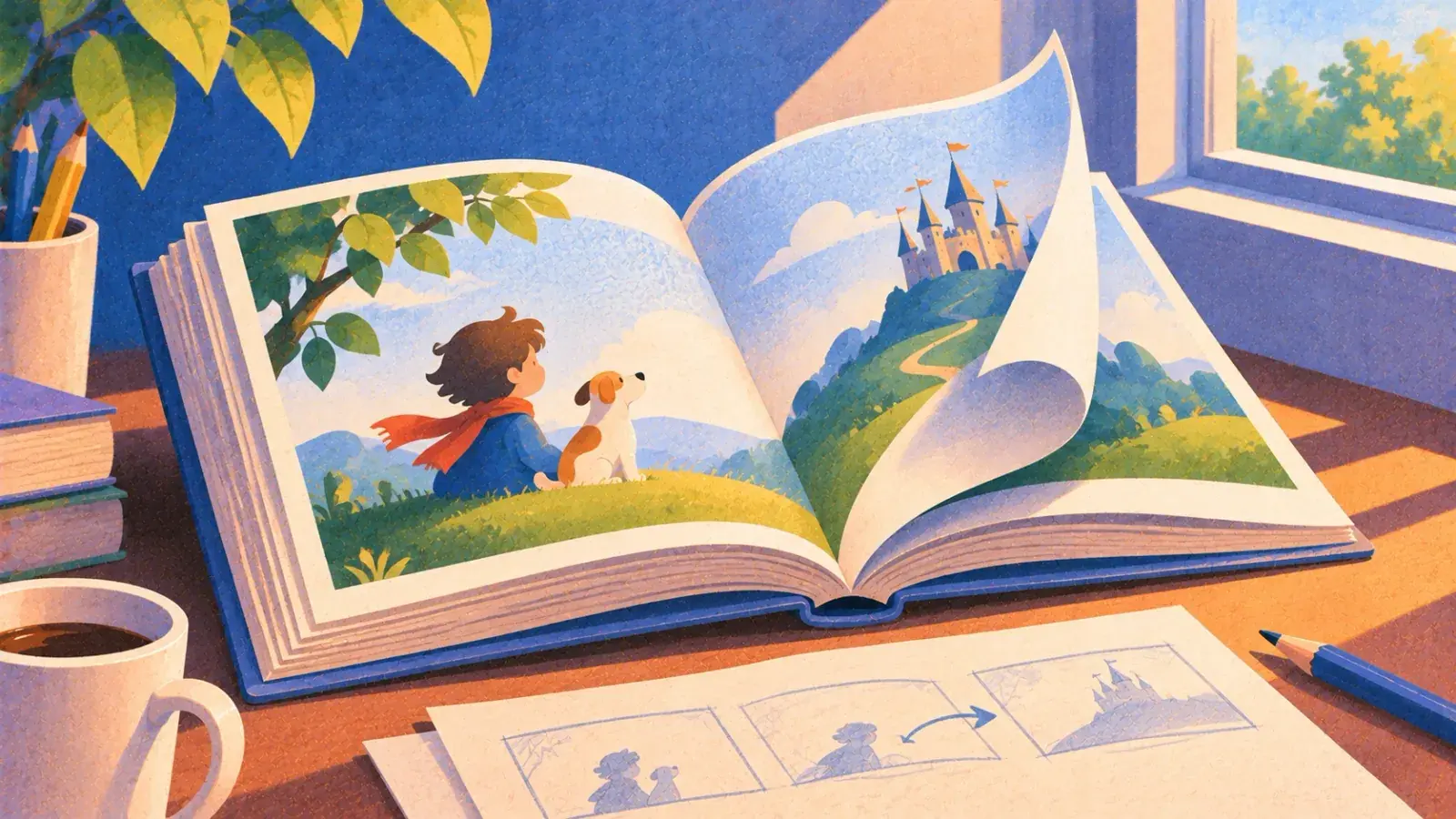
A dummy is a mock-up of the book with your text where it would fall. Author-illustrators send polished ones with sample art. If you write only the words, yours is a test. Fold eight sheets of letter paper in half and staple them at the fold: eight sheets, two leaves each, two sides to a leaf, 32 pages. Mark the title and copyright pages, write each chunk of text on its spread and sketch stick figures. Then read it aloud as a book, and note every spread where you wanted to rush and every turn that gave you nothing.
A picture book manuscript example
A complete text of about 230 words, not counting the art note, for the 12 story spreads of a self-ended book. Many writers mark spreads with a blank line instead of numbers.
THE FIRST SNOW IS MINE
by Rosa Delgado · 230 words
Spread 1. All night the snow fell on Ash Street. Ollie pressed his nose to the window. Not one footprint in the courtyard. Not one. “Tomorrow,” said Ollie, “the snow is mine.”
Spread 2. In the morning he pulled on his boots. He pulled on his hat. He pulled on his mittens, the wrong way around and then the right way around. He opened the door and…
Spread 3. Somebody had been there first. Little prints, in a little line, all the way to the bakery door. “Mrs. Pagano's cat,” said Ollie.
Spread 4. All day, more snow. “Tomorrow,” said Ollie, “the snow is mine.” He set his alarm clock. He went to bed in his boots.
Spread 5. When the alarm rang, the sky was still dark. He opened the door and…
Spread 6. Somebody had been there first. Big flat boots and two long lines. “Mr. Dowd and his newspaper sled,” said Ollie.
Spread 7. That night Ollie didn't go to bed at all. He sat by the door in his hat and his boots and his mittens, and he waited. And waited.
Spread 8. Somebody else was awake. “Is it snowing?” whispered June. June was three. She had never been first at anything.
Spread 9. In the gray light Ollie looked at the courtyard. Smooth and white. Not one footprint. Not one. He looked at June.
Spread 10. He opened the door. “You go,” said Ollie.
Spread 11. [Art note: Wordless spread. June's small boot prints loop and zigzag across the whole courtyard. Ollie watches from the step.]
Spread 12. That night it snowed again. “Tomorrow,” said June, “the snow is ours.”
Twice Ollie opens the door to find he has been beaten, and twice the reveal waits behind a page turn. The third time he breaks the pattern himself. The text never says how he feels giving the snow away; the art and the listener supply it. One art note covers the one wordless spread, and the refrain ends on “ours” instead of “mine,” which is the whole story in a word.
Submitting without an illustrator
Harold Underdown answers the most common question directly: “No, the publisher selects the illustrator.” That happens after the publisher offers a contract, and the illustrator, he adds, typically receives half of the royalties. If neither of you is published, he warns, teaming up with an illustrator before you submit will reduce “the already slim chance that a publisher will be interested.”
Send the complete manuscript, double-spaced, with your name, contact details, title and word count at the top. Charlesbridge's submissions page, for one, asks for the complete manuscript and says illustrations are not necessary. On page breaks, Belgrave advises leaving them out and Kole suggests white space or a marker such as “(Page 1).” Add a short query; see how to write a query letter and the query letter template.
Underdown, in an article last updated in 2025, writes that writers for children now generally need an agent, and that most houses say they consider manuscripts only from agents or published authors. Some smaller publishers still read unagented work, but windows open and close: as of November 2026, Charlesbridge's page says its open children's submissions program is paused. Check each publisher's current page, and see how to get a literary agent. SCBWI, the Society of Children's Book Writers and Illustrators, runs regional chapters and critique groups where you can find a critique partner who knows the form. If you self-publish, you hire the illustrator yourself; for a flat fee, the work-for-hire agreement template covers who owns the art.
Common picture book mistakes
- Too many words. A fiction text over 1,000 words is well past current advice, which puts the ceiling near 600.
- Describing the pictures. Colors, clothes and faces belong to the illustrator.
- A grown-up saves the day. A rescue by a parent takes the story away from the child it belongs to.
- A lesson at the end. “And so Benny learned that sharing is caring” tells the child what to think.
- Every spread the same. One room can work if something changes in each picture. Twelve near-identical kitchen conversations give the illustrator one picture to draw twelve times.
- Writing for the adults. Nostalgia and jokes only parents catch.
Frequently asked questions
What if I illustrate my own picture book?
Then you submit differently. Author-illustrators usually send a dummy of the whole book with a few finished pieces of art rather than the text alone, so check each agent's or publisher's guidelines for the format they want. If you only write, don't hire an artist to strengthen the submission: in traditional publishing the publisher chooses the illustrator, and you need your own only if you self-publish.
Should a picture book rhyme?
It can, if the rhyme and meter hold up when someone else reads the text aloud cold and the story would stand without them. Forced rhymes and stumbling lines are easy to hear when a parent reads aloud. Prose with rhythm, repetition and a refrain gives you most of the music with less risk.
How do you format a picture book manuscript?
Double-spaced text in a plain font, with your name, contact details, title and word count on the first page. Page breaks are optional: Mary Kole shows them with white space or a marker such as (Page 1), while Harold Underdown and Laura Belgrave advise leaving them out, so follow the guidelines you are sending to. Keep art notes short and few.