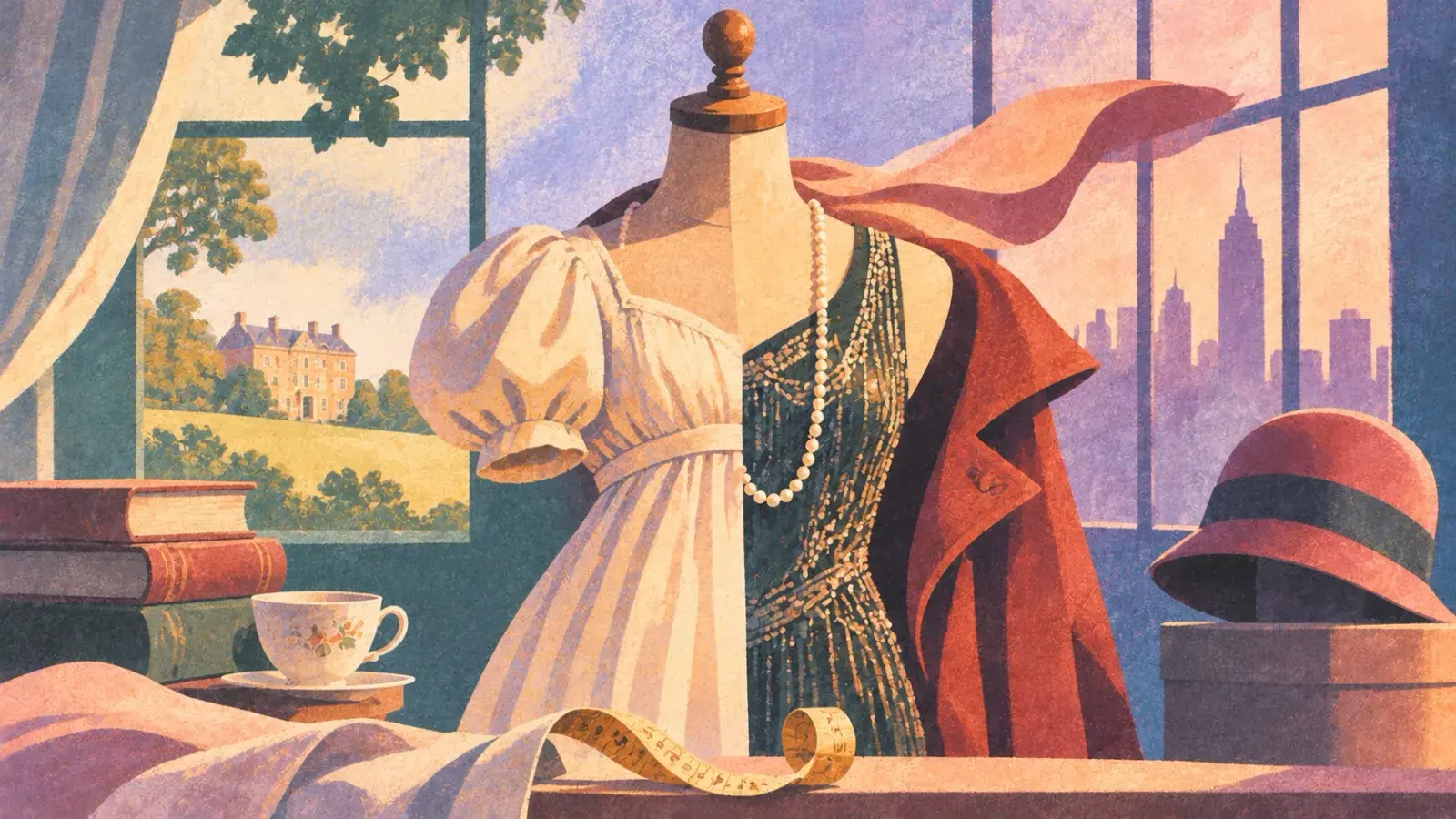
To describe an outfit in writing, choose the one or two details that tell the reader something they need to know, such as the wearer's money, era, mood or opinion of themselves, and name those details exactly. A frayed cuff, a borrowed coat or a dress that's wrong for the occasion does more than a list from hat to shoes. Let the viewpoint character notice the clothes for a reason, and the description will tell the reader about the person looking as well as the person dressed.
What clothes tell the reader
Clothes are evidence. They are chosen, paid for, borrowed, mended or ruined, and each of those verbs is a piece of character. A description can point the reader at six kinds of information:
| What clothes reveal | Look at | On the page |
|---|---|---|
| What clothes revealMoney and class | Look atFabric, fit, wear, what's new and what's mended | On the pageMuslin at five shillings a yard |
| What clothes revealEra and place | Look atCut, fastenings, the names of things | On the pageA tucker, a mantle, a girdle with a clasp |
| What clothes revealPersonality and self-image | Look atWhat they chose when they had a choice | On the pageThe one red ribbon among white dresses |
| What clothes revealMood and occasion | Look atThe gap between the clothes and the event | On the pageBlack satin at a coming-out ball |
| What clothes revealSecrets and evidence | Look atStains, mismatches, haste, wear in odd places | On the pageBoots that don't match |
| What clothes revealThe observer | Look atWhat the viewpoint character notices first | On the pageMud on a petticoat, or no mud at all |
The last row matters most. A description of clothes always belongs to someone. Austen never tells the reader what Elizabeth Bennet wore on her walk to Netherfield. She lets the people who saw her do it.
Elizabeth arrives “with weary ancles, dirty stockings, and a face glowing with the warmth of exercise.”
That evening Mrs. Hurst hopes everyone saw “her petticoat, six inches deep in mud” and “the gown which had been let down to hide it not doing its office.”
“Your picture may be very exact, Louisa,” said Bingley; “but this was all lost upon me.” And: “Her dirty petticoat quite escaped my notice.”
Austen spends the description on the people looking. Mrs. Hurst sees mud and bad manners, Bingley sees only Elizabeth, and the reader learns about all three from one hem. (“Ancles” is Austen's spelling.)
Clothes say even more in a world with rules about them. Edith Wharton's The Age of Innocence (1920) opens “on a January evening of the early seventies” at the New York opera, where the Countess Olenska appears in a dress the Archer family will later pick apart at dinner.
The narrator: a “dark blue velvet gown rather theatrically caught up under her bosom” by “a girdle with a large old-fashioned clasp.”
Newland Archer's sister Janey: “At the Opera I know she had on dark blue velvet, perfectly plain and flat—like a night-gown.”
His mother: “What can you expect of a girl who was allowed to wear black satin at her coming-out ball?”
The dress never changes; the observers do, and each gives something away. The narrator, seeing with old New York's eye, notices the cut and the clasp, and the words “theatrically” and “old-fashioned” show a society that reads any departure from its fashions as a statement. Janey, wondering aloud whether the Countess wears a round hat or a bonnet in the afternoon, fixes on how plain the velvet was: her curiosity, and her disapproval, are about what's proper to wear when. Mrs. Archer skips the dress entirely, reaches back to black satin at a coming-out ball and blames the upbringing; to her, clothes are evidence about a family. Fitzgerald gets the same effect in one line, when Tom Buchanan dismisses Gatsby's claim to be an Oxford man: “Like hell he is! He wears a pink suit.”
How to describe an outfit
- Decide what the clothes need to say
Give each description one job: money, era, mood, self-image or a clue. A first appearance usually needs class and self-image; a crime scene needs evidence.
- Choose who is looking
A tailor notices the seams, a teenager notices whether it's embarrassing, a detective notices the wear on the left cuff. Describe what the viewpoint character would notice, in their words, and skip what they couldn't see: a woman can't watch her own hem drag behind her (more in the guide to point of view).
- Find the telling detail
Look for what's off: new, worn, borrowed, mended, mismatched or wrong for the occasion. Sherlock Holmes makes it a method in “A Case of Identity” (1891): “Never trust to general impressions, my boy, but concentrate yourself upon details. My first glance is always at a woman’s sleeve. In a man it is perhaps better first to take the knee of the trouser.” His client's boots turn out to be “odd ones; the one having a slightly decorated toe-cap, and the other a plain one.” Mismatched boots are a question the reader wants answered.
- Name it exactly
Not a dress but a gray wool shift. Not a jacket but a waxed field coat with a torn pocket. The next section has words to start with, and the descriptive words list has more for texture and color.
- Let the wardrobe change with the story
When clothes change, give the change a reason. Engaged to Rochester, Jane Eyre watches him choose “a rich silk of the most brilliant amethyst dye, and a superb pink satin,” and talks him down: “With infinite difficulty, for he was stubborn as a stone, I persuaded him to make an exchange in favour of a sober black satin and pearl-grey silk” (Charlotte Brontë, Jane Eyre, 1847, Chapter 24). The argument over two dresses is an argument over who she'll be in the marriage.
- Cut what doesn't earn its place
Delete every garment that tells the reader nothing new. One detail per character per scene is usually enough; two if they pull against each other.
Fabric, fit and color words
Precise words do the describing, so you need fewer of them. Fabric tells the reader about money and season, fit tells them who made the clothes and for whom, and condition tells them what has happened since.
Fabrics in motion
A fabric is most vivid when it does something: creases, crushes, slides off a shoulder, fades where it's worn.
| Fabric | In motion, or by the end of the day | What it can suggest |
|---|---|---|
| FabricTweed | In motion, or by the end of the dayKeeps its shape when he slumps; steams by the fire after rain | What it can suggestCountry weekends, the lecture hall, old money or a wish to look like it |
| FabricLinen | In motion, or by the end of the dayCreased at the elbows and lap by noon | What it can suggestHeat, leisure, money that doesn't mind wrinkles |
| FabricMuslin | In motion, or by the end of the dayLifts at the slightest breeze; tears on a bramble | What it can suggestRegency gowns and summer; in Austen, a topic of conversation |
| FabricSatin | In motion, or by the end of the daySlides off a shoulder; shows every crease and water mark | What it can suggestEvening and glamour, or an effort to look expensive |
| FabricVelvet | In motion, or by the end of the dayCrushes where she sat; darkens where it's rubbed | What it can suggestWeight, winter, the theater, a touch of the old-fashioned |
| FabricDenim | In motion, or by the end of the daySoftens and fades at the knees and pockets | What it can suggestWork and youth; the fading shows how it was worn |
| FabricLeather | In motion, or by the end of the dayCreaks when new; takes the wearer's shape over years | What it can suggestToughness, or a good bag carried for thirty years |
Fit and condition
These words describe a garment's history, which is often more interesting than the garment.
| Word | In a sentence |
|---|---|
| WordTailored | In a sentenceA suit tailored for the man he was twenty pounds ago |
| WordOff the rack | In a sentenceAn off-the-rack tuxedo, the trousers an inch short |
| WordHand-me-down | In a sentenceHer brother's hand-me-down parka, his name inked inside the collar |
| WordLet out | In a sentenceA wedding dress let out twice by her mother |
| WordPressed | In a sentenceJeans pressed with a crease down the front |
| WordThreadbare | In a sentenceCorduroy worn threadbare at the knees of a man who gardens |
| WordShiny at the elbows | In a sentenceA good suit, a few years past good |
| WordTags still on | In a sentenceA dress with the tag tucked into the sleeve, going back on Monday |
Color that means something
Color is the first thing writers reach for and the least informative on its own. Make it specific (oxblood, camel, bottle green, dove gray, ecru, mustard) or make it mean something. Thomas Hardy does both in Chapter 2 of Tess of the d'Urbervilles (1891). The women walking with the village club “were all dressed in white gowns,” yet “no two whites were alike among them”: “some had a bluish pallor,” and others “inclined to a cadaverous tint.” Then Tess: “She wore a red ribbon in her hair, and was the only one of the white company who could boast of such a pronounced adornment.” One ribbon picks her out of the crowd.
Put clothes in motion
A garment on a hanger is a catalog entry. On a moving body it's a scene. Fitzgerald introduces Daisy Buchanan and Jordan Baker almost entirely through what the air does to their dresses.
The only completely stationary object in the room was an enormous couch on which two young women were buoyed up as though upon an anchored balloon. They were both in white, and their dresses were rippling and fluttering as if they had just been blown back in after a short flight around the house.
Only the color and the movement are described, and it's enough: the women seem weightless, idle and a little unreal. Movement doesn't have to mean wind:
- Weather. Wet wool that smells like a dog, a coat held shut at the throat.
- The body. A shirt that won't stay tucked, heels taken off at midnight and carried.
- Hands. A cuff picked at in a meeting. As a beat in dialogue, a gesture with clothes can carry what the character won't say; the mannerisms list has more.
- Other people. A jacket put around someone's shoulders, a tie straightened by a mother.
Clothes can carry a whole emotional scene. In Chapter 5, Gatsby shows Daisy his wardrobe:
He took out a pile of shirts and began throwing them, one by one, before us, shirts of sheer linen and thick silk and fine flannel, which lost their folds as they fell…
“They're such beautiful shirts,” she sobbed, her voice muffled in the thick folds. “It makes me sad because I've never seen such—such beautiful shirts before.”
Daisy isn't crying about shirts. The pile stands in for the money and the years it took Gatsby to make it, and the falling folds give the reader something physical to hold while the feeling arrives.
Research clothing for another era
Period clothing goes wrong in two ways: the garment didn't exist yet, or it existed and meant something else. Five habits help:
- Read what people wrote at the time. Novels, letters and diaries mention prices and rules that costume books skip. In Northanger Abbey (1817), Henry Tilney charms a chaperone with his muslin: “I gave but five shillings a yard for it, and a true Indian muslin.” Austen adds, “Mrs. Allen was quite struck by his genius.”
- Look at the garments themselves. Many costume museums put their collections online, with dates and close-ups of linings, fastenings and wear. Photographs of ordinary people show what fashion plates leave out.
- Check fastenings and fibers. The zipper is the classic trap: Gideon Sundback's patent was issued in 1917, the name comes from B. F. Goodrich's “Zipper Boot,” a rubber boot trademarked in 1923, and zippers didn't beat buttons on men's trouser flies until 1937.
- Use the words like a native, once you've checked them. Wharton writes tucker, mantle and girdle without explanation, because her characters wouldn't need one, and a gloss for the modern reader turns into an info dump. But words move. Merriam-Webster gives girdle two senses, an article of dress worn around the waist and a close-fitting undergarment; Wharton's, with its “large old-fashioned clasp,” is the first, and a modern reader may picture the second. Check tucker, mantle and any other garment name against the decade before you borrow it.
- Find the rules. Every period has them, and characters know when they're broken.
Miss Sophy Jackson remembers the old ways: “Amy Sillerton has always told me that in Boston the rule was to put away one's Paris dresses for two years.” Mrs. Baxter Pennilow, she adds, “used to import twelve a year, two velvet, two satin, two silk, and the other six of poplin and the finest cashmere,” and in the end “they found forty-eight Worth dresses that had never been taken out of tissue paper.”
Wharton wrote this in 1920 about the 1870s. The speech does a costume historian's work, from fabrics to the Paris house to the rule about not wearing them too soon, and tells you about Miss Jackson, who has kept count.
For a period detail, ask the Strokes Assistant to look it up, such as what a clerk in 1890s Chicago wore to work; it browses the web and answers beside your draft. Check anything you'll rely on against a museum collection or a period source.
Examples of clothing description
Each example below does one job. The first three are original, written for this guide. The last is Hawthorne's.
Marguerite's good black coat still had the dry cleaner's paper tag stapled inside the collar. The date on it was from her brother's funeral, four years ago.
One tag says she owns one good coat and how long it has been since the last funeral. Nothing about grief is said.
Danny's new suit was charcoal, and it fit him, which was how Ruth knew it hadn't come from the mall. Mall suits were always an inch long in the sleeve, so he could grow into them. This one was cut for the man he was now, and somebody else had paid for it.
The description is really about Ruth: her budget, her memory of the boy and her worry about whoever paid. The fit does the telling.
Chapter 1. Nell's raincoat was yellow, the kind sold for children, and she wore it to every hearing so the judge would remember her.
Chapter 22. She found the yellow coat at the back of the closet, the hood still creased where she'd folded it the day of the verdict, and gave it to the girl from the shelter, who was nine and asked if it was hers to keep.
One garment tracks the change. The coat becomes a symbol without the narration calling it one, which is show, don't tell on the scale of a whole book.
On the breast of her gown, in fine red cloth, surrounded with an elaborate embroidery and fantastic flourishes of gold-thread, appeared the letter A.
A woman in the crowd: “She hath good skill at her needle, that’s certain.”
The letter was meant as a punishment. Hester's embroidery turns it into her own work, and the grudging compliment shows the town noticing.
Mistakes when describing clothes
The narrator of Northanger Abbey has the last word on overdoing it: “Dress is at all times a frivolous distinction, and excessive solicitude about it often destroys its own aim.” The same goes for describing it.
- The catalog. Hat, coat, shirt, trousers, shoes, bag, top to bottom. Readers skim inventories, because nothing in one says what matters.
- Labels instead of details. A brand name speaks only to readers who know the brand, and it dates a book. Use one when the character would say it, with the detail that shows why it matters.
- The mirror scene. A character studies her reflection so the author can list her outfit. Many readers know the device. Let someone else notice instead.
- Catalog voice. “A stunning emerald gown that hugged her curves” is product copy, a short step from purple prose. Use the words your viewpoint character would use.
- Clothes that never change. A hero in the same jacket for three days should look and smell like it. Mud, rain and creases stay until someone deals with them.
- Costume shorthand. Clothes are an individual's choice, not a uniform for a group. When they come from a character's faith, culture or job, describe this person's version: the scarf pinned her own way, the uniform with the sleeves rolled.
Before. She wore a fitted navy blazer over a cream silk blouse, slim black trousers, black patent heels and small gold hoops. Her brown leather handbag matched her belt.
After. She had matched her belt to her handbag, which told Priya everything about how the interview was going to go.
The revision keeps one detail and gives it to the viewpoint character, who draws a conclusion. The reader learns about two people instead of one outfit.
Frequently asked questions
How do you describe clothes without listing them?
Choose the one garment or detail that is new, worn, borrowed, mismatched or wrong for the occasion, and drop the rest. Put it in a sentence where something happens: the coat gets wet, the tie gets loosened, someone comments on the shoes. Readers fill in a whole outfit from one good detail.
What are good words to describe clothing?
Fabric words (tweed, linen, velvet, corduroy, cashmere), fit words (tailored, boxy, oversized, let out, off the rack) and condition words (pressed, rumpled, pilled, threadbare, darned, shiny at the elbows) do the most work, especially with a verb: linen that creases, velvet that crushes, wet wool that sags. Specific colors such as oxblood, camel or bottle green help when the color matters to the scene.
Should you use brand names when describing clothes?
Sparingly. A brand name means something only to readers who know the brand, it can date a book quickly, and several in a row read like product placement. Use one when your character would name it and it says something about them, such as a logo they're proud of or ashamed of.