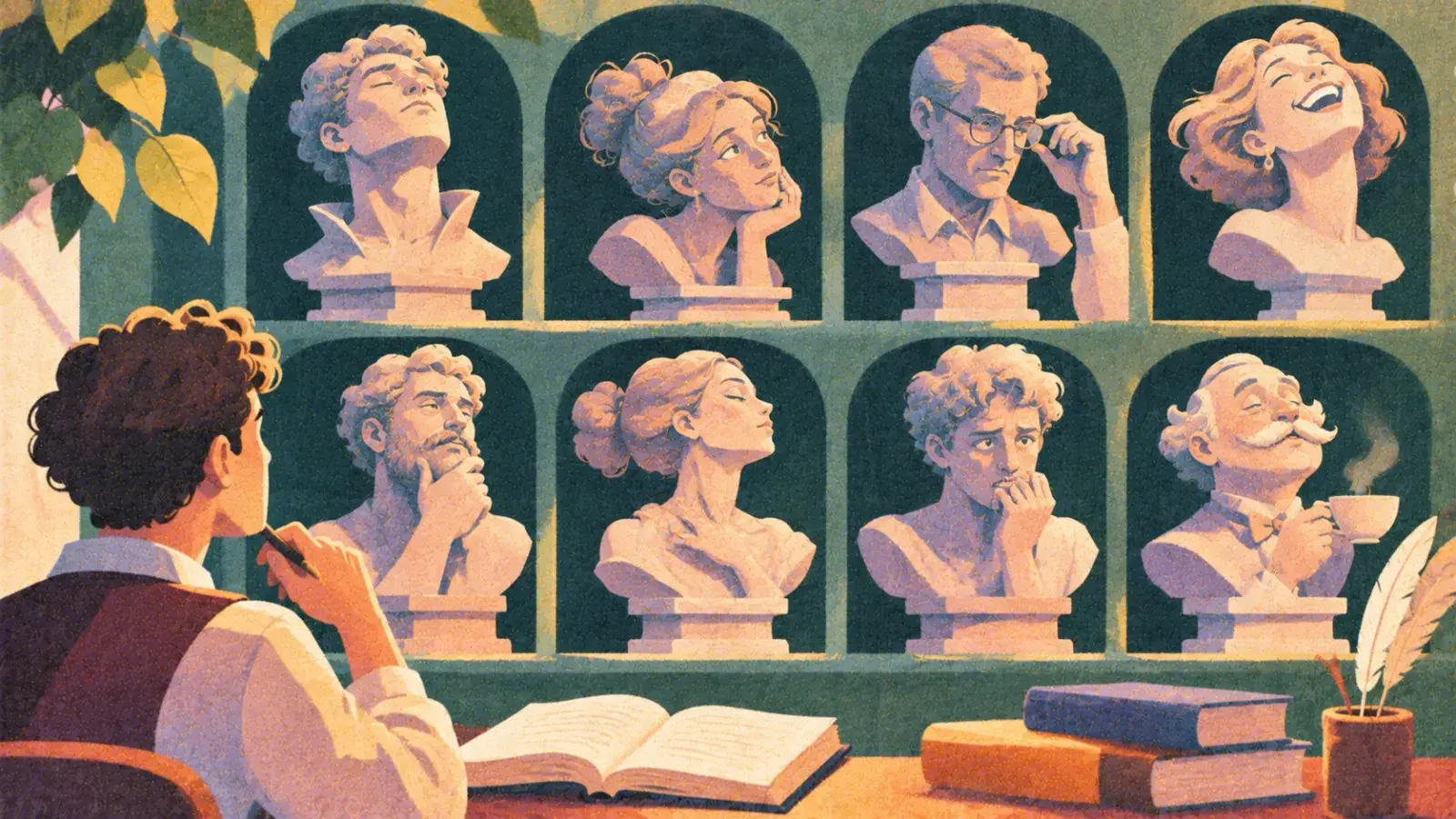
A mannerism is a habitual gesture, expression or way of speaking that a person repeats, often without noticing: cracking their knuckles before a hard job, clearing their throat before bad news, ending every opinion with “but what do I know.” In fiction, a mannerism lets readers recognize a character from a single line and read a feeling the character never names. The 220 below are grouped by where they show, from the hands to the objects people fidget with, and each comes with what it can signal.
“Can signal” matters. A gesture has no fixed meaning; it means what the scene and the character's history make it mean. Folded arms are hostile in one character and simply cold in another. Decide what a mannerism means for this person, show it once where the meaning is clear, and from then on the reader will read it for you. Treat the note after each entry as a reading to try, not a code. For the traits a habit can point to, see the character traits list.
| Group | Examples | Numbers |
|---|---|---|
| GroupHands and gestures | ExamplesCracked knuckles, steepled fingers, air quotes | Numbers1–40 |
| GroupFace and eyes | ExamplesA raised eyebrow, a held gaze, a smile with the mouth only | Numbers41–75 |
| GroupPosture and movement | ExamplesA back to the wall, a step ahead, a hug that lasts too long | Numbers76–110 |
| GroupVoice and speech | ExamplesPet phrases, long pauses, the throat-clear before bad news | Numbers111–150 |
| GroupNervous habits | ExamplesBitten nails, a bouncing knee, a shredded napkin | Numbers151–185 |
| GroupHabits with objects | ExamplesA twisted ring, polished glasses, tea stirred too long | Numbers186–220 |
Before the list, one revision shows what a signature habit does that stock gestures can't, and what happens to it under pressure:
Before. Dana sighed and pushed her hair back. “You're late.” Mark shrugged and smiled. “Traffic.” She raised an eyebrow and crossed her arms. He nodded, rubbed the back of his neck and shrugged again.
After. “You're late.” Dana didn't look up from the oven. Mark set the wine on the counter, label out, the way he did when he wanted credit for something. “Traffic,” he said. She turned the timer to zero, though the bread had six minutes left.
Under pressure, chapters later. The bank statement was open on the counter when he came in. Mark set the wine down next to it, label to the wall.
The first version has nine gestures and tells the reader almost nothing, because anyone sighs, shrugs and nods. The second has two. Mark's label-out bottle is a habit only he has, and the narration says once what it means, so from then on the reader can read it alone. Dana's timer shows anger without a word about anger. In the third, the habit turns around: there is nothing to take credit for, the label faces the wall, and the reader has the scene before anyone speaks.
Hand gestures and mannerisms
Hands are the busiest part of a character on the page. One gesture, repeated at the right moments, tells the reader what a character feels before they say it.
- Cracks his knuckles — readiness before a hard job, or wanting to look ready.
- Steeples her fingers under her chin — weighing what she has just heard, and wanting you to see her weigh it.
- Drums his fingers on the table — impatience, or a song only he can hear.
- Points with a pen while she talks — authority; a teacher's or a lawyer's habit.
- Talks with her hands, wider as she gets excited — enthusiasm, or a childhood in a loud family.
- Keeps his hands in his pockets — shyness, cold, or something in the pocket he doesn't want seen.
- Wipes her palms on her jeans before a handshake — nerves she is trying to hide.
- Rubs his palms together — anticipation; in the wrong character, scheming.
- Clasps her hands behind her back — formality, military training, or holding herself back.
- Holds her own wrist — self-comfort under stress.
- Counts points off on her fingers in an argument — a methodical mind that wants to win on points.
- Makes air quotes — skepticism, irony, or distance from his own words.
- Waves a hand to close a topic — someone used to being obeyed.
- Touches people's arms while talking — warmth, or a habit of steering people.
- Holds a handshake a beat too long — wanting to be liked, or wanting to dominate.
- Shakes hands with both hands — sincerity, or a politician's version of it.
- Pats her pockets before leaving a room — fear of losing things; a checker.
- Pinches the bridge of his nose — tiredness, a headache, or patience running out.
- Covers her mouth when she laughs — self-consciousness, or a strict upbringing.
- Flicks invisible dust off his sleeve — vanity, or a way of ending a conversation.
- Taps the side of his nose — “between us”: a secret, a deal, a conspiracy of two.
- Gives a thumbs-up instead of answering — avoiding words, or wanting to seem easy.
- Ruffles children's hair — affection, or a refusal to treat them as old enough.
- Rests a hand on her stomach — pregnancy, hunger, or dread.
- Holds up a palm to interrupt — authority; impatience with other voices.
- Rubs the back of her neck — embarrassment, or buying time before saying no.
- Counts his change twice — care with money, or distrust of whoever gave it to him.
- Laces his fingers behind his head — ease, or a show of it.
- Puts a hand on his heart when he promises — sincerity, or a performance of it.
- Crosses her fingers behind her back — a lie she thinks doesn't count.
- Snaps his fingers when a word won't come — impatience with his own memory.
- Taps two fingers against her lips — deciding whether to say it.
- Draws shapes in the air while explaining — a visual thinker; an architect or an engineer.
- Knocks on wood — superstition; fear of spoiling good luck.
- Shakes out his hands before he goes on — loosening up; an athlete's or a musician's routine.
- Chops the air with the side of her hand — certainty; an argument already won in her head.
- Mimes signing a check to ask for the bill — a lifetime of restaurants; old-fashioned.
- Holds up one finger while finishing a text — priorities, made visible.
- Massages her own hands — arthritis, cold, or a pianist's habit.
- Steers with one hand at twelve o'clock — confidence, or carelessness.
Face and eye mannerisms
Faces carry the fastest signals and the most clichés. Use these through another character's eyes: in close point of viewa character can feel her jaw clench, but she can't see her own raised eyebrow.
- Raises one eyebrow — skepticism; a dry sense of humor.
- Narrows her eyes when she listens — concentration, or suspicion.
- Looks up and to the side before answering — searching her memory, or deciding how much to say.
- Avoids eye contact — shyness, shame, or an upbringing where holding an elder's gaze was rude.
- Holds eye contact a beat too long — confidence, challenge, or flirtation.
- Blinks fast — surprise, strain, or tears held back.
- Smiles with his mouth only — politeness without warmth.
- Smiles with one side of her mouth — private amusement; irony.
- Bites her lower lip — nerves, concentration, or desire.
- Purses her lips — disapproval, or a remark held back.
- Clenches his jaw — anger kept in, or pain he won't mention.
- Flares his nostrils — anger, effort, or a smell he doesn't like.
- Puffs out her cheeks before a hard job — “here we go.”
- Wrinkles her nose — distaste, or a story she doesn't believe.
- Licks his lips before speaking — nerves, or appetite for the fight.
- Rolls her eyes — contempt, or a teenager's affection.
- Glances at the door — wanting to leave, or a fear of being trapped.
- Checks the exits when she enters a room — training, or a past where she needed them.
- Stares into the middle distance — memory, grief, or boredom.
- Laughs before the punch line — nerves, or wanting to be liked.
- Laughs at his own jokes — confidence, or loneliness.
- Goes very still when angry — dangerous control.
- Frowns while reading — concentration; a skeptical reader.
- Squints at menus and won't wear glasses — vanity, or denial about age.
- Touches her face while talking — self-consciousness, or a scar she still checks.
- Wipes his eyes with the heel of his hand — tears he won't call tears.
- Tilts her head when listening — interest, sympathy, or eagerness to please.
- Nods before the other person finishes — impatience, or agreeing just to end it.
- Talks with her eyebrows — expressive, eager, impossible to bluff.
- Sticks out the tip of his tongue when he concentrates — a child's habit he never lost.
- Looks at her shoes when praised — modesty, or disbelief.
- Watches people's hands before their faces — a card dealer, a nurse, a pickpocket.
- Winks at children in waiting rooms — playfulness; a grandparent in training.
- Closes his eyes to listen to music — absorption; a private man in public.
- Rubs her eyes until they're red — fatigue, or tears passed off as fatigue.
Posture and movement habits
How a character stands, sits and crosses a room shows status, mood and history: the veteran who sits with his back to the wall, the teenager who folds herself small on the bus.
- Stands with feet planted wide — confidence; owning the space.
- Leans back with arms folded — skepticism, cold, or self-protection.
- Leans in when listening — interest, intimacy, or intimidation.
- Hunches over his phone at dinner — absorption, or avoidance.
- Walks fast everywhere — impatience, ambition, or always running late.
- Takes the stairs, never the elevator — restlessness, fitness, or a fear of small spaces.
- Shuffles in slippers all day — age, low mood, or comfort.
- Sits on the edge of the chair — eagerness, or readiness to leave.
- Sprawls across two seats on the train — entitlement, or exhaustion.
- Tucks one leg under herself — comfort; at home in the room.
- Sits with his back to the wall — wariness; a cop's or a soldier's habit.
- Stands too close — no sense of space, or dominance.
- Keeps a desk between herself and visitors — formality; distance as defense.
- Paces while on the phone — restlessness; thinks by moving.
- Rocks on his heels — impatience, or boredom.
- Bounces on the balls of her feet — nervous energy before a fight or a performance.
- Squares his shoulders before walking in — gathering courage.
- Ducks through doorways he clears by a foot — a tall man's lifelong habit, or one from a house with low beams.
- Walks a step ahead of his partner — impatience, or control.
- Makes herself small on the bus — shyness, or a lifetime of being told to.
- Turns her whole body toward whoever is speaking — full attention.
- Leans in doorways — casual, and always with a way out.
- Stands with hands on hips — authority, impatience, or a challenge.
- Puts his feet on the furniture — ease, or disrespect.
- Sits ramrod straight — the army, ballet, or a strict school.
- Slumps the moment the boss leaves — energy as a performance.
- Hugs with one arm — reserve, or a family that never hugged.
- Hugs too long — loneliness, or grief.
- Kicks off her shoes indoors — at home; or a household where shoes stayed at the door.
- Walks on the street side of the sidewalk — old-fashioned protectiveness.
- Always takes the same chair — routine, or a claim on the room.
- Clears plates while others are still eating — restlessness, or service as a hiding place.
- Stretches like a cat after sitting — at ease in her body.
- Moves without a sound — a careful upbringing, or a past where noise was dangerous.
- Bows slightly when greeting — formality, upbringing or culture.
Voice and speech habits
Verbal mannerisms are the cheapest to write and the easiest to overuse. A pet phrase works best when it turns up at the same kind of moment each time, so the reader learns to hear what it means. The guide to writing dialogue covers giving each character a voice of their own.
- Clears his throat before bad news — buying a second.
- Says “to be honest” — about to say what he really thinks, or about to lie.
- Ends opinions with “but what do I know” — false modesty, or real insecurity.
- Answers a question with a question — evasion, or a teacher's habit.
- Repeats the last word you said — listening, or stalling.
- Says “with respect” before the disrespect — contempt with a coat of paint.
- Uses your name in every sentence — a sales technique; control.
- Hums while she works — absorption, contentment.
- Whistles through his teeth at bad news — dismay; an old-fashioned man.
- Talks to herself — loneliness, or a busy mind.
- Speaks so quietly people have to lean in — control, or shyness; the room's reaction tells you which.
- Pauses a long time before answering — care, or calculation.
- Fills every silence — discomfort with quiet.
- Never finishes a sentence — distraction, or a hope that someone else will.
- Corrects other people's grammar — pedantry, or insecurity about class.
- Uses long words in small talk — wanting to impress, or a reader who has rarely heard the words said aloud.
- Swears fluently, except in front of her mother — two selves.
- Calls everyone “pal” — warmth, or not remembering names.
- Says “no offense” first — knows exactly what he's doing.
- Talks in sports metaphors — a former athlete, or a manager who wishes he were one.
- Quotes films — a way to be funny without risking his own words.
- Tells the same story at every party — nostalgia for a peak he can't get past.
- Does the voices when telling a story — a performer.
- Sighs before agreeing — reluctance, or martyrdom.
- Clicks her tongue — disapproval, or sympathy; the tone decides.
- Says “anyway” to change the subject — a sore point she won't touch.
- Apologizes for everything — fear of being a burden, or years in a job where the customer was always right.
- Never says sorry — pride, or a childhood where an apology was used against you.
- Goes formal when hurt: “I see. Thank you for letting me know.” — distance as defense.
- Speaks in lists: “Three things.” — an orderly mind; a lawyer or a manager.
- Mutters measurements while he works — a carpenter's or a tailor's habit.
- Slips into her first language when angry — the real self under pressure.
- Says “I hear you” and changes nothing — management speak; a wall.
- Uses “we” for decisions he made alone — a politician's habit.
- Gives directions by landmarks that are gone — a long memory; a town changing around her.
- Whispers in libraries, churches and his own kitchen — timidity.
- Laughs one dry “Ha” without smiling — irony, or disbelief.
- Says “It is what it is” — resignation, or a refusal to discuss it.
- Ends sentences with “right?” — needing agreement, or pushing for it.
- Calls her parents by their first names — distance, an unusual childhood, or a joke that stuck.
Nervous habits and fidgets
Nervous habits leak what a character is trying to hide. They're most useful when the character doesn't know they have them and someone else does.
- Bites her nails — anxiety, or concentration.
- Chews the inside of his cheek — worry kept private.
- Picks at her cuticles — anxiety she won't admit.
- Jiggles his knee under the table — restlessness, nerves.
- Twirls a strand of hair — boredom, nerves or flirtation.
- Tucks her hair behind her ear again and again — self-consciousness.
- Pulls her sleeves down over her hands — feeling exposed.
- Rubs her thumb over her knuckles — self-soothing.
- Checks his phone when nothing has arrived — waiting for one particular message.
- Goes back to check the stove — worry; a fear of the disaster nobody else imagines.
- Scratches the back of his head — confusion, embarrassment.
- Tugs at his collar — heat, guilt, or a tight spot.
- Touches her necklace — anxiety, or a memory of who gave it to her.
- Hums tunelessly in waiting rooms — nerves.
- Laughs at nothing in tense moments — nerves leaking out.
- Over-explains — fear of being misunderstood.
- Straightens things on other people's desks — a need for control.
- Counts the stairs in every new building — a ritual for calm.
- Picks lint off a clean sweater — avoiding someone's eyes.
- Rubs his temples — stress, or a headache coming on.
- Crosses and uncrosses her legs — discomfort; wanting to leave.
- Clicks a ballpoint pen — impatience, nerves, or a colleague's breaking point.
- Plays with a zipper — restless fingers.
- Smooths her skirt before standing — composure; a reset.
- Adjusts his glasses before disagreeing — gathering himself.
- Keeps one earbud in during conversations — only half present.
- Cracks her neck when stressed — tension stored in the shoulders.
- Grinds his teeth at night — stress he won't talk about.
- Rereads a text ten times before sending it — fear of judgment.
- Shreds a paper napkin into strips — a hard conversation, happening or coming.
- Taps her foot — impatience, or nerves before her turn.
- Breathes out slowly through pursed lips — calming herself with a technique someone taught her.
- Sniffs when he's out of his depth — a tell his poker friends know.
- Swallows hard before answering — fear, or something hard to say.
- Takes a deep breath before every phone call — dread of being caught off guard.
Habits with everyday objects
Objects give hands something to do and give the reader a detail to remember. The best ones belong to one character's history: a dead father's watch, a lighter kept after quitting.
- Twists her wedding ring — doubt about the marriage, or a widow's habit.
- Polishes his glasses while stalling — buying time.
- Flicks a lighter he no longer needs — a quitter's craving.
- Stirs her tea long after the sugar has dissolved — distraction, or something hard to say.
- Turns his mug so the handle faces right — order; a small daily ritual.
- Walks a coin across his knuckles — restlessness, or a showman.
- Chews pen caps — concentration, or a smoker's hands with nothing to hold.
- Brings the same pen to every meeting — superstition, or attachment.
- Twirls her car keys — ready to leave.
- Folds receipts into tiny squares — restless hands; can't throw things away.
- Holds a mug in both hands — needing warmth, or comfort.
- Peels the label off a bottle — boredom, or nerves.
- Doodles spirals in the margins — a mind somewhere else.
- Opens and shuts a pocket watch — impatience, or nostalgia.
- Taps a cigarette on the pack before lighting it — ritual; stalling.
- Smooths his tie — nerves, vanity, or both.
- Puts on lipstick before bad news — armor.
- Pushes her sunglasses up to look at someone — ready to deal with them.
- Chews ice — restlessness, boredom.
- Smells a book before opening it — a book lover.
- Wipes down a clean table — nervous energy before a talk.
- Arranges food so nothing touches — order, or a childhood habit.
- Rolls a cigarette and never lights it — a quitter's ritual.
- Pulls out a tape measure and lets it snap back — a builder's fidget.
- Taps her phone against her chin — deciding.
- Turns the key ring over without picking a key — dread of the door.
- Rubs a worry stone in her pocket — self-soothing; a gift from someone.
- Chews the arm of his glasses — thinking.
- Plays with her earring on the phone — a call she isn't enjoying.
- Spins a beer mat on the bar — restlessness.
- Licks a finger to turn pages — old-fashioned, or careless.
- Keeps her place in a book with one finger while she talks — keen to get back to it.
- Wears his father's watch, set five minutes fast the way his father kept it — grief kept in a habit.
- Snaps a rubber band against her wrist — a trick for breaking another habit.
- Unwraps a candy, rewraps it and puts it back — indecision, or a promise to someone.
Mannerisms in classic novels
Charles Dickens is the master of the signature habit, and his habits still work because each one points at something underneath. These are all from public-domain novels and stories, quoted from the original texts.
| Character | The mannerism | What it tells the reader |
|---|---|---|
| CharacterUriah Heep, David Copperfield (1850), chapters 15–16 | The mannerismHe “frequently ground the palms against each other,” wipes them “in a stealthy way, on his pocket-handkerchief,” and calls himself “the umblest person going” | What it tells the readerHumility as a performance. David's first handshake gives him away: “what a clammy hand his was!” |
| CharacterMr. Jaggers, Great Expectations (1861), chapters 20 and 26 | The mannerismBites “his forefinger at the clients,” throws it at them, and “washed his clients off, as if he were a surgeon or a dentist” | What it tells the readerPower over people, and distaste for the trade that pays him. His washing closet “smelt of the scented soap like a perfumer's shop” |
| CharacterWemmick, Great Expectations, chapter 21 | The mannerism“His mouth was such a post-office of a mouth that he had a mechanical appearance of smiling” | What it tells the readerA face for the office: a smile that is only a slot |
| CharacterMr. Pocket, Great Expectations, chapter 23 | The mannerismPuts “his two hands into his disturbed hair” and tries “to lift himself up by it” | What it tells the readerHelplessness in a house that runs him. Later in the chapter he “really did lift himself some inches out of his chair” |
| CharacterMr. Jarndyce, Bleak House (1852–53), chapters 6 and 8 | The mannerismAnnounces “The wind's in the east” and retreats to his “growlery” | What it tells the readerEsther and Ada agree that he uses the pretence “to account for any disappointment he could not conceal” |
| CharacterMrs. Bennet, Pride and Prejudice (1813), chapter 1 | The mannerismAppeals to her “poor nerves” | What it tells the readerA way to win arguments. Her husband answers that her nerves are his “old friends” |
| CharacterSherlock Holmes, “The Red-Headed League” (1891) | The mannerismSettles into his armchair “putting his fingertips together, as was his custom when in judicial moods” | What it tells the readerA verdict is coming, and the reader learns to wait for it |
| CharacterMr. Micawber, David Copperfield, chapters 11–12 | The mannerismBuilds a grand sentence and lets it drop into “in short” | What it tells the readerBig language falling back to plain fact, like his finances |
Notice how often the mannerism contradicts the character's words. Uriah says he is humble and his hands say otherwise. Mr. Jarndyce blames the wind so he never has to admit he's disappointed. That gap between what a character claims and what their habit shows is one of the most useful things a mannerism can do, and it's a small-scale version of show, don't tell.
How to use mannerisms well
- Give a main character one or two
A signature mannerism works because it's rare. One or two for a main character, one for a minor character, and one for a walk-on only if it's all the reader needs to remember about them.
- Tie each one to a trigger
Decide what sets it off: a name, a lie, a deadline, a smell. A mannerism with a trigger carries meaning. One without is just movement.
- Introduce it, then save it
Show the habit early, in a scene where its meaning is clear. Then hold it back for the moments that matter. A habit on every page stops being seen.
- Let someone read it
The strongest use is another character noticing: the wife who knows what the throat-clear means, the detective who watches the ring twist. A misreading works too, and can turn a scene.
- Let it stand in for a tag
Once readers know a habit, it can identify the speaker without dialogue tags. “Mark set the bottle down, label out” tells the reader who's about to speak and what he wants.
- Change it when they change
A habit that stops, grows or appears for the first time is the quietest way to show an arc. If she stops twisting the ring in the last chapter, you don't have to explain why.
Common mistakes with mannerisms
- The stock six. Nods, shrugs, sighs, smirks, raised eyebrows and eye rolls. Fine once in a while; on every page they're noise, and every character ends up with the same face. The descriptive words list has words for faces and movement that do more.
- One habit for the whole cast. If everyone bites their lip, nobody does. Assign mannerisms the way you assign names: one owner each.
- A habit that never means anything. If the knuckle cracking never connects to a feeling, a decision or another character, cut it.
- Gestures the viewpoint character can't see. In first person or close third, she can feel her face go hot. She can't watch herself smirk.
- Gestures used as a code. “He touched his nose, so he was lying” belongs to pop psychology. On the page, a gesture means what the context and the character's history make it mean.
- Mannerisms as stereotypes. An accent, a gesture or a food habit standing in for a whole culture or group reads as a caricature, however lovingly it's meant.
- Real conditions written as quirks. The tics of Tourette syndrome are, in the words of the U.S. National Institutes of Health, “sudden unwanted and uncontrolled” movements or sounds, not a personality habit, and a stammer isn't shorthand for nerves or guilt. If a character has a condition, research it and write the person, not the symptom.
To count the stock six in a chapter, ask the Strokes Assistant to list every nod, shrug, sigh, smirk, raised eyebrow and eye roll with the sentence it's in. A list of twenty shrugs makes the case faster than any rule.
Frequently asked questions
What is the difference between a mannerism and a habit?
A habit is anything a person does regularly, like running at six or reading before bed. A mannerism is a small, characteristic way of moving or speaking that shows up in the middle of other things: a throat-clear, a hand gesture, a pet phrase. Every mannerism is a habit, but most habits aren't mannerisms.
Is a mannerism the same as a tic?
No. A mannerism is a habit a person could stop if they noticed it. A tic, in the medical sense, is not under the person's control: the NIH describes the tics of Tourette syndrome as sudden, unwanted and uncontrolled movements or vocal sounds. People call a pet phrase a verbal tic in casual speech, but in fiction treat real tics as part of a condition.
What is Mannerism in art?
With a capital M, Mannerism is a European art style. Britannica describes it as predominating in Italy from the end of the High Renaissance in the 1520s to the beginnings of the Baroque around 1590, and the name comes from the Italian maniera. Pontormo, Rosso Fiorentino and Parmigianino are among its painters. Merriam-Webster notes its “spatial incongruity and excessive elongation of the human figures.”