A compare and contrast essay puts two subjects side by side to show something neither shows on its own. Pick a few points both subjects share, write a thesis that says what the comparison reveals, then organize the body one of two ways: block (everything about A, then everything about B) or point-by-point (one point per paragraph, with A and B in each). Point-by-point is the safer default for analytical essays. Block works for short pieces and for essays where one subject is a lens for reading the other.
Choose subjects and points to compare
Start with the prompt. "Compare" often means similarities and differences both; "contrast" means differences. Words like "evaluate" or "which is more effective" ask for a judgment, so the comparison is a step toward an argument rather than the whole job. Some prompts hide the request entirely: "How do Blake and Wordsworth see London?" is a comparison assignment even though neither word appears.
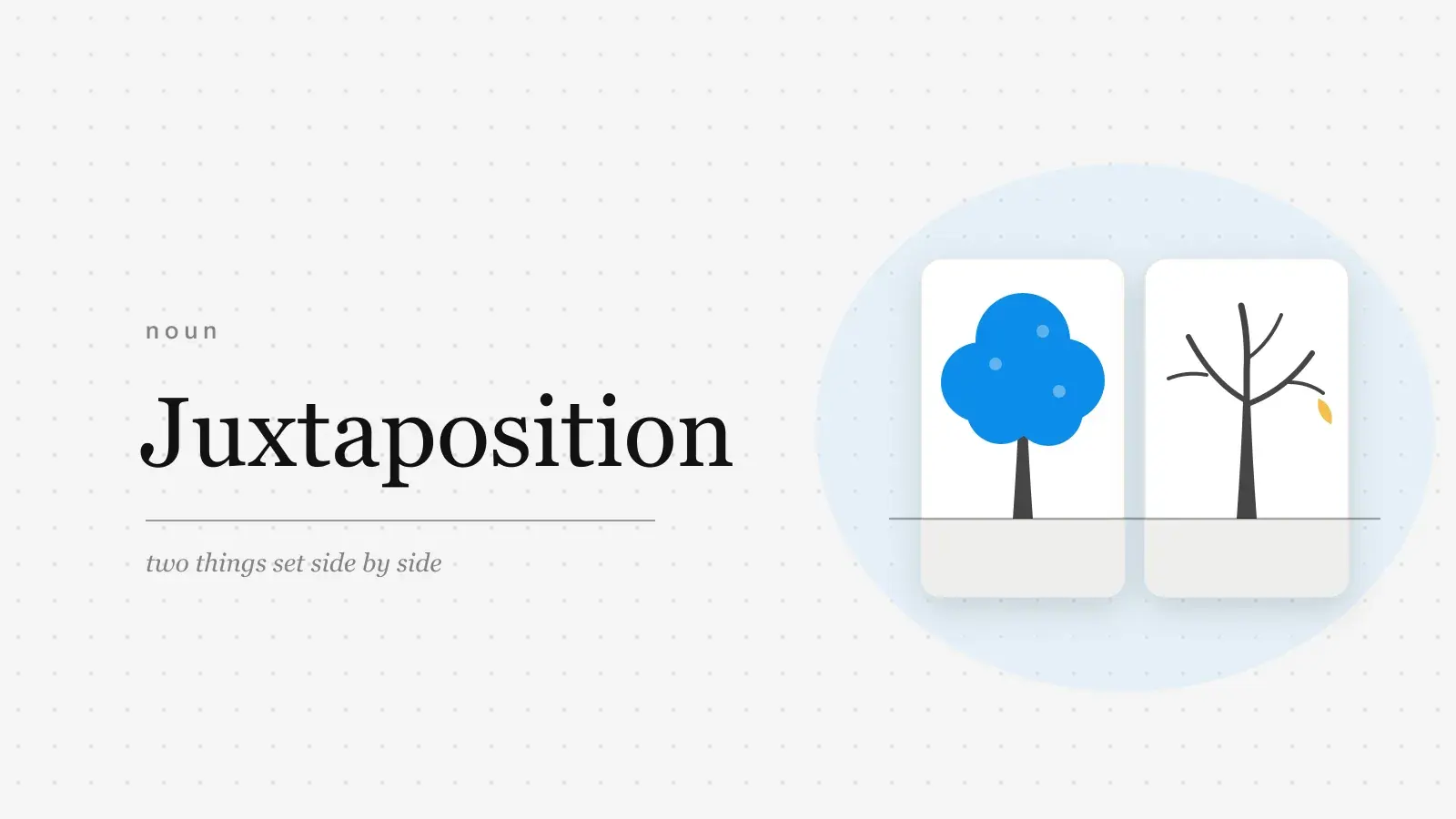
If you choose the subjects yourself, make sure they share enough ground to be worth comparing. Two stories by the same author, two policies aimed at the same problem, a novel and its film adaptation, a protagonist and his foil: each pair has an obvious basis, so the differences mean something. A novel and a toaster have no basis, and the reader spends the essay wondering why they are together. A good pairing works like juxtaposition in fiction, where setting two things side by side makes each one easier to see.
Then build a comparison chart. A Venn diagram sorts features into shared and unshared, which is fine for brainstorming. A chart is better for planning because it makes you answer the same question about both subjects, and that is exactly what each body paragraph will do. Here is one for the example used through this guide, two Edgar Allan Poe stories about murderers who tell their own crimes.
| Point | "The Tell-Tale Heart" (1843) | "The Cask of Amontillado" (1846) |
|---|---|---|
| PointMotive | "The Tell-Tale Heart" (1843)None he can name; the old man's "vulture" eye | "The Cask of Amontillado" (1846)Revenge for an insult he never describes |
| PointMethod | "The Tell-Tale Heart" (1843)Seven nights of watching at midnight | "The Cask of Amontillado" (1846)Carnival, an empty house, a trowel |
| PointListener | "The Tell-Tale Heart" (1843)A "you" who thinks he is mad | "The Cask of Amontillado" (1846)A "you" who knows "the nature of my soul" |
| PointAftermath | "The Tell-Tale Heart" (1843)Confesses to the police before dawn | "The Cask of Amontillado" (1846)Undiscovered for half a century |
| PointGuilt | "The Tell-Tale Heart" (1843)Hears the dead man's heart | "The Cask of Amontillado" (1846)Blames his sick heart on the damp |
Not every row earns a paragraph. "Both are short stories by Poe" is true and useless. Keep the points that are relevant to the prompt and that lead somewhere, and decide early whether the similarities or the differences are the interesting part. With subjects this alike, it is the differences.
Write a thesis that makes a claim
Most weak compare and contrast essays fail here, before the first body paragraph. The thesis announces that similarities and differences exist and stops. A real thesis names the comparison and then says why it matters: what the reader understands about the subjects after seeing them together. Two tests help. Could a reasonable reader disagree? Does it answer "so what"?
Weak: "The Tell-Tale Heart" and "The Cask of Amontillado" have many similarities and differences.
Better: Both stories are narrated by murderers, but they differ in motive, method and ending.
Strong: Both of Poe's killers insist they are in perfect control, but only one of them is: the narrator of "The Tell-Tale Heart" breaks within hours, while Montresor keeps his secret for fifty years, which makes the later story the more frightening of the two.
The weak version is a topic. The better version is a list of paragraphs. The strong version is an argument, and it tells the reader which point will matter most. If you need a starting shape, try "Although A and B both ___, A ___ while B ___, which shows ___," then rewrite it so it sounds like you rather than a form.
- History: The Articles of Confederation and the Constitution both tried to bind thirteen states into one country, but only the Constitution let Congress levy taxes, and that difference did more than any other to turn a league of states into a working government.
- Speeches: Lincoln's Gettysburg Address and his Second Inaugural are both short, but the first asks the living to finish the war, while the second asks the nation to forgive the people it is about to defeat.
- Adaptation: Mary Shelley's Frankenstein (1818) gives the creature an education and a voice; the 1931 film takes away his speech, and with it the novel's question of who the real monster is.
The speech pairing works well if you have already written a rhetorical analysis of the Gettysburg Address: the comparison adds a second text and a reason to read them together.
Block vs point-by-point structure
Both structures use the same introduction and conclusion. They differ in how the body is cut. Writing centers use several names for them: block is also called subject-by-subject or text-by-text, and point-by-point is also called the alternating method.
Block method (subject by subject)
The block method covers everything about the first subject, then everything about the second. It is easier to draft, because you think about one subject at a time, and it suits essays where the first subject sets up a frame for reading the second. Its risk is that the two halves never meet. To avoid that, every paragraph in the second block should point back to the first ("Unlike the first narrator, Montresor…"), and the body should end with a paragraph that puts them together.
- Introduction. Hook, both stories named with their dates, thesis.
- "The Tell-Tale Heart." No motive but the eye; seven nights of careful watching; a confession before dawn.
- "The Cask of Amontillado." A grudge instead of an eye; a trap set during carnival; fifty years of silence. Each point set against the first story.
- What the difference shows. Control that holds is more frightening than control that cracks.
- Conclusion. The thesis restated in light of the evidence, and one implication beyond the two stories.
Point-by-point method (alternating)
The point-by-point method gives each body paragraph one point of comparison and discusses both subjects in it. The comparison happens in every paragraph, so the essay cannot drift into summary, and the reader never has to remember what you said about A three paragraphs ago. For longer essays you can give each point two paragraphs, one per subject, as long as they sit next to each other.
- Introduction. Hook, both stories, thesis.
- Motive. An eye he cannot stand against an insult he will not explain.
- Method. Nights of watching against a trap built on the victim's pride.
- Aftermath. A confession within hours against fifty years of silence. The decisive point goes last.
- Conclusion. Why the story whose killer never breaks is the more frightening one.
Five paragraphs is the classroom default, not a rule. A longer essay adds points, or gives each point more room. The essay outline template has the same claim, evidence and analysis slots for each body section and works for either structure.
Which one to use
| Aspect | Block | Point-by-point |
|---|---|---|
| AspectBest for | BlockShort essays; one subject as a lens on the other | Point-by-pointAnalytical essays; most class assignments |
| AspectDrafting | BlockEasier: one subject at a time | Point-by-pointHarder: both subjects in every paragraph |
| AspectMain risk | BlockTwo summaries with no comparison | Point-by-pointChoppy back-and-forth inside paragraphs |
| AspectFix | BlockA synthesis paragraph; cross-references in block B | Point-by-pointTopic sentences that state the point, not the subject |
Sample paragraphs, annotated
Here is an opening and one body paragraph for the point-by-point version. Both are original to this guide; the quotations are from Poe, whose stories are in the public domain.
In 1843 and again in 1846, Edgar Allan Poe published a story told by a murderer who wants you to admire how carefully he worked. The narrator of "The Tell-Tale Heart" and Montresor of "The Cask of Amontillado" plan with patience, kill without witnesses and hide the body where no one will look. Both insist they are in perfect control, but only one of them is: the first narrator breaks within hours, while Montresor keeps his secret for fifty years, which makes the later story the more frightening of the two.
Each narrator claims perfect control, and each story tests that claim once the killing is done. Poe's first narrator boasts of "how wisely I proceeded," yet a little after four o'clock that morning, with the police sitting in the very room where the body lies under the boards, he hears a heartbeat and shrieks, "I admit the deed!" His control lasts a few hours. Montresor's lasts a lifetime. When Fortunato cries "For the love of God, Montresor!" he answers with the same words and keeps laying stone, and his one flicker of feeling, "My heart grew sick," he blames at once on "the dampness of the catacombs." The difference is not in how carefully the two men plan but in what happens afterward: one is undone by a guilt he cannot name, the other admits to none, and for "the half of a century" no one disturbs the bones. That is why the second story frightens more. Its murderer gets away with it.
What each part of the body paragraph is doing:
- Topic sentence names the point (control after the murder) and covers both subjects, so the reader knows this is a comparison before any evidence appears.
- Evidence from A is short and quoted exactly. Two or three words of quotation carry more weight than a long block.
- The pivot ("His control lasts a few hours. Montresor's lasts a lifetime.") does the contrast in two short sentences instead of a transition word.
- Evidence from B answers the same question asked of A, which is the comparison chart at work.
- Analysis says what the difference means and ties it back to the thesis. Without these last sentences the paragraph would be two summaries sharing a page.
Write it step by step
- Decode the prompt
Underline what it asks for: similarities, differences, both, or a judgment. Note the length and any required sources.
- Fill in a comparison chart
List four to six points down the side and the two subjects across the top. Fill every cell. Cut the rows that are obvious or unrelated to the prompt.
- Draft the thesis
Look across the chart for the one difference (or likeness) that changes how you see both subjects. That is your claim. Write it in one or two sentences.
- Pick a structure and outline
Choose point-by-point unless one subject is clearly a lens for the other. Order the points so the one that carries your thesis comes last: readers remember the final point best.
- Write the body first
Each paragraph: a topic sentence naming the point, evidence from both subjects, then analysis. Quote briefly, and when you use paraphrasing instead, cite it the same way.
- Add the introduction and conclusion
Write the opening once you know what the body proves. A concrete first line works better than a broad one; the guide to essay hooks has options. The conclusion should answer "so what", not repeat the thesis.
- Revise for balance
Check that both subjects get similar space, that every body paragraph mentions both (or, in block structure, that block B refers back to block A), and that the title says something. If the title still reads "Compare and Contrast Essay," see how to title an essay.
Transition words that show the relationship
Transitions tell the reader which way the comparison is turning. Choose them for meaning, not variety, and do not start every sentence with one.
| To show | Words and phrases |
|---|---|
| To showSimilarity | Words and phrasessimilarly, likewise, in the same way, both, just as |
| To showDifference | Words and phrasesin contrast, however, whereas, while, unlike, on the other hand |
| To showConcession | Words and phrasesalthough, even though, granted, despite |
| To showThe bigger difference | Words and phrasesmore important, above all, the sharper contrast |
Mistakes that cost marks
- Two summaries stapled together. If you could split the essay down the middle and lose nothing, the comparison never happened.
- A thesis that only announces. "There are many similarities and differences" is true of any two things.
- Mismatched points. Discussing motive in one story and setting in the other leaves nothing to compare. Ask the same question of both.
- Uneven coverage. Three paragraphs on the subject you know and one on the subject you skimmed reads as exactly that.
- Obvious similarities. Both novels have characters. Both cities have streets. Mention it once or cut it.
- Ping-pong sentences. Alternating A, B, A, B every sentence inside a paragraph is tiring. Group the evidence, then compare.
Drafting it in Strokes
Strokes is a desktop editor for macOS and Windows that keeps your documents as files on your own machine. A project folder per class holds the prompt, your notes and the drafts as separate documents. Version history saves drafts automatically, which helps with the structure decision: write the point-by-point version, save a version, rearrange into blocks, then preview the earlier version with the changes marked. Restoring the one you prefer takes one click.
The AI Assistant opens beside the document. Use it as a reader, not a ghostwriter: ask whether each body paragraph discusses both subjects, whether the thesis makes a claim someone could dispute, or which point is weakest. When the essay is done, export it to Word or PDF for submission. Check your school's AI policy before you use any assistant on graded work.
Frequently asked questions
How many paragraphs should a compare and contrast essay have?
Five is the common classroom shape: an introduction, three body paragraphs and a conclusion. Longer essays add a paragraph per point of comparison, or two per point in point-by-point structure. Follow the length your assignment sets.
Is block or point-by-point better?
Point-by-point is the safer choice for most analytical assignments because the comparison happens in every paragraph. Block suits short essays and cases where one subject is a lens for reading the other, as long as the second half refers back to the first and a closing paragraph brings them together.
Should similarities or differences come first?
Lead with whichever matters less and end with whichever carries your thesis. With subjects that look alike, the differences are usually the point; with subjects that look unrelated, the similarities are.
Can I compare more than two subjects?
Yes, if the assignment allows it. Point-by-point structure scales better than block, because three or four blocks become hard to hold in mind. Fill in a chart with one column per subject first, so every subject answers the same questions.
What is the difference between compare and contrast?
To compare is to look at similarities, and in many assignments both similarities and differences. To contrast is to look only at differences. Read the prompt closely to see which one it wants.