The central idea of a text is the main point the whole text develops: what the writer wants you to understand about the topic, put into one sentence. The topic is what a text is about, in a word or two. The central idea is what the text says about it. Informational texts usually state it outright, often near the beginning or the end. Stories and poems usually leave it implied, and there it overlaps with theme.
This guide is about central ideas in context: in speeches, essays, satire, stories and poems, where the most quoted line and the real point are often different things. It starts with one short text taken apart, then shows how to find and state a central idea, with a practice set at the end. For a story's central idea stated as a general truth about life, see theme examples.
Topic, central idea and evidence
The three layers are easiest to see in a short text. Here is one, three paragraphs long.
Most writers reread their drafts with their eyes, and the eyes are forgiving. They skip the repeated word, supply the missing “the” and glide over a sentence that runs out of breath.
The ear has no such manners. Read a page aloud and you hear the third “however,” the clause that needs a second breath, the joke that only worked in silence. When the poet in my writing group reads us a draft, she pencils a mark at every line she trips on, before anyone has said a word.
None of this needs an audience. A closed door and ten minutes will do. Read at the speed you would use for a friend, mark each stumble, and fix those places first.
| Layer | In the passage |
|---|---|
| LayerTopic | In the passageReading drafts aloud |
| LayerCentral idea | In the passageReading a draft aloud catches problems that silent rereading misses, and you can do it alone in ten minutes. |
| LayerEvidence | In the passageThe eyes “skip the repeated word”; the ear hears “the third ‘however’”; the poet pencils a mark at every line she trips on; “A closed door and ten minutes will do.” |
Stated or inferred? No sentence in the passage says all of that. The first paragraph says silent rereading misses problems, the second says the ear catches them, the third says anyone can do it alone, so the central idea is inferred: you build it from what each paragraph does. Had the writer ended with “Read every draft aloud; your ear will catch what your eyes forgive,” the idea would be stated, and your job would shift to checking that the rest supports it.
Central idea, theme and main idea
Five terms get used for nearly the same thing. They differ mostly in scale, and in the kind of text they belong to.
| Term | What it names | Mostly used for |
|---|---|---|
| TermTopic | What it namesThe subject, in a word or a phrase | Mostly used forAny text |
| TermMain idea | What it namesThe point of one paragraph or a short passage | Mostly used forParagraphs, sections, short informational texts |
| TermCentral idea | What it namesThe point the whole text develops | Mostly used forWhole texts, from essays and speeches to novels |
| TermTheme | What it namesA general truth about life that a work implies | Mostly used forStories, plays and poems |
| TermThesis | What it namesThe central idea of your own essay, stated as a claim to defend | Mostly used forEssays you write |
Take Henry David Thoreau's “Resistance to Civil Government” (1849), now usually printed as “Civil Disobedience.” Its topic is a citizen's duty to the state. Its central idea is narrower and arguable: a person must not support a government that does wrong, even if refusing means prison. The claim you make about that idea in an essay is your thesis; the thesis statement examples show how one is built.
The vocabulary comes partly from school standards. In the Common Core reading standards, which many US states adopted, second graders identify the “main topic” of a text, third to fifth graders determine its “main idea” (“two or more main ideas” in fifth), and from sixth grade the same standard asks for “a central idea,” with “two or more central ideas” in seventh. For stories, plays and poems, the standards ask for a “central message, lesson, or moral” in second and third grade, “a theme” in fourth and fifth, and “a theme or central idea” from sixth. Central idea, in other words, is the older student's name for the main idea of a whole text, and in literature it sits so close to theme that the standards name the two together.
The central idea in informational texts
In essays, articles, speeches and reports, the writer has a point and usually says it. Look in the title, at the end of the introduction, in the conclusion, and for any claim that keeps coming back in different words. The facts, examples and stories in between support it.
Every thing that is right or natural pleads for separation. The blood of the slain, the weeping voice of nature cries, ’Tis time to part.
The topic of Common Sense is the colonies' tie to Britain. The central idea is in the last four words: the colonies should break with Britain, and now. Paine's pages on monarchy, trade and America's ability to defend itself are reasons for that sentence. A text written to persuade states its point plainly.
I heartily accept the motto,—“That government is best which governs least;”…
Under a government which imprisons any unjustly, the true place for a just man is also a prison.
The opening sentence sounds like the central idea and isn't. It opens the topic, and Thoreau moves past it. His point is the line that comes well into the essay: a just person must refuse to cooperate with injustice, even from a cell. Thoreau spent a night in jail for refusing to pay a tax, and the essay tells that story, but the night in jail is a supporting detail, not the idea.
…the only thing we have to fear is fear itself…
This Nation asks for action, and action now.
Our greatest primary task is to put people to work.
The first line is the one everyone remembers, and it comes near the start, where it sets the mood. The central idea arrives later: the country can climb out of the Depression if the government acts at once and on a large scale, and if Congress won't act, Roosevelt will ask it for “broad Executive power to wage a war against the emergency.” Speeches are full of lines built to be quoted. Test them against the whole speech.
I grant this food will be somewhat dear, and therefore very proper for landlords, who, as they have already devoured most of the parents, seem to have the best title to the children.
Swift's narrator proposes, calmly and with figures, that the babies of Ireland's poor be sold as food. Read literally, that is the central idea, and it is the wrong answer. Satire says the opposite of what it means, so the central idea comes from its target: the landlords and the policies that keep the Irish poor starving are already devouring them. The sentence above gives the game away.
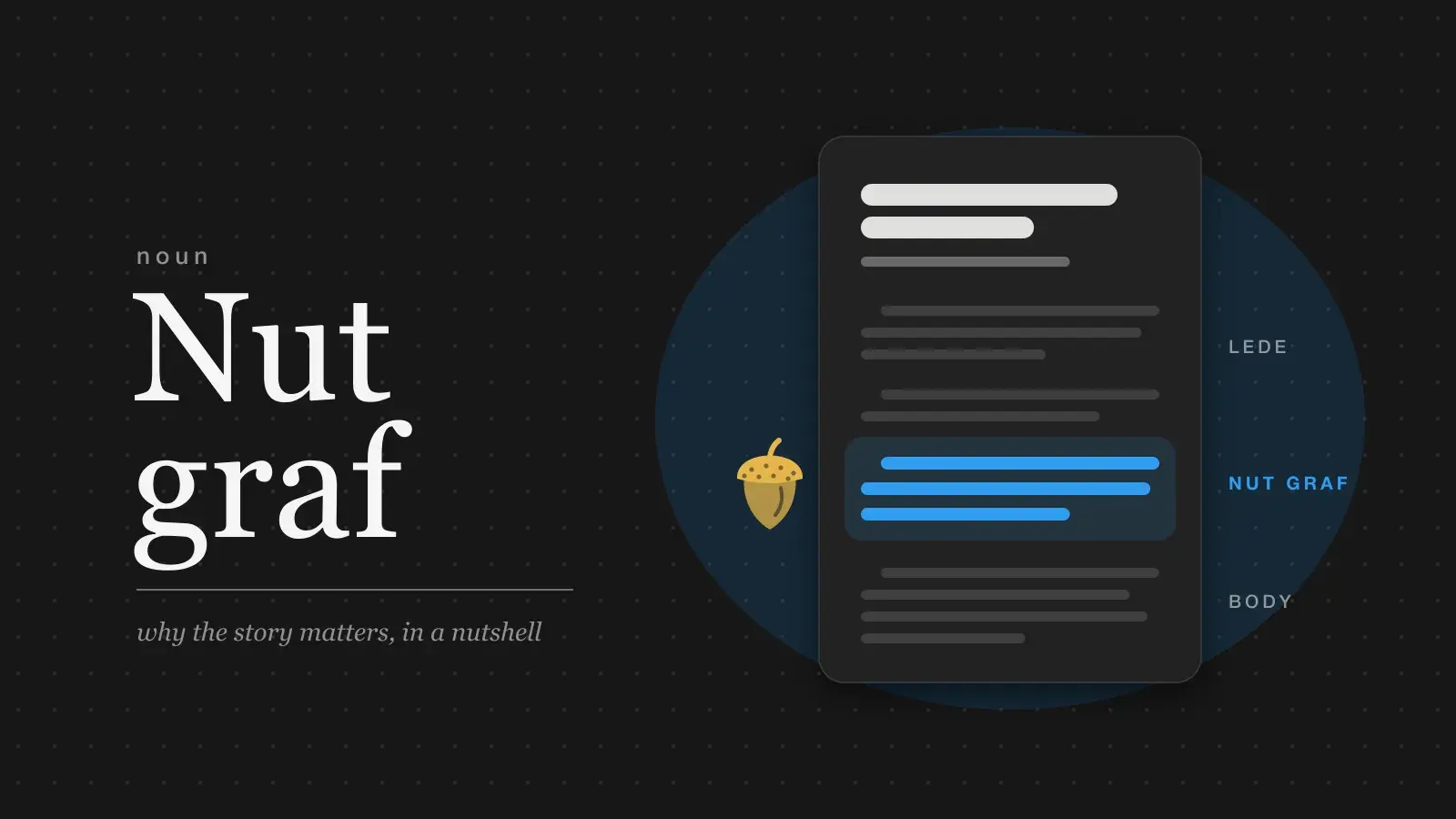
Journalism has its own name for the paragraph that states a story's central idea: the nut graf, often within the first few paragraphs of a feature.
Central ideas in stories and poems
Fiction and poetry rarely announce their point. The central idea is put together from what happens, what the characters choose and how it ends, which is why it sits so close to theme. Some poems do state it, and spend the rest of their lines proving it.
Success is counted sweetest
By those who ne'er succeed.
To comprehend a nectar
Requires sorest need.
Not one of all the purple host
Who took the flag to-day
Can tell the definition,
So clear, of victory,
As he, defeated, dying,
On whose forbidden ear
The distant strains of triumph
Break, agonized and clear!
The first two lines are the central idea, nearly word for word: people who never succeed understand success best. The next two stanzas prove it with one picture: a dying soldier on the losing side, hearing the winners' distant music, knows what victory means better than they do. A statement followed by one strong case is a pattern worth borrowing for an essay paragraph.
A man said to the universe:
“Sir, I exist!”
“However,” replied the universe,
“The fact has not created in me
A sense of obligation.”
Nothing in the poem says what it means. The reader works it out from the exchange: the universe owes people nothing for existing. The comedy, a universe answering like a polite official, is how the idea arrives. That is typical of literary texts. The central idea is something you state about the poem, not a line you copy out of it.
Four old friends, Mr. Medbourne, Colonel Killigrew, Mr. Gascoigne and the widow Wycherly, drink water from the Fountain of Youth. Young again, the three men fight over the widow, the vase shatters, and all four grow old. Their host, Dr. Heidegger, draws a lesson: “…for if the fountain gushed at my very doorstep, I would not stoop to bathe my lips in it…” His guests draw another: They resolved forthwith to make a pilgrimage to Florida and quaff at morning, noon and night from the Fountain of Youth.
A quick reader copies down Heidegger's lesson. The last sentence says more: the four have seen what youth made of them and want it back anyway. A central idea for the story: people given a second youth would repeat the follies of the first, and most would choose to. When a character states a moral, check it against the ending.
A story's central idea stated as a general truth is a theme statement. The guide to themes in literature lists 50, and theme examples gives 40 statements with the reasoning behind each.
How to find the central idea
- Name the topic
Write the subject in a word or two. The title and the words that keep repeating usually give it away: government, success, youth.
- Read the opening and the ending first
In nonfiction the central idea often sits at the end of the introduction or in the conclusion. In a story the ending decides it, so read the last page as carefully as the first.
- Give every section a job
Beside each paragraph, write a few words on what it does: gives a reason, tells a story, answers an objection. Then ask which claim most of those jobs serve.
- Write one sentence
Put the topic and what the writer says about it into one sentence, in your own words. Quote the text only when the writer states the idea outright, as Paine does.
- Test it against the whole text
Every major section should fit under your sentence. If one doesn't, the sentence is too narrow, or the text has two central ideas, as longer texts often do.
The passage at the top of this page runs through the same steps: the topic is in the words that keep coming back (read, draft), each paragraph does one job, and the sentence that joins the jobs covers every paragraph, which is the test.
How to state a central idea
- Write a full sentence with a subject and a claim. “Government” is a topic.
- Name the writer in nonfiction. “Thoreau argues that…” keeps the claim his and your opinion out of it, which is also what the standards ask of a summary.
- Cover the whole text, not one paragraph or example, in your own words.
- Keep it to one sentence. Any longer and you are summarizing.
| Weak | Why it fails | Stronger |
|---|---|---|
| WeakSuccess. | Why it failsA topic, not a claim | StrongerDickinson's poem argues that only people who have failed understand what success is worth. |
| WeakThoreau goes to jail for not paying a tax. | Why it failsA supporting detail | StrongerThoreau argues that a just person must refuse to support an unjust government, even from a prison cell. |
| WeakRoosevelt says the only thing we have to fear is fear itself. | Why it failsThe famous line, not the point | StrongerRoosevelt argues that the country can recover if the government acts at once, and asks for the power to make sure it does. |
| WeakSwift wants the poor to sell their babies as food. | Why it failsThe satire read literally | StrongerSwift attacks the landlords and policies destroying Ireland's poor by proposing, with a straight face, that the rich eat their children. |
Mistakes that hide the central idea
- Taking the first sentence on trust. Thoreau's opening motto is a doorway, not his point.
- Picking the most quotable line. “Fear itself” sets a mood; “action, and action now” carries the speech.
- Reading satire literally. Swift means the opposite of his proposal.
- Promoting a detail. An example or a statistic supports the central idea and can't replace it.
- Copying a character's moral. Dr. Heidegger's lesson is only half of Hawthorne's.
Practice: find the central idea
State the central idea of each passage in one sentence, then note the details that support it.
Every spring the river floods the low fields east of Kellbrook. For eighty years the county built levees, and every few years the river broke through them and took the road with it. In 2009 the county stopped rebuilding and bought the fields instead, for less than it had spent on the last two repairs. Now the water spreads out, drops its silt and drains within a week, and Kellbrook has stayed dry. Sometimes the cheapest way to control a river is to give it room.
Ask a carpenter about her first chair and she will tell you what was wrong with it. Ask a pianist about his first recital and he will name the bar where his hands froze. Ask a novelist about her first book and, if she is honest, she will tell you it is in a drawer. Not one of them wishes they hadn't made it.
The new boy ate lunch alone for nine days. On the tenth, Mara, who also ate alone, set her tray down across from him without a word. On the eleventh he was at her table first, with two cartons of chocolate milk. He slid one across.
| Passage | Central idea | Evidence | Stated or inferred |
|---|---|---|---|
| Passage1 | Central ideaGiving a river room to flood can protect a town better than walls can, and for less. | EvidenceThe levees failed “every few years”; the buyout cost less than the last two repairs; the water now drains within a week and the town has stayed dry | Stated or inferredStated in the last sentence |
| Passage2 | Central ideaA flawed first attempt is worth making, even though its maker never forgets the flaws. | EvidenceThe chair, the frozen bar and the book in the drawer; “Not one of them wishes they hadn't made it.” | Stated or inferredInferred from three parallel examples |
| Passage3 | Central ideaA small act of company can end loneliness for two people at once. | EvidenceMara “also ate alone”; she sits down without a word; the next day he is there first, with a carton for her | Stated or inferredInferred from what each child does |
Write your central idea first
Readers look for a central idea because writers are supposed to have one. Before you draft an essay, a feature, a speech or a nonfiction chapter, write its point as one sentence at the top of the document, the way you would want a reader to state it afterward. If you can't write that sentence yet, the draft will wander looking for it. An essay outline puts the same sentence above the arguments that support it.
When the draft is done, ask the Strokes Assistant which paragraphs do least for that first sentence, and reread those first.
Frequently asked questions
Is the central idea the same as the theme?
They overlap. Theme is used for stories, plays and poems and means a general truth about life that the work implies. Central idea is used for any text, essays and speeches included, and means its main point. In literature the two are so close that the Common Core standards ask for a theme or central idea.
What is the difference between central idea and main idea?
Mostly scale and grade level. Main idea usually means the point of a paragraph or a short passage, and it is the term used in elementary school. Central idea means the point of a whole text, and the Common Core standards switch to it in sixth grade. A long text has many main ideas that add up to its central idea.
Can a text have more than one central idea?
Yes. Long or complex texts often develop two or more, and the seventh-grade Common Core standard asks students to find two or more and trace how each develops. A history of a war might argue both why it started and why it lasted. If one sentence can't cover every major section, look for a second idea.