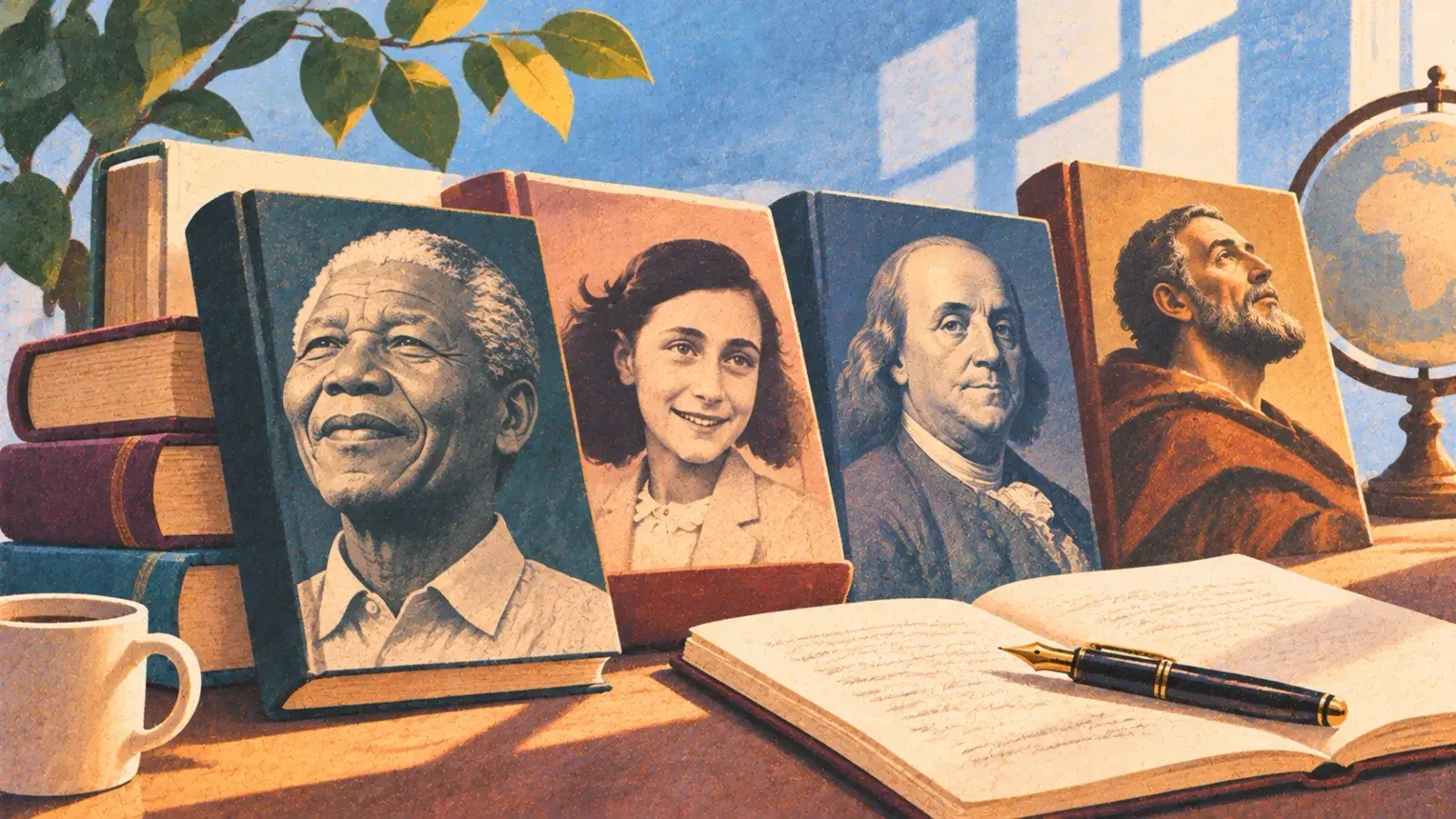
An autobiography is the story of a person's life written by that person, usually from childhood to the time of writing and in roughly the order it happened. Classic examples include The Autobiography of Benjamin Franklin, Frederick Douglass's Narrative (1845), Booker T. Washington's Up from Slavery (1901), The Autobiography of Malcolm X (1965), written with Alex Haley, and Nelson Mandela's Long Walk to Freedom (1994).
This page is about whole-life accounts: autobiography beside memoir and biography, 15 famous examples, four classic openings read closely, four short originals for applications, jobs, books and school, and how to write your own. For books that take one stretch of a life instead, see the memoir examples.
Autobiography vs memoir vs biography
All three are true life stories. They differ in who writes them and how much of the life they take on.
| Autobiography | Memoir | Biography | |
|---|---|---|---|
| Who writes it | AutobiographyThe subject | MemoirThe subject | BiographySomeone else |
| Scope | AutobiographyThe whole life so far | MemoirOne period, relationship or theme | BiographyThe whole life, or a major part |
| Order | AutobiographyUsually chronological | MemoirWhatever serves the story | BiographyUsually chronological |
| Point of view | AutobiographyFirst person; a few use third | MemoirFirst person | BiographyThird person |
| Built on | AutobiographyMemory, records, the writer's own papers | MemoirMemory, checked against records | BiographyInterviews, archives, letters |
| Example | AutobiographyUp from Slavery | MemoirWalden | BiographyThe Life of Charlotte Brontë |
Merriam-Webster defines autobiography as “the biography of a person narrated by that person,” and dates the word in English to 1797. In practice the line with memoir is scope. Helen Keller called The Story of My Life (1903) an autobiography, but it stops in her college years, which is a memoir's reach. If you want to turn your life into fiction instead, the guide on writing a novel about your life covers the autobiographical novel and autofiction.
Famous autobiographies, classic and modern
Fifteen, oldest first, with what each one covers. The craft notes come with the four openings after the list.
- Confessions (397–400), Augustine of Hippo — thirteen books addressed to God as prayer, from a wayward youth to his conversion. Often called the first Western autobiography.
- Confessions, Jean-Jacques Rousseau — written 1765–70 and published after his death, 1782–89. His first fifty-three years, told through worldly experience and feeling rather than conversion.
- The Autobiography of Benjamin Franklin — written in parts between 1771 and 1788, the first part as a letter to his son. It is unfinished: the story stops in 1757, more than thirty years before his death.
- Narrative of the Life of Frederick Douglass, an American Slave (1845) — the first of his three autobiographies, followed by My Bondage and My Freedom (1855) and Life and Times of Frederick Douglass (1881).
- Incidents in the Life of a Slave Girl (1861), Harriet Jacobs — published under the name Linda Brent and addressed to white women in the North.
- Charles Darwin's autobiography — written in 1876 for his children, “as if I were a dead man in another world looking back at my own life.” His son Francis printed it later, with passages left out.
- Up from Slavery (1901), Booker T. Washington — from his birth into slavery in Virginia to building Tuskegee Institute. It first ran as a series of articles in The Outlook.
- The Story of My Life (1903), Helen Keller — her childhood and education up to her college years; she calls it an autobiography.
- The Education of Henry Adams — written in the third person, circulated privately in a limited edition from 1907 and published after his death in 1918. Pulitzer Prize, 1919.
- An Autobiography, or The Story of My Experiments with Truth, Mohandas K. Gandhi — written in Gujarati and translated into English by Mahadev Desai.
- The Autobiography of Alice B. Toklas (1933), Gertrude Stein — Stein's own life in Paris between the world wars, written as if by Toklas. It was a commercial success.
- The Autobiography of Malcolm X (1965) — the life of the man born Malcolm Little, written with Alex Haley, who later wrote Roots.
- I Know Why the Caged Bird Sings (1969), Maya Angelou — her childhood, ending with the birth of her son: the first of the autobiographies in which she told her life in installments.
- Long Walk to Freedom (1994), Nelson Mandela — from his childhood through the long imprisonment that began with his life sentence in 1964, eighteen years of it on Robben Island.
- Autobiography of Mark Twain — largely dictated, with instructions that much of it wait 100 years after his death. The first volume of the complete edition came out in November 2010.
Two of the fifteen were written with, or as, someone else: Haley for Malcolm X, Stein as Toklas. If you are hiring help, the guide on becoming a ghostwriter shows the arrangement from the writer's side.
How four classic autobiographies open
An opening tells the reader who is speaking, to whom and from when. These four are public domain, so the openings are quoted at length.
Dear Son: I have ever had pleasure in obtaining any little anecdotes of my ancestors. You may remember the inquiries I made among the remains of my relations when you were with me in England, and the journey I undertook for that purpose.
Franklin turns a public life into a letter. Naming one reader fixes the tone, and it gives him a reason to tell small family things a reader in general would not ask for. In the same opening pages he says he would happily live the same life again, “only asking the advantages authors have in a second edition to correct some faults of the first,” and he calls his own mistakes “errata,” the printer's word.
I was born in Tuckahoe, near Hillsborough, and about twelve miles from Easton, in Talbot county, Maryland. I have no accurate knowledge of my age, never having seen any authentic record containing it. By far the larger part of the slaves know as little of their ages as horses know of theirs, and it is the wish of most masters within my knowledge to keep their slaves thus ignorant.
The conventional first line, where I was born, turns into evidence: the missing record was enforced. (The National Park Service now gives his birth as February 1818.) A gap in your own story can be the point, not something to apologize for. Douglass told the same life twice more, in 1855 and 1881, each time from a later vantage point, which is one way to handle a life that keeps changing after the book.
I was born a slave on a plantation in Franklin County, Virginia. I am not quite sure of the exact place or exact date of my birth, but at any rate I suspect I must have been born somewhere and at some time. As nearly as I have been able to learn, I was born near a cross-roads post-office called Hale’s Ford, and the year was 1858 or 1859. I do not know the month or the day.
Washington meets the same missing record with understatement, and the joke wins the reader's trust. His guess was also off: the National Park Service, which runs his birthplace as a national monument, gives April 1856. Even the person who lived a life can get its facts wrong.
Under the shadow of Boston State House, turning its back on the house of John Hancock, the little passage called Hancock Avenue runs, or ran, from Beacon Street, skirting the State House grounds, to Mount Vernon Street, on the summit of Beacon Hill; and there, in the third house below Mount Vernon Place, February 16, 1838, a child was born, and christened later by his uncle, the minister of the First Church after the tenets of Boston Unitarianism, as Henry Brooks Adams.
Adams holds himself at arm's length: “a child was born,” and his name arrives only at the end of a sentence that is mostly about Boston. The third person lets him treat his own life as a case study in what his schooling failed to teach him. The chapter title, a place and a span of years, is a handy way to divide any life.
Short autobiography examples
Not every autobiography is a book. Applications, hiring committees, novels and classrooms often want a page or less. Four originals, with notes. Each label gives the writer's age, the span of life covered and the point of view, because a page written at fifteen for a class does a different job from one written in mid-career for a committee.
I was born in 1991 in Yakima, Washington, the second of four children, and grew up above my parents' tire shop on Nob Hill Boulevard. My mother kept the books and my father kept the radio on. By twelve I could change a tire and balance the register, and I assumed I would run the shop someday.
At nineteen I did run it, for six months, while my father recovered from heart surgery. I learned more in the hospital that winter than in a year of community college: how the night nurse explained his medications to my mother in Spanish, slowly, twice, and how much calmer all of us were afterward.
I finished an associate degree in business in 2013 and managed the shop for eight years. In 2021 I began interpreting on Saturdays at a free clinic downtown, and in 2023 I started my prerequisites at night: anatomy, microbiology and statistics, all completed with A's.
I am applying to the accelerated nursing program because I want to be the person who explains things slowly, twice, in either language. I can work long shifts, keep careful records and stay calm with frightened people. I learned all three at the shop.
It runs in order, but every paragraph moves toward the program. One remembered detail, the nurse explaining twice, becomes the reason for the application, and the last paragraph turns the family business into qualifications. Dates and grades make the claims checkable.
My first job was shelving books at the branch library two blocks from our house in Dayton, Ohio. I was fifteen, I was paid minimum wage, and I was fired twice that summer for reading in the stacks, both times by Mrs. Okafor, who rehired me both times.
I studied history at Wright State, worked nights at a bookstore, and spent my twenties in jobs that had nothing to do with libraries: a bank, a moving company, two years teaching English in Busan. In 2014 I came back to Dayton and to the library as a part-time circulation clerk, and finished my library degree online while working full time.
For the past six years I have run adult programs at our largest branch. I started the job-search lab, which now sees about forty people a week, and a Tuesday night English conversation group that grew out of what I learned in Busan. I am applying to manage the branch because it is where I started, and because I know what it takes to keep a teenager who reads in the stacks employed.
A career autobiography is not a résumé in sentences. The opening scene becomes the closing argument, the detour years are owned and tied to a skill, and one number does more than three adjectives. For third-person versions to put on a website or in a program, see the bio examples.
My grandfather worked nights at a steel plant south of Buffalo for thirty-one years and told me exactly three stories about it. This novel is built on those three stories; nearly everything else is invented. Stan Wójcik is not my grandfather. He is braver, angrier and much better at cards. The fire in chapter 9 happened, though years later than I have put it, and no one died in the real one. The union meeting in chapter 14 follows the minutes my grandmother kept in a shoebox, with the speakers' names changed. If you worked at the plant and remember it differently, you are probably right, and I would like to hear from you.
Readers of a novel drawn from life want to know what is real, and this note answers in specifics: one character, one date, one event. It separates the true from the invented without apology, and the last line is generous to the people who were there.
I was born in Phoenix, Arizona, in 2011, and I have lived in three apartments. I remember each one by its kitchen.
The first kitchen had a yellow table and a window that looked at a parking lot. My abuela lived with us then. Every Sunday she made tortillas and let me flatten the dough with my fist, and every Sunday she said I was doing it wrong and kept letting me.
The second kitchen was so small that only one person could cook at a time, so my mom and I took turns. That is where I learned to make eggs, where I did my homework in fourth grade, and where my mom told me that my abuela was moving back to Hermosillo. I cried into the eggs.
The third kitchen is the one we have now, in Tempe. It has a dishwasher, which my mom says is the best thing that has ever happened to her. My little brother does his homework at the counter and I help him with fractions, badly.
In five years I want to be studying engineering, maybe in Arizona, maybe somewhere with snow. I am not sure yet. I am sure that wherever I live, I will learn the kitchen first.
One organizing idea turns a list of moves into a story, and each place gets one memory instead of a summary. The humor (“badly”) keeps it honest, and the ending looks forward. Rooms, cars, schools or jobs can work the same way.
How to write an autobiography
- Decide who it's for
Franklin wrote to his son, Darwin to his children, Jacobs to readers she needed to persuade. Name your reader, whether family, a committee or the public, and let that decide length, tone and what needs explaining.
- Build a dated timeline from records
List years, places and people, then check them against birth certificates, school records, letters, photos and old calendars. Where memory and record disagree, note both: Washington's guess at his birth year is a story in itself. If the timeline lives in Strokes, attach it and a transcribed interview with a relative to a chat with the Strokes Assistant and ask where the two disagree.
- Divide the life into chapters
Use stages, places or jobs, as Adams does with “Quincy (1838-1848).” A decade where little changed can be a page.
- Write the turning points as scenes
Give each chapter one or two moments in full: a place, people talking, something changing. Summarize the years between, and show, don't tell where it counts.
- Choose your vantage point and person
Say when and where you are writing from, at least once. The third person, as Adams uses it, gives distance and irony at the cost of warmth.
- Be fair to the living
Other people's private lives are theirs. Write what you saw and what it did to you, and check the legal notes in how to write a memoir before you publish anything about living people.
- Revise for proportion
Read the draft with the timeline beside it. The years that changed you should get the pages, and the quiet ones a paragraph. If one chapter grows into the book, you may be writing a memoir after all.
Mistakes that flatten an autobiography
- Equal time for every year. Chronology is the order, not the budget.
- A list of achievements. Job titles in sequence read like a résumé. Say what each one cost and taught you.
- No present-day narrator. Without a voice that knows how things turned out, the story is a string of events.
- Settling scores. A chapter written to win an old argument makes readers doubt the rest.
- Unchecked dates. One wrong year a relative can spot undermines every page around it.
Frequently asked questions
Can an autobiography be written in the third person?
Yes. The Education of Henry Adams, which won the Pulitzer Prize in 1919, refers to its author as “he” throughout, and Gertrude Stein wrote her own life as The Autobiography of Alice B. Toklas, in Toklas's voice. The third person gives distance and room for irony. Most autobiographies still use the first person, which keeps the reader close to the writer.
What was the first autobiography?
Augustine of Hippo's Confessions, written between 397 and 400, is often called the first Western autobiography. It tells his life in thirteen books addressed to God, from his youth to his conversion. Rousseau's Confessions, published in the 1780s, is a later landmark that tells a life through worldly experience rather than religious conversion.
How long should a short autobiography be?
As long as the request says: applications and school assignments usually set a word or page limit, so start there. Without one, a page of 250 to 500 words is enough to cover where you began, two or three turning points and where you are now. Choose scenes over summary, and cut any year that doesn't move the story.