When to use it
- Pitching a feature film to a producer, manager or development executive
- Getting notes on the story before you spend months on a screenplay
- Planning an adaptation of a novel, an article or a true story
- Applying to a development fund or lab that asks for a treatment
- Mapping a TV pilot or a documentary before the shoot
A film treatment is a prose summary of a film written before the screenplay: the whole story, told in the present tense from the opening image to the last scene, with the main characters and the tone. It lets a producer, a fund or a writing partner read the movie in one sitting and say yes, no or “change the second act.”
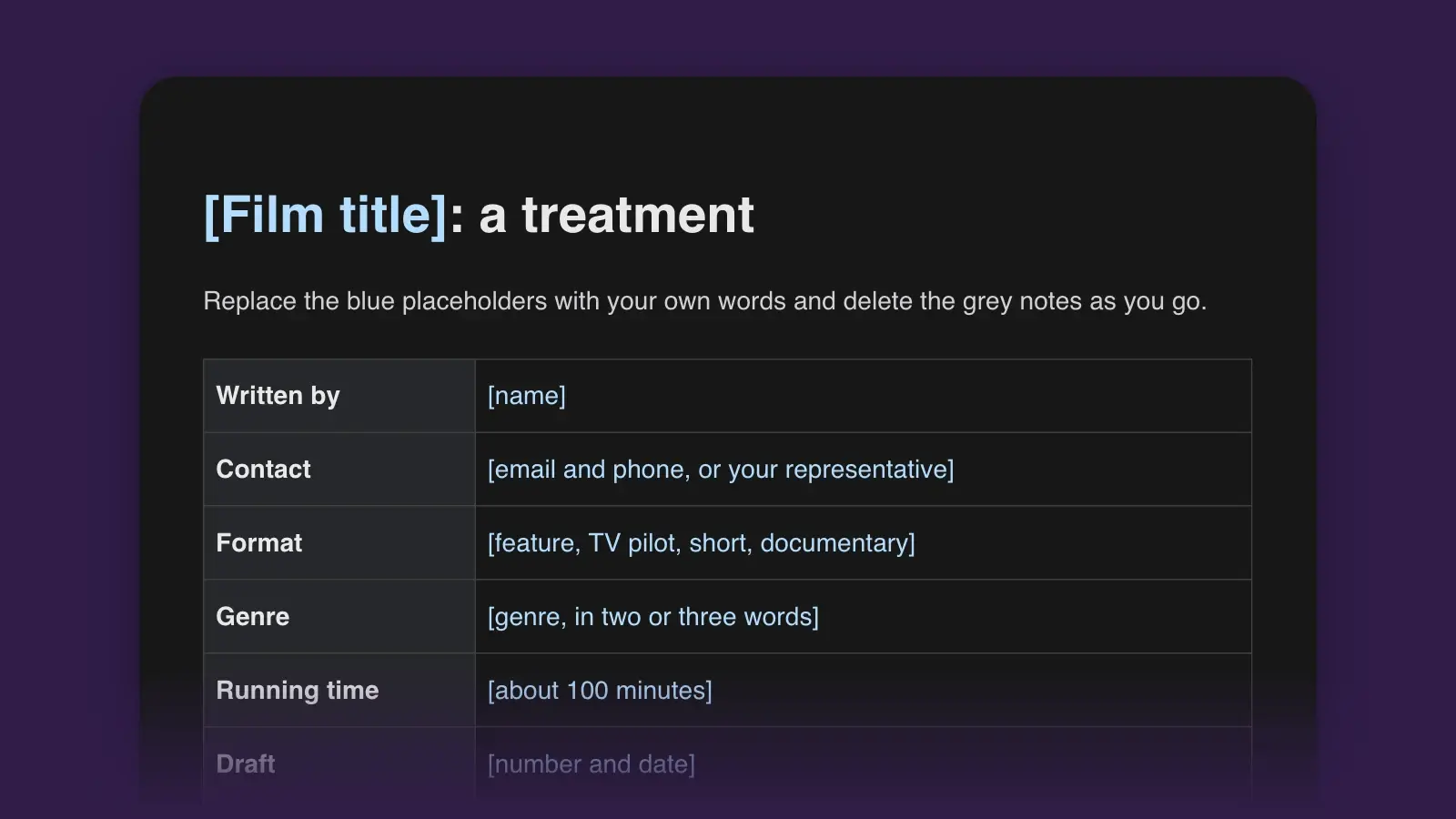
This template holds the parts most treatments share: a title page, a logline, a short synopsis, the characters, the story act by act, and notes on tone and look. The full example comes first: a treatment for an invented film, Move-In Ready. When a producer, fund or lab sets its own format or page limit, follow theirs over this one.
Film treatment example
Here is the template filled in for an invented feature: a contained drama with comedy, set in Phoenix over thirty days.
Logline. A home stager who secretly sleeps in the empty houses she decorates is caught by a widower, who keeps her secret on one condition: his house must never sell.
Synopsis. Nora Vask stages houses for a Phoenix broker and has slept in them since her divorce left her with debts and no address. When Walt Ibarra lets himself into his own empty house at 2 a.m. and finds her in his bed, he offers a deal: he won't report her if she keeps the house from selling, because he isn't ready to leave the rooms his late wife painted. Nora sabotages the showings, and two people hiding from the same thing become friends. When Walt's daughter finds out, Nora loses her job and Walt loses his excuse. He sells; she stages the house honestly one last time and signs a lease on an apartment she can't yet afford to furnish.
Characters. NORA VASK, 38, home stager: precise, funny, rootless. She can make any room look lived-in and lives in none. WALT IBARRA, 71, retired high school band director, widowed in March: courteous, stubborn, lonely in a way he calls busy. CARMEN IBARRA-LOWE, 44, his daughter, an ER nurse in Tucson handling the sale. Not a villain: she's right that he shouldn't live alone. PRIYA DESAI, 50, Nora's boss, with a listing to sell in 30 days.
Act one. A living room at dusk, perfect: lemons in a bowl, a throw folded just so. NORA checks the street and the lockbox, brushes her teeth in a staged bathroom and sleeps on top of the duvet so it won't crease. By six she's gone, her life folded into the trunk of a Corolla. In a notebook she writes the address and one line about the house; there are two years of entries. Her new listing is the Ibarra house, a 1962 ranch with a turquoise kitchen and a lemon tree, and that night she sleeps there. At 2 a.m. the front door opens. WALT has come to water the lemon tree, as he does every night since he moved out, and finds a stranger in his bed. A fire extinguisher, a scream, then two people at the kitchen counter eating his late wife's freezer soup. He doesn't call the police. He offers a deal: stay as long as you like. The house doesn't sell.
Act two. Nora stages the house to fail. The thermostat sits at 84 for every showing, the hall mirror hangs a degree crooked, the guest room smells faintly of a cat that never existed. Buyers are gone in ten minutes, and PRIYA can't work out why. At night Walt brings takeout and they eat under the staged centerpiece. He shows her the pencil marks inside the pantry door where he and his wife measured their daughter every birthday. Nora was hired to paint over them. She doesn't. At the midpoint, a young couple expecting their first child sees the marks and offers full price. Nora could kill the deal with one lie; instead she tells them the seller isn't ready, and they walk away. CARMEN drives up from Tucson to find out why the house won't sell and finds a toothbrush and the notebook. Nora is fired in the driveway, and Walt, cornered, tells her to go. That night she sleeps in her car in a supermarket lot, still 98 degrees at midnight, and rereads the notebook: two years of other people's homes and not one line about her own life.
Act three. Walt calls the young couple himself, then calls Nora. He'll sign, but he wants the house staged properly first, and she's the only one who knows how. She comes in through the front door, in daylight. The turquoise kitchen stays, so do the pencil marks, and one of his wife's paintings goes back on the wall. At the walkthrough Walt tells the couple the story of the marks, and signs. Nora rents a studio across town with nothing in it but a folding chair and writes its address in the notebook, the first entry with her name on the lease. A knock: Walt, with a lemon tree in a pot, grown from a cutting of his own. That night she sleeps under the covers.
Tone and look. A quiet comedy that turns tender. Phoenix in late summer: hard white light, empty pools, the heat as a clock. The sabotage plays as deadpan farce; the night scenes are hushed and warm. Most of the film happens in one house, which keeps it contained.
Everything in it can be filmed. Nora's loneliness is a duvet she won't sleep under and a notebook with no entry of her own, not a sentence about how she feels: that is show, don't tell at the scale of a whole film. Each act ends on a change of situation (the deal, the firing, the lease), the midpoint forces a choice rather than an accident, and the last image answers the first. A reader can stop after the synopsis and still know the movie.
Treatment vs synopsis vs outline
These documents all summarize the same story at different sizes, and the names overlap in practice. What separates them is how much of the film each one holds and who it's for. Here is the midpoint of Move-In Ready as a beat outline would hold it, beside the treatment's version.
| Written as | The midpoint | What it gives the reader |
|---|---|---|
| Written asBeat outline | The midpointMidpoint: a couple offers full price; Nora turns them away. | What it gives the readerWhere the turn falls and what it changes in the plot, at a glance |
| Written asTreatment | The midpointAt the midpoint, a young couple expecting their first child sees the marks and offers full price. Nora could kill the deal with one lie; instead she tells them the seller isn't ready, and they walk away. | What it gives the readerWhat the audience will see (the pencil marks, a family about to start), the choice Nora makes (the truth, though a lie would also have killed the sale) and how quietly the scene plays |
The beat line is quicker to move around, which is why writers plan in outlines. The present-tense prose lets a reader picture the scene and feel its weight, which is why a treatment is written that way. Most projects use both, at different stages.
| Document | Size | What it holds | Used for |
|---|---|---|---|
| DocumentLogline | SizeOne or two sentences | What it holdsProtagonist, goal, obstacle, stakes | Used forPitches, query emails, your own focus |
| DocumentSynopsis | SizeA paragraph to a page | What it holdsThe plot from start to finish, in brief | Used forSubmissions, the top of the treatment |
| DocumentTreatment | SizeSeveral pages or more | What it holdsThe story in prose, sequence by sequence, with characters and tone | Used forSelling the story and getting notes before the draft |
| DocumentOutline or beat sheet | SizeA list | What it holdsEvery scene or beat in order, often numbered | Used forPlanning the draft; working documents |
| DocumentScreenplay | SizeA feature-length script | What it holdsEvery scene, with full dialogue | Used forProduction; contests |
The Writers Guild of America's Basic Agreement draws the same line. Its 2023 text defines a treatment as an adaptation of a story or other material for motion picture purposes “in a form suitable for use as the basis of a screenplay” (Article 1.B.2), and the screenplay as “the final script with individual scenes, full dialogue and camera setups” (Article 1.B.3). Screenplay competitions such as the Academy's Nicholl Fellowships judge that last document, the feature screenplay, not the treatment. To plan the structure first, the Save the Cat beat sheet and the three-act structure template lay out the beats a treatment then tells in prose.
How to use this template
- Start with the logline
One sentence with the protagonist, the situation, the goal and what stands in the way. If you can't write it yet, the treatment is likely to wander, because you don't yet know what the film is about.
- Write the one-page synopsis, ending included
Beginning, middle and end in one paragraph or a page. Producers and development readers generally expect the ending; a teaser can read as a writer who doesn't know it yet.
- Give each lead three lines
Name, age, what they want, the flaw that gets in the way, and how they change. For deeper work on one character, the character profile template goes further.
- Tell the story in sequences
Write what the audience will see and hear, in the present tense and in order. Give the big turns room (the inciting incident, the midpoint, the low point, the climax) and cover the rest in a sentence. Capitalize each character's name the first time they appear, a screenplay habit many treatments borrow.
- Add tone and look, then read it as a stranger
A paragraph on how the film should feel. Then read the whole thing as someone who has never heard your pitch: could they retell the story to a friend tomorrow? If not, the plot isn't clear yet.
What goes in a film treatment
| Section | What goes in it | Guide |
|---|---|---|
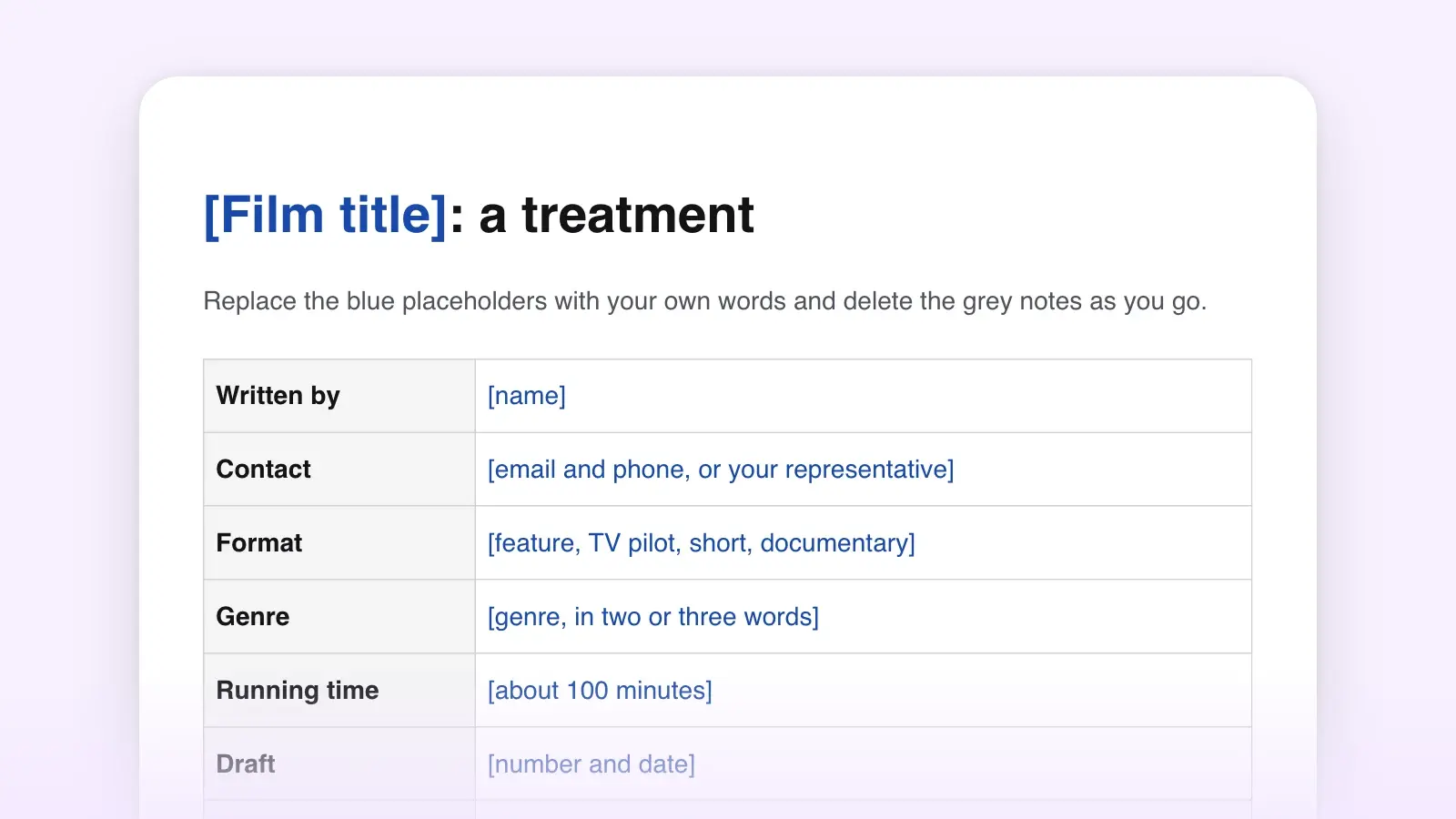
| SectionTitle page | What goes in itTitle, writer, contact, format, genre, running time, draft and date | GuideOne block at the top |
| SectionLogline | What goes in itThe film in one sentence | GuideUnder 40 words |
| SectionSynopsis | What goes in itBeginning, middle and end, ending included | GuideOne paragraph to one page |
| SectionCharacters | What goes in itEach lead: age, role, want, flaw, change | GuideTwo or three lines each |
| SectionThe story | What goes in itAct by act, in present-tense prose: what we see and hear | GuideMost of the document |
| SectionTone and look | What goes in itHow it should feel, the world, the light, the sound | GuideOne paragraph |
| SectionWhy this film | What goes in itFor a pitch: why this story, why now, why you | GuideOptional, a short paragraph |
There is no standard length, and what counts as normal depends on who asked for the treatment. A few pages can pitch a feature to a producer, a fund or lab may set its own page limit, and a treatment you write to plan every sequence for yourself can run much longer. The synopsis at the top lets a busy reader stop after one page and still know the film.
Treatments for TV, documentaries and shorts
| Project | What changes in the treatment |
|---|---|
| ProjectTV pilot or series | What changes in the treatmentTell the pilot as above, then add what a feature doesn't need: the engine that produces episodes, the season arc and where the main characters are heading. Save the full show bible for later. |
| ProjectDocumentary | What changes in the treatmentDescribe the subject, your access, the story you expect to find, how it will be told (interviews, observation, archive, narration) and why you. Expect it to change once you shoot. |
| ProjectShort film | What changes in the treatmentOne or two pages: one situation, a small cast, one turn. Skip the act headings and tell it straight through. |
| ProjectAdaptation | What changes in the treatmentSay what you keep, cut and change from the source, and confirm who holds the rights before you send it anywhere. |
| ProjectCommercial or music video | What changes in the treatmentA director's treatment: the director's take on someone else's script or song, with the look, casting, locations and references. |
For a documentary, the documentary script template takes the treatment's plan into interviews, sequences and a paper edit. Novelists pitching a book work with a different document, the novel synopsis, which many agents ask for with their own length rules.
Mistakes that sink a treatment
Reads like a film
- Present tense: what the audience sees and hears
- Every major turn on the page, the ending too
- A line or two of dialogue only where the words matter
- Scenes dramatized: “He lets her voicemail go unplayed”
- One short synopsis before the long version
Reads like notes or a novel
- Thoughts no camera can film: “She wonders if she'll ever belong”
- A teaser ending: “What will Nora choose?”
- Camera directions and shot lists
- A cast list with no story attached
- Summary in place of scenes: “They become friends”
Treatments, the WGA and copyright
In a Writers Guild deal, the treatment is paid work. The WGA's Schedule of Minimums for its 2026 Basic Agreement, effective May 2, 2026, lists feature screenplay deals “including treatment,” with an installment due on delivery of the treatment, and a separate line for a story or treatment written on its own. On spec, a treatment is a cheap way to test an idea before you spend months on a draft.
Before you send it out, know what the law covers. The US Copyright Office states it plainly: “Copyright does not protect ideas, concepts, systems, or methods of doing something.” It protects your expression, the treatment as written. As of November 2026, the WGA West Registry accepts treatments, synopses and outlines as well as scripts; a registration lasts five years, can be renewed, and doesn't take the place of registering the work with the Copyright Office. Keep dated drafts either way. This is general information, not legal advice.
Frequently asked questions
How long should a film treatment be?
There is no standard length. A treatment meant to pitch a feature can do it in a few pages, while one that plans every sequence of your draft can run much longer. Start with a one-page synopsis so a busy reader gets the whole film first, and if a producer, fund or lab sets a page limit, follow it.
Should a treatment include dialogue?
Only a little. A treatment describes what happens; the screenplay holds the dialogue. A line or two is worth quoting where the exact words carry the scene, such as a confession or the last line of the film. If you find yourself writing exchanges, you've started the screenplay.
Can someone steal my film treatment?
Copyright protects your treatment as written but not the idea behind it, as the US Copyright Office states. You can register the treatment with the Copyright Office, and the WGA West Registry also registers treatments, for five years at a time. Keep dated drafts, send work to people you have reason to trust, and ask a lawyer about anything specific.