When to use it
- A faculty application that asks for a diversity, inclusion or DEI statement
- A prompt under another name, such as a perspective, service or community statement
- A cover letter or teaching statement that asks you to address the topic in a paragraph
- A fellowship or award application with a question about mentoring or access
A diversity statement, also called a DEI statement or a statement of contributions to diversity, is a short document some colleges and universities ask faculty candidates to write about what they have done to support students and colleagues of different backgrounds, and what they would do in the job. The first rule is to answer the prompt you were given, in its own terms: prompts differ by institution, and some come under another name, such as a service or perspective statement. Fewer institutions ask for one than a few years ago, and some states bar public colleges from requesting it; a dated summary follows the samples.
How to use this template
Click Use this template and the fill-in version opens in Strokes as a document you can edit and export.
- Answer the prompt you were given
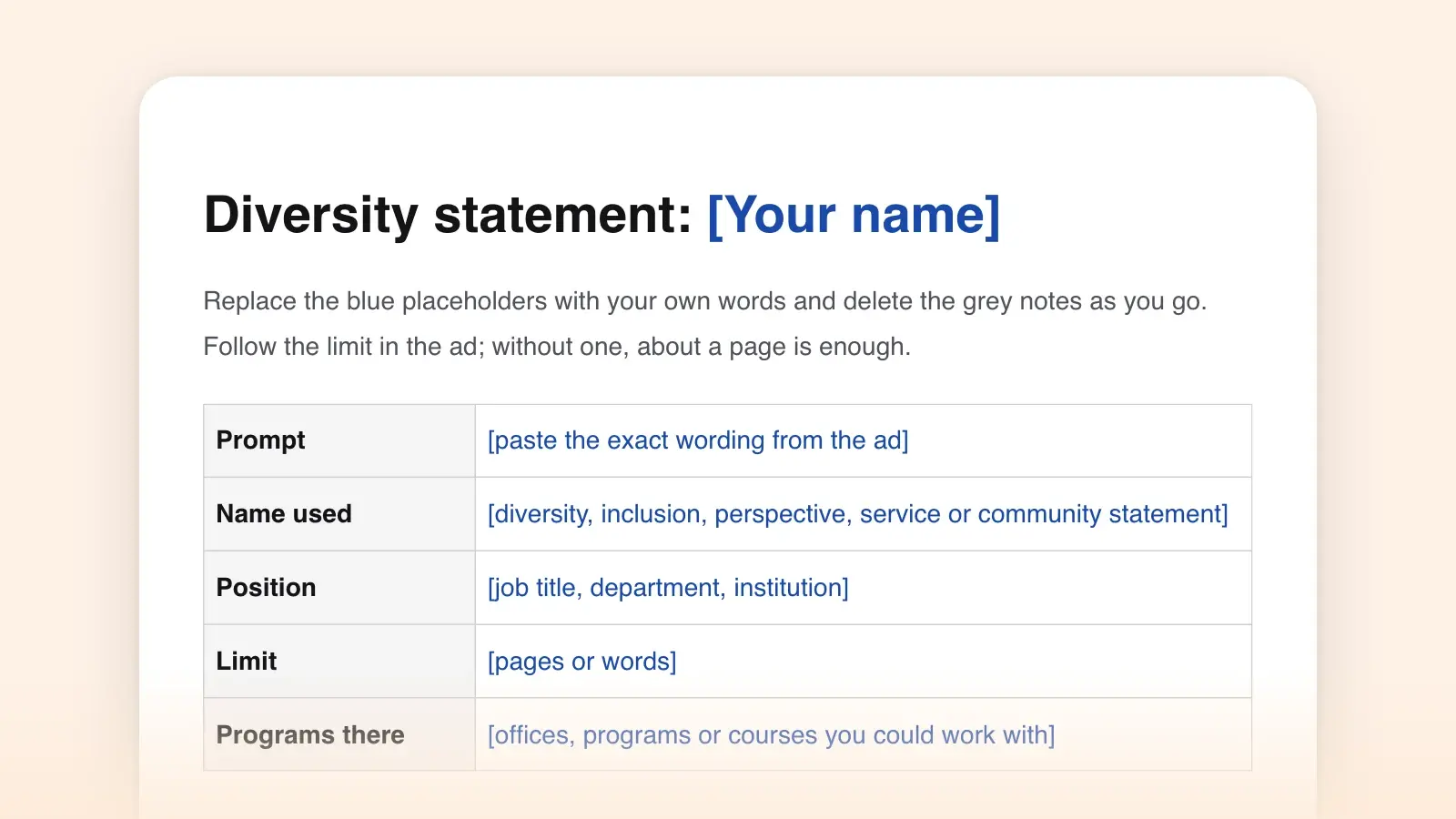
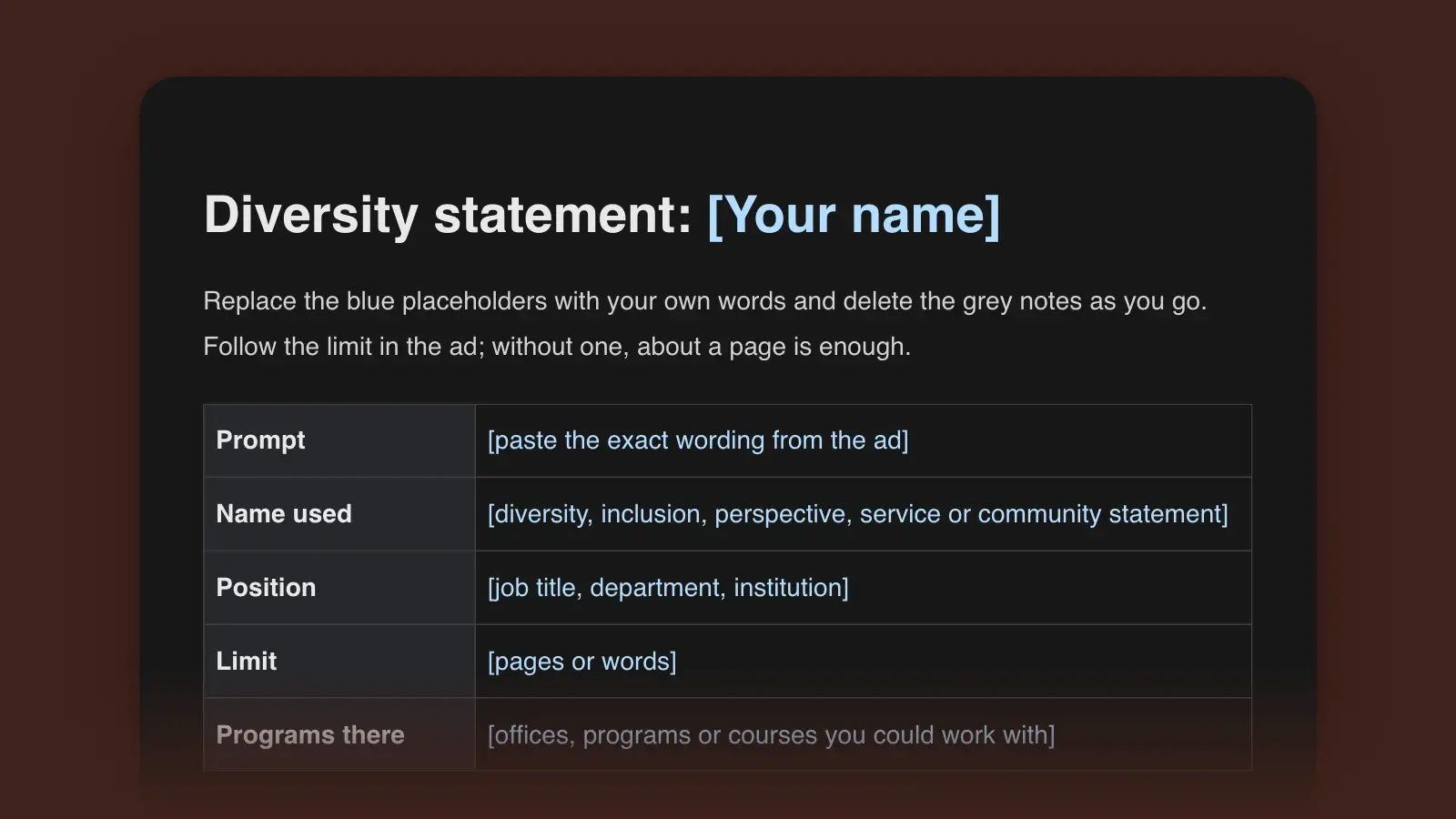
Penn's guide advises reading the instructions carefully and giving exactly the information the school asks for. Prompts differ: one it quotes asks what diversity means to you in your field and in a university community, another asks for evidence of working effectively in an urban setting. Copy the prompt into the top of the template and check every paragraph against it. Once you have a draft, you can ask the Strokes Assistant which part of the prompt the draft leaves unanswered and which claims have nothing behind them.
- List what you have actually done
Teaching, mentoring, advising, outreach, accessibility work, research with community partners, service on committees. Include small things with real results: a study session that changed who passed, a guide that helped new students read papers. Leave out what you only attended.
- Write two or three as situation, action, result
Who the students or colleagues were, what you did, and what changed, with a number if you have one. State your role plainly: founded, ran, helped with.
- Connect it to the institution
Penn suggests researching the school's own policies and programs and its student population, and linking your past work and plans to what already exists there. Name the program, the course or the office you would work with.
- Lead with what you could start in year one
A plan that uses the job's courses, time and existing programs is easy for a committee to picture. If an idea depends on a new office or budget, say what you would do before it exists.
What goes in each section
| Section | What it answers | Rough length |
|---|---|---|
| SectionOpening | What it answersWhere this work shows up in your field and your job | Rough lengthA few sentences |
| SectionEvidence | What it answersTwo or three things you did, for whom, with results | Rough lengthMost of the statement |
| SectionWhat you learned | What it answersHow the experience changed the way you teach, mentor or do research | Rough lengthA paragraph, or a line in each example |
| SectionPlans at this institution | What it answersThe programs, courses or offices you would work with, and what you would do | Rough lengthOne paragraph |
| SectionClosing | What it answersWhat you want students and colleagues to be able to count on from you | Rough lengthOne or two sentences |
Write it in the same voice as your teaching statement and your research statement, and don't repeat their examples, since a committee may read all three together.
Diversity statement sample
A complete statement for an invented candidate: a mechanical engineering PhD applying for an assistant professorship at a university that asks for a statement of contributions to diversity, equity and inclusion. About 400 words.
Much of what I know about who gets to become an engineer I learned in the machine shop. As a teaching assistant for Manufacturing Processes, I noticed that the students who struggled most with the first machining project were not the weakest students. They were the ones who had never used a lathe, and many had transferred from community colleges. This statement describes three things I have done about that, and what I would do at Ashcombe.
Open shop hours. In 2023 I started two evening sessions a week, run with the shop manager, where any student could practice on the lathe and mill before graded work. About 25 students came regularly, most of them transfer students. In the two semesters after the sessions began, the share of students who failed the first machining project fell from 18 percent to 7 percent, and the department now pays undergraduate mentors to staff the sessions.
Lab materials everyone can use. When a deaf student enrolled, I worked with the disability resource center to caption our twelve safety videos and to post a written step list at each station. The step lists turned out to help everyone: in the end-of-term survey, two thirds of students named them the most useful material in the lab.
Mentoring summer researchers. For three summers I have mentored students in the department's research program for community college transfers. Four of my six mentees presented at the undergraduate research symposium, and two are now in graduate school. I learned to schedule meetings around their jobs, not mine, and to explain the unwritten rules of a lab on the first day rather than after the first mistake.
At Ashcombe. Ashcombe's Engineering Bridge program brings incoming transfer students to campus the summer before they start. I would build on the open shop hours there, with a two-week shop module, so that transfer students reach their first graded project having already used the machines. I would judge it the way I judged the open hours: by first-project results, and by who comes back the next semester. In my own courses I would keep open shop hours, and each summer I would recruit at least one transfer student into my lab.
Engineers learn to build things in very different places before they reach us. I want the first time a student uses a machine in my courses to be practice, not a grade.
What makes it work: it answers with actions, not adjectives. Each example says what he did, for whom, and what changed, with a number. The open-hours paragraph and the plan for Ashcombe form one chain: an action, a measured change, and a next step that will be measured the same way. The accessibility example shows a change that helped more students than the one it was made for. The plans name an existing program and stay small enough to start in year one. It doesn't disclose anything about the writer's own background, and doesn't need to.
Diversity statement samples for other situations
Most students in my College Algebra sections work, and many are parents. When I moved homework deadlines from 9 a.m. to midnight and arranged Saturday-morning hours at the testing center, missed assignments fell by half. I now build every course around the week my students actually have, and I would bring the same habit to Ridgeway's corequisite sections.
At a teaching-focused institution, a course policy and its effect on the students already enrolled can be the strongest evidence you have.
My oral history project on postwar factory work is built with the county library: students in my survey course record interviews with retired workers, often their own relatives, and the recordings go into the library's local collection. Forty families have donated interviews so far, and for many students it is the first time a relative's working life has appeared in a history course.
The contribution comes through the research and teaching themselves, which suits fields where outreach and scholarship overlap.
For two years I have run the department's writing group for graduate students, which meets weekly and now has 30 members, about half of them writing in their second language. I would offer to start the same group at Ashcombe and to share the guide I wrote on reading and responding to reviewer reports, which our graduate office now sends to every new student.
A renamed prompt changes the frame, not the method: one practice, who it serves, a number, and an offer the institution can take up.
I haven't led a program, but I have tutored at the university writing center for three years, more than 400 sessions, many with first-generation and multilingual students. The habit I took from it is to ask what a student already knows how to do before I explain anything. In my own courses, I would hold the first office hour of the semester in the writing center, where many students already feel at home.
Honest about the limits, specific about what exists, and a plan that follows directly from it.
Write an honest diversity statement
The test is whether a colleague who worked beside you would recognize every sentence. The rule fiction writers call show, don't tell applies: describe what you did and let the reader draw the conclusion.
Honest and specific
- Two or three things you did, and who they helped
- Your role stated plainly: founded, ran or helped with
- What you learned, and what you changed because of it
- Plans that fit the job's courses, time and resources
- The institution's own programs, named and connected to your work
Inflated or generic
- Values and definitions with no actions
- Credit for a program you attended once
- Personal background offered in place of evidence
- Plans that depend on a new office or budget, with nothing to do first
- Phrases lifted from the institution's website
Whether you write about your own background is your choice. A statement can be strong without mentioning it, or it can explain how your background shaped the way you teach or mentor. Either way, the examples of what you have done carry the statement. If your record is thin, say so in a sentence, as the early-career sample does, and make the plan concrete. For the application's main argument, see the cover letter template; for statements written for admissions rather than jobs, the personal statement examples are closer to what you need.
Where diversity statements are still requested
Requirements have changed quickly since 2023 and differ by state, by institution and sometimes by department. Where things stood as of November 2026:
- State laws. Texas's Senate Bill 17 (2023) bars public colleges and universities in the state from compelling, requiring, inducing or soliciting a diversity, equity and inclusion statement, or giving anyone preference for providing one, beginning with the spring 2024 semester. Utah's HB 261, signed on January 30, 2024, and in force from July 1, 2024, bars the state's public colleges and universities from requiring, requesting, soliciting or compelling statements of this kind in hiring, admissions and other decisions. Texas and Utah are two of several states with such laws, so check the law in the institution's state.
- Federal guidance. A Justice Department memo of July 29, 2025, to recipients of federal funding lists diversity statements among potentially unlawful proxies when they are used in a way that advantages applicants who discuss experiences tied to protected characteristics.
- Universities. MIT (May 2024) and Harvard's Faculty of Arts and Sciences (June 2024) stopped requiring them; Harvard's FAS replaced the statement with a service statement and a teaching and advising statement, required only of finalists. In March 2025 the University of California's systemwide provost announced that the Regents had determined that requiring stand-alone diversity statements in new recruitments is no longer permitted. Berkeley's faculty-equity office says candidates can still be given opportunities to discuss such contributions "if they wish."
- Optional or renamed. Penn's career services notes that some schools have moved away from requesting diversity statements, some ask you to address the topic in your cover letter or teaching statement instead, and others request a similar document as an "inclusion statement," "perspective statement," "service statement" or simply a "statement."
Rules keep changing, so treat the job ad and the institution's current hiring page as the most reliable guide. If the ad asks for a statement, answer the prompt it gives, in its words; if it doesn't, there's no need to send one.
Frequently asked questions
Are diversity statements still required?
Less often than a few years ago. As of November 2026, Texas (from spring 2024) and Utah (from July 2024) bar their public colleges and universities from requesting them, and other states have similar laws. MIT and Harvard's Faculty of Arts and Sciences stopped requiring them in 2024, and in 2025 the University of California stopped allowing stand-alone statements to be required in new recruitments. Elsewhere they may be optional or renamed, so read each ad.
How long should a diversity statement be?
Follow the limit in the job ad or the application form. If there isn't one, a page usually holds two or three specific examples and a plan for the job. If the form gives you a short answer box instead, keep your strongest example, what changed because of it, and one sentence on what you would do in the job.
Do I have to share my own identity in a diversity statement?
That is your decision. A statement can be written entirely about what you have done and would do: teaching, mentoring, outreach, accessibility, research or service. Some writers choose to explain how their background shaped their work. Either way, specific examples of your actions are what carry the statement, and the prompt's wording tells you what it asks for.
What is an inclusion statement or a perspective statement?
They are names some institutions use for a document similar to a diversity statement, according to Penn's career services, along with service statement or simply statement. The prompt may ask about community, service or the perspective you would bring rather than diversity as such. Answer the question as worded, using the same method: specific actions, results and plans.