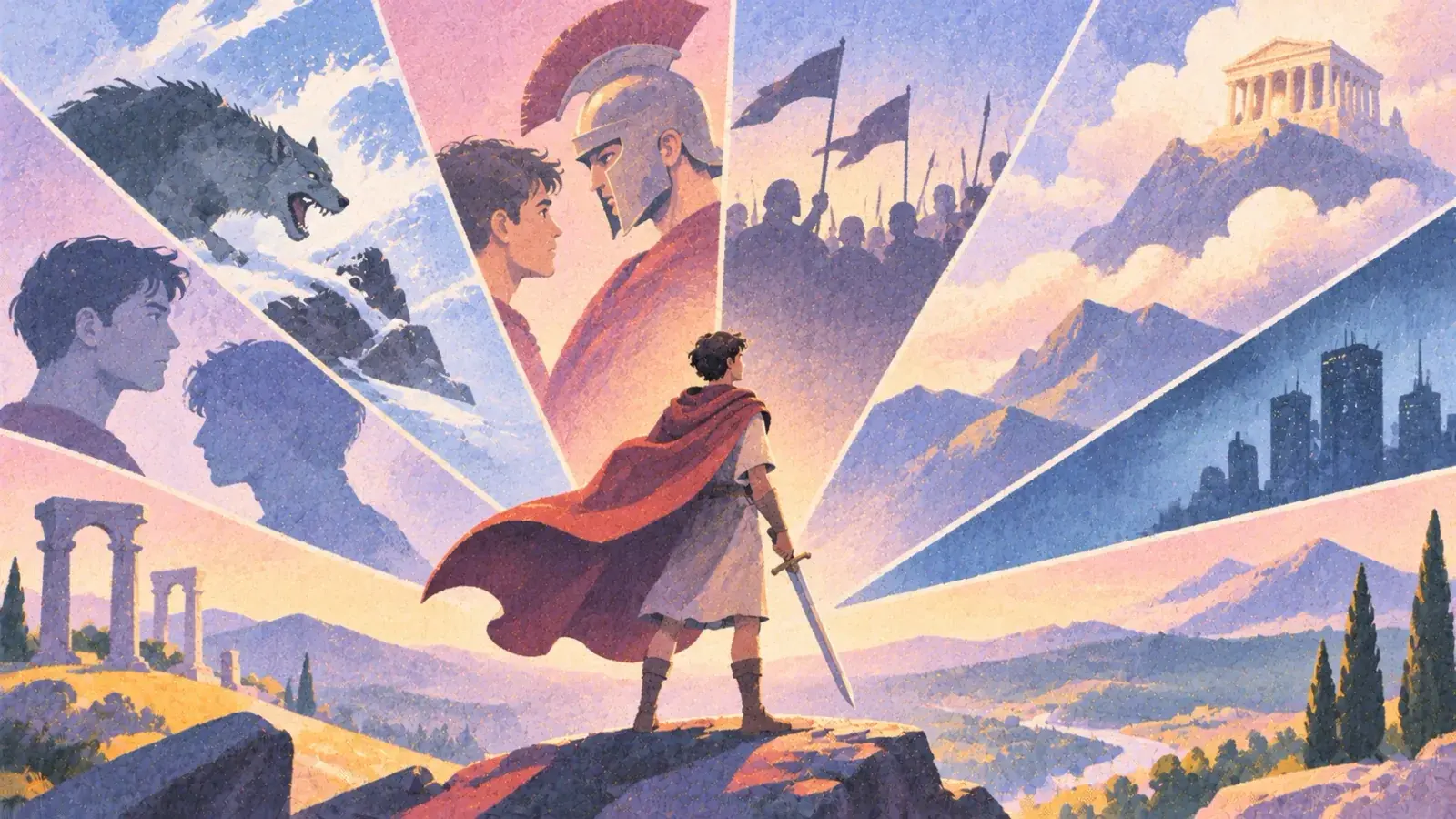
The types of conflict in literature are often given as seven, and this guide uses that list: character vs. self, character vs. character, character vs. society, character vs. nature, character vs. technology, character vs. the supernatural and character vs. fate. The first is internal, a struggle inside one mind. The other six are external, a struggle with something outside it. To name the type, ask one question: what stands between the character and what they want?
You will also meet shorter lists: three types (against another person, against nature, against oneself), or four with society added. The seven-type list splits those categories more finely, which makes it easier to say exactly where the pressure comes from. Older books say “man vs.” where most now say “character vs.” The idea is the same: a story needs a character who wants something and a force that pushes back.
The seven types at a glance
| Type | The opposing force | The question it asks | Classic example |
|---|---|---|---|
| TypeCharacter vs. self | The opposing forceTheir own fear, desire, guilt or belief | The question it asksWill they overcome what's inside them? | Classic exampleHamlet (c. 1600) |
| TypeCharacter vs. character | The opposing forceAnother person with opposing goals | The question it asksWho will win? | Classic example“The Final Problem” (1893) |
| TypeCharacter vs. society | The opposing forceLaws, customs, institutions, the crowd | The question it asksWill they conform, escape or change it? | Classic exampleThe Scarlet Letter (1850) |
| TypeCharacter vs. nature | The opposing forceWeather, wilderness, animals, illness | The question it asksWill they survive? | Classic example“To Build a Fire” (1908) |
| TypeCharacter vs. technology | The opposing forceMachines, science, systems people built | The question it asksWill the creation turn on its makers? | Classic exampleFrankenstein (1818) |
| TypeCharacter vs. the supernatural | The opposing forceGhosts, monsters, curses, gods | The question it asksCan the unnatural be beaten or understood? | Classic exampleDracula (1897) |
| TypeCharacter vs. fate | The opposing forceProphecy, destiny, chance | The question it asksCan anyone escape what is foretold? | Classic exampleOedipus Rex (c. 429 BC) |
Internal conflict: character vs. self
The struggle is inside one mind: two desires pulling against each other, or a desire against a belief, a duty against a fear. It is the only internal type, and it often gives the external ones their meaning.
- Hamlet (c. 1600). “To be, or not to be, that is the question” begins a soliloquy in which Hamlet argues both sides of going on living. He knows what the Ghost demands and can't make himself do it.
- Strange Case of Dr Jekyll and Mr Hyde (1886). Robert Louis Stevenson turns the inner split into plot. Jekyll's confession that “man is not truly one, but truly two” explains the whole book.
- Modern. Stevens, the butler in Kazuo Ishiguro's The Remains of the Day (1989), sets his devotion to duty against the life he never let himself have.
Inner conflict usually needs outside pressure to become visible. Put the character where they must choose, and the reader watches the struggle instead of being told about it. A character flaw is often where it starts.
External conflict: six opponents
Character vs. character
Two people want things that can't both happen. It is often the easiest external conflict to dramatize, because the opponent can talk back. Sherlock Holmes calls Professor Moriarty “the Napoleon of crime” in Arthur Conan Doyle's “The Final Problem” (1893), and the story ends with both men gone over the Reichenbach Falls. In Shakespeare's Othello (c. 1603), Iago destroys his general with words and a handkerchief. The opponent needn't be a villain: a rival, a parent or a lover works. What it needs is a want of its own, which the guide to writing a villain covers in depth.
Character vs. society
The opponent is a social order: its laws, customs, institutions, or the crowd that enforces them. Hester Prynne stands on the scaffold in Puritan Boston with a scarlet A on her breast in Nathaniel Hawthorne's The Scarlet Letter (1850). In Sophocles' Antigone (c. 441 BC), Antigone buries her brother against King Creon's decree. Nora Helmer walks out on her marriage at the end of Henrik Ibsen's A Doll's House (1879). Modern versions include The Hunger Games (2008) and The Handmaid's Tale (1985). Give society a face, a judge, a neighbor, a mother who enforces the rule, so the conflict can play out in scenes.
Character vs. nature
The opponent is the physical world: cold, sea, desert, animals, disease. Nature has no motive, which is what makes it frightening. In Jack London's “To Build a Fire” (1908), a man walks a Yukon trail alone at seventy-five below zero against an old-timer's advice, and dies. (In London's 1902 version he lives.) Stephen Crane based “The Open Boat” (1897) on his own shipwreck that January, and its first line puts four men at the mercy of the waves: “None of them knew the color of the sky.” Later the correspondent decides that nature is “indifferent, flatly indifferent.” Andy Weir's The Martian (2011) is a modern one. The conflict sharpens when the character's own choices make nature worse, as the lone walk does in London.
Character vs. technology
The opponent is something people built: a machine, an experiment, a system. Victor Frankenstein's creature turns on the man who made him (1818). In E. M. Forster's “The Machine Stops” (1909), people live underground, each alone in a room, with every need met by the Machine, until it fails. Karel Čapek's play R.U.R. (1920), which gave English the word robot, has its robots rise up and wipe out all of humanity but one man. HAL 9000 in 2001: A Space Odyssey (1968) and The Terminator (1984) are the modern classics. Some of the strongest versions are about dependence: the character can't live without the thing that threatens them.
Character vs. the supernatural
The opponent breaks natural law: a vampire, a ghost, a curse, a god. Bram Stoker's Dracula (1897) is the model hunt. Henry James's The Turn of the Screw (1898) never settles whether the ghosts are real or the governess imagines them, so the conflict may be with herself. In Washington Irving's “The Legend of Sleepy Hollow” (1820), the Headless Horseman may be a rival in disguise. Stephen King's The Shining (1977) is a modern example. Set rules for the force and keep them: readers will accept a monster far more readily than one whose powers change when the plot needs them to.
Character vs. fate
The opponent is destiny: a prophecy, the gods, chance. The characters struggle, and the struggle often brings about what they fear. Oedipus runs from the prophecy that he will kill his father and marry his mother, and fulfills it by running (Sophocles, Oedipus Rex, c. 429 BC). Romeo and Juliet (c. 1595) gives its ending away in the Prologue, whose sixth line is “A pair of star-cross'd lovers take their life”; the audience hopes against it anyway. Thomas Hardy closes Tess of the d'Urbervilles (1891) with the President of the Immortals ending “his sport with Tess.” Fate conflict tends to work best when the characters' own choices, not the author's coincidences, carry out the prophecy.
Layering conflicts in one story
The types name where the opposition comes from, not how many stories you have. One conflict, a single want blocked, can meet several kinds of opposition at once, and many strong stories run two or three. Here is one premise built that way.
Outside (nature): A fire lookout in Montana has two days to get a family off a ridge before the fire jumps the river.
Her world (society and character): The father refuses to leave land the bank is about to take, and the county won't send a crew to drag him out.
Inside (self): Six years ago she froze on a fire that killed her crew chief, and she hasn't trusted her judgment since.
One want runs through all three layers: get the family off the ridge in time. Four kinds of opposition stand in its way: nature in the fire, a character in the father, society in the bank and the county, and the self in her memory. Each tightens the others. The father's refusal eats the time the fire leaves her, and every hour of delay is another test of the judgment she no longer trusts.
Jane Austen's Pride and Prejudice (1813) layers the same way.
| Layer | In the novel |
|---|---|
| LayerCharacter vs. character | In the novelElizabeth against Darcy's pride, and later against Lady Catherine de Bourgh |
| LayerCharacter vs. society | In the novelAn entail that will pass the family home to Mr. Collins, and a marriage market where five daughters without fortunes must marry |
| LayerCharacter vs. self | In the novelElizabeth's own prejudice, which she sees only when she rereads Darcy's letter: “Till this moment, I never knew myself.” |
Society's rules sharpen the clash between Elizabeth and Darcy. The clash forces her to see herself. And the changed Elizabeth is the one who can face down Lady Catherine, the society conflict in person. To check your own draft, write one line per layer for the protagonist: who or what opposes them outside, what in their world makes it harder, and what inside them makes it hardest. An empty line is a layer the story could add.
With the chapters attached, the Strokes Assistant can find where each layer appears and tell you which one goes quiet for long stretches.
Building conflict into a draft
- Start with a concrete want
Conflict is a want meeting resistance. “She wants freedom” is too big for a scene; “she wants the lease on the corner bakery before her brother signs it” can be played out on the page.
- Give the opposition momentum
The opposing force has to push, not just sit there: a rival with a plan, a storm getting worse, a rule someone is enforcing. An obstacle that never moves is scenery.
- Escalate in steps
Each round should cost more than the last. Switching layers helps: when the fight with the rival stalls, let the town turn against the protagonist.
- Tie the outer conflict to the inner one
Aim the external pressure at the character's weak point, so that winning outside requires changing inside.
- Decide it at the climax
Every conflict you open needs an answer, and the main one gets the climax. Smaller ones can close earlier, or in the denouement.
Common conflict mistakes
- Bickering instead of conflict. Characters argue, but nothing they want is at stake, so nothing changes.
- Society as wallpaper. The oppressive regime is described but never shows up in a scene to stop anyone.
- Nature that waits. The mountain is there, but the weather never turns and the climb never forces a choice.
- Resolved by chance. A storm, a heart attack or a stranger ends the conflict, and the protagonist's choices stop mattering.
Practice: name the conflict. Which type drives each premise? (1) A deep-sea welder's air line snags on a wreck as a storm builds above. (2) A teacher keeps a banned novel on her reading list after the school board orders it removed. (3) A widower can't make himself open his wife's last letter. (4) Two chefs bid for the same restaurant lease. (5) A city's new water-allocation software starts cutting off the poorest districts. (6) A girl foretold to burn her kingdom down tries to live a blameless life.
Frequently asked questions
What are the 4 types of conflict?
Shorter lists use four: character vs. character, character vs. society, character vs. nature and character vs. self. The seven-type list keeps those four and adds technology, the supernatural and fate, which shorter lists fold into nature or society. Both lists describe the same idea: a conflict is named after the force that opposes the character.
Is character vs. society internal or external?
External. The opposing force is outside the character: laws, customs, institutions or the people who enforce them, as in The Scarlet Letter or The Hunger Games. It often comes with an internal conflict, though. A character who defies society usually has to fight their own fear of exclusion or punishment as well.
Can a story have more than one type of conflict?
Yes, and many do. A novel usually has one main conflict that the climax decides, plus others layered around it. Pride and Prejudice sets Elizabeth against Darcy, against the rules of inheritance and marriage, and against her own prejudice, and each layer pushes on the others.
What is the difference between conflict and tension?
Conflict is the opposition itself: a character wants something and a force resists. Tension is what the reader feels about it, the uncertainty and dread about how it will turn out. Conflict is the usual source of tension, but tension can also come from a secret the reader knows and a character doesn't, or from a deadline drawing near.