Podcast interview questions work best when they're open, specific and asked in the right order: easy questions first, the guest's story next, the hard ones once they're warm, and a reflective close. The 150 below are grouped by stage of the interview, from the pre-interview call to the last question, and by kind of guest. Pick eight to twelve, write a follow-up under each, and listen more than you ask.
| Group | Use it for | Questions |
|---|---|---|
| GroupBefore the interview | Use it forThe pre-interview call, not the recording | Questions1–10 |
| GroupOpening and warm-up | Use it forThe first five minutes | Questions11–22 |
| GroupOrigin and backstory | Use it forHow they got here | Questions23–36 |
| GroupThe work itself | Use it forWhat they do, and how | Questions37–50 |
| GroupTurning points | Use it forThe middle, once they're warm | Questions51–64 |
| GroupFollow-up questions | Use it forWhenever an answer opens a door | Questions65–80 |
| GroupClosing questions | Use it forThe last five minutes | Questions81–90 |
| GroupAuthors and writers | Use it forBook launches and craft talk | Questions91–100 |
| GroupFounders and owners | Use it forBusiness and startup shows | Questions101–110 |
| GroupExperts and academics | Use it forScience, research, explainers | Questions111–120 |
| GroupArtists and makers | Use it forMusic, art, craft | Questions121–128 |
| GroupPublic servants and organizers | Use it forLocal, civic and nonprofit shows | Questions129–136 |
| GroupOne remarkable story | Use it forWitnesses, unusual jobs, first-person accounts | Questions137–142 |
| GroupLightning round | Use it forA fast change of pace near the end | Questions143–150 |
Flat questions and better ones
Here is the same moment in an interview with a baker, asked two ways.
HOST: Was opening the bakery hard?
GUEST: Oh, yeah. Really hard. Long hours.
HOST: How did that feel?
GUEST: Exhausting, honestly.
HOST: What was the hardest morning in the first year?
GUEST: The Saturday the oven died. We had three hundred croissants ordered for a wedding, and at four in the morning it just stopped.
HOST: What did you do?
GUEST: Called the pizza place across the street. Sal opened up at five and let us bake in his oven until ten. I still don't know why he said yes.
HOST: Did you ever ask him?
The first question can be answered with one word, and its follow-up asks for a feeling the guest has already summarized. The second asks for one morning, so the answer arrives as a scene, and “What did you do?” keeps it moving. Now look at where the last question came from. The guest ended on “I still don't know why he said yes,” and the host picked up that loose end instead of moving to the next question on the list. “Did you ever ask him?” isn't on any list, including this one: it was waiting in the answer. Prepare the questions below, then listen for the line a guest leaves unfinished.
Questions that open
- What did your first customer buy?
- What was the hardest week?
- What did you say when you heard?
- One question, then silence
- What should someone try this week?
Questions that close
- Tell us about yourself.
- Was it hard?
- How did that make you feel?
- Three questions joined with “and”
- Any advice for our listeners?
Questions for the pre-interview
A ten-minute call a few days before the recording. These questions are for planning, not for the episode, so each one comes with what it's for. None of them belongs on tape.
- What do interviewers usually ask you that you're tired of answering? — Skip those, or find a new way in.
- What's a story you tell friends that you've never told on a show? — Often the best tape of the episode.
- Is there anything you'd rather not talk about? — Ask early, and keep to the answer on the day.
- Is there anything from past interviews you'd like to correct? — Guests remember a misquote for years.
- How do you say your name, and the names of anyone you might mention? — Write the answers phonetically in your notes.
- What would make this hour worth your time? — Tells you what the guest wants from the episode.
- Who do you hope hears this, and what do you want them to do afterward? — Shapes the closing questions.
- Which numbers, dates or titles might come up? — So you can check them before you publish.
- Where will you record from, and what's the room like? — Better to hear about the echoing kitchen now.
- Who else should I talk to before I talk to you? — Colleagues and critics give you questions the guest won't expect.
Opening and warm-up questions
Easy to answer and hard to answer badly. The first minutes are for the guest to relax and for you both to find the rhythm.
- Where are you right now, and what can you see from where you're sitting?
- What did this morning look like before you sat down to talk?
- How would you explain what you do to a ten-year-old?
- What's on your desk this week that tells us something about your work?
- How did you introduce yourself the last time you met a stranger?
- What were you doing this time last year?
- What are you working on this week that has nothing to do with why I invited you?
- What's the most recent thing you changed your mind about?
- How did your family describe your job when you first started?
- What's something small that went right today?
- What's the question you were hoping I'd start with?
- Before we get into it, what should listeners know about you that isn't in your bio?
Origin and backstory questions
Ask for moments, not summaries. “When did you first notice” gets a scene; “tell us about your background” gets a résumé.
- When did you first notice you cared about this?
- Who was the first person to take your interest seriously?
- What did you want to be before you wanted to be this?
- What was the first thing you made, wrote or built that someone else saw?
- Where did you grow up, and where does it show up in your work?
- What did your parents do for a living, and what did you learn from watching them?
- What was your first job, and what did it teach you that you still use?
- Was there a moment you almost quit before you'd really started?
- Whose work did you copy when you were starting out?
- What did you believe about this field then that you don't believe now?
- What decision from your twenties would you make again?
- What was the first money you earned from this, and what did you spend it on?
- What did you have to unlearn?
- What part of your story usually gets left out?
Questions about the work
The middle of most interviews. Ask for the process step by step, so a listener could picture doing it.
- Walk me through a normal working day, from the first thing you do.
- What does a good day look like, and how often do you get one?
- What part of your work does nobody see?
- Which tool or habit would you be lost without?
- How do you decide what to work on next?
- What's the hardest part of your job that looks easy from outside?
- Take me through one project, from the first idea to the day it was done.
- Where do you get stuck, and what do you do then?
- What do you do differently from most people in your field?
- How do you know when something is finished?
- What beginner's mistake do you still catch yourself making?
- Who do you work with most closely, and what do they do that you can't?
- What do you measure, and what do you deliberately ignore?
- What do you do that you'd never recommend to anyone else?
Turning points and hard moments
Save these for the second half, after the guest trusts you. Ask one, then wait. Before the most personal ones, give the guest an easy way out (“Pass if you'd rather not”), and if they take it, move on without comment.
- When did it nearly fall apart?
- What was the worst week you've had doing this?
- Tell me about a time you were sure you were right and weren't.
- What did you give up to get here?
- Which “no” changed the direction of your work?
- What decision did you agonize over longest?
- When did you first feel you'd made it, and did the feeling last?
- What criticism stung, and was any of it fair?
- What did you do the day after your biggest failure?
- Who did you let down along the way, and did you tell them?
- What would you be doing if this hadn't worked?
- What are you still not sure you got right?
- When did you ask for help, and who gave it?
- What did success cost that nobody warned you about?
Follow-up questions that find stories
Much of the best tape comes from the second question, not the first. Keep these within reach for every answer; each comes with when to use it. A follow-up that goes somewhere painful can be declined like any other question, so leave the door open as you ask it.
- What happened next? — Keeps a story moving. Often the most useful follow-up of all.
- What did that look like? — Turns a summary into a scene a listener can picture.
- What was going through your head right then? — Gets the inside of an event, not just its outline.
- Can you give me an example? — After any general claim.
- Who else was there? — Adds people and a second point of view.
- What did you say? — Gets the actual words, which make better audio than a paraphrase.
- Why do you think that is? — Asks for the reasoning behind a fact.
- What do you mean by …? — For jargon: repeat their word back to them.
- How did you know? — Tests a conclusion without challenging the person.
- And then? — The shortest follow-up, and often enough.
- What would the other side say? — Invites fairness on a contested point.
- Was that the first time? — Finds the pattern behind an incident.
- What did you do about it? — Moves from feeling to action.
- Say more about that. — For an answer that stopped too soon.
- What's the part of that story you usually skip? — Opens the version they've polished over the years.
- Is that still true? — Checks whether an old view has changed.
Questions to close the interview
Leave five minutes for these. The last answer is often the one listeners remember.
- What's one thing you'd like a listener to try this week?
- What are you working on now that you can talk about?
- What should I have asked you?
- What do you believe about your work that would start an argument among your colleagues?
- Who should I talk to next, and why them?
- What would you tell yourself on your first day?
- Where can people find your work, and which piece should they start with?
- What could a listener do that would help you most?
- What are you curious about right now that has nothing to do with your work?
- If we talk again in five years, what do you hope you'll be telling me?
Questions for authors and writers
Book interviews tend to go flat when every question is about the plot. Ask about the making of it.
- What's the first sentence you wrote for this book, and is it still in there?
- What did you cut that you miss?
- Where do you write, and what's on the wall?
- How long did the first draft take, and how long did everything after it take?
- Which scene or chapter was hardest to get right?
- Who reads your drafts first, and what do you ask them to look for?
- What did your editor change that you fought, and who was right?
- What did you research that never made it onto the page?
- Which book did you keep rereading while you wrote this one?
- What would you tell a writer who's stuck halfway through a draft?
Questions for founders and owners
Ask for decisions and numbers, not the pitch. The pitch is on the website.
- What problem were you trying to solve for yourself when you started?
- What did the first version look like, and who was your first customer?
- What number do you check every morning?
- What did you spend money on early that you shouldn't have?
- When did you hire your first person, and what did you get wrong about it?
- What do customers use your product for that surprised you?
- Which of your decisions did your advisers or investors disagree with?
- What does a bad month look like now, compared with the first year?
- What do you still do yourself that you could hand to someone else?
- What would you do differently if you started again tomorrow?
Questions for experts and academics
Experts are used to explaining. Ask about doubt, method and what doesn't fit, and you may get the interview they don't usually give.
- What question are you trying to answer, in one sentence?
- What does the public most often get wrong about your field?
- What's the most interesting result you've found that doesn't fit?
- How sure are you, and what would change your mind?
- What does a working day in the lab, the archive or the field actually look like?
- Which finding in your area gets more attention than it deserves?
- What experiment would you run if money were no object?
- How do you explain your work at family dinners?
- Which open question in your field do you think will be answered first?
- What should a listener read if they want to go deeper?
Questions for artists and makers
Ask about materials, habits and unfinished work. Audio can't show the art, so the questions have to help the guest describe it.
- What does a piece look or sound like halfway through?
- Which of your tools is older than your career?
- What was the first thing you made that you were proud of, and do you still like it?
- Where does a new piece usually start: a sound, an image, a material, a line?
- What do you do on days when nothing works?
- How has your work changed since people started paying for it?
- Who taught you a technique you still use every week?
- Which piece took the longest, and why?
Questions for public servants and organizers
For local, civic and nonprofit shows. Ask about the people served and the trade-offs, and keep the questions neutral on politics.
- Who does your work serve, and how do you hear from them?
- What does success look like on an ordinary Tuesday?
- Which rule or policy shapes people's lives without most of them knowing it exists?
- What's the hardest trade-off you've made with a limited budget?
- Tell me about one person whose situation changed because of your work.
- What do new volunteers usually misunderstand?
- What would you do with one more person on staff?
- What can a listener do this month if they want to help?
Questions for one remarkable story
For guests who are on the show because of one event. If it involves loss or harm, agree in advance what's off limits, and tell them they can stop at any point. Before each follow-up that goes deeper, offer the way out again.
- Where were you when it started, and what were you doing?
- What's the first thing you remember noticing?
- Who did you call first?
- What do people get wrong when they retell this story?
- What did you do the next morning?
- How has the way you tell this story changed since the first time?
Lightning round questions
Short answers only, near the end, when the energy needs a lift.
- Coffee or tea, and how do you take it?
- The last book you finished?
- A word you overuse?
- The best advice you ignored?
- One tool you'd keep if you could keep only one?
- A place you'd go back to tomorrow?
- A skill you'd learn in a weekend?
- What are you looking forward to this week?
How to build the interview
- Research before you write a question
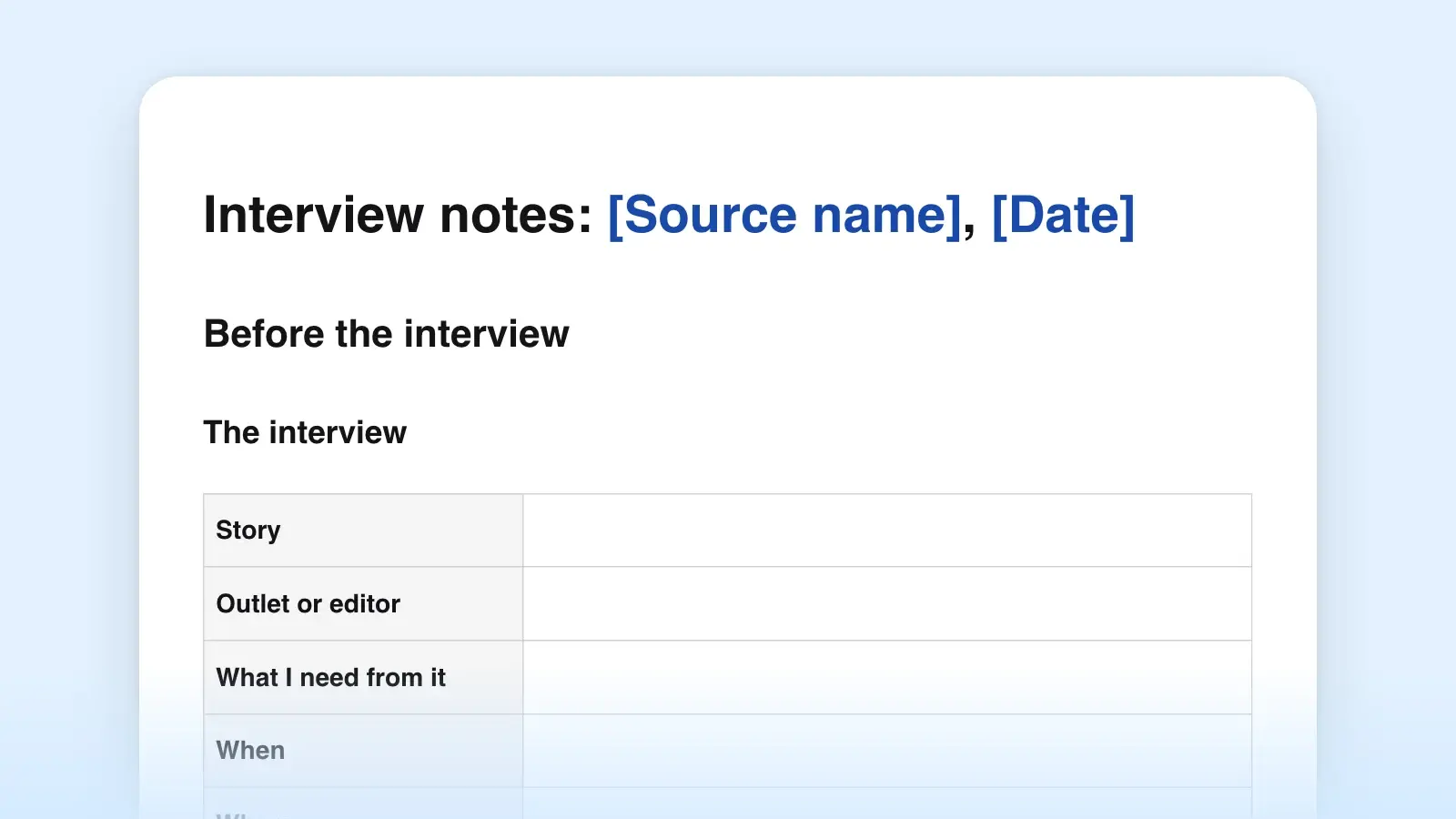
Read or listen to the guest's recent work and two or three of their recent interviews. Note what they've been asked every time; those are the questions to skip. The interview notes template keeps the research, quotes and facts to check in one place.
- Make the pre-interview call
Ten minutes, questions 1 to 10. Agree on anything off limits, get the pronunciations, and listen for the story they light up telling. That story often belongs in the episode.
- Pick a spine of eight to twelve
Choose from the stage groups in order: warm-up, origin, the work, a turning point, the close. Add three or four from the guest's own group. Put the hardest question two-thirds of the way through.
- Write the first question in full, and follow-ups under each
The first question sets the tone, so write it out and know it by heart. Under every main question, note two likely follow-ups from the list above.
- In the room, listen
Tick questions off rather than reading them. After an answer, wait a beat before you speak: guests often add the best line into the pause. When an answer opens a better door than your next question, go through it.
- Close on time
Leave five minutes for the closing questions and end with 83. Thank the guest, tell them when the episode comes out, and send them the link. Then turn the list into segments with the podcast outline template.
Mistakes that flatten an interview
- Reading the bio back as a question. “So you founded three companies and wrote two books…” gives the guest nothing to say but yes. Introduce them yourself, then ask.
- Double-barreled questions. Ask two things at once and the guest usually answers the easier one.
- Leading questions. “Wasn't that terrifying?” puts your word in their mouth. “What was that like?” lets them choose their own.
- Filling every pause. Silence feels long on your side of the microphone and short on tape. Count to two before you speak.
If you keep the list in Strokes, ask the Strokes Assistant to review it before the call for double-barreled, leading and yes-or-no questions, which are easy to miss in your own wording.
Frequently asked questions
How many questions should I prepare for a podcast interview?
For a 30- to 45-minute interview, prepare eight to twelve main questions in order, with two likely follow-ups under each. You won't ask them all. A spine of questions lets you follow the guest's best answers without losing the shape of the episode, and you can drop the rest when a conversation takes off.
Should you send podcast questions to the guest in advance?
Send the topics and one or two sample questions, not the full list. Guests who read a list tend to prepare answers, and prepared answers can sound rehearsed. The exception is anything that needs facts or figures: tell the guest in advance so they can check, and confirm anything that's off limits.
How do you start a podcast interview?
Introduce the guest yourself, then ask something easy and specific: where they are, what their morning looked like, how they'd explain their work to a child. Avoid “tell us about yourself”, which invites a résumé. The first few minutes are for the guest to relax; the harder questions come once you've found the rhythm.