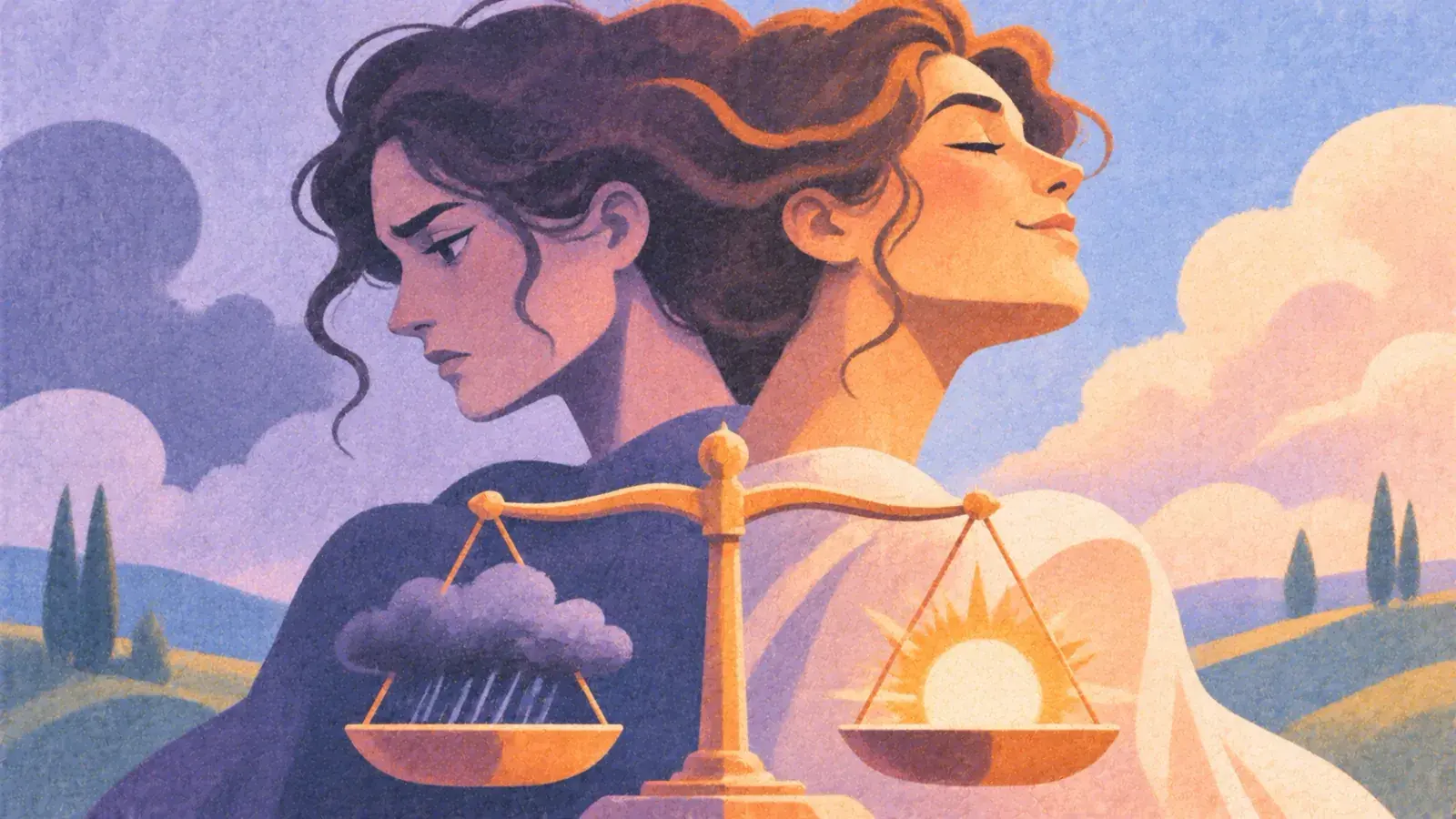
Character strengths and weaknesses are the qualities that help a character get what they want and the ones that get in the way. They're balanced when each strength costs something on the page and each weakness has a reason the reader can follow. Often the most convincing pair is one trait seen twice: the loyalty that makes a hero worth following is the same loyalty that keeps her defending the wrong man.
This page is the method for putting the two together in one person: seven steps, then a worksheet to fill in, with a worked example. If you only need names of traits, use the lists instead. For 100 weaknesses, each paired with the strength it grows from, see the personality weaknesses list; for 150 strengths and how each one backfires, the positive character traits list.
How to balance a character
- Choose the strength the climax will need
Work backward from the end. If the final scene needs her to hold her nerve, courage or composure is the core strength, and the chapters before it test that strength from different sides.
- Find its shadow
Pick the weakness the same habit produces, from the Aristotle table further down or the 100 pairs in the weaknesses list. A weakness from the same root is easier to believe because the reader has watched the root at work.
- Show the strength winning first
Give the strength an early scene where it solves a problem at small cost. Readers are quicker to forgive a trait they've seen work.
- Make the weakness cost more each time
The second time the habit shows, it costs something. The third time, it costs something the character cares about, in front of the reader.
- Aim the antagonist at the strength
Some of the sharpest opponents work on the hero's strength rather than the weakness, because the hero can't give up a strength without becoming someone else. The guide to writing a villain shows Iago doing exactly this to Othello's trust.
- Add a counterweight
Give the character a second strength that checks the first, or a person who does: a careful friend for a bold hero. A foil with the opposite balance makes both of them easier to see.
- End with the right amount
In many positive arcs the strength survives and its use changes. Decide what the right amount looks like on the last page; the guide to character arcs shows where the turns fall.
A strengths and weaknesses worksheet
Fill this in for each main character, in order. It fits on one page, and the answers slot into the character profile template.
- The strength, in one word, and one sentence of what it looks like in action.
- Where it came from: the person or event that taught it.
- The weakness it casts, and the clause it breaks: wrong person, wrong extent, wrong time, wrong motive or wrong way (explained in the next section).
- Who brings out the weakness, and why that person.
- The scene where the strength wins, with its chapter.
- Two or three scenes where the weakness costs something, each costing more.
- How the antagonist, or the plot, uses the strength.
- The counterweight: a second strength or a person that checks the first.
- What the climax asks of the strength.
- The right amount: how the character uses the strength on the last page.
1. Strength. Never turns anyone away. The only large-animal vet in a Minnesota farm county, she'll drive out at 3 a.m. for a calving.
2. Source. Her father's practice, where he took eggs and firewood as payment and she rode along in the truck.
3. Weakness. The same habit, too much: ninety-hour weeks, unpaid bills, and nobody she ever says no to.
4. Who brings it out. Her ex-husband, who “just needs one favor,” and the old farmers who knew her father.
5. Strength wins. Chapter 2: the blizzard calving no one else would drive to.
6. Weakness costs. Chapter 7: she misses her daughter's concert. Chapter 13: an exhausted dosing mistake, and a dog nearly dies. Chapter 19: the bank calls in the loan.
7. How it's used against her. A regional vet chain offers to buy the practice and keep her on salary, knowing she'll say yes to keep serving the county.
8. Counterweight. Freya, her fifteen-year-old daughter, who says no on her behalf.
9. What the climax asks. To turn one person away, the ex-husband, so she can keep the practice for everyone else.
10. The right amount. She hires a new graduate for the night calls and takes Thursdays off. She still never turns an animal away.
The strength and the weakness are the same sentence. The plot never asks Bea to stop caring; it asks her to choose who gets her care, which is Aristotle's “right person” test, from the next section, turned into a story.
With the worksheet filled in, attach it and a few chapters and ask the Strokes Assistant whether the strength helps before it hurts and where the weakness costs something. Compare its answer with lines 5 and 6.
The strength that becomes the weakness
The idea is old. Aristotle's Nicomachean Ethics describes a virtue as “a mean between two vices, that which depends on excess and that which depends on defect” (Book II, in W. D. Ross's 1908 translation). Courage, his best-known case, sits between cowardice and rashness. For balance, both sides matter: a strength can fail a character by running short as well as by running over.
| Strength | Too little | Too much |
|---|---|---|
| StrengthTruthfulness about yourself | Too littleMock modesty | Too muchBoastfulness |
| StrengthReady wit | Too littleBoorishness | Too muchBuffoonery |
| StrengthTrust | Too littleSuspicion | Too muchGullibility |
| StrengthLoyalty | Too littleFickleness | Too muchBlind loyalty |
| StrengthConfidence | Too littleSelf-doubt | Too muchArrogance |
| StrengthCaution | Too littleRecklessness | Too muchParalysis |
| StrengthCompassion | Too littleColdness | Too muchEnabling |
| StrengthAmbition | Too littleDrift | Too muchRuthlessness |
Aristotle adds that the mean isn't a fixed amount. Of anger and of giving money, he says that “to do this to the right person, to the right extent, at the right time, with the right motive, and in the right way, that is not for every one, nor is it easy.” Each clause is a different way for a strength to misfire, and each one hands you a scene:
- The wrong person. Patience with the bully and none with the child.
- The wrong extent. Too little caution and the expedition doesn't come back; too much and it never leaves.
- The wrong time. Calm that steadies the crew in a storm and reads as indifference at a hospital bedside.
- The wrong motive. Generosity that keeps a tally: the gifts are real, and so is the debt they create.
- The wrong way. Honesty used as a weapon: the truth is right and the delivery is cruel.
Pick the clause that fits your character, and the weakness arrives with its own scenes attached.
Examples from classic novels
Three public-domain novels whose characters fail by their best qualities, and what each one teaches about balance.
Elizabeth to Jane: “You never see a fault in anybody. All the world are good and agreeable in your eyes.”
Charlotte Lucas, on Jane's composure: “If a woman conceals her affection with the same skill from the object of it, she may lose the opportunity of fixing him.”
Elizabeth, once Bingley has gone back to London: his “easiness of temper, that want of proper resolution, which now made him the slave of his designing friends.”
Jane's good nature and Bingley's easy temper are why readers like them, and together they nearly end the romance. Jane hides her feelings so well that Darcy decides she doesn't care, and Bingley lets his friends talk him out of returning. Neither changes much. The balance comes from the cast: Elizabeth's frankness and Darcy's admission that he was wrong do what the two agreeable people can't.
She had been forced into prudence in her youth, she learned romance as she grew older: the natural sequel of an unnatural beginning.
Austen pins down the moment the strength turns. Anne Elliot is nineteen, “Captain Wentworth had no fortune,” and the person urging caution is Lady Russell, “one who had almost a mother's love, and mother's rights.” In that company, good sense and deference to her elders look like the right instincts, so she “was persuaded to believe the engagement a wrong thing: indiscreet, improper, hardly capable of success, and not deserving it,” and gives him up. The strengths are real. Her age, his lack of fortune and the adviser she trusts make them a liability. At twenty-seven she believes she “should yet have been a happier woman in maintaining the engagement.” The novel doesn't make her reckless. It gives her the choice again when she's old enough to trust her own judgment: the same strength, in the right amount.
…an extraordinary gift for hope, a romantic readiness such as I have never found in any other person…
Nick says this before the reader has met Gatsby, and it's praise. The same readiness lets Gatsby invent himself and convinces him the past can be had back. The character flaws list counts his refusal to let go of the past as a fatal flaw; this is the same gift seen from the front, and it's the quality Nick admires most.
Borrow strengths from psychology
Psychologists use “character strengths” in a narrower sense. The VIA Institute on Character publishes a classification of 24 strengths under six virtues, and it makes a good menu for a character's core strength. The third column below is ours, not VIA's: what each family of strengths can look like when a character overdoes it.
| Virtue | VIA strengths | Overdone in a character |
|---|---|---|
| VirtueWisdom | VIA strengthsCreativity, curiosity, judgment, love of learning, perspective | Overdone in a characterThe dabbler, the know-it-all, the one who sees every side and picks none |
| VirtueCourage | VIA strengthsBravery, honesty, perseverance, zest | Overdone in a characterRecklessness, bluntness, stubbornness, energy that wears everyone out |
| VirtueHumanity | VIA strengthsKindness, love, social intelligence | Overdone in a characterPeople-pleasing, smothering, manipulation |
| VirtueJustice | VIA strengthsFairness, leadership, teamwork | Overdone in a characterRigidity, bossiness, going along with the group |
| VirtueTemperance | VIA strengthsForgiveness, humility, prudence, self-regulation | Overdone in a characterThe doormat, self-erasure, indecision, coldness |
| VirtueTranscendence | VIA strengthsAppreciation of beauty and excellence, gratitude, hope, humor, spirituality | Overdone in a characterSnobbery, deference, denial, flippancy, otherworldliness |
Mistakes that unbalance a character
- Strengths with no cost. A hero who is brave, kind and clever and never pays for any of it gives readers nothing to worry about, and they stop worrying early.
- Weaknesses with nothing behind them. A character who is only difficult gives readers no reason to stay. Show the strength the weakness comes from.
- Unrelated pairs. “Brilliant surgeon, terrible at parking” is two facts, not a character. Pairs that share a root interact; random ones just sit there.
- Counting instead of balancing. Three good traits and three bad ones don't add up to balance. One strength and its shadow, shown well, does.
- A weakness that switches off. If the trait vanishes the moment the plot stops needing it, readers notice. Let it flare once after the change, at a lower cost.
- Curing the strength. An ending that takes away the loyalty, the courage or the hope takes away the character. Adjust the amount, not the trait.
Frequently asked questions
How do you fix a character who is too perfect?
Take their best strength and push it one step too far: the brave one takes a risk that hurts someone else, the kind one can't refuse the wrong request. Then make it cost something in a scene the reader sees. The character stays admirable and becomes believable.
Do weaknesses make a character less likable?
Usually the opposite. Readers warm to characters whose weaknesses they understand, especially when the weakness grows out of something admirable, like a generous person who can't say no. What makes a character unlikable is a weakness with no reason behind it, or one that hurts other people and never costs the character anything.
Does a character have to overcome their weakness?
No. In a positive arc the weakness usually loosens, but in a tragedy it wins, and some characters barely change at all. Jane Bennet and Mr. Bingley end Pride and Prejudice much as they began, and Elizabeth and Darcy supply the balance their good nature lacks. What the story needs is a weakness that costs something on the page, whatever happens to it at the end.