When to use it
- A teacher or counselor writing for a student's college, scholarship or summer program application
- A professor supporting an application to graduate school, a fellowship or a research position
- A manager recommending a current or former employee to a new employer
- A colleague or client vouching for someone's work when a hiring manager asks for a letter
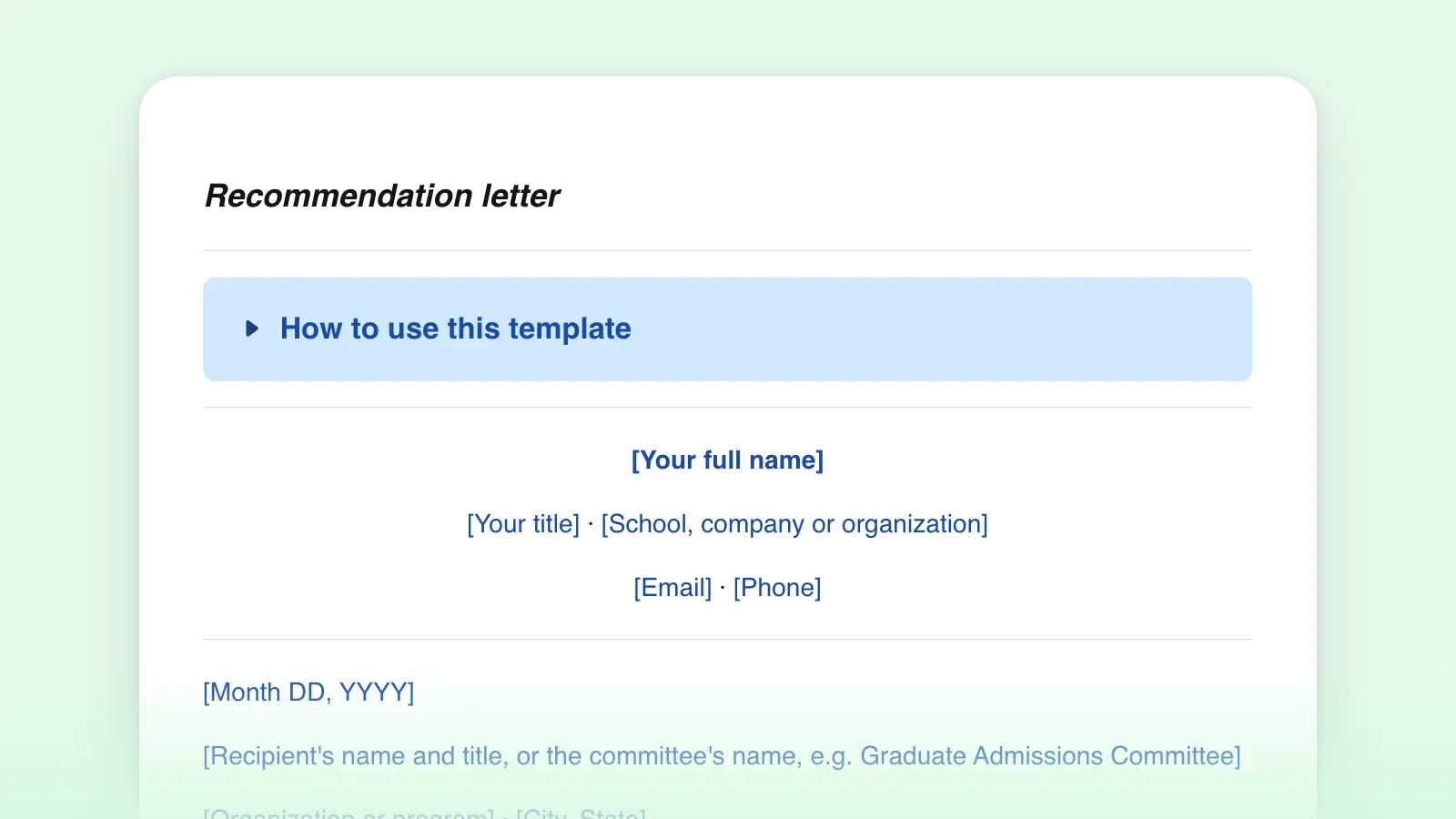
How to use this template
- Collect the facts before you write
Ask the candidate for the exact name of the position or program, the deadline, how the letter is submitted (an upload link, an email address, a form), their résumé, and two or three things they hope you will mention. If you cannot write a strong, specific letter, say so now. A late no is worse than an early one, and a lukewarm letter does more damage than none.
- Pick two qualities and one story for each
Choose the two qualities this reader cares about most. A graduate program wants to know whether the student can do research on their own. An employer wants the main requirement of the job. For each quality, find one moment you saw yourself. If no story comes to mind, that is not a quality you can vouch for, so pick another.
- Write the comparison and the verdict
These are the two sentences readers hunt for. Say where the candidate ranks among the people you have known in the same role, with the size of the group, and end with a recommendation that has no hedge in it. "I believe she would do well" reads as a warning.
- Keep it to one page, sign it, send it as asked
Download the .docx to paste onto your school or company letterhead, sign it, and export a PDF unless the portal asks for something else. Upload or send it a few days before the deadline, then tell the candidate it is in.
Three versions of the letter
The structure holds for every recommendation. What changes is your relationship to the candidate, which qualities matter to the reader, and who you are comparing them against. All three letters below are invented, names and places included.
For a student
Teachers and professors should write about how the student thinks and works, because the transcript already shows the grades. Name the courses you taught them and compare them with a group you can count.
Dear Admissions Committee,
I am writing to recommend Daniela Reyes for admission. I taught Daniela in Chemistry as a junior and AP Chemistry as a senior at Fairview High School, and I advise the science club, where she is treasurer. She is one of the most independent students I have taught in nineteen years.
In October of her junior year, Daniela's lab group reported a yield of 112 percent, which is impossible. Most students round down and move on. Daniela stayed after school, repeated the drying step three times, and showed that our oven ran 15 degrees cooler than its dial, so the product had never fully dried. Her one-page write-up is now part of the lab handout, and I check the oven every fall because of her.
Other students ask her for help, and she is careful about how she gives it. When a new student joined the class in January, she did not hand him her notes. She met him at lunch twice a week for a month and had him work the problems while she watched.
Of the roughly 140 students I have taught in AP Chemistry, Daniela is among the top three for curiosity and for the clarity of her written explanations. I recommend her without reservation. She will be the student in your first-year lab who asks why the numbers came out wrong, and then finds out.
Sincerely,
Mark Lindqvist
Chemistry Teacher, Fairview High School
For an employee
A manager's letter should read like a performance review someone would want to show off: one story about results, one about how the person works with others, and a comparison across everyone you have managed. Before you write on company letterhead, check your employer's policy. Some companies only let HR confirm dates and job titles.
Dear Ms. Patel,
I am writing to recommend Jordan Ellis for the Operations Manager position at Wren & Hale Logistics. Jordan reported to me for three years at Tallis Freight, first as a dispatcher and then as dispatch team lead, until our Portland office closed in June. He is the person I trusted with our worst days.
When our routing software failed during the December peak, Jordan rebuilt the next morning's 46 routes by hand from paper manifests, called every driver himself, and had the trucks out 40 minutes late instead of a day late. The following week, without being asked, he wrote the paper fallback procedure we used from then on.
He also made his team better. He inherited a dispatch team that lost people every few months, and he started a fifteen-minute weekly review of missed deliveries where the question was what to change, not who to blame. In his last year nobody on his team of six left, and on-time deliveries rose from 91 to 96 percent.
I have managed about forty people. Jordan is one of two I would hire again without an interview, and I recommend him without reservation for a role that puts him in charge of a team and a schedule. I am glad to talk by phone at (555) 013-4410.
Sincerely,
Renée Castillo
Regional Operations Director, Tallis Freight
For a colleague
A peer letter has one advantage over a manager's: you saw the work up close, every day. Say plainly that you are a colleague, not a supervisor, and make that your evidence.
Dear Selection Committee,
I am writing to recommend Priya Raman for your fellowship in data reporting. I am not her supervisor. For four years I have been the copy editor on her stories at the Harlow Valley Record, which means I have read nearly everything she has filed, usually at ten at night.
Many reporters treat a fact check as a hurdle. Priya treats it as part of the story. When she reported last spring that the county had given 70 percent of its road work to three paving contractors, she sent me her spreadsheet, her formulas and a list of every number in the draft with the cell it came from. I found no errors, and in August the county board changed its bidding rules.
She shares her methods, too. After that story three reporters asked how she had built the dataset. Instead of explaining it three times, she wrote a two-page guide and ran a lunch session on it. The newsroom still uses the guide.
I have copy-edited about thirty reporters. Priya is the one I learn the most from, which is an odd thing for an editor to admit and also true. I recommend her with enthusiasm. A year spent on data skills will show up in every story she writes after it.
Sincerely,
Tom Becker
Senior Copy Editor, the Harlow Valley Record
What makes a recommendation persuasive
Readers see a lot of letters, and most of them praise. What separates a strong one is evidence the reader could not have guessed and a verdict without qualifiers. Adjectives on their own prove nothing: every candidate is "hardworking" and "a pleasure to work with."
Specific
- Of about 140 students in AP Chemistry, she is among the top three.
- He rebuilt 46 routes by hand overnight and had the trucks out 40 minutes late.
- I recommend her without reservation.
Generic
- She is a hard worker and a pleasure to have in class.
- He is a team player with great communication skills.
- I believe she would do fine in your program.
Some patterns weaken a letter without the writer noticing. A one-page guide from the University of Arizona's Commission on the Status of Women, based on studies of real letters by Trix and Psenka (2003) and by Madera, Hebl and Martin (2009), lists the ones that turn up more often in letters for women: effort words like "hardworking" where achievement words like "skilled" belong, a minimal assurance ("she can do the job") instead of an endorsement, personal details that have nothing to do with the application, and doubts the reader did not need. Read your draft once for each of them, whoever the candidate is, and give everyone the same formal titles.
When you are the one asking
Choose the person who knows your work best over the person with the grandest title. A short letter from a famous name says less than a specific one from your direct supervisor. Ask early, ask in person or by a short, polite email (these professional email examples cover the request), and make the letter easy to write by sending everything at once.
If the letter supports a scholarship or a graduate application, it will sit next to your own essay, so the two should not repeat each other. Let the essay carry your reasons and the letter carry someone else's evidence. The scholarship essay examples show the other half.
Frequently asked questions
What is the difference between a recommendation letter and a reference letter?
A recommendation letter is written for one application and one reader, such as an admissions committee or a hiring manager, and argues that the candidate fits that role. A reference letter is general, often addressed 'To whom it may concern,' and the candidate can reuse it. This template works for both: for a general reference, drop the recipient block and make the closing about the kind of role rather than one position.
How long should a letter of recommendation be?
One page, usually four to six paragraphs: the opening, two stories, the comparison and the verdict. Faculty letters for graduate programs and fellowships sometimes run longer. When a program sets a limit or a format, follow it.
My recommender asked me to draft the letter myself. Should I?
It happens, especially with busy managers. Write only facts the signer can confirm, in plain language they can make their own, and expect them to edit it. They must read every sentence, sign it and send it themselves. If the application asks the recommender to confirm that the candidate had no part in writing it, do not draft it.
Should a student waive the right to read the letter?
In the United States, FERPA lets students waive the right to see confidential letters written for admission, a job or an honor. The waiver must be in writing, a school cannot require it as a condition of admission, and a student who waives can still ask for the names of the people who wrote letters. Decide before you invite recommenders, because some writers only send confidential letters.