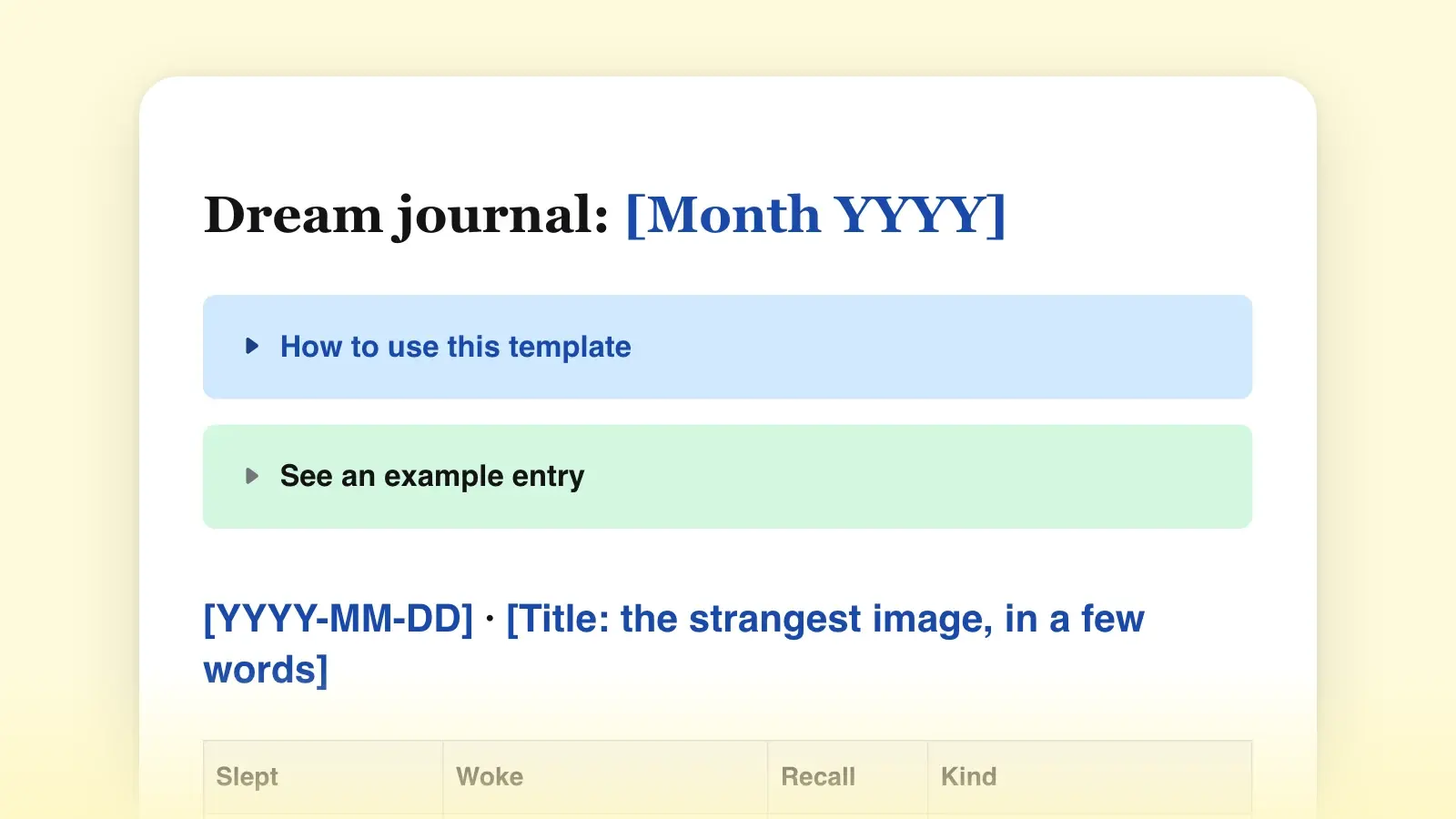
When to use it
- Starting a dream journal with a structure that fits into five minutes a morning
- Practicing lucid dreaming and keeping a running list of the dream signs that repeat
- Collecting images, places and situations from dreams for fiction, poems or art
- Seeing which people, places and feelings come back over months, without a dream dictionary
A dream journal entry has two jobs, and they happen at different times. The first is to catch the dream before it goes, which takes a minute and happens before you are properly awake. The second is to write it up: what happened, who was there, how it felt, what it borrowed from your week. This template splits each entry along that line, then adds an index for the things that keep coming back. It records dreams. It does not try to interpret them.
How to use this template
- Set up the page the night before
Before you sleep, add a new entry with tomorrow's date and your bedtime. Keep the journal where your hand lands when you wake: a notebook and pen on the nightstand, or this file open on your phone or laptop. For paper, print one entry from the Word download and copy its headings into the notebook. In the morning there is nothing to set up, only something to write.
- Capture before you sit up
The Sleep Foundation's advice is to write before sitting up or getting out of bed. Put down keywords, not sentences: "library, water, sister age ten, the name Halvard." A voice memo works if typing in the dark is the obstacle. If nothing comes, write the mood you woke in and the first thing on your mind. Now and then the dream comes back while you do.
- Write the entry the same morning
Turn the fragments into The dream while they still mean something: in order, in the present tense, with gaps marked (…). Don't smooth the gaps over. Writers are trained to make events connect, and a dream recorded that way becomes a story you made up at breakfast. Then fill in the Details table, a minute or two of work.
- Update the index weekly, review monthly
Once a week, reread the week's entries and move anything that has appeared twice into the Index. At the end of the month, fill in Month in review and start a new document. One file per month stays short enough to reread in one sitting.
What good entries look like
The easiest mistake is to interpret on the spot. Dream dictionaries invite it: a door means opportunity, water means emotion. Once the meaning is written down, the details that don't fit it tend to fall out of the record. Write what you saw. You can decide what it means later, or never.
Recorded
- A red door at the end of Grandma's hallway, where the real house has a wall
- I'm relieved when the phone goes dead, then guilty about it
- Title: The library with the tide in it
Interpreted too early
- A door: something new is about to open up
- Phone dying = I'm avoiding someone
- Title: Anxiety dream
- Title it after the strangest image. "The library with the tide in it" finds one dream in a month of entries. "Weird school dream" finds six.
- Fragments count. One image is an entry. So is "nothing remembered", and it belongs in the monthly count too.
- Keep Waking life factual. "Watched a documentary about tides on Thursday" is useful later. "My subconscious is processing change" is a guess dressed up as a fact.
- Short and daily beats long and rare. Three lines every morning give the index more to work with than a full page twice a month. On a rushed morning, skip The dream and fill in only the Details table. The Sleep Foundation suggests the same shortcut: track a few elements, such as characters, emotions, actions and objects.
A filled-in example
This is an imagined entry, written for this page. The capture took under a minute. The rest was written after breakfast.
The library with the tide in it. Slept 11:40 p.m. to 7:10 a.m. Woke to the alarm. Recall 4 of 5. Kind: recurring.
Quick capture. library / gym, water on floor, tide, sister ~10, card drawers, "Halvard", late, cold feet
The dream. I'm in a library that is also my old school gym. Water covers the floor to my ankles and moves in and out like a tide, about once a minute. My sister is there, ten years old, though she is 34 now. She pulls out card catalog drawers and reads the cards aloud, and every card says the same name: Halvard. I know I'm late for something and can't remember what. (…) Then I'm outside on dry pavement, carrying one of the drawers.
Details. People: my sister at ten; a librarian I hear stamping but never see. Places: the library that is a gym. Objects: catalog drawers, cards. Actions: listening, trying to leave, taking a drawer. Feelings: calm in the water, anxious about being late (3 of 5); curious on waking. Senses and words: cold water, the stamping, "Halvard". Odd details: a tide indoors, my sister's age, every card the same.
Waking life. Watched a documentary about tides on Thursday. My sister called on Saturday. I don't know anyone named Halvard.
Keep for later. A library that floods with the tide twice a day, and the librarian who keeps the timetable.
Notice what the entry leaves alone. It doesn't explain the water or decide what Halvard stands for, and the gap before the dry pavement stays a gap. Kind says recurring because water indoors already has a row in the index: January 14, a puddle on the kitchen floor; February 2, a flooded hallway; now a tide. That row is the most interesting thing in the journal so far, and no single entry shows it.
Where the Details rows come from
The rows are borrowed from dream research. In 1966 the psychologists Calvin Hall and Robert Van de Castle published The Content Analysis of Dreams, a system for coding written dream reports. It sorts what happens in a dream into categories that include characters, social interactions, activities, emotions, settings and objects. Researchers at UC Santa Cruz publish the coding rules online, and the DreamBank archive created there holds more than 20,000 dream reports.
You don't need to code anything. The categories are useful because they describe a dream without explaining it. "Who was there" and "where were you" have answers you can check against your memory. "What does it mean" doesn't, and a journal built around that question ends up recording the interpreter more than the dream.
Tracking recurring dreams
Recurring elements are easier to see in a list than in a stack of entries, which is what the Index is for. A place, person, object or situation goes in when it shows up a second time, with the dates, and the last column notes how it changed. Fiction writers would call a recurring image a motif, and the habit of watching it shift from one appearance to the next is the same.
People practicing lucid dreaming keep the same kind of list for a narrower purpose. They look for dream signs: recurring oddities, such as a house with extra rooms or a phone that won't dial, that could tip them off that they are dreaming. The Odd details row feeds that list, and the Kind line marks the nights it worked.
Dreams as material for writing
Writers have mined dreams for a long time, and the famous cases share a pattern. The dream supplied an image or a scene. The story was built awake.
Samuel Taylor Coleridge is the cautionary one. In the 1816 preface to "Kubla Khan" he says the poem came to him during about three hours of sleep and that he started writing it down as soon as he woke, until he was called away by "a person on business from Porlock." When he returned to his room, all but some eight or ten scattered lines and images had gone. Critics have questioned parts of the account, but the lesson for a dream journal holds: capture first, then answer the door.
Mary Shelley's account is in her introduction to the 1831 edition of Frankenstein. In the summer of 1816, near Lake Geneva, Lord Byron proposed that he and his companions each write a ghost story. Days later she lay in bed, not asleep by her own account, and saw a student kneeling beside the creature he had made. The next morning she began writing, "making only a transcript of the grim terrors of my waking dream."
Robert Louis Stevenson credited the "Brownies" of his sleep with half his work. In "A Chapter on Dreams" (Scribner's Magazine, January 1888) he says he dreamed the scene at the window in Jekyll and Hyde and the scene where Hyde, pursued, takes the powder and changes in front of the people chasing him. The rest, he says, was made awake and consciously.
That is the job of Keep for later. A dream rarely arrives as a story. It arrives as a situation, a place with one wrong rule, a name nobody owns. Collect those and let the waking draft do the rest. If you want a longer writing habit to attach the journal to, morning pages start at the same moment: capture the dream, then keep the pen moving.
Frequently asked questions
What should I write if I don't remember any dreams?
Write the date and "no recall", plus the mood you woke in and what was on your mind. Sometimes a dream comes back while you write that. A night with nothing is still worth a line: it keeps the habit going and makes the monthly count honest.
Should a dream journal be written in the present tense?
Many dream journal guides suggest it, because the present tense keeps you inside the scene instead of summarizing it. It is a preference, not a rule. If the past tense comes faster, use it. Speed matters more than tense.
Does this template tell me what my dreams mean?
No. It records what happened, what you noticed and what the dream borrowed from your week. Patterns across months show up in the index. What they mean, if anything, is your call.
Should I write down nightmares?
If you want a complete record, yes, and the entry can be as short as you like. If nightmares regularly wake you or make you dread going to sleep, talk to a doctor. A journal is a writing practice, not a treatment.