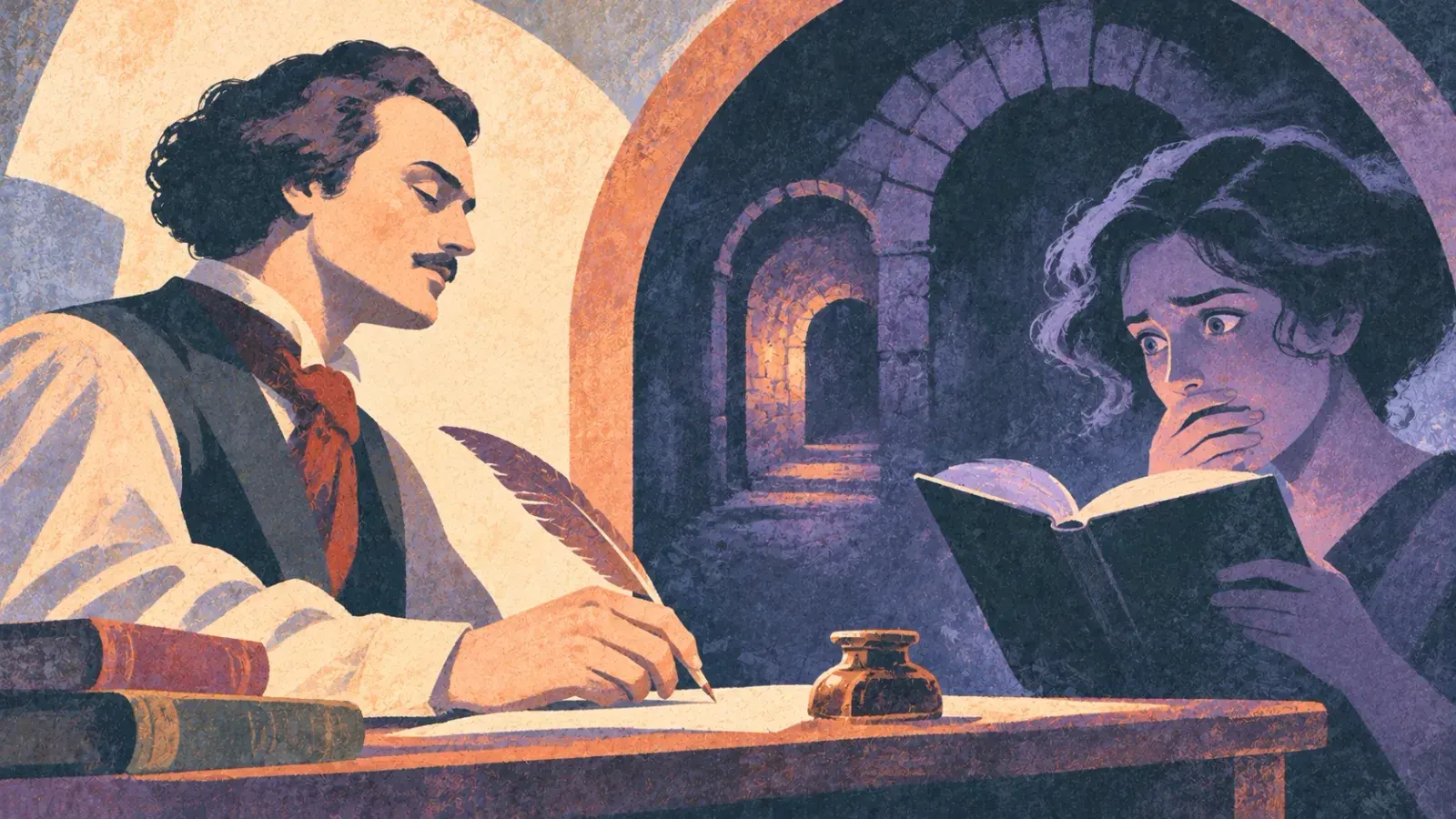
Tone is the writer's or narrator's attitude toward the subject; mood is the feeling the writing creates in the reader. A narrator can sound calm while making the reader uneasy: calm describes the tone, unease describes the mood. To tell them apart, ask two questions: “How does the writer feel about this?” gives you the tone, and “How does this make me feel?” gives you the mood. A memory trick: tone belongs to the teller, mood belongs to me.
The difference is easiest to see in one passage, so that comes first, followed by a comparison table, the ways the two interact, how to answer the exam question and a practice set. For each term in depth, see tone in literature and mood in literature; for where both sit among the other parts of a story, see literary elements.
One passage, both identified
Poe's “The Cask of Amontillado” (1846) is a classic case, because its tone and mood point in opposite directions from the first paragraph.
The thousand injuries of Fortunato I had borne as I best could, but when he ventured upon insult, I vowed revenge. You, who so well know the nature of my soul, will not suppose, however, that I gave utterance to a threat. At length I would be avenged; this was a point definitely settled—but the very definitiveness with which it was resolved, precluded the idea of risk. I must not only punish, but punish with impunity. A wrong is unredressed when retribution overtakes its redresser. It is equally unredressed when the avenger fails to make himself felt as such to him who has done the wrong.
Each phrase below gives evidence for both labels, and each label gets its own reading of the same words.
| Wording | Tone: calm, precise, self-satisfied | Mood: dread |
|---|---|---|
| Wording“I vowed revenge” | Tone: calm, precise, self-satisfiedStated as a settled fact, without heat | Mood: dreadThe story's goal is now a crime |
| Wording“You, who so well know the nature of my soul” | Tone: calm, precise, self-satisfiedConfiding and intimate, pleased to be understood | Mood: dreadBeing taken into this man's confidence is itself unsettling |
| Wording“I must not only punish, but punish with impunity” | Tone: calm, precise, self-satisfiedBalanced syntax and a lawyer's word, “impunity” | Mood: dreadA punishment the victim can neither escape nor answer |
| Wording“The thousand injuries of Fortunato” | Tone: calm, precise, self-satisfiedNo anger, and the injuries are never described | Mood: dreadWithout them, the reader can't judge the revenge, only fear it |
Put together: the tone is cold, calculating and confiding; the mood is dread. The calm produces the dread. A narrator who raged would likely be less frightening than one who reasons like a judge, and the story keeps that composure all the way to the last stone.
Tone and mood compared
| Tone | Mood | |
|---|---|---|
| What it is | ToneThe attitude the writing takes toward its subject and reader | MoodThe feeling, or atmosphere, the reader experiences |
| Whose it is | ToneThe teller's: narrator, speaker or writer | MoodThe reader's |
| Question to ask | ToneHow does the writer feel about this? | MoodHow does this make me feel? |
| Built mainly from | ToneDiction, sentence shape, what the narrator says about things | MoodSetting, imagery, sound, pacing and events |
| Typical words | Toneironic, earnest, sardonic, detached, admiring | Moodeerie, tense, peaceful, oppressive, joyful |
| In “The Cask of Amontillado” | ToneCalm, precise, self-satisfied | MoodDread and suspense |
Think of a ghost tour. The guide's cheerful patter is the tone. The cold in the crypt, and the way the group bunches together on the stairs, is the mood. The two can match, as when the guide lowers her voice, or pull apart, as when she jokes in the dark. Both are real, and both are made of choices.
How tone and mood interact
Four patterns come up often, and naming the one in front of you can anchor an analysis.
| Pattern | Tone | Mood | Example |
|---|---|---|---|
| PatternThey match | ToneGrave, heavy-hearted | MoodGloom, dread | ExamplePoe, “The Fall of the House of Usher” (1839) |
| PatternCalm tone, disturbing mood | ToneDetached, matter-of-fact | MoodSuspense, horror | ExampleAmbrose Bierce, “An Occurrence at Owl Creek Bridge” (1890) |
| PatternLight tone, dark mood | ToneNeighborly, ordinary | MoodMounting unease | ExampleShirley Jackson, “The Lottery” (The New Yorker, 1948) |
| PatternWry tone, tender mood | ToneAmused, affectionate | MoodSympathy, worry | ExampleO. Henry, “The Gift of the Magi” (1905) |
When tone and mood match, the reader sinks into the scene; Poe's gloomy narrator and gloomy house are analyzed in mood in literature. When they split, the gap does the work. Bierce describes a man about to be hanged in the flat language of a report. Jackson's villagers gather on a June morning for an annual event while their children pile up stones, and the calm, neighborly telling is what lets the unease grow. Jonathan Swift's A Modest Proposal (1729) is the satirical version: a reasonable tone, a horrified reader. An unreliable narrator often produces a split too, since the reader feels what the narrator won't admit.
In your own fiction the split is a tool you can aim. Write both at the top of a scene, for example “narrator: calm, a little amused; reader: uneasy,” then ask the Strokes Assistant what tone the narrator takes and what mood the scene builds, quoting the words that do each. If its reading doesn't match your note, look hard at those words. It can misread a passage, as readers do, so treat its answer as one reading.
Answering the exam question
- Read what the question asks
“Attitude,” “regard” and “how the narrator feels” point to tone. “Atmosphere,” “the feeling the passage creates” and “the effect on the reader” point to mood. If the question names neither, answer both.
- Underline the evidence
For tone: judgment words, formal or casual diction, sentence shape. For mood: setting, sensory images, pacing and events.
- Name it in one or two precise words
“Good,” “bad,” “happy” and “sad” tend to earn little credit. Detached, sardonic, wistful or menacing says what you noticed. The tone words list has plenty to choose from.
- Quote, then explain the effect
One short quotation per claim, followed by what it does. If tone and mood split, say so and say why: that is often the point of the passage.
Two answer frames
Tone: The narrator's tone is [word] and [word]. The phrase
"[quotation]" shows [what it reveals], and [a feature of the
diction or sentences] adds [its effect].

Mood: The passage creates a [word] mood. [A detail of setting
or imagery] and [a detail of pacing or sound] make the reader
feel [the feeling].
A man stood upon a railroad bridge in northern Alabama, looking down into the swift water twenty feet below. The man's hands were behind his back, the wrists bound with a cord. A rope closely encircled his neck.
Answer. The tone is detached and clinical. Bierce reports a hanging in flat, exact sentences (“twenty feet below,” “bound with a cord”) and calls the victim only “a man.” The mood is tense dread: the details arrive one at a time, and the rope comes last, in the shortest sentence.
On multiple-choice questions, cross out answers that describe the subject (“violent,” “about war”) rather than an attitude or a feeling, and answers that are mood words when the question asks for tone. Of the two or three left, pick the one you could support with a quotation.
Practice: tone and mood
For each passage, name the tone and the mood in a word or two each, and find one phrase for each.
- “One dollar and eighty-seven cents. That was all. And sixty cents of it was in pennies. Pennies saved one and two at a time by bulldozing the grocer and the vegetable man and the butcher until one's cheeks burned with the silent imputation of parsimony that such close dealing implied. Three times Della counted it. One dollar and eighty-seven cents. And the next day would be Christmas.” (O. Henry, “The Gift of the Magi,” 1905)
- “The ‘Red Death’ had long devastated the country. No pestilence had ever been so fatal, or so hideous. Blood was its Avatar and its seal—the redness and the horror of blood.” (Edgar Allan Poe, “The Masque of the Red Death,” 1842)
- “And this is the nursery! The last owners left in a hurry, so the crib comes with the house. Don't mind the scratches on the inside of the door. You'll love how quiet it is.” (Original example)
- “Patient: Biscuit, terrier, male, 14 years. Owner present throughout. Time of death 7:12 p.m. Collar returned to owner.” (Original example)
- “The last ferry left at six, and the voices went with it. The fog came in over the harbor and took the lighthouse, then the pier, then the boat sheds one by one, until the only sound was a bell buoy knocking somewhere out of sight.” (Original example)
- Tone: wry and affectionate (“bulldozing,” “the silent imputation of parsimony,” grand words for haggling over pennies). Mood: sympathetic worry, because the sum keeps coming back and Christmas is a day away.
- Tone: grave and formal, like a chronicle (“had long devastated,” “its Avatar and its seal”). Mood: horror, building as the sentences narrow to blood.
- Tone: cheerful and salesy (“You'll love how quiet it is”). Mood: creeping unease (a hurried exit, scratches on the inside of a door). The split is the point.
- Tone: clinical and detached (“Patient,” “Time of death”). Mood: grief, which the record never mentions and the returned collar brings home.
- Tone: quiet and somber. Mood: eerie isolation, as the fog removes the town piece by piece and leaves one sound. Here the two match.
Frequently asked questions
Is suspenseful a tone or a mood?
Usually a mood, because suspense is what the reader feels while waiting for an outcome. Some words work for both, such as melancholy or somber, which can describe a narrator's attitude or a reader's feeling. In an answer, make clear whether you mean the writer's attitude or the effect on you, and quote the words that support it.
How do you identify the mood of a story?
Notice how you feel, then find what caused it. Look at the setting and weather, the sensory images, the pace at which information arrives and what happens. Name the feeling precisely, such as eerie, tense or serene, and point to two or three details that create it. If the mood changes, say where it turns.
Is tone the author's attitude or the narrator's?
Strictly, tone belongs to the voice on the page: the narrator in fiction, the speaker in a poem, the writer in an essay. The author can feel differently. Montresor is calm and pleased with himself, while Poe is building horror. When the two differ, the gap is irony, and naming both attitudes makes the strongest answer.