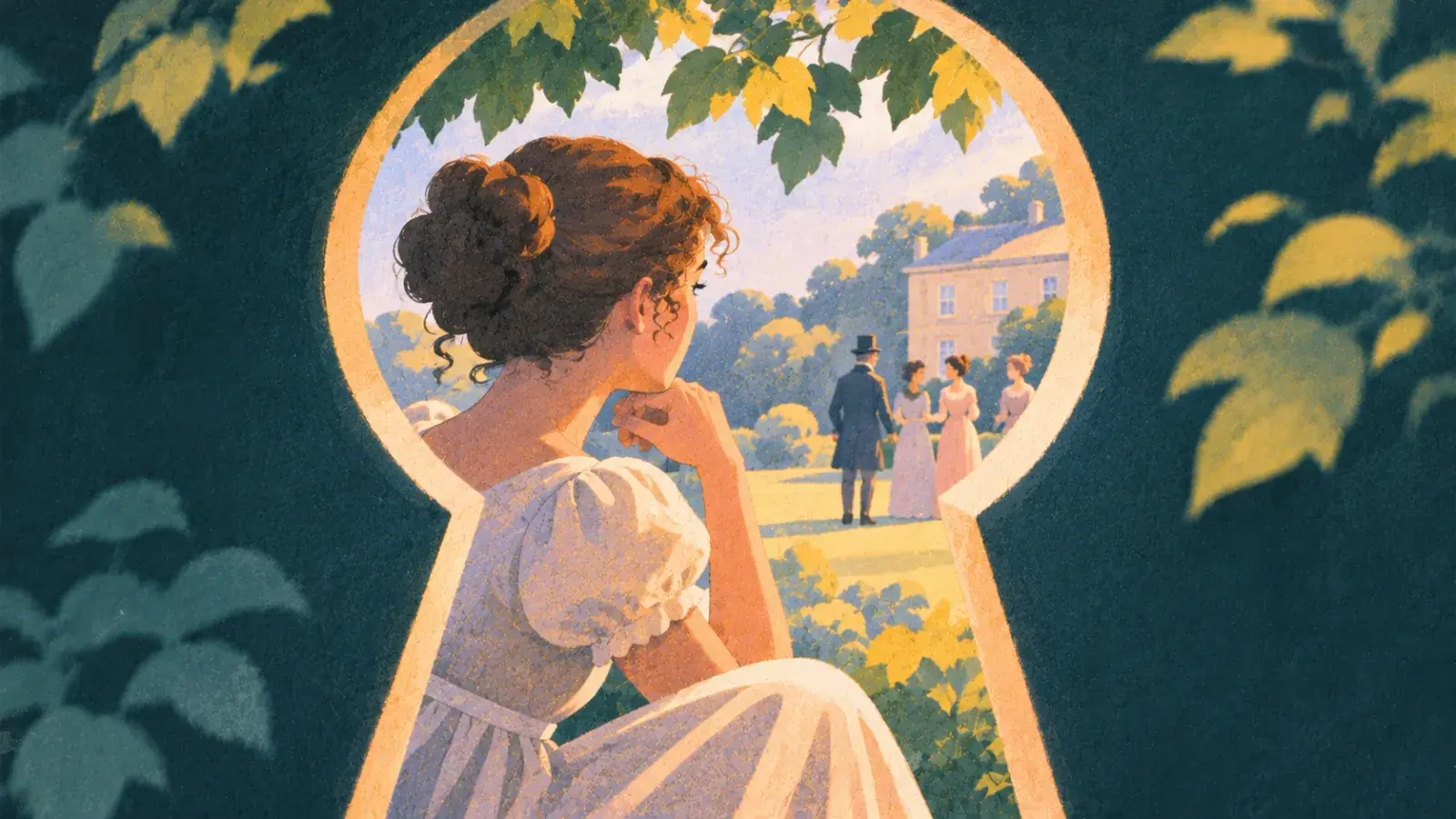
Third person limited is a point of view in which the narrator tells the story in the third person (he, she, they) but stays with one character at a time, reporting only what that character sees, hears, thinks and knows. Other characters' minds stay closed: the reader learns what they feel from what they say and do, as seen by the viewpoint character. It is the point of view of a great deal of modern fiction, including most of the Harry Potter books.
You will also meet it as limited omniscient in older textbooks and as selective omniscience in the critic Norman Friedman's 1955 survey of point of view, and many writers call it close third, though strictly that is its closest setting. This page covers how it works, how close the narration can sit, free indirect discourse, classic examples, multiple viewpoints and the slips that break it. For a narrator who can enter any mind, see third person omniscient; for how every point of view compares, start with the point of view guide.
How third person limited works
One character per scene is the viewpoint character, and the narration rides along behind their eyes. Everything on the page has to be something that character could perceive, remember, think or reasonably guess. The narrator may still call them by name and describe them, which is what makes it third person, but it knows nothing they don't. Here is one moment told three ways, all from the same viewpoint:
Distant. Tomas Reyes, who had baked bread on Delancey Street for twenty years, heard a van pull up outside.
Middle. Tomas heard the van before he saw it, and knew from the muffler that it was Marco.
Close. That muffler. Four fifteen, and Marco was early again, and of course he was.
The three versions sound different, but they draw on the same store of information: what Tomas can hear (a van, that muffler), what he knows (his twenty years on the street, the time, whose van it is) and how he feels about it. None of them can say why Marco is early. Whose head the narration is in decides what it can know. How close it sits, covered in the next section, changes how it says it.
The narration can report
- What Tomas hears and sees: the van, the muffler
- What he knows or guesses: that it's Marco, early again
- How he feels about it: “of course he was”
- How other people look and sound to him
- His mistakes, at the moment he makes them
It can't report
- What Marco is thinking, or why he is early
- Anything on the other side of the wall
- What Tomas doesn't notice
- What people say about him after he leaves the room
- What will happen later, in a book that stays close
That limit is the point. A reader who knows only what Tomas knows wonders what he wonders, and can be surprised when he is. Mysteries, thrillers and romances often depend on that: the detective's blind spot, the danger nobody has seen yet, the love interest whose feelings stay unreadable for three hundred pages.
Close and distant third person
Whose head the narration is in is one choice. How close it sits is another. The novelist John Gardner called this second dial psychic distance, and the five-rung ladder in our point of view guide shows its full range. The three Tomas sentences above sit at three points on it, and the table shows what changes between the far end and the near one:
| Distant third | Close third | |
|---|---|---|
| Naming | Distant thirdFull name, a description, a summary of who he is | Close thirdFirst name or just “he” |
| Vocabulary | Distant thirdThe narrator's | Close thirdThe character's own words |
| Thoughts | Distant thirdReported, often with “he thought” | Close thirdWoven into the narration, no tags |
| Perception | Distant thirdFiltered: “he heard,” “he saw” | Close thirdDirect: the sound itself |
| Time | Distant thirdSummary is easy | Close thirdMoment by moment |
Many novels move up and down the dial within a chapter, pulling back for a sentence of setting and leaning in at the turns. What breaks the spell is a jump nobody asked for, such as a close, angry paragraph followed by a line that sounds like a museum label. The closest setting of all, with no filter words and nothing the character wouldn't think in their own words, is what many genre writers call deep POV.
Free indirect discourse
Free indirect discourse is the main technique behind close third. The narration takes on a character's thoughts, words and attitude while keeping third person and the book's tense. There is no “she thought,” no italics and no quotation marks. The sentence belongs to the narrator grammatically and to the character in everything else.
It darted through her, with the speed of an arrow, that Mr. Knightley must marry no one but herself!
Read it in two halves. “It darted through her, with the speed of an arrow” is the narrator, reporting what happens to Emma and choosing the simile. “Mr. Knightley must marry no one but herself!” is Emma's own thought moved into third person: she would think “me,” and the narrator writes “herself,” but the urgency of “must” and the exclamation mark are hers. That blend, the narrator's grammar carrying the character's feeling with no seam between them, is free indirect discourse.
Lily, the caretaker's daughter, was literally run off her feet.
Joyce's narrator has no reason to say “literally” in that loose way, but Lily would. The first sentence of the story is already in her idiom, while it is still describing her from outside.
Every morning, therefore, uncle Charles repaired to his outhouse but not before he had greased and brushed scrupulously his back hair and brushed and put on his tall hat.
“Repaired” is uncle Charles's own genteel word for going to the outhouse. The critic Hugh Kenner, in Joyce's Voices (1978), named this the Uncle Charles Principle: the narration borrows the vocabulary of the character it is describing, even when that character isn't the one thinking.
To write free indirect discourse in your own draft:
- Draft the thought plainly
Write it with a tag first: “She thought that she couldn't bear another Sunday at his mother's.”
- Cut the tag
Delete “she thought that” and keep the tense and the person: “She couldn't bear another Sunday at his mother's.”
- Let her talk
Put the sentence in her words and her rhythm: “Another Sunday at his mother's. Another roast. She couldn't.” The fragments, the repetition and the stopping short are hers.
- Read it back for the voice
If the sentence could only have been thought by this character, it is working. If it could be anyone's, give it a word, an image or a grudge that is particular to her.
Third person limited examples
Emma Woodhouse, handsome, clever, and rich, with a comfortable home and happy disposition, seemed to unite some of the best blessings of existence; and had lived nearly twenty-one years in the world with very little to distress or vex her.
The novel will live inside Emma, but it begins outside her, and “seemed” is the narrator's warning. The rest of the book closes the distance until the reader shares her mistakes, then pulls back far enough to see them.
Strether's first question, when he reached the hotel, was about his friend; yet on his learning that Waymarsh was apparently not to arrive till evening he was not wholly disconcerted.
James tells nearly all of The Ambassadors through Lambert Strether's perceptions. Even the first sentence is about a feeling (“not wholly disconcerted”) and a hesitation, and the novel's drama is Strether slowly seeing what the reader is never shown directly.
Although it was so brilliantly fine—the blue sky powdered with gold and great spots of light like white wine splashed over the Jardins Publiques—Miss Brill was glad that she had decided on her fur.
Dear little thing! It was nice to feel it again.
The sky “powdered with gold” and the wine-like light are Miss Brill's delighted view of a Sunday in the park, and “Dear little thing!” is her talking to her fur. Because the story never leaves her head, the reader overhears the cruel remark at the end exactly as she does, with no warning.
Modern fiction is full of limited third. The Harry Potter books stay with Harry for almost every chapter, so the reader learns the truth about Snape when Harry does. George R. R. Martin's A Song of Ice and Fire gives each chapter to a single viewpoint character, named at the top, which is limited third repeated across a large cast.
One viewpoint or several
A single viewpoint character gives the tightest suspense and the strongest bond. Several give range: two sides of a romance, a hunter and the hunted, a family seen from each member's chair. Friedman called the second approach multiple selective omniscience, which describes it well: limited, but chosen afresh at each break.
- Switch at a break. A new chapter, or a scene break marked with a blank line or a centered symbol. A switch in the middle of a scene, with no break, reads as head-hopping.
- Name the viewpoint character early. Ideally the first sentence after the break tells the reader whose head they are in, and where and when.
- Give every viewpoint a job. Each needs a goal of its own and scenes only they can witness. A viewpoint that exists only to deliver information can usually be folded into someone else's chapter.
- Don't replay scenes. Showing the same conversation twice from two sides is worth doing only when the gap between the versions is the point.
- Track the rotation. Add a POV column to your chapter outline so you can see when a character has vanished for ten chapters.
Tomas held the door open and let the cold in. He was going to be a soft old man, he could see it coming.
#
Marco had been awake since three, and he had driven the long way round so he would arrive late for once, and he had still arrived at four fifteen.
The second scene opens with Marco's name, and gives the reader something Tomas could never know: Marco tried to be late. The reader now holds both men's versions of the same morning.
POV slips and how to fix them
A slip is a sentence that steps outside what the viewpoint character could know or, in close third, would say. The first kind is a slip at any distance. The second depends on how close the book has chosen to sit. One slip rarely ruins a page, but each one loosens the reader's sense of where they are standing, and most fixes move the information into something the character can perceive.
| Genuine POV slip | Before | After |
|---|---|---|
| Genuine POV slipAnother character's thoughts | BeforeMarco was relieved to see him. | AfterMarco let out a breath he seemed to have been holding. |
| Genuine POV slipEvents out of sight | BeforeOutside, a cat slipped under the van. | AfterWhen he opened the door, a cat shot out from under the van. |
| Genuine POV slipKnowing what he can't | BeforeThe new driver, a student named Lia, climbed out. | AfterA young woman he had never seen climbed out of the passenger side. |
| Slip in close third only | Before | After |
|---|---|---|
| Slip in close third onlySeeing himself from outside | BeforeTomas's face went red. | AfterHeat climbed his neck. |
| Slip in close third onlyThe narrator's vocabulary | BeforeTomas admired the van's chiaroscuro of rust and primer. | AfterHe had never seen so much rust on one van. |
| Slip in close third onlyForeknowledge | BeforeHe would regret this conversation for years. | AfterHe had a feeling he was going to regret this. |
| Slip in close third onlyFiltering | BeforeHe saw that the crates were empty. | AfterThe crates were empty. |
Slips are hard to see in your own draft, because you know what every character is thinking. Ask the Strokes Assistant to list every sentence in a chapter that reports something the viewpoint character couldn't see, hear or know, then decide which of them are deliberate.
Third person limited vs first person
Close third and first person can be almost as intimate as each other, and many writers draft a chapter in both before deciding. The differences are practical.
| Third person limited | First person | |
|---|---|---|
| Pronouns | Third person limitedHe, she, they | First personI |
| Voice | Third person limitedThe narrator's sentences, colored by the character | First personThe character's voice in every line |
| Distance | Third person limitedAdjustable, from far to very close | First personClose, or looking back from later |
| Describing the viewpoint character | Third person limitedEasy: the narrator can name and describe them | First personTakes more care: self-description or other people's remarks |
| Unreliability | Third person limitedPossible through free indirect discourse | First personThe natural home of the unreliable narrator |
| Several viewpoints | Third person limitedEasy to switch at breaks | First personSeveral “I”s need clear labels |
| Tense | Third person limitedPast or present | First personPast or present |
Choose first person when the voice is the attraction, or when the story is about how one person tells it. Choose limited third when you want to move a little in and out of the character, describe them without tricks, or hand the story to another viewpoint later. If the narrator's account should turn out to be wrong, read about the unreliable narrator before you decide. And if the story needs a voice above all the characters, look at third person omniscient instead.
A close third scene, annotated
The van was early again. Tomas heard it from the proving room, that muffler, and looked at the clock over the ovens. Four fifteen. Of course it was.
He wiped his hands on his apron and went to unbolt the back door, rehearsing it on the way. Marco, we said five. Not angry. Reasonable. Five, so the loaves have time to cool, so the crust doesn't sweat in the crates. He had said it in his head so many times that it sounded like somebody else's sentence.
Marco was already out of the van, stamping his feet against the cold. He had a new hat, a red one with a bobble, and he looked about twelve in it.
“Morning, chief,” Marco said. “Traffic was nothing. Flew here.”
Tomas held the door open. The cold came in and found his wrists.
“Crates are by the rack,” he said.
- “The van was early again” is Tomas's judgment, not a neutral fact. The scene starts inside his irritation.
- “That muffler… Of course it was” is free indirect discourse: his words and his sigh, no “he thought.”
- “Marco, we said five” is his rehearsal in his own grammar, unmarked. Close third can slip into direct thought this way for a line or two, as long as the voice is unmistakably his.
- “He looked about twelve in it” shows Marco only from outside, through Tomas's fond and annoyed eyes.
- “The cold came in and found his wrists” gives the sensation directly, without “he felt.”
- “Crates are by the rack” is what he actually says. The reader knows what he rehearsed, so the gap between the two is the scene.
Exercises for close third
- Strip the filters. Take a page of your draft, delete every “she saw,” “she heard,” “she felt,” “she noticed” and “she realized,” and rewrite each sentence as the perception itself.
- Three distances. Write one moment three times: from far away, from the middle and from inside the character's head, as in the Tomas example.
- The other side of the door. Rewrite a scene in the other character's limited view. List what each version knows that the other can't.
- Lose the tags. Take a paragraph with three “she thought” tags and turn every thought into free indirect discourse.
Frequently asked questions
What is the difference between third person limited and third person omniscient?
Third person limited stays with one character per scene and knows only what that character perceives, thinks and guesses. Third person omniscient can enter any mind, report facts no character knows, see the future and comment in its own voice. A limited novel can switch viewpoints, but only at chapter or scene breaks.
Can you describe the viewpoint character's appearance in third person limited?
Yes. Because the narrator can name and describe the character, limited third can mention appearance directly, especially at a distance: “Tomas Reyes, a big man in a floury apron.” In close third, keep to what the character would notice about themselves at that moment, such as a sleeve that is too short or a sore knee. A long look in the mirror is the usual cliché.
Is Harry Potter written in third person limited?
Mostly. The books follow Harry in close third person, so the reader learns what he learns when he learns it. A few chapters step outside his view, such as the opening of the first book, which begins with Mr. Dursley, and the openings of some later books.
Can third person limited be written in present tense?
Yes. Point of view and tense are separate choices. Third person limited works in past tense, the traditional default, or in present tense, which adds immediacy and is common in some literary and young adult fiction. Choose one tense for the main narrative and keep it consistent.