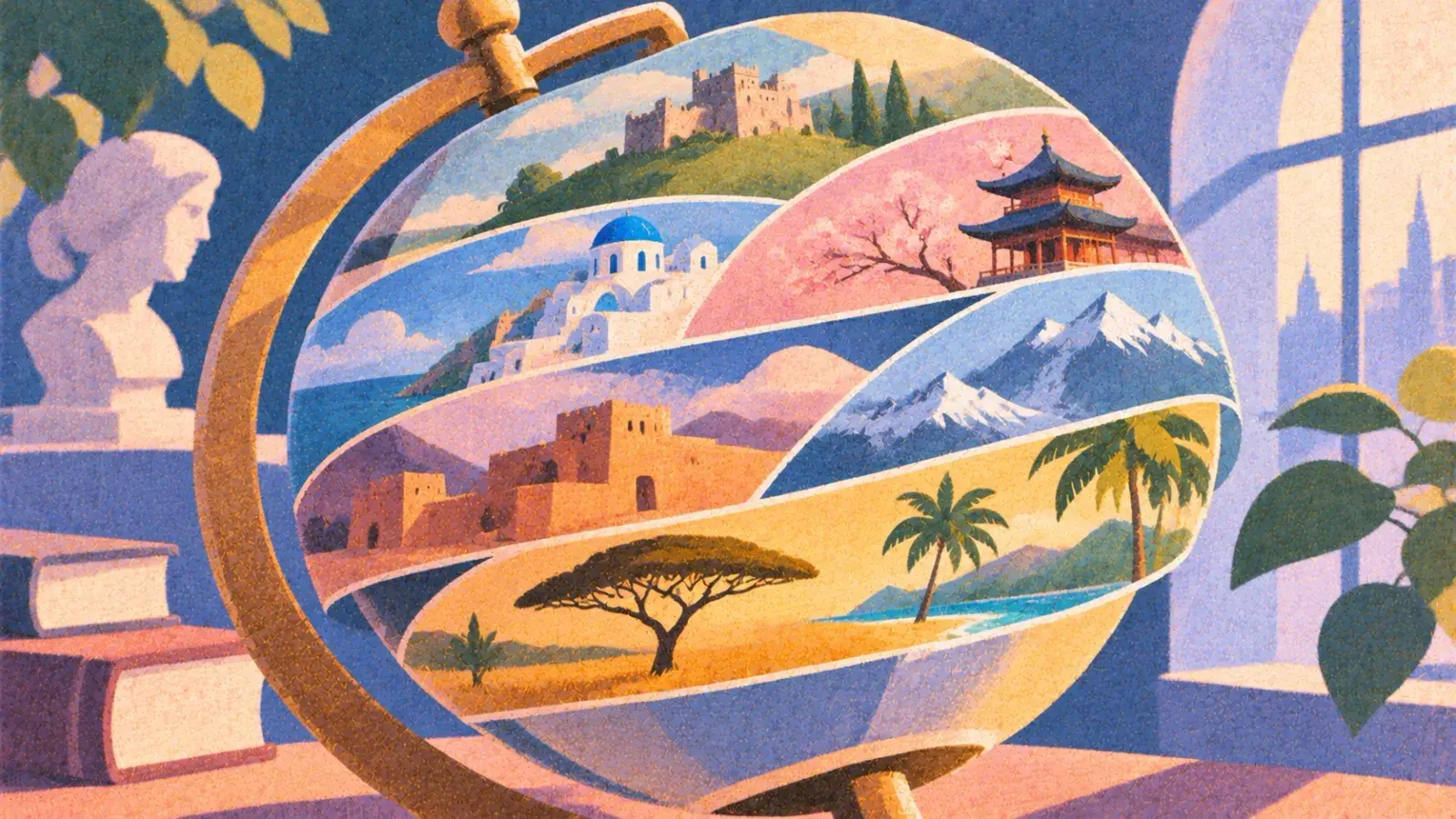
Good last names for characters fit the family's history: where the character's ancestors lived, when, and what kind of people they were. The 350 surnames below are real names, grouped by origin, from English and Irish to Armenian, Yoruba and Vietnamese, and then by how they work on the page: easy to forget, said differently from how they look, tied to a period, or hard to forget. Meanings are given where they are documented, and each group notes the naming customs a writer has to get right.
Use the list to start, not to finish. Pick the group that fits the family, choose two or three candidates, then say each one aloud with the first name and with the names of the people around it.
| Group | Origins | Numbers |
|---|---|---|
| GroupBritish and Irish | OriginsEnglish, Scottish, Irish, Welsh | Numbers1–58 |
| GroupWestern European | OriginsGerman, Dutch, French, Italian, Spanish, Portuguese | Numbers59–137 |
| GroupNorthern and Eastern European | OriginsNordic, Slavic, Hungarian, Greek | Numbers138–187 |
| GroupArmenian, Jewish, Middle Eastern | OriginsArmenian, Jewish, Arabic, Persian, Turkish | Numbers188–241 |
| GroupSouth and East Asian | OriginsSouth Asian, Chinese, Japanese, Korean, Vietnamese, Filipino | Numbers242–303 |
| GroupWest and East African | OriginsIgbo, Yoruba, Akan, Mande, Wolof, Ethiopian, Kenyan | Numbers304–322 |
| GroupOn the page | OriginsEasy to forget, said differently, tied to a period, hard to forget | Numbers323–350 |
One surname, several forms
The same family name can look different depending on where the family settled, which alphabet it passed through and which naming rules it follows. Before you fix a spelling, decide which branch of the family your character belongs to.
| Name | What changes it | Forms |
|---|---|---|
| NameChen | What changes itRegion and dialect | FormsChen in Mandarin, Chan in Cantonese, Tan in Hokkien: one character, three readings |
| NameSmirnov | What changes itTransliteration | FormsSmirnov in English today, Smirnoff in the older French-style spelling the vodka label still uses |
| NamePetrosyan | What changes itDialect and spelling reform | FormsPetrosyan in Armenia, Bedrosian in the Western Armenian diaspora |
| NameNovák | What changes itNaming convention | FormsNovák for a man, Nováková for his wife or daughter |
| NameMüller | What changes itEmigration | FormsMüller in Germany, Mueller or Miller in many American families |
British and Irish surnames
Most of these began as a trade, a place, a father's name or a nickname, which is why so many still sound like ordinary words.
English
- Smith: a metalworker; the most common surname in England and in the United States.
- Taylor: a tailor.
- Wright: a maker, as in wheelwright or shipwright.
- Fletcher: an arrow maker.
- Cooper: a maker of barrels and casks.
- Thatcher: a roofer who worked in straw or reed.
- Chandler: a maker or seller of candles.
- Wainwright: a wagon builder.
- Fuller: a cloth worker who cleaned and thickened woven wool.
- Sawyer: a man who sawed timber into planks.
- Mercer: a dealer in fine cloth such as silk.
- Turner: a woodworker who shaped wood on a lathe.
- Webster: a weaver.
- Baxter: a baker.
- Parker: the keeper of a park, an enclosed hunting ground.
- Robinson: son of Robin, itself a pet form of Robert.
- Watson: son of Wat, a pet form of Walter.
- Atwood: someone who lived at the wood.
- Townsend: someone who lived at the end of the town.
- Ashby: from English place names built on the Old Norse for a farmstead, with ash trees.
- Kirby: from a place name meaning a settlement with a church, also from Old Norse.
- Armstrong: a nickname for a strong man, and a family name of the Anglo-Scottish border.
Scottish
Gaelic Mac means son, so MacDonald is the son of Donald. Lowland names often look English.
- Campbell: from Gaelic for “crooked mouth”; one of Scotland's ten most common surnames.
- Cameron: probably from Gaelic for “crooked nose”.
- Stewart: a steward, and the name of Scotland's royal house.
- Robertson: son of Robert; one of Scotland's most common surnames.
- Thomson: son of Thom, usually spelled without the p in Scotland.
- Murray: from Moray, in the north-east.
- MacDonald: son of Donald, and the name of a great Highland clan.
- Mackenzie: son of Coinneach, a Gaelic given name.
- Douglas: thought to come from the Gaelic for “black stream”.
- Menzies: traditionally pronounced “Mingis”, a trap for anyone reading aloud.
- Wilson: son of Will; among Scotland's most common, with Smith and Brown.
- Anderson: son of Andrew, Scotland's patron saint.
Irish
Ó means descendant and Mac means son. Many anglicized forms dropped the O', so Sullivan and O'Sullivan are one name. The meanings below belong to the Gaelic personal names the surnames come from.
- Murphy: descendant of Murchadh, “sea warrior”; Ireland's most common surname.
- Kelly: descendant of Ceallach, a name linked to “strife”.
- O'Sullivan: descendant of Súilleabhán, “dark-eyed” or “one-eyed”.
- Walsh: “Welshman” or Briton, for families who came over from Britain.
- O'Brien: descendant of Brian.
- Byrne: descendant of Bran; also O'Byrne.
- Ryan: descendant of Rian, a name possibly meaning “king”.
- O'Connor: descendant of Conchobhar.
- O'Neill: descendant of Niall, possibly “champion” or “cloud”.
- Fitzgerald: a Norman-Irish name; Fitz- is the Anglo-Norman for “son of”.
- Quinn: descendant of Conn.
- Gallagher: a Donegal name, from the far north-west.
Welsh
Wales has a small stock of surnames, so the same few recur, Jones, Williams and Davies above all. Fixed surnames spread from the 15th century, but in some rural areas the old patronymics lasted into the early 19th. Many surnames add an s to a father's name, or fuse ap, “son of”, onto it.
- Jones: from John; the most common surname in Wales.
- Williams: from William; second in Wales.
- Davies: from David; third in Wales.
- Evans: from Evan, a Welsh form of John.
- Hughes: from Hugh.
- Griffiths: from Gruffudd.
- Powell: from ap Hywel.
- Price: from ap Rhys; also Pryce.
- Pritchard: from ap Richard.
- Pugh: from ap Hugh.
- Bowen: from ab Owen.
- Upjohn: from ap John, a rarer name than it deserves to be.
Western European surnames
Trades, fathers and landscapes, in six languages. Where a country's rank is given, it comes from published counts of its most common surnames.
German
Germany's ten most common surnames are all trades or offices, which makes them useful for characters who should sound ordinary there.
- Müller: a miller; Germany's most common surname, Mueller or Miller in many emigrant families.
- Schmidt: a smith.
- Schneider: a tailor.
- Fischer: a fisher.
- Meyer: originally an estate manager, later a farmer.
- Weber: a weaver.
- Wagner: a wagon maker.
- Schulz: a village headman.
- Becker: a baker.
- Hoffmann: a steward at a manor court, and later a farmer.
- Koch: a cook.
- Richter: a judge.
- Zimmermann: a carpenter.
- Fuchs: fox, a nickname.
Dutch
Surnames became compulsory in the Netherlands with a registration in 1811, though most families already had one. Particles such as van and de are lowercase after a first name (Anna van den Berg) and are ignored in Dutch alphabetical order. In Belgium they are capitalized and counted, so directories fill up under D and V.
- De Jong: the young; the most common Dutch surname.
- Jansen: son of Jan.
- De Vries: the Frisian.
- Van den Berg: from the hill, literally “of the mountain”.
- Van Dijk: from the dike.
- Bakker: a baker.
- Visser: a fisher.
- De Boer: the farmer.
- Mulder: a miller.
- Vos: fox.
- Dekker: a thatcher.
- Dijkstra: a Frisian name for a family from a place near a dike; -stra and -ma are Frisian endings.
French
Many of France's commonest surnames are old given names, such as Martin, Bernard and Thomas. The rest are places, trades and nicknames.
- Martin: from the Latin name meaning “of Mars”; France's most common surname.
- Bernard: a Frankish given name built on “bear”.
- Dubois: someone who lived in the woods.
- Petit: short.
- Durand: enduring, literally “lasting”.
- Leroy: the king, a nickname rather than a pedigree.
- Moreau: dark, “like a Moor”.
- Lefebvre: a blacksmith.
- Roux: red-haired.
- Fournier: a baker, the man who ran the oven.
- Chevalier: a knight or horseman.
- Boucher: a butcher.
- Tremblay: a Quebec name, and one of the most common surnames in Canada.
Italian
Italian surnames often end in -i, and many began as nicknames for hair or coloring. Two of the most common were often given to abandoned children.
- Rossi: red, for red hair; Italy's most common surname, mainly in the north and center.
- Russo: red, the southern form.
- Ferrari: a blacksmith.
- Esposito: “exposed”, a surname given to abandoned children.
- Bianchi: white, for fair hair or skin.
- Romano: Roman.
- Colombo: dove, and in some places a surname given to foundlings.
- Bruno: brown.
- Ricci: curly.
- Greco: Greek.
- Marino: a sailor.
- De Luca: son of Luca.
- Mancini: left-handed.
- Barbieri: a barber.
Spanish
Spanish speakers carry two surnames, usually the father's first and then the mother's: Gabriel García Márquez is García to an indexer. The ending -ez means “son of”.
- García: possibly from a Basque word for “young”; Spain's most common surname.
- Fernández: son of Fernando.
- González: son of Gonzalo.
- Rodríguez: son of Rodrigo.
- López: son of Lope, from Latin lupus, “wolf”.
- Martínez: son of Martín.
- Sánchez: son of Sancho.
- Pérez: son of Pedro.
- Díaz: son of Diego.
- Hernández: son of Hernando; the most common surname in Mexico.
- Moreno: brown-haired, dark or tanned.
- Romero: a pilgrim, originally one bound for Rome.
- Navarro: from Navarre.
- Delgado: thin.
Portuguese
Portuguese and Brazilian names usually put the mother's surname before the father's, and the last one is the name people use: Luiz Pereira da Silva is Mr. Silva, not Mr. da Silva.
- Silva: woodland; Portugal's most common surname.
- Santos: saints.
- Ferreira: a blacksmith.
- Pereira: pear tree.
- Oliveira: olive tree.
- Costa: coast.
- Ribeiro: brook.
- Pinto: painted or spotted.
- Carvalho: oak.
- Rocha: rock.
- Teixeira: a place covered with yew trees.
- Monteiro: a huntsman, or a guard of the woods.
Nordic, Slavic, Hungarian and Greek surnames
These are the groups where grammar does the most work: endings change for women, for daughters or for the region a family came from.
Nordic
Most -son and -sen names were once patronymics that changed every generation. Denmark passed a naming act for all citizens in 1828, Sweden made family names compulsory in 1901 and Norway required them for newborns from 1923. Iceland never switched: Jón Einarsson's daughter is Sigríður Jónsdóttir, and the phone book is ordered by first name.
- Andersson: son of Anders; Sweden's most common surname, with a double s.
- Johansson: son of Johan.
- Nilsson: son of Nils.
- Hansen: son of Hans; Norway's most common surname.
- Olsen: son of Olav, Ola or Ole.
- Nielsen: son of Niels; one of Denmark's two most common surnames, with Jensen.
- Sørensen: son of Søren.
- Lindberg: linden tree plus mountain, a coined Swedish nature name.
- Ahlström: alder plus stream.
- Stolt: proud, one of the names given to soldiers in Sweden's old allotment army.
- Haugen: a Norwegian farm name meaning hill or mound.
- Solberg: sunny hill.
- Korhonen: Finland's most common surname, of uncertain meaning.
- Virtanen: from Finnish virta, “stream”.
- Järvinen: from järvi, “lake”.
Slavic
Slavic surnames change form for women: Novák becomes Nováková in Czech, Ivanov becomes Ivanova in Russian, and Kowalski becomes Kowalska in Polish. A Russian character also has a patronymic: Anna Petrovna Ivanova is Anna, daughter of Pyotr.
- Nowak: a newcomer, “new man”; Poland's most common surname.
- Kowalski: from kowal, “smith”.
- Wiśniewski: from wiśnia, “cherry”.
- Kamiński: from kamień, “stone”.
- Novák: new man; the most common Czech surname.
- Svoboda: a freeholder; the word means freedom.
- Dvořák: the holder of a manor farm.
- Procházka: a walker or wanderer.
- Veselý: cheerful.
- Ivanov: descendant of Ivan; one of Russia's most common surnames, with Smirnov and Kuznetsov.
- Kuznetsov: the smith's.
- Smirnov: from smirnoy, “the meek one”.
- Volkov: the wolf's.
- Melnyk: a miller; Ukraine's most common surname.
- Shevchenko: the shoemaker's.
- Bondarenko: the cooper's.
- Jovanović: son of Jovan; Serbia's most common surname.
- Horvat: a Croat; Croatia's most common surname.
Hungarian
In Hungarian the family name comes first: Nagy János in Budapest is János Nagy in English.
- Nagy: big or great; Hungary's most common surname.
- Kovács: a smith.
- Tóth: a Slav, especially a Slovak or Slovene.
- Szabó: a tailor.
- Varga: a leatherworker.
- Kiss: little.
- Molnár: a miller.
- Balogh: left-handed.
Greek
Greek endings often point to a region: -opoulos to the Peloponnese, -akis to Crete, -idis to the Pontic Greeks, -atos to Kefalonia. Women use the genitive: Mr. Yannatos, Mrs. Yannatou.
- Papadopoulos: descendant of a priest, from papas plus -opoulos.
- Papakostas: son of Kostas the priest.
- Papadakis: the Cretan form of a priest's descendant.
- Georgiou: of Georgios, a genitive surname typical of Cyprus.
- Nikolaidis: son of Nikolaos.
- Samaras: a saddle maker.
- Papoutsis: a shoemaker.
- Kritikos: from Crete.
- Kontos: short.
Armenian, Jewish and Middle Eastern surnames
Names shaped by migration and by law: several of these systems were created, or rewritten, by a government order with a date on it.
Armenian
Most Armenian surnames add -yan or -ian, originally a mark of descent, to an ancestor's given name, trade or town. Romanized spellings from Armenia usually end in -yan; diaspora families, who kept the classical spelling, more often write -ian, and Western Armenian pronunciation turns Petros into Bedros: Petrosyan in Yerevan, Bedrosian in Beirut or Los Angeles.
- Grigoryan: from Grigor (Gregory); Armenia's most common surname.
- Harutyunyan: from Harutyun, “resurrection”.
- Sargsyan: from Sargis (Sergius).
- Hovhannisyan: from Hovhannes (John).
- Khachatryan: from Khachatur, “given by the cross”.
- Hakobyan: from Hakob (Jacob).
- Petrosyan: “issued from Petros” (Peter).
- Karapetyan: from Karapet, “forerunner”.
- Keshishian: “issued from the priest”.
- Bjishkian: “issued from the doctor”.
- Kahvejian: a coffee merchant, from the Turkish word.
- Tashjian: from Turkish taş, “stone”.
- Ter-Petrosyan: the Ter- prefix, from the way a priest is addressed, marks a priest among the ancestors.
- Artsruni: an old noble house, one of the -uni names still in use.
Jewish
Most Ashkenazi families took fixed surnames under laws in Austria (1787), the Russian Empire (1804) and Prussia. Sephardic names often record a town in Spain or Italy. In Israel, many immigrants took Hebrew names: Golda Meyerson became Golda Meir.
- Cohen: priest, for families of priestly descent; Israel's most common surname.
- Levi: a Levite; also Levy.
- Katz: from the initials of Kohen Tzedek, “priest of justice”.
- Segal: from the initials of S'gan Levi, “Levitical head”.
- Shapiro: from Speyer, the city on the Rhine.
- Rabinowitz: tied to rabbis; some families anglicized it to Robinson or Robbins.
- Friedman: man of peace.
- Mizrahi: easterner.
- Dahan: an oil merchant.
- Bejarano: from Béjar, in Spain.
- Mitrani: from Trani, in southern Italy.
- Toledano: from Toledo, in Spain.
Arabic
A traditional Arabic name chains a given name to a father's (ibn, “son of”; bint, “daughter of”) and can add a nisba, a name of origin or trade. Most Arab countries now use a fixed family name, a wife keeps her own, and the al- stays when you address someone: Mr. al-Ahmad, not Mr. Ahmad.
- Haddad: a blacksmith.
- Najjar: a carpenter.
- Khayyat: a tailor.
- Sabbagh: a dyer.
- Attar: a perfumer or druggist.
- Khoury: a priest; common among Christian families in the Levant.
- Halabi: from Aleppo, Halab in Arabic.
- Masri: Egyptian.
- Mansour: victorious, from a given name.
- Hakim: wise, or a physician.
Persian
Iran introduced surnames in 1919, and a law under Reza Shah made them compulsory. Many end in -i, “of”, after a place, or in a suffix of descent such as -zadeh or -nejad.
- Ahmadi: from Ahmad; one of the most common surnames in Iran.
- Tehrani: from Tehran.
- Shirazi: from Shiraz.
- Tabrizi: from Tabriz.
- Esfahani: from Isfahan.
- Yazdi: from Yazd.
- Hosseinzadeh: descendant of Hossein.
- Moazenzadeh: descendant of a muezzin.
- Pahlavi: the surname Reza Shah chose for his own family.
Turkish
Turkey's Surname Law of 21 June 1934 gave every family two years to take a fixed Turkish surname, and it banned endings such as Armenian -ian, Slavic -ov and Greek -poulos, so many minority families shortened or translated their names. Mustafa Kemal became Atatürk under a follow-up law that November.
- Yılmaz: unyielding; Turkey's most common surname.
- Kaya: rock.
- Demir: iron.
- Şahin: hawk.
- Çelik: steel.
- Yıldız: star.
- Yıldırım: thunderbolt.
- Aydın: enlightened.
- Özdemir: pure iron.
South and East Asian surnames
In most of East Asia the family name comes first, and in parts of South Asia there may be no inherited surname at all.
South Asian
Across South Asia a surname can signal region, language, religion and sometimes caste, and many families have changed theirs. Some communities don't use one at all: many Tamils use initials for a village and a father's name instead.
- Singh: lion; the name Sikh men traditionally take, and one used by many others too.
- Kaur: princess; the name Sikh women traditionally take.
- Kumar: prince; often a middle name.
- Devi: goddess; used by women, and often listed among India's most common surnames.
- Das: servant; one of India's most common surnames.
- Lal: darling, an epithet of Krishna, or red.
- Iyer: a Tamil surname.
- Pillai: Tamil and Malayali.
- Nair: a Malayali surname from Kerala.
- Banerjee: Bengali.
- Desai: one of the surnames that record a family's old trade or office.
- D'Souza: Portuguese in origin, common among Konkani Catholics of Goa and Mangalore.
- Rahman: gracious; common in Bangladesh.
- Hossain: handsome; common in Bangladesh.
- Perera: Portuguese in origin; Sri Lanka's most common surname.
- Dissanayake: a Sinhalese surname.
Chinese
The family name comes first and is usually a single syllable: Wang Fang, not Fang Wang. Spellings follow the dialect and the era, so one name can look like several. The top 100 surnames cover about 85 percent of China's population.
- Wang: king; one of China's two most common surnames, Wong in Cantonese.
- Li: plum; often spelled Lee.
- Zhang: Cheung in Cantonese.
- Liu: the family name of the Han emperors; Lau in Cantonese.
- Chen: Chan in Cantonese, Tan in Hokkien.
- Yang: poplar.
- Huang: yellow; also Wong in Cantonese, which makes two different Wongs.
- Wu: Ng in Cantonese.
- Zhou: the name of an ancient dynasty; Chow in Cantonese.
- Lin: forest; Lam in Cantonese, Lim in Hokkien.
Japanese
Many Japanese surnames are two characters describing a landscape: a field, a mountain, a village, a well. Many farming families had surnames before but could not use them in public; the modern system dates from the family registry of the 1870s. The family name comes first in Japanese, and in 2019 the government decided to use that order in official English documents too.
- Satō: Japan's most common surname; its second character means wisteria.
- Suzuki: the second most common.
- Takahashi: “high bridge”.
- Tanaka: “middle of the rice field”.
- Watanabe: among Japan's ten most common.
- Nakamura: “middle village”.
- Kobayashi: “small forest”.
- Yamamoto: “base of the mountain”.
- Inoue: “above the well”.
- Matsumoto: “base of the pine tree”.
Korean
In the 2015 census, 44.6 percent of South Koreans were named Kim, Lee or Park. Families are told apart by bon-gwan, the clan's place of origin, such as the Gimhae Kim. Women keep their surname at marriage, and given names usually have two syllables.
- Kim: gold; the most common surname in Korea.
- Lee: plum; also spelled Yi and Rhee.
- Park: also spelled Pak or Bak.
- Choi: also Choe.
- Jung: also Jeong or Chung.
- Kang: also Gang.
- Yoon: also Yun.
- Lim: also Im or Rim; the same character as Chinese Lin.
Vietnamese
Vietnamese names run family name, middle name, given name, and people are addressed by the given name: Nguyễn Văn Toàn is Mr. Toàn. Women keep their surname at marriage.
- Nguyễn: carried by more than a third of all Vietnamese, by most estimates; also the name of the last royal dynasty, 1802 to 1945.
- Trần: about one Vietnamese in ten, and the name of an earlier dynasty.
- Lê: close behind Trần.
- Phạm: the fourth most common.
- Hoàng: also Huỳnh; the same name, written with the same character.
- Phan: in the top six.
- Vũ: also Võ, one name in two spellings.
- Đặng: in the top ten; keep the crossed Đ.
Filipino
On 21 November 1849, Governor-General Narciso Clavería ordered Filipinos to take surnames from an official catalog, the Catálogo alfabético de apellidos, to make the census easier. That is why the commonest Filipino surnames are Spanish. The middle name is the mother's maiden surname.
- Dela Cruz: “of the cross”; among the most common surnames in the Philippines.
- Reyes: kings.
- Bautista: the Baptist.
- Villanueva: new town.
- Panganiban: a native Tagalog surname.
- Dalisay: “pure”.
- Magbanua: “town dweller”.
- Halili: “successor” or “heir”.
- Macapagal: one of the native noble surnames.
- Lacson: from the Hokkien for “sixth grandson”, a Chinese Filipino name.
West and East African surnames
Many of these were given names a generation or two ago, which makes them good for family histories that go back only as far as a grandfather.
West African
Igbo families traditionally had no family names: a child was told apart by adding the father's first name. In the early to mid 20th century many adopted a grandfather's name as a surname. Yoruba names often carry a whole phrase of meaning, and Akan names can record the day or the order of a birth.
- Okonkwo: Igbo; a name for a boy born on Nkwọ, one of the four market days.
- Okorie: Igbo; for a boy born on Orie market day.
- Adewale: Yoruba; names that begin Ade- often belong to royal families.
- Ogunleye: Yoruba; Ogun- ties a family to Ògún, the god of blacksmiths and hunters.
- Oluwole: Yoruba; Christian families often use Olu-, “Lord”, in place of an òrìṣà's name.
- Mensah: Akan; it echoes Mensa, the birth-order name for a third son.
- Osei: Akan, and the first name of Osei Tutu, founder of the Asante kingdom.
- Keita: Mande; the clan of Sundiata Keita, founder of the Mali Empire.
- Traoré: Mande; the family of Sundiata's general Tiramakhan in the epic tradition.
- Camara: Mande; held to be the oldest family in Manden.
- Touré: Mande; borne by Ahmed Sékou Touré, president of Guinea from 1958 to 1984.
- Ndiaye: Wolof; in legend, the line of a stranger who became ruler of Walo.
- Diop: Wolof; borne by the filmmaker Djibril Diop Mambéty.
East African
Ethiopians and Eritreans have no inherited surnames: the second name is the father's given name, and an Eritrean's legal name adds a grandparent's. Women keep their names at marriage. Among the Luo of Kenya, names often record the circumstances of a birth, such as the time of day or the season.
- Woldemariam: Ethiopian; a father's name serving as a last name, “son of Mary”.
- Gebrselassie: as in the runner Haile Gebrselassie, whose second name is his father's given name.
- Bikila: as in Abebe Bikila, the barefoot Olympic marathon champion of 1960; Bikila was his father's name.
- Otieno: Luo; many Luo names began as a record of the circumstances of a birth, such as the time of day.
- Odhiambo: Luo; a name of the same kind, now carried as a surname.
- Moi: as in Daniel arap Moi, Kenya's second president; arap is the Kalenjin patronymic.
Last names by how they work on the page
Sometimes the question isn't where a family came from but how the name will behave in a scene: whether readers will notice it, say it right, connect it to a real family or remember it.
Easy to read, easy to forget
Names that disappear on the page, useful for a narrator, a witness or an everyman, or for a large cast where only a few names should catch the eye. Johnson, Brown, Miller and Davis are all in the top ten of the US Census Bureau's 2010 surname count.
- Johnson: son of John.
- Brown: a nickname for brown hair or a dark complexion.
- Miller: a miller.
- Davis: son of Davy, a pet form of David.
- Moore: someone who lived by a moor.
- Clark: a clerk, someone who could read and write.
- Walker: a cloth worker who trod wool in water to thicken it.
- King: usually a nickname, not a pedigree.
Spelled one way, said another
Names a reader will say wrong on the first try. Use one when the mistake can earn a moment, such as a newcomer corrected at dinner, and give the right sound once, in dialogue.
- Cholmondeley: pronounced “Chumley”, and a quick test of who knows.
- Featherstonhaugh: usually said as written, though “Fanshaw” is one recorded pronunciation; from a place in Northumberland.
- St John: often pronounced “Sinjin”, especially as a given name or the first half of a double-barreled surname.
- Schuyler: pronounced “Skyler”; a prosperous Dutch family of colonial Albany.
Tied to a period and a place
Names that belong to real families of a particular time and region. Readers who know the history will think of the real family first, which helps in a novel set among them and distracts in one that isn't.
- Winthrop: the family of John Winthrop, an early governor of Massachusetts Bay.
- Percy: the family of the Earls of Northumberland.
- Courtenay: the family of the Earls of Devon.
- Fitzwilliam: Norman “son of William”, and an earldom.
- Lowell: one of the old Boston families that Oliver Wendell Holmes Sr. called the “Brahmin caste of New England” in 1860.
- Saltonstall: another old Boston family, prominent in Massachusetts since the colony's first years.
- Van Rensselaer: Dutch colonial New York, with a great estate on the Hudson.
- Livingston: a colonial New York family with a Hudson Valley manor.
Hard to forget
Real surnames that make readers look twice. Use them on purpose and sparingly: for comedy, or for a character who has spent a lifetime spelling it out. More than one or two in a book and they compete for attention.
- Naaktgeboren: Dutch, literally “born naked”.
- Zondervan: Dutch, and familiar to many American readers from the Grand Rapids publishing house.
- Gotobed: English, and a gift for any scene set at night.
- Death: English, and heavy going for a comic minor character.
- Goodenough: English, a nickname that sounds like a verdict.
- Thistlethwaite: northern English; -thwaite is the Old Norse for a clearing.
- Merryweather: English, a nickname for a cheerful person.
- Lovelace: English, borne by the Cavalier poet Richard Lovelace.
When surnames became fixed
For historical fiction, the date matters as much as the name. A Swedish farmer in 1880 was probably still a -son whose name changed with each generation, and a Turkish family in 1930 may have had no surname at all. These dates come from the naming customs above.
| Where | When | What changed |
|---|---|---|
| WhereWales | WhenFrom the 15th century; rural patronymics into the early 1800s | What changedFixed surnames replaced ap names slowly, gentry first |
| WhereAustria (Habsburg lands) | When1787 | What changedJews were compelled to adopt German surnames |
| WhereRussian Empire | When1804 | What changedJews required to take fixed surnames |
| WhereNetherlands | When1811 | What changedCompulsory registration of surnames |
| WhereDenmark | When1828 | What changedA naming act applying to all citizens |
| WherePhilippines | When1849 | What changedSurnames taken from Clavería's official catalog |
| WhereJapan | When1870s | What changedThe modern family registry system |
| WhereSweden | When1901 | What changedHereditary family names became compulsory |
| WhereIran | When1919, then compulsory under Reza Shah | What changedSurnames introduced, then required |
| WhereNorway | When1923 | What changedNewborns required to receive a hereditary family name |
| WhereIceland | When1925 | What changedNew family names banned; patronymics remain the norm |
| WhereTurkey | When1934 (in force from 1935) | What changedFixed Turkish surnames for every family |
| WhereIgbo communities, Nigeria | WhenEarly to mid 20th century | What changedMany families took a grandfather's name as a surname |
How to choose a last name
Four questions, in this order, narrow the list quickly. They work best once you know the character's history, which the guide to character development helps you build.
- Where did the family come from, and when? Start from the family's history, not the character's current address. A detective in Chicago can be a Kowalski, a Nguyễn or a Gallagher, and each tells the reader something about the grandparents. Check the date too: an Andersson in a Swedish novel set in 1850 may be the son of an Anders in the most literal sense.
- Which spelling did this branch end up with? Emigrant families often changed spellings or translated names: Müller became Mueller or Miller, Rabinowitz became Robinson. A family's spelling is a small plot point about how they arrived.
- How does it sound with the first name? Contrast length and stress. A one-syllable first name often works with a longer surname (Jo Wiśniewski), and a long first name with a shorter one (Evangeline Shaw). Avoid matching first letters unless the alliteration is the point, and say the full name aloud twice.
- What does it mean, and does that matter? Most readers won't know that Mancini means left-handed or Kontos means short, so a meaning is a private joke unless a character mentions it. Check anyway: a surname that means “deaf” or “large-nosed” in its own language will make some readers laugh at the wrong moment.
Then check the name against the rest of the cast. Two families called Brennan and Brannigan in one book are easy to mix up. Keep every surname, with its spelling and the chapter where it first appears, in your story bible, the same way a copy editor keeps a style sheet. Add columns for first letter and syllables, and crowding shows at a glance: if four names start with M, one of them should probably change. For invented worlds, the fantasy novel guide covers building names from a culture's sounds.
Avoid stereotypes and naming slips
A surname tells readers where a family comes from, which means it can also carry assumptions the book never intended.
- One name standing in for a culture. If the only Italian family runs a restaurant and the only Arabic name belongs to a suspect, the surnames are doing the stereotyping. Give characters from every background jobs, wants and flaws that have nothing to do with their origin, and build them with the same care: the character profile template works for every name on this page, and the character description examples show how to describe people of any background without shortcuts.
- Foreign names as flavor or menace. A villain whose name is the only “foreign-sounding” one in the book reads as a choice about foreignness, not about villainy.
- Getting the customs wrong. A Russian woman called Ivanov, a Spanish character with one surname, a Korean wife who took her husband's name, a Vietnamese manager called “Mr. Nguyễn” by colleagues who know him well: readers from those cultures are likely to notice in the first chapter.
- Missing accents and letters. Nguyễn, Jiménez, Müller and Wiśniewski are spelled that way. If the family dropped the marks in English, decide once and keep it consistent.
- Status shortcuts. In South Asia especially, a surname can signal caste or community. Don't use one as shorthand for a character's status unless the book deals with that seriously, and research the family's region and religion first.
- Guessing instead of asking. If a character's heritage isn't yours, ask a reader who shares it to look at the names, along with everything else.
To check a custom while you draft, such as whether a Czech character's married name changes or how a Vietnamese colleague would address someone, ask the Strokes Assistant to look it up, and confirm anything the plot depends on with a reader who knows the culture.
Frequently asked questions
Is a surname the same as a last name?
In English, usually. But in Chinese, Japanese, Korean, Vietnamese and Hungarian names the family name comes first, so the surname is the first name written. Spanish and Portuguese speakers often have two surnames, and most Icelanders and Ethiopians have a father's name where an inherited surname would be. Family name is the safest term.
Which last names mean “son of”?
Many. English and Scandinavian names ending in -son or -sen, Gaelic Mac and Welsh ap (hidden in Price and Powell), Norman Fitz-, Spanish -ez and Portuguese -es, Russian -ov and -ev, Serbian and Croatian -ić, Greek -idis, Armenian -yan, and Arabic ibn or bin. Most began as a father's name and became fixed when the family kept it.
Can I use a real surname for a fictional character?
Yes. Surnames are shared by thousands or millions of people, and novels use real ones all the time. The care point is the full name: a real, findable person with the same first and last name, in the same town or profession as your character, especially an unflattering one. Search the full name before publication. This is not legal advice.